
 Josh Gold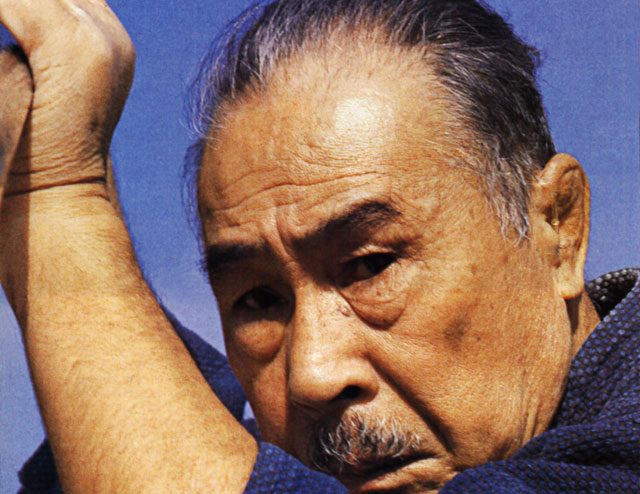
“If you keep focusing on technical (gi) and physical (tai) training only, if you neglect to train your spirit (shin) and refuse to change your way of thinking and the way you live, then you won’t adapt to the changes in your aging bodies and one day you will no longer be able to move your bodies.”
The highlight of the gathering was lunch when everyone started sharing personal stories which included everything from facts to how the practice of Budô under Mochizuki Sensei’s guidance had been an essential part of their lives.
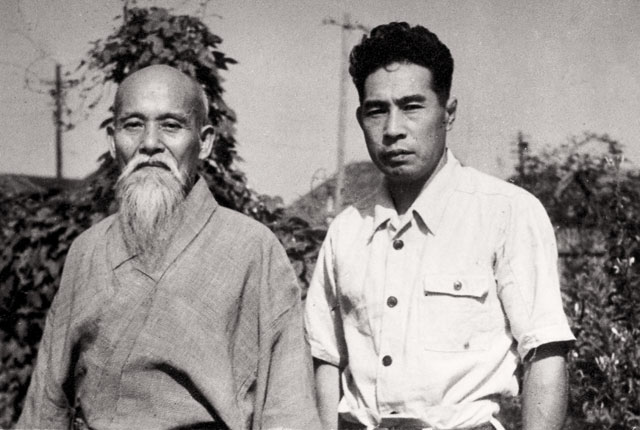
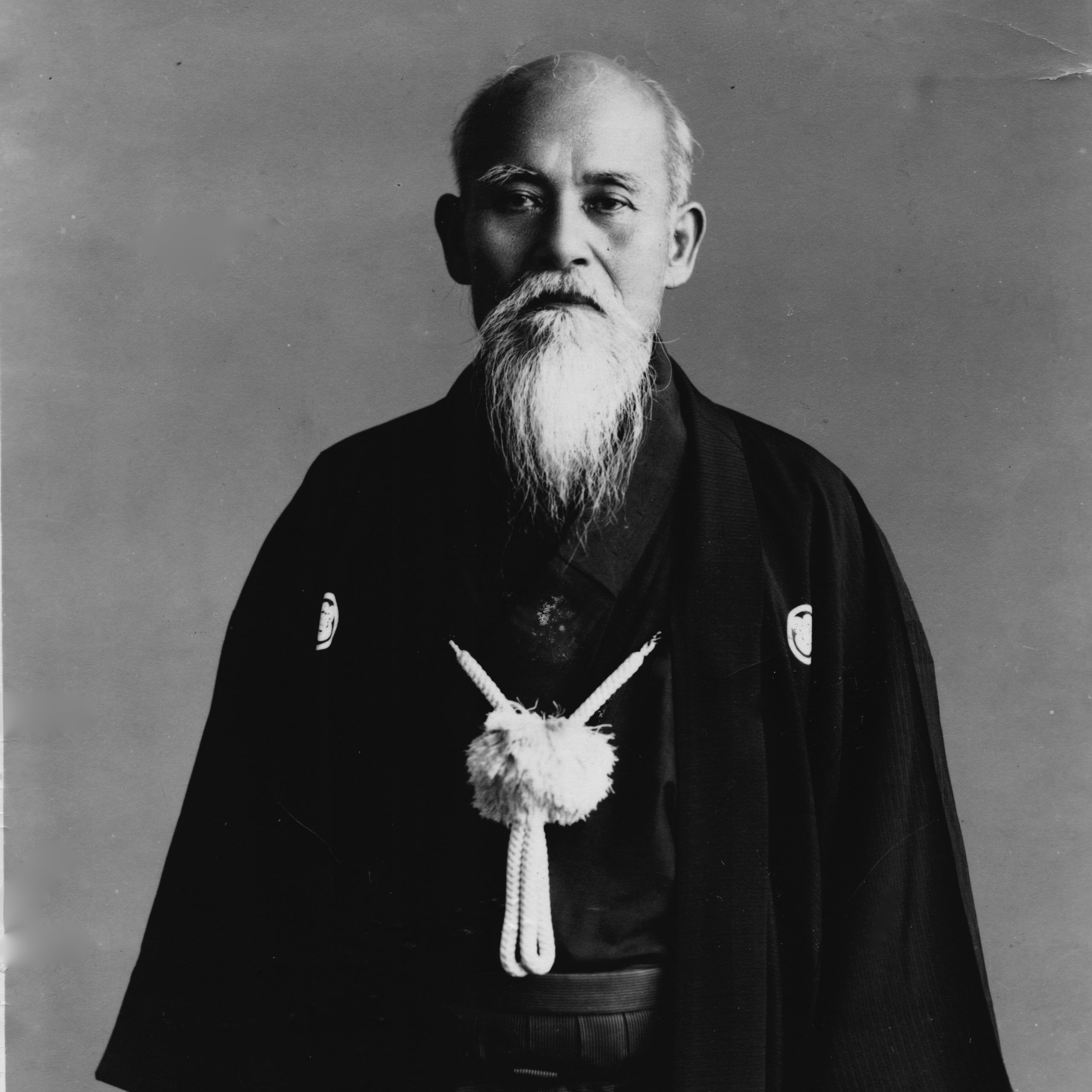
It is always interesting to hear the same stories from different people. Everyone has his own angle of vision. Some had vivid memories of Ueshiba Sensei’s visits on his way back to Tôkyô. For example, one hot summer afternoon, when Sugiyama Sensei was a beginner, an old man showed up at the dojo genkan (entrance): “Is Mochizuki here? Tell him that Ji (the old man) is here!” Sugiyama Sensei recalls, “I rushed to the second floor to announce the visitor. . . . A few minutes later Ueshiba Sensei was in his underwear, sitting and talking informally with Kanchô Sensei. . . . He had the body of an athlete in his twenties with the head of a man in his seventies! I couldn’t believe it!” Ueshiba Sensei ended up staying for several days until Kisshomaru Sensei had to come to Shizuoka to take him back home. They remembered Ueshiba Sensei as an eccentric, dynamic, warm, joke- and pun-loving gentleman, not the side of him that seems to fit the popular belief.
Often, Mochizuki Kanchô Sensei lectured us on the importance of evolution. “If you keep focusing on the technical (gi) and physical (tai) training only, if you neglect to train your spirit (shin) and refuse to change your way of thinking and the way you live,” he would say, referring to those who escape the uncertainties of the insubstantial by searching for more techniques, more training, more ranks, more trophies, and the like, “then you won’t adapt to the changes in your aging bodies and one day you will no longer be able to move your bodies.” Unfortunately, few of us listened and even among those who listened, few understood the meaning, unless we went directly to Sensei and asked for clarifications.
In Bujutsu, one trains under an instructor solely to develop technique and the body so as to achieve a tangible result: survival, a medal, a rank (belt), a title, or a victory on the battlefield, in the gym or in the arena. In Budô, one uses technique and body under a teacher’s guidance as tools to manage the challenges encountered in the dôjô, namely, dealing with physical discomfort and pain (as in the case of a beginner learning ukemi and kihonwaza), and with mental struggle such as lack of concentration, low self-esteem, doubt, etc. Then one applies the same skills to manage challenges outside the dôjô.
Let’s briefly clarify the difference between an instructor and a teacher. An instructor focuses only on techniques and strategies. His lifestyle has nothing to do with it, whether he instructs as a job or a hobby. His relationship with the student, whether business-like or chummy, will remain superficial. He will retire or quit depending on his personal circumstances. A teacher on the other hand is a student who teaches in order to continue his study. His whole life is focused on sharpening his physical and mental skills, in and out of the dôjô. While an instructor may study and teach in order to support and upgrade his lifestyle, a teacher will set his lifestyle in order to support his study and teaching. His relationship with the student will become an essential part of his study since he sees his student as a reflection of his teaching, whether the student makes himself teachable or not. A teacher never retires. Mochizuki Sensei taught us the lessons he received from his own teachers through the example of his daily life.
Today’s sports with their emphasis on profit, politics, and entertainment have turned into transitory ego-satisfying endeavors. That’s the Bujutsu level. However, serious athletes are constantly looking for ways to improve and polish their skills through the application of the Principle of Maximum Efficiency (seiryoku zenyô).
Mochizuki Sensei explained that the principle of maximum efficiency is the foundation of our training. First, we persistently look for the most efficient ways to use our bodies through techniques together with rigorous physical training. This eventually takes us beyond the survival level and to the realization of the Principle of Mutual Welfare (jitakyôei), the moral aspect that led to the evolution of Bujutsu into Budô. We understand that in this dualistic world of gain and loss, victory and defeat, ups and downs, etc., there will always be both peace and conflict. It is inevitable. Hence, we must train ourselves to expect the unexpected with the understanding that peace follows conflict and that we should maintain that understanding while planning our strategy.
The dôjô as a laboratory of human behavior provides us with a place where we can develop and cultivate new patterns of behavior that would be difficult to put immediately into practice in real life. We take our time to become comfortable with this new pattern; for example, learning to speak assertively (with kiai) until we have the confidence that blame or praise from others will no longer result in our reverting to our former behavior by default.
The students (monjin) make the dôjô. Mochizuki Sensei stressed that others’ existence is what makes our existence possible. Acknowledging others’ existence results in the understanding that we are all dependent upon each other; this includes all our ancestors (blood related and not), our generation, and all those who will come after us. From this understanding comes the realization of Mutual Welfare as the logical extension of the application of the principle of Maximum Efficiency.
Mochizuki Sensei also explained that in order to understand Maximum Efficiency, as a first step we have to become familiar with the notion of “Flexibility overcoming Rigidity” (ju yoku gowo seisu). This principle is easy to understand in the phenomenal world: Water flows around obstacles; twigs bend under the weight of snow or the violence of a storm, while stiff branches break. Advanced students experience this at some moment in their training when all components come together and the technique flows smoothly. This phenomenon tends to occur more and more frequently (morphic resonance) as they persevere in their training.
How does this apply to our spiritual training? When we act out of obligation in order to gain some reward or out of fear in order to avoid some unwanted consequence, we are using rigidity which will inevitably lead to rupture. What will come out as injury in the physical world will eventually appear in the spiritual world as defeat of the mind (boredom, discouragement, rebellion), whether the desired result (rank, medal, recognition, etc.) was achieved or not. Hence, we should act out of understanding.
In order for us to develop that ability we must first cultivate an awareness of our motivation and manage it before it turns into greed. Mochizuki Sensei often scolded those of us who acted mindlessly, to the point of comparing us to frogs in a well. “They are born, live and die in the well. They assume that the whole world is there and don’t question anything,” he said. “However, if they just looked up, couldn’t they realize the depth of the sky?”
Everything, everyone exists for a reason. We just have to observe our surroundings to understand that nothing and no one exists from its own, of its own, or for its own. Then we can understand the way in which society functions. In the dôjô, which represents a microcosm of society, each of us is an individual who comes with different goals and expectations. However, we realize that we are all depending on each other for learning and progressing. Some partners make it easy for us and others make it hard. As in our daily lives, we tend to avoid difficult people and look for “friendly” ones. When we reflect on this it becomes obvious that those who make it hard for us give us the best preparation for real life situations. Let us remember that those who practice Budô as an exotic hobby or past-time are only practicing Bujutsu, since their approach is conditional and consequently devoid of Dô.
In contrast to obligation, understanding is adaptable, hence flexible. Some people look at flexibility as weakness. It may seem so at first sight. But just as a crook out of ignorance looks at honesty as a weakness and eventually traps himself in his own snare, the stiff one will also succumb to his stiffness, physically and mentally. That law is universal.
Some students will respond: “It’s beautiful, but in the real world things don’t function like that. If I try to practice Budo outside the dôjô, I won’t be able to keep up with the competition, I’ll lose my job!” Others will claim that Budô is just a health exercise and that all that spiritual mumbo-jumbo was what brought Japan into the war. Yet others will ask, “Can we get some guidance on how to start training ourselves in daily life?”
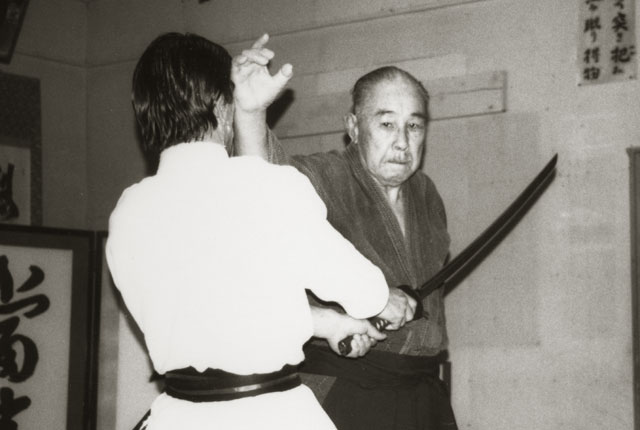
Mochizuki Sensei taught us that when there is a problem at home, we should stay home and take care of it. It’s part of our training. When we are obsessed with improving our technical ability and physical conditioning, we can’t see anything else. Eventually our family members will resent it and Budô will be blamed as the cause of all the problems. “Kano Sensei was often away, came back late at night, and then made everyone in the family get up early in the morning to practice Judô before breakfast. Ueshiba Sensei sometimes left home on the spur of the moment and could be gone for weeks to some undisclosed location, leaving everything to his wife. As a result their children hated Budô,” Mochizuki Sensei said. Can we learn from that and evolve?
“We are all egoists (the very word used by Sensei in Japanese), it’s human nature!” Mochizuki Sensei once told me. “But if we must inevitably be selfish, we still can’t ignore others’ existence!” Otherwise, consequences may not appear immediately, but when they do, and they will, the loss will be greater than the gain. The problem with most of us is that we expect to collect and enjoy the fruits of our efforts within our lifetimes, and so we act, consciously or not, with that objective in mind. That way, we end up as parasites, taking more than what we contribute. We just have to reflect on what others did before us and the consequences on our present generation to understand that. If we are truly selfish, let’s first admit it; then let’s be wisely selfish, that means let’s take others’ needs into consideration.
Mochizuki Sensei’s recommendation for how to develop flexibility was to first start with easy things like food, for example. “No strong likes, no strong dislikes,” was the advice. “If you are willing to eat anything and if you are moderate in your tastes, you will maintain your composure. It will also be hard for your enemies (or those who might take advantage of you) to corner you since they won’t find your weaknesses.” Occasionally Mochizuki Sensei tested foreign newcomers’ flexibility by taking them to a sushi restaurant. Nowadays every one is familiar with the more popular types of sushi, but serve them octopus, calamari, salmon eggs, natto, etc. and observe their reactions. . . ! The test is still valid. Amazingly, I have seen some people pass the test but fail in their Budô study later. But to my knowledge those who failed the test inevitably failed sooner or later in their study!
Contact Patrick Augé Sensei of the International Yoseikan Budo Federation






Thank you Augé Sensei for sharing this rich resource with everyone. Even though I never knew him, Mochizuki Sensei is very real to me because of your writing and the example you provide in your daily life and teaching.
Thank you also to Mr Pranin for the efforts to provide this and other quality assets for our study.
Steve Varley
E X C E L L E N T. Thank you for a valuable reminder/lesson.
Bogdan
Thank You Augé Sensei for this taste/reminder of Mochizuki Sensei’s teachings.
Quoting from your text: “we must first cultivate an awareness of our motivation and manage it before it turns into greed.”
I understand this as saying: What drives us? Do I have a clear purpose in life and are my decisions and actions compatible with that purpose or randomly controlled by urges and emotions?
Yves Boudreau
North Carolina Yoseikan Budo
That is the meaning.
Thank you for clarifying.
Dear Augé Sensei, thank you for this very informative article that has given me much to think about in my study of Budo.
I find this essay to be a very interesting and useful. In particular, I am interested in Mochizuki Sensei’s teachings concerning the importance of the teacher-student relationship and the application of the principal of mutual welfare. Thank you very much, Augé Sensei, for passing these teachings on to us.
Thank you, Auge Sensei, for this thought-provoking essay! I will have to reflect upon it slowly and steadily to absorb it all, but for now I have been thinking a lot about what you have to say about how Mochizuki Sensei, by creating a “lifestyle in order to support his study and teaching,” was able to unite and integrate his life and his teaching. This example which is handed down through generations of teachers can inspire us to do the same and to use our study of Budo to face the myriad challenges that daily life throws at us. This enables us to embody what we learn and to continue our study between practices at the dojo. Thank you for giving me so much to think about.