
 Josh Gold
The following article was prepared with the kind assistance of Pavel Rott of the USA.
A note on terminology: In this essay, I am using the terms aikijutsu and aikido to refer to two distinct psychophysical states of being, not to the specific martial art traditions of these names. Jutsu (meaning art/artifice/technique) has the implication of calculation and skilled means; do (meaning Tao or Way) has traditionally had the implication of spontaneous unreflected action in the service of a higher aim.
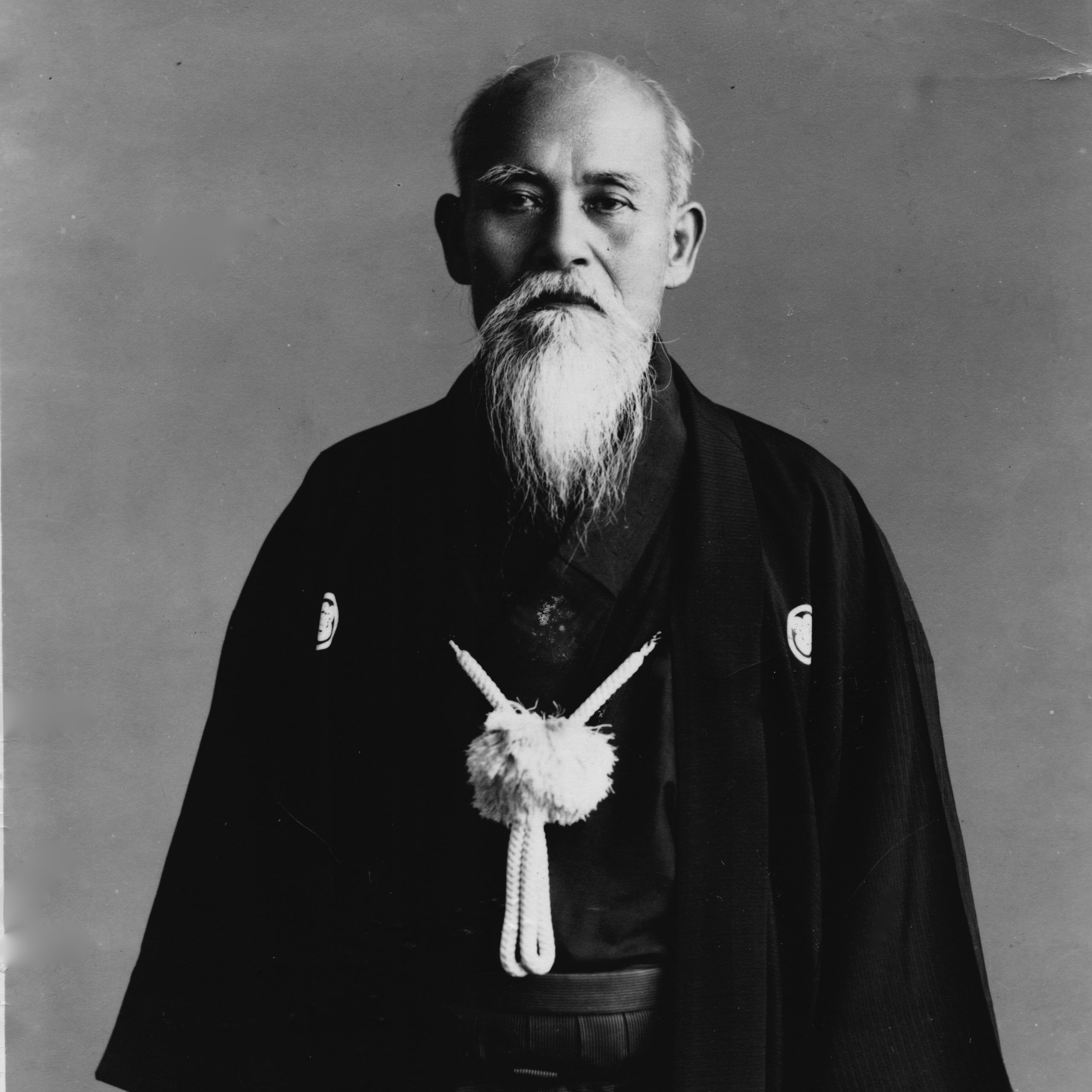
In the 1920s, Morihei Ueshiba Sensei taught his martial art to a group of high-ranking military officers, among whom was Admiral Isamu Takeshita. Some years ago, I spoke with Masao Muto Sensei, a noted kobudo teacher and researcher of Japanese martial history, who possessed a copy of Admiral Takeshita’s diary of his training sessions. According to Muto Sensei, among Ueshiba Sensei’s statements quoted in this diary was the following: “Aiki is a means of achieving harmony with another person so that you can make them do what you want.”
This is a statement that I have “sat with” for many years. It is remarkably similar to the teachings of other martial arts which explain methods of using kiai (aiki with the characters reversed) to the same end. Kiaijutsu is usually assumed to be a loud shout, but that is only its most trivial expression. First of all, kiai is always a psychophysical method to organize one’s own energy and will. At the same time, it is a method of affecting another’s inner world. This can be for a variety of purposes: to understand another’s intentions, to deceive them as to your own intentions, or to neutralize an opponent’s strong points by manipulating spacing, timing, even breath. Kiaijutsu can be amazingly sophisticated, taking many years to master. For example, in the Jikishinkage-ryu, a mid-Edo period school of kenjutsu (sword fighting), there are four kiai each of which embodies a season. Not only do they sound different (winter, indeed, is silent), but the processes engendered within and between the expressor and opponent are as radically dissimilar as the seasons themselves.
Among the methods that I was taught was to pick out an individual and think, “Look at me” over and over again until they did, without making any “move” other than thinking kindly of them. Conversely, I would think “don’t look at me” while doing things that would invite a look. I could vary my study by expressing another emotion, or changing my somatic organization.
Lest I be misinterpreted, aikido is not sweetness, nor is it social compromise. It can be rigorously martial, even apparently violent. In its essence, however, it is a movement both within oneself and between one and another which does not cause the other to do what you want, but which establishes the fundamental ethical relationship between people, that in the face of each of us is a command which comes out of our vulnerability itself: “Thou shalt not murder me.”
Another technique would be used in sparring (or combat), particularly with someone from another system. This is a form of kokyu-ho. Breathing is not a solitary activity, and, of course, breath (kokyu) is not the simple inhaling and exhaling of air. A relationship of any sort, be it friendship, or murder, has its own rhythm, its own breath. As our relationship develops, so does our breath—both its physical and spiritual manifestations. Any change in the kokyu of one individual within the relationship will affect the other. This is always happening on an unconscious level, but one can alter kokyu intentionally. The degree that kokyu becomes subject to our will is the degree that the other individual becomes accessible to our influence. In this method, I would mirror my opponent’s breathing until we were in sync, and then, catching my breath or even my thoughts, create the same “catch” in my opponent, if only on the most subtle level. However, the “break” in my breathing pattern (or psychological state), would be under my control. I could thereby move into the suki (opening) and defeat my adversary.
Other kiai were used to freeze an opponent, to appear suddenly larger, to seem vulnerable, or to actually be vulnerable and use that weakness to win.
Let me offer a single example of the use of weakness as kiaijutsu. Its grotesqueness is chosen deliberately to illustrate how much larger and inclusive is the concept of kiaijutsu beyond a mere loud shout; it illustrates that any psychological or physical state can be expressed in such a way as to create a controllable relationship between two individuals.
You are confronted by a large man who holds a knife to your throat, all the while screaming threats and obscenities that smash like blows. Your fear is so great that you feel your eyes tear and your bladder sphincter loosen. You could fight a losing (or winning) battle with your own body, thinking “I will be shamed for life if I piss on myself. I’d rather die.” Instead of focusing on saving your life, you are centered upon keeping your shorts dry.
On the other hand, you could embrace both your fear and shame, and encompass it into something larger. You hold both fear and shame within a will to survive, thereby accepting them as givens (and therefore gifts) of what it is to be alive. So you deliberately let go of your bladder. Seeing the evidence, your attacker may laugh at you or curl his lip in scorn or draw back in disgust, whereupon you move into the “opening” between you, and hurt him devastatingly, or simply run away. Your pride would have gotten you killed; this kiai uses your weakness as a weapon rather than as something to fight within yourself.
There is nothing in this concept which denotes pacifism. It is, instead, that state of being in the eye of the hurricane, somehow at peace, despite fear and anger all around. This paradoxically means that the peaceful self, the center point, is also a manifestation of the violence spinning around it, and it is, in fact, co-created with it. Aikido, then, becomes a harmonizing with both the eye and the wind, encompassing them within a larger stable system.
In one martial tradition, I spent the first six months learning how to formally serve a mistrustful individual sake or tea, and at the fraction of a second that their guard was down, leap in and kill them. I had to learn to hide any movement or energy which would communicate my intention to attack; instead, I had to express a deep and sincere welcome to an honored guest, and at the moment I was trusted, destroy them.
Sounds awful, doesn’t it? And yet, about ten years ago, a deranged speed addict took a five-year-old child hostage at knife point in Tokyo. After a long standoff with the police, he demanded food, which was brought to him by the child’s 70+ year-old grandfather—who just happened to be a 6th dan in kendo. At the moment of handing over the tray of food, he “dropped” it and slugged the kidnapper with a dub he had concealed, saving his grandchild.
Kiaijutsu is a field of amazing complexity and subtlety, and there are as many forms of expression as there are martial traditions. However, it is, in essence, synonymous with Ueshiba Sensei’s concept of aiki as quoted by Admiral Takeshita, and I will hereafter refer to this essential state as aikijutsu.
The martial traditions that Morihei Ueshiba Sensei studied, including the Daito-ryu that he taught in his early days, were first and foremost arts of survival, both for the individual and even more importantly, for one’s socio-political group. One was taught to do whatever one had to do to insure survival, and fair play was not a part of the ethos. In fact, fair play would be looked upon with scorn, if not incomprehension. One would be regarded as nothing less than a complete idiot if one were so irresponsible to give warning of one’s intentions to someone who meant to kill one’s family, clan, or political faction.
As some of you may have noticed, however, there is something psychopathic about all of this. Empathy and spiritual intimacy are evoked for the sake of manipulation of another. It is important to understand, however, that this is not merely lying. This state of being can only occur through opening oneself up fully to the other person, and yet somehow bracketing off a part of oneself which is both involved and apart, in the service of one’s own aims.
The practice of aikijutsu forces one to walk a very fine line that lies between expedient action for the sake of self and others, and a dissociation from the implications of one’s acts. The line between compassion and indifference, a warrior’s morality and psychopathy, is not only paper-thin, but it shifts and contracts with the beating of our hearts.
Let me offer a single example of the use of weakness as kiaijutsu. Its grotesqueness is chosen deliberately to illustrate how much larger and inclusive is the concept of kiaijutsu beyond a mere loud shout; it illustrates that any psychological or physical state can be expressed in such a way as to create a controllable relationship between two individuals.
“Aiki is a means of achieving harmony with another person so you can make them do what you want.” This statement is not necessarily evil, but it leaves a safe bourgeois ethic for something out on the edge where the winds blow hard and cold, and acts are judged on how they ensure survival—at whatever price necessary.
Aikijutsu can save lives. When my older son was about three years old, he suddenly dashed out of the house. I was sitting in the garden and I heard a car roaring down the one-lane road in front of our house, a lane so narrow that cars would brush the hedges on either side as they passed. My son’s foot hit the curb, and I screamed a form of kiai that has the function of creating terror and stopping a person momentarily in their tracks. He froze, impossibly, one foot in the air, the other on the edge of the curb. The car rushed by, inches from his body, and then, overbalanced, he fell forward into the street. He cried for 15 minutes, not in fear of the car, but in fear of my voice. I saved my child’s life with a weapon usually used to immobilize an enemy in battle to cut him down.
Nonetheless, this mode of being can sometimes be profoundly damaging. Situations are usually not so simple as saving a child’s life. As philosopher Emmanuel Levinas states, pure ethics could only exist if there were two people alone in the world. With the addition of a third, which blossoms into all of humanity, ethics becomes justice, the choice between different ethical demands. And with justice is born suffering, for someone must lose in the weighing of the ends and means. This is as likely to be the wielder of power as it is the receiver.
It damages one terribly when one loses compassion and becomes detached or numb, convinced of one’s own rectitude, and not even realizing how this wounds the soul; it also hurts when one acts impeccably for the sake of a larger cause and realizes that in doing so one has had to offer a piece of oneself in sacrifice to make it work; it hurts when the cause turns out to be wrong, or when the cause, no matter how just, does not justify the means one chooses. And what is most troubling is the allure of power. It is never difficult to rationalize the use of the will for what one believes are selfless aims. And one can easily slide into a cold grandiosity, where even rationalization is no longer necessary; power and its expression are their own reward.
The practice of aikijutsu forces one to walk a very fine line that lies between expedient action for the sake of self and others, and a dissociation from the implications of one’s acts. The line between compassion and indifference, a warrior’s morality and psychopathy, is not only paper-thin, but it shifts and contracts with the beating of our hearts.
Aikijutsu can be imagined as a hidden cavern deep within oneself, its twists and turns glittering with crystal and precious stones, treasures that can be mined for the good of ourselves and the service of others. But one must remember that caverns hold dragons, and they are beasts necessary for the existence of the treasure itself. One can neither kill them, nor steal from them, nor truly become friends with them. A fine line to walk, indeed.
I believe that Morihei Ueshiba Sensei felt this dilemma full force, and he attempted to find a way out in his philosophical shift from aikijutsu to aikido. This is expressed in his statement “The ai (harmony, fitting together) of aikido is also ai (love).” This later concept of aiki is best translated in my mind as “compassion.” The prefix “com-” roughly means the same as “ai” or “awase” (together, in harmony, etc.) and “passion” has all the nuances of energy, or a force that lives in us rather than something subject to our will. Aikido thus expresses the dynamic balance between our existence as individual, isolated beings, and, at the same time, as particular expressions of the same universal life energy.
Compassion is real contact across the void of individual existence. It is not solicitude nor maternal embrace, nor the acceptance of comradeship, nor the interpenetration and envelopment of lovers, nor the sometimes Machiavellian infighting of aikijutsu. It is a fundamental open acceptance of both oneself and the other, and a trust that this very openness will preserve life and allow it to flourish. Lest I be misinterpreted, aikido is not sweetness, nor is it social compromise. It can be rigorously martial, even apparently violent. In its essence, however, it is a movement both within oneself and between one and another which does not cause the other to do what you want, but which establishes the fundamental ethical relationship between people, that in the face of each of us is a command which comes out of our vulnerability itself: “Thou shalt not murder me.” And this, in its broadest sense, means “thou shalt not do anything which negates the humanity of the other, and thereby of oneself.” Aikido is a state of being which occurs only when one truly opens one’s heart to another (for a philosophical exegesis of this concept, see Emmanuel Levinas’, Ethics and Infinity, published by Duquesne University Press).
There is nothing in this concept which denotes pacifism. It is, instead, that state of being in the eye of the hurricane, somehow at peace, despite fear and anger all around. This paradoxically means that the peaceful self, the center point, is also a manifestation of the violence spinning around it, and it is, in fact, co-created with it. Aikido, then, becomes a harmonizing with both the eye and the wind, encompassing them within a larger stable system.
“Aiki is a means of achieving harmony with another person so you can make them do what you want.” This statement is not necessarily evil, but it leaves a safe bourgeois ethic for something out on the edge where the winds blow hard and cold, and acts are judged on how they ensure survival—at whatever price necessary.
And if the other is so violent that they cannot perceive or receive that compassion through the space between you, then the hand that strikes, the body that moves to throw can be a (necessarily unsubtle) expression of compassion. It is true that ninety-nine times out of a hundred, this “up-side-the-head” aikido for the other’s sake is as delusional as the harsh spanking inflicted “for the child’s own good.” Nonetheless, it is a possibility within us, and our training is a lie unless it creates an opportunity for us to eventually achieve a state of aikido (ethical compassion) within the most violent and frightening situations.
I have seen, in my own job as a crisis intervention specialist, how different aikijutsu and aikido are. In the former, I am calculating, if only for a fraction of a second. I am doing something to another, albeit for reasons I believe are both ethical and in the other’s best interest. It is a powerful and sometimes wonderful state of being, and sometimes lives have been saved through accessing this mode. However, the state of aikido is different; rather than a conscious decision to act, a knowing happens, and it happens through me, and then through us. Something occurs, and the right action/right being emerges without deliberation.
It is an illusion that one can achieve a state of aikido without the acquisition of skillful means. Training is the only means towards such a goal. However, it is also an illusion that one can achieve such a state through skillful means. When one attempts to access aikijutsu, one tries to be “on”; when one is accessed by aikido, one “opens.” My reaction to a good aikijutsu intervention is pride at my skill; my reaction after a true aikido intervention is gratitude for grace unearned and unsought.
Ellis Amdur is both a consultant specializing in trainings for those who face hostile and aggressive individuals and also a crisis intervention specialist in the Seattle, Washington area. He received his B.A. in psychology from Yale University in 1974, and his M.A. in psychology from Seattle University in 1990. He is a National Certified Counselor and a State Certified Child Mental Health Specialist. He is the author of two iconoclastic books on martial arts. The first, Dueling with Osensei, a revised compendium of all of his articles for Aikido Journal, addresses the interface between combative studies in the dojo and the use of those skills, both mental and physical in the real world. The second, Old School, pending publication in the fall of 2002, describes koryu, Japanese martial traditions, from his own unique perspective. He is a licensed instructor in two koryu, the Araki-ryu and the Toda-ha Buko-ryu, and has been involved in aikido for close to thirty years. This article first appeared in Aikido Journal and is subsequently available in the book, Dueling With O-Sensei.
If there were an “ordinary martial arts book,” this would be its evil twin. Unflinchingly honest, writing from a perspective both authoritative and unique, Amdur explores aspects of budo, its philosophies and dilemmas, its remarkable rewards and yes, its pathologies, in a way no other author has. He does so with humor, compelling creativity, and a wickedly sharp-edged insight that make this book a delight.–Dave Lowry, author of Persimmon Wind
Far more than just a martial arts book, Dueling with O-Sensei has wide applicability in any field where questions of integrity and leadership arise.






Add comment