
 Josh Gold
Spiritual mastery is a quality or state for which there are no certain, reproducible objective criteria. As is the case with the creative arts, evaluation is difficult and our judgments reflect our own needs and biases as much as the particular characteristics of a given spiritual master. That there are movements, schools, and critical differences regarding the nature and quality of art reflects not so much the validity or invalidity of the vision of each artist as shifts of cultural and epochal context within which the art is produced and evaluated. The greater number of artists and art movements find their brief moment of full expression, and fade into the ground of existence against which the current creative state-ments are viewed. So it is with most spiritual masters, who contribute meaningfully to the lives of people within their culture and epoch and then fade with time and distance to become, not distinct forces, but part of the overall spiritual heritage from which new masters draw the energy and expression which is their own.
There are masters of art and spirituality, however, whose message speaks across gulfs of time and distance. These masters need not be arbitrarily limited to those who have also garnered the widespread acknowledgement accorded to a Michelangelo or Buddha, for there are those who, even from the anonymity of the author of the Cloud pf Unknowing, speak to us as clearly. The quality shared by the universal masters of art and spirituality seems to be their ability to speak from the heart to the heart.
Communication which transcends the barriers of culture and epoch is not generated by intellectual exercise, practical need or passions of the moment. These are truly meaningful only to the time and place from which they arise. Communication from the heart is generated by love, and in the case of the spiritual master it is expressed in the form of love of God for man, of man for God, and of man for man.
Such a Path of the Heart, expressible through love, may be found springing from the ashes of violence and hatred, as will wildflowers from the charred destruction of a forest conflagration. The suffering and despair of lost human souls may serve to fertilize and germinate the seeds of love planted and nurtured by a master of the heart. Tragedy often seems to precede the joyful contributions of such a master, suggesting only that tragedy is as timeless as love; necessary to the balance of the universe until such a time as the world of opposites falls away.
The true test of mastery may be the willingness to serve the balance of the universe, to be both planter and seed of love. The acknowledgement and action upon this realization, that mastery is service, may constitute the completion and fulfillment of the Path of mastery. The need to dominate, the search for physical and spiritual power, the aggrandizement of public recognition, all fall by the wayside and are consumed by an inner fire which purifies the self and leaves it open, humble, and totally in service of all mankind; of all creation. The concept of the bodhisattva is not alien; it is the ultimate in mastery, the possible end-point of the Path of the Heart.
The mythic figure of the hero which each of us can become in a mythology of our own casting seeks to follow a Path of the Heart and use that passage to resolve the tensions of existence, the tensions created by the pulls of a dichoto-mous world. This is the world of maya, the everyday world which can be transcended but not denied.
Aikido recognizes and seeks to resolve maya, the illusion of separate existence from which we suffer during our lives. By seeking to unite the body, spirit and mind of the individual, and by gradually expanding each person’s sphere of responsibility to include as it did for O’Sensei all of the universe, Aikido training alleviates the suffering created by attachment to the illusion of separation in the physical world. As in Buddhism, the physical world is not denied, for it sustains and nurtures us. Within the context of the physical world we are given the opportunity to move toward acceptance of the ultimate unity of man and man, man and universe. With this realization of unity comes a sense of responsibility for man and universe. With the assumption of responsibility comes personal empowerment, the sense of belonging in the world which is a sign that the world belongs to you.
O’Sensei taught that the only real thing in the world is love–all else is illusion. Wherever there is a dichotomy (and all that we see is a part of dicho-tomy), there is light or dark, good or evil, male or female, you or I. Wherever there is a reality of you or I, there is a tendency toward becoming you and I, or you/I, through the force of love, which is the force of the attraction of bodies. Only in the fulfillment of love is the veil of illusion lifted, as we move from the false world of you or I, toward the world of you/I, of unity in love.
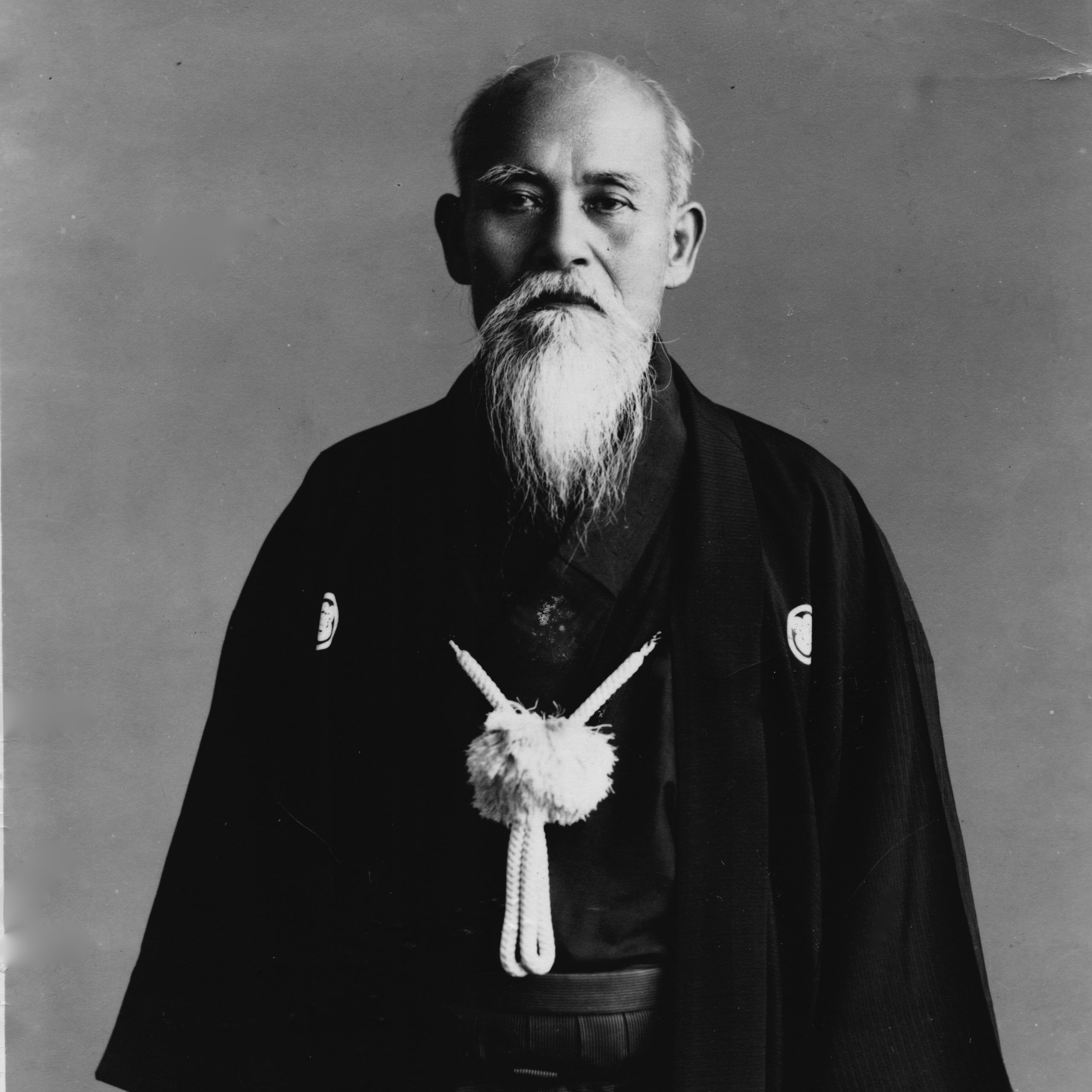
The person who lives his life as a life of love, who truly experiences it in all his relationships, becomes you/I; that is, he becomes the entire universe, and is the universe. He cannot be in conflict with the universe, for the universe is him. As the universe unfolds in elegant and ordered precision, there are no surprises, no accidents, no denied responsibility. This is what it means to be a master. Morihei Uyeshiba, the founder of Aikido, was clearly a master–of the body, of the spirit, of the universe.
The Path which he blazed through the warrior’s craft is not an inherently spiritual one, in the sense that it is not an unfailing technique by which to attain a specific spiritual state. His Path does not constitute a right set of steps which will invariably move one to the same achievements as Uyeshiba made. It requires the enlivening action and personal commitment of an individual who has chosen to use it as a tool to express his own spiritual potential.
The martial arts are no more than the expression of the practitioner’s inner spirituality. They are a barometer to the inner self, a mirror to the soul. Their influence is not toward the eradication of evil, but the realization of that which is good, that which works. Uyeshiba blazed a trail, what has been called a Path, toward this realization. That the form and experience of this Path is not fixed or literally “true” is displayed by the observation that, though many have apparently benefited by the practice of Aikido, none have quite duplicated Uyeshiba’s art. His accomplishment remains unique. Indeed, none have followed quite the same Path, as I have extensively outlined here. The history and attainments of each person who has studied the art is different. Their form is different, as are their ethical concepts, their orientation to service, their relationships within the pattern of life. It cannot be said that they have reached the same state, nor can it be said that they have gone through the same processes.
What must be recognized is that Aikido, as other martial arts, and as all other spiritual arts and endeavors, are less tools of human alteration than vehicles of expression. They are a means of making real in the world our own unrecognized ties to the Universal.
A vehicle does not change what it carries; it has no control over the destination, it simply facilitates the realization of that which is already there. Aikido, as any other discipline, has nothing to do with making people spiritually fulfilled. It only provides the opportunity within which they may express their own innate spirituality. The option of will and the exercise of choice remain para-mount to such fulfillment.
The importance of Uyeshiba comes not so much from his synthesis of particular arts into a unified form, but from the personal spirit with which he enlivened them. His message was not one of forms, but one of spirit and love, expressed within the context of his techniques. Each individual, whether through Aikido or any other activity, will create, consciously or not, his or her own synthesis as a means of expressing the love and service that comprises the visible aspects of spirituality. Thus it is no surprise that there is a quality of uniqueness to each individual’s martial art, for it is an expression of personality, and as varied as personality can be.
This does not suggest that there is no importance in matters of technique, for a vehicle, a tool of expression rather than restructure, is crucial to make real the uniqueness of each person. Such a “Path” as Aikido, though not truly a defined set of steps, gives a structural basis for the individualization of the human within society. That there are many styles of Aikido taught, that there are many martial arts with other emphases and that there are many options available aside from the Way of the Warrior, serves to accommodate the range of expression which human spiritual potential can take.
There is no one Path, as there is no one Aikido. Aikido, above all is not the Path, though it may be a part of, or form the basis for, the individual and unique Path that each of us, consciously or not, must tread during this interval between birth and death that we call life.
There are many Paths, as many as there are beings, now, in the past, and in the future. Their number could serve to define the word, “infinite”. The only question we need ask, the only test we need put it to: “does this Path have a Heart?”.
Does this path have a heart? If it does, the path is good, if it doesn’t, it is of no use. Both paths lead nowhere; but one has a heart, the other doesn’t. One makes for a joyful journey; as long as you follow it, you are one with it. The other will make you curse your life. One makes you strong; the other weakens you.(149)
Don Juan
(149) Castaneda, The Teachings of Don Juan, p. 107.






Then there exists in many the belief in words such as John Anderson’s lyrics, “You only get one life / And this I know / I’m gonna get my licks in now before I go…”
I lean toward the philosophy in the original post, but I can’t help but see just as much validity for the lyrics of this country song. Anderson’s most famous song, however, is “Seminole Wind,” which I find much more in tune with spirituality.
Drew
What are McCarty’s qualifications?
Adam,
Ref qualifications: I have been training in Aikido since 1974, initially in the Bay Area with Rick Rowell, Bruce Klickstein, Bill Witt, George Leonard and others; teaching since 1981, first at Aikido of Diablo Valley and currently at Island Aikido on San Juan Island in WA state. I received a BA in Human Development at Cal State Hayward and an MA from John F. Kennedy University in 1981, the degree for which the thesis from which the recently published articles were derived was submitted. More recently I wrote an article on the Practical Application of Aikido, also published in the Aikido Journal, and submitted as part of my sandan requirements, along with a demonstration of techniques against attacks with “street” weapons.
I received my shodan from the Aikikai in 1981, my sandan in 2009 from the Takemusu Aikido Association. I was awarded Fukushidoin in 2010.
I am employed by the San Juan County Sheriffs Office as a dispatcher, photographer, evidence technician and reserve deputy. I am a Vietnam veteran, having served with the First Cavalry Division in a medical MOS (91C20) from mid-68 to mid-69, subsequently working in emergency rooms for 11 years.
I would be happy to correspond directly with you or interested others on matters relating to Aikido, especially as regards its use in employment situations and daily life.
Thanks for the interest,
Chuck McCarty
[email protected]
Thanks, Chuck.
I should have been more specific. What are your qualifications (relevant personal experience and/or formal training and/or informal training) for the spiritual assertions resting on your authority?
If you prefer, [email protected].
Adam,
That’s a lot harder to answer than aikido and life history stuff. For the purpose of writing a thesis there is an expectation that you don’t bring too many predispositions and expectations to the project, but obviously I had already been a devoted aikido student and for years when I chose my thesis topic, and that influenced both my choice of topic and the course of the project.
The academic program in which I was enrolled at John F Kennedy University was titled “Comparative Mysticism”, later retitled “Religion and Consciousness”. It was an academic study of world religions and belief systems, and did not require personal belief, but did require an open mind. I became somewhat known as a skeptic, but I tried to be as open as my Catholic (fallen) upbringing allowed. The program was mostly academic, but included class exercises from various spiritual disciplines, including Aikido classes on campus for credit, as well as various mystical practices that sometimes left the class members a little dazed and unready for rush-hour traffic for the commute home.
Our unofficial motto was “Whither? Thither!”, relating back to a joke that made the rounds in our classes that had the punchline “Whither is thither? About a 1/4 mile past splat!” You had to be there.
Personally I am an atheist when it comes to belief in an anthropomorphic god, a believer when it comes to a universal force that ties humans and creation together, that can neither be quantified or properly explained, hence the “white ants” reference in the opening section of the thesis. (If you like, I can email the entire document to you or anyone who so requests.)
In 1980, when the document was written, I was hardly qualified either in aikido or the mystical realm to undertake such an ambitious project, nor do I consider myself any more qualified today. What I was, and remain, is a devoted student of aikido and all of the human belief systems that we use to understand, and also rationalize, our lives and its meaning.
I have the skepticism of 14 years in law enforcement, and an equal number of years working in the medical care field, where it is impossible to escape the realization that we are all destined to die; plus exposure to the sudden and meaningless death of war, without the comfort that I suspect true believers benefit from. 36 years of study and teaching experience in Aikido are what sustain me, for when all else fails, I do believe in a good nikyo.
Thanks again for your interest.
Chuck McCarty
Hi Chuck, great stuff! Beautifully written and demonstrating a comprehensive holistic understanding (like Nev’s writing in that respect). That’s a most impressive resume and background you have as well! Backed up with a keen sense of humor I see (believing in a good Nikkyo, indeed!).
To add something content wise, I don’t really believe in “masters” (period) martial arts or otherwise. Guess the word carries too much the connotation of a fixed piece of work (only God can be a master and I’m with you on that one). Can’t really be a “master” (at least not to oneself) and keep beginner’s mind, can one? As if the battle is over. We (humans) always tend to deify those we admire (example by calling them masters), which is a weak point on on our part making possible the rise of evil leaders and regimes (power corrupts, absolute power…). Those who are great in one field invariably show themselves to be all too human in other ways (we have some obvious examples in the news lately).
I prefer the word mage. A mage doesn’t have to claim any kind of perfection or even arrival nor does he or she have to vie for sainthood. But they must be able to handle themselves (nikkyo or otherwise) [wink]. Preferably benevolent mages [another wink]. Aikido techniques do look something like magic, don’t they? Using awareness, timing, a good spirit, and the fruits of practice to restore harmony (not chaos, to echo what Carl well said).
All the best putting Aikido to work in law enforcement!