
 Josh Gold
The following interview with Koichi Tohei Sensei, 10th-dan head of the Ki Society, took place on March 14, 1996 at the Ki Society Headquarters in Tokyo.
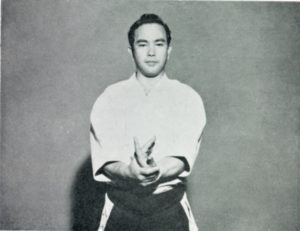
AJ: Many people have aspired to become as skilled as you, yet they have found it very difficult. Would you please share with us some of the actual experiences you had in reaching your level of skill. For example, what was your aikido training like during the two years between the time you entered the Ueshiba dojo in 1940 and the time you were sent off to the war?
Tohei: I trained in the Ueshiba dojo for exactly a year and a half before going overseas. Ordinarily such a short period is nothing special, but during that time I was sent as Ueshiba Sensei’s representative to teach in places like the Shumei Okawa school in the imperial palace grounds, and the military police training academy. I must have been in the dojo for only six months or so before being sent to teach at those places.
When the people I went to teach heard that I was a Keio University student, some of them expected me to be a weak, effeminate type, for that was the typical prejudice directed at Keio even then. But I used to show up in kimono and wooden clogs, looking like your typical impoverished student of those days.
One of the people I was teaching at the military police training academy was a 4th-dan, but I myself didn’t even have a kyu ranking, let alone a dan ranking. When they asked me, “Sensei, what dan rank do you have?” I would fob them off by saying things like, “gojo-dan,” a pun on the word “dan,” meaning, “you must be joking.” They would pursue it further, saying, “No, really, Sensei, all joking aside, it couldn’t possibly be that all you have is a kyu ranking, could it…?” I always just answered, “nenju mukyu,” another pun, on the word “kyu.” In the end nobody really knew my true rank, or lack of it I should say.
It was only after I went into the army that Ueshiba Sensei sent me the rank of 5th-dan. That was the first rank I’d ever received! Until then I’d had neither kyu nor dan ranking, despite the fact that I’d been teaching people who were ranked up to 4th-dan! Actually, though, dan rankings in those days were awarded in an extremely haphazard and subjective way. Ueshiba Sensei would give out 3rd and 4th-dans left and right whenever the urge struck him.
Once Ueshiba Sensei received a request from Kenkoku University in Manchuria to send someone to teach aikido there. It was decided that Mr. Tomiki should go. Ueshiba Sensei then decided that since Tomiki would be considered a member of the university teaching staff, he should be at least an 8th-dan so Tomiki was immediately awarded an 8th-dan. You have to take those old ranks with a grain of salt. The same could be said of the 4th-dan-ranked man I was teaching at the military police training academy. How else could a completely unranked individual like myself teach him?
AJ: But, since you were sent out to teach after training for only six months, you must have attained a certain level of skill…
Tohei: Not at all. Six months is simply not long enough to develop any sort of real skill. When I look back at it now I feel embarrassed to have been in such a position. In reality it’s just that I knew a little bit more than those I was teaching. Certainly I had achieved nothing to be proud of, and it was only because the others around me knew even less that my authority to teach went unchallenged. If I saw that sort of thing now I would surely criticize it roundly.
I had been weak as a child, and on top of that had developed pleurisy from about the time I entered Keio University; but I’d had enough of it and was dead-set on becoming well and making my mind and body stronger. One day my younger sister brought me a book on Tesshu Yamaoka, the famous swordsman. It was My Teacher by Tetsuju Ogura, one of Yamaoka’s top students. The book detailed Yamaoka’s life and somehow struck a chord in me. One of the things that impressed me most was the idea of doing everything in a way that admits no deception, of oneself or others, and to approach everything with a full-on attitude, even to the point of self-sacrifice. The book mentioned a misogi (purification) dojo, the Ichikukai, that still conducted Yamaoka-style training, and I decided to go there.
Although, the pleurisy had forced me to do nothing but go home and rest in bed every day after my university classes, I decided that I would go to the Ichikukai to make myself stronger, even if it killed me. The name Ichikukai literally means: “The One-Nine Society” and is so named because the anniversary of Yamaoka’s death falls on the 19th of the month. It also has to do with the philosophy that every individual has at least “the power of one,” and that, through training and effort, that person can add the other nine for a total of ten. I thought that even I had at least the power of one, and I wanted to increase it to ten.
When I went to the Ichikukai, however, I was told that someone as weak from illness as I was simply would not be able to survive the type of ascetic training they did there. They wouldn’t even let me in the door. They told me the training involved shouting in a loud voice from morning to night and being struck on the back, and that it was hardly to be expected that a Keio student would be able to withstand it. I didn’t give up, though. I had already resolved to make myself strong or die in the attempt, so I persisted in asking them to admit me. Eventually, the head of the school, Tesso Hino Sensei came out from the back. He said that since I was so determined, they would let me start with zazen (seated Zen meditation), and move into the more difficult ascetic exercises (misogi) later, once I had strengthened my body to a certain degree.
The zazen training was conducted by Josei Ota, head priest of Daitoku Temple in Kyoto. He came all the way to Tokyo to teach for three intensive days each month.
Each time, I sat in meditation all night long. Nobody else was in the habit of sitting in zazen throughout the night, but Hino Sensei said that he would sit with me if that was what I wanted to do, and so the two of us would sit together until dawn.
After about six months it was decided at last that I could move into misogi training. The training indeed involved shouting and being slapped on the back, and my chest began to hurt again on the evening of my first day. I assumed the pleurisy had come back, but since I’d said that I was determined to become strong even if I died trying, I couldn’t very well complain that my chest hurt and ask to go home. I thought, in any case, that if I collapsed on the floor, they would surely do something to help me. I simply put the pain out of my mind and forgot about it. After that the pleurisy went away and never returned. (I had myself X-rayed later and was surprised to find there was no trace that I had ever had it.) This was the first experience that showed me the power of the mind.
In 1940, Mr. Shohei Mori introduced me to Ueshiba Sensei and I became his student. I was terribly impressed by the way Ueshiba Sensei would throw people without using any strength at all. I went to the dojo for every practice, but I found that I couldn’t even measure up to the high school students who were training there. After a while, however, I noticed that whenever I came to aikido practice completely exhausted after a session at the Ichikukai, nobody could move me. I also noticed that when I threw people while in that exhausted state, they would really go flying. These two phenomena made me realize that the trick was to let go of strength. On the other hand, Ueshiba Sensei was always telling us to use strength in the techniques. So I experimented in various ways with both using strength and then letting it drop away, then using it again and so on.
I tried to put into practice Yamaoka’s teaching that once you have chosen a teacher, you should follow what that teacher teaches you, whether you think it good or bad. Things that don’t seem logical in the mind can be understood through experiencing them with your body. Once you understand them in that way, you can always stop doing them if you so choose. In contrast, if you start off with the attitude: “I’m going to learn this, but I don’t want to learn that,” you end up missing all of the good things your teacher has to offer. That’s why I know everything Ueshiba Sensei did, including both the good and bad.
At that point I realized that relaxation was an important key, although I also noticed that there were things that I could not do simply by relaxing. I felt that the reason must be something I was doing wrong.
I understood what that thing was when I went off to the battlefield and was confronted with the prospect of death. What I understood then was that the universe has a mind. I wondered about the meaning of all the training I had done. If I were to die now, I thought, then what had all my training been for? I thought that surely it was not for the purpose of dying on this battlefield. Surely the universe had made me train myself like I had because there was something else I was supposed to do. If that were true, then there was no reason for me to die there. Surely if my training had been in accord with the mind of the universe, I would not die on that battlefield. So thinking, I decided to test this theory out in practice.
Once I made that decision, I suddenly became much more at ease, and after that, no matter how intense the fighting became, the bullets did not hit me. Gradually I became bolder—perhaps even arrogant—and I told my men that if they followed me, bullets would not hit them. They all believed this, and at the time mine was the only patrol to come back with all 80 men unscathed. From that experience I realized that the universe must have a mind of some sort. When I talk about the “mind of the universe” now, it is based on that experience. The universe has a rhythm of its own and governs life. To be right means being in accord with the principle, or order, of the universe; that which is not in accord with that principle is impossible or requires unnatural effort.
The problem is determining what that principle or order is. You can think of the principle or order of the universe as something that nobody can deny, in which case there is no problem. Some may say that since the universe is limitless, there will always be many things we do not know. In that case, one should admit whatever one does not know, or perhaps go and consult a specialist on the particular topic. The important thing is to do the right thing decisively, quit doing wrong decisively, and if you don’t know something, then say so decisively. This is how I have tried to live my life.
Even a great teacher can teach the wrong things. In my case, I tried doing them anyway, and I simply stopped doing them once I knew that they were not appropriate for me. Rejecting this and accepting that without even trying something is nothing more than building illusions.
When I returned from the war, I found that whereas Ueshiba Sensei could throw me very easily, other people’s techniques were completely ineffective. There was obviously some difference between the two applications of technique. Others said that it was simply that Ueshiba Sensei had “the strength and skill of a thousand men,” but I wondered if it were really true that there were some things that, despite both of us being human, Sensei could do and I could not do. Such questions began welling up in me. Again, I feel that only by frankly admitting that you do not know something can you eventually understand it.
It was around that time that I discovered Tempu Nakamura Sensei. He taught me that “the mind leads the body.” The mind is the upstream and the body is the downstream. If the upstream is muddy, so will be the downstream. From Nakamura I learned that unification of mind and body is possible through purifying the mind and allowing it to influence the body. I had already experienced this on the battlefield, but I had not connected that experience with this principle.
I think the same can he said of aikido. Looking back on what Ueshiba Sensei did, it is clear that he would apply his techniques only after leading his opponent’s mind. By contrast, we were all trying to lead our opponents’ bodies, and then trying to figure out how to throw them. Naturally they would resist and become impossible to throw.
In order to lead your opponent’s mind, you must first have complete control over your own mind. If you can’t control your own mind, you can’t expect to be able to lead the minds of others.
Actually, in that sense, Ueshiba Sensei was not able to control his own mind; he would easily lose his temper or start saying completely nonsensical things. He had something to say, but could not express it without falling back on the Omoto religion. In this sense, I think it is pointless to imitate Ueshiba Sensei’s inability to control his own mind.
The only thing of true value he taught was how to relax. But that is all right, because a person only really needs to have one thing of value to teach for you to make them your teacher. The only thing I learned from Tempu Nakamura, for example, was that “the mind leads the body.” On all other matters he used to ask me questions! He was very modest and humble in that respect. When I said that I did not know the answer, he would then say, “Well, let us study it together then.”
Ueshiba Sensei, on the other hand, would say things like: “There is nothing that I do not understand; the things I say even scholars and saints are incapable of understanding, and even I, though I am saying them, do not understand…”
It is impossible to understand this kind of talk! Even the relaxation Ueshiba Sensei taught was not explained in words, but rather something he demonstrated with his body.
AJ: Even after realizing that relaxation was an extremely important aspect of aikido, you must have gone through some sort of trial and error process in order to figure out how to integrate that into your own training. What were some specific approaches that you tried?
Tohei: It was, as you say, a process of trial and error. I was not able to relax immediately; my ability to do so, and to use ki instead of strength, simply evolved naturally the more I trained.
AJ: Aikido is traditionally learned by watching a demonstration by the teacher and then doing your best to duplicate it. In practice, though, the techniques are sometimes so fast that it is difficult to see or understand what was done. Also, the explanations offered often seem more like Zen riddles that nobody could really understand. Given this background, how should people approach aikido training?
Tohei: While I was still a member of the Aikikai I used to speak out against that sort of thing. Teaching shouldn’t be treated as an opportunity for showing off. There was a senior instructor there who would allow his ukes to start taking the fall softly, but at the last instant smash them down hard onto the mat. I said there was no need to be so malicious and that he should stop it. It was wrong to try to make oneself look strong by doing that sort of thing. It was mean and cowardly to throw people roughly to the mat when they had already lost the ability to resist. Nothing changed, of course. I have never injured anyone like that during practice. I am also firmly against turning aikido into something mystical.
AJ: Sensei, you have very strong-looking arms. How did they get that way?
Tohei: By training in a relaxed manner. They were not always like this, of course. You can tell people to relax but actually most people find it rather difficult. If you build up your muscles thoughtlessly they’ll only hinder you when you get older. Here, feel my arm. [rolls up sleeve]
AJ: It’s very soft.
Tohei: That’s right. Now feel it again, [tenses muscles]
AJ: Now it’s as hard as iron.
Tohei: When you are truly relaxed your entire body can become quite solid when you want it to be. People who try to build up their muscles can only generate power in certain places and in certain ways. Being relaxed allows people to use their strength in a much more comprehensive manner. When someone tries to run into me I can make my whole body become like iron for an instant and send him reeling back. For that reason, karate punches and the like don’t really have much effect on me.
There used to be a well-known boxer, Takeshi Fuji, nicknamed Yamato Damashi (“The Spirit of Japan”). He had a coach named Kimura who used to train by punching concrete walls. I once let Kimura take a full-power shot at my abdomen. I told him I didn’t particularly want to get hit in the face, but that he could go ahead and try his best with a punch to the stomach. He asked if it was really okay, and I said, “Sure, go ahead.” He came in with a tentative, cautious sort of blow, but I said that was no good and told him to strike for real. So he did. But just before his punch landed I filled my body with ki, and he ended up hurting his hand!
AJ: I’ve heard a story that once some of the younger students at the time, including Yasuo Kobayashi and Yoshio Kuroiwa, tried to really flatten you during an Aikikai demonstration.
Tohei: Yes, I remember that. It was at the Yamano Hall. Tamura came up and asked me how many people I wanted to be my ukes. I said it didn’t matter how many, so he showed up with 10 ukes! It was a relatively small place, so I asked if he intended for all of them to attack me at once. He said that was what he had been thinking. There wasn’t anything I could do about it at that point, so we just went ahead and started the demonstration. We came to the last part, where several people were to attack me at once. The mat was so small that no matter where I turned there were always five or six of them trying to get me and there was no place to go. Finally, as we were going at it, one of them yelled, “I’ve got him!” and I was completely surrounded.
They moved in to knock me on my back and pin me, and then they all piled on top of each other, thinking that I was at the bottom of the pile. In fact I was already standing at the microphone saying, “Ladies and gentlemen, thank you for watching our demonstration today…” By the time whoever it was had yelled “I’ve got him!” I had already escaped. They were trying to extract themselves from the pile they had formed, but they couldn’t get up very quickly. I looked back at them and saw Tamura, who had put them up to it in the first place and who was now just standing around, so I grabbed him by the collar and threw him on top of the pile too!
AJ: I heard another story in which you and Tadashi Abe put down some trouble with the yakuza (Japanese Mafia). What was that all about?
Tohei: In Iwama, Ueshiba Sensei was looking after the wife of one of his students who had died. It turned out, however, that she had begun seeing the boss of the local yakuza gang. It had become something of a scandal, but I thought it was a private matter and did not say anything.
Abe, on the other hand, was quite enraged at the situation. He confronted the gangster when he came around to see the woman, and gave him a thrashing. He took him to the outhouse and threw him in. Then he started prodding him with a stick and daring him to try to get out. When I saw what was happening I immediately pulled Abe away and made him stop.
Well, Ueshiba Sensei found out about the incident and told his son Kisshomaru and me to go and apologize. Kisshomaru was a little hesitant but I assured him I would do all the talking. When we got to where the gang was they were all lined up and waiting. The boss knew that I was the one who had pulled Abe off him, so he was willing to listen to what we had to say. In the end we secured a promise that they would stay away and leave Abe alone.
AJ: It seems that Abe was always trying to trick and challenge you, but never succeeded.
Tohei: Once he hid inside the entrance to the dojo, waiting to strike me with a bokken (wooden sword) when I came in. But I sensed that something was up and stopped by the washroom to get a pail of water. When I walked in he was just about to strike, but I swung around and doused him. He said, “Hey, that was really rotten!” but I said, “Which is worse, throwing water on somebody or trying to hit them with a bokken?”
That sort of thing was always going on. Actually, I must confess that I used to egg him on sometimes. Once I said, “Why are you always picking on me? Why not try Kisshomaru for a change?”
As a result, Abe climbed up to pour a bucket of water on Kisshomaru. He must have felt a little hesitant at first because he just dribbled out a few drops at a time. It was so little that Kisshomaru didn’t notice, so he gradually increased the amount until suddenly all the water came dumping down to soak Kisshomaru thoroughly.
AJ: When do you think Ueshiba Sensei perfected or completed his aikido? When did he reach his peak? Some say before the war, others during his time in Iwama, and still others in the last year of his life.
Tohei: I don’t think he ever perfected it. I don’t know what criteria one would use as a basis for saying he perfected it. I think he probably mastered the art of relaxing during the time he was involved with the Omoto religion.
The problem is, if you start talking about “divine techniques” or perfection, you can’t discuss it in any rational way. You end up, as Ueshiba Sensei did, talking about all the gods of Heaven and Earth turning into purple smoke and entering completely into the hara (lower abdomen), or about teleportation, or about becoming a golden Buddha.
If you want to see a “golden Buddha,” just go to rural Japan. That’s what they call people there who accidentally fall into the outhouse after having one too many, (laughs)
The art of relaxing is itself a great enough gift to leave to the world, and there is no need to go talking about divine techniques or perfection or anything like that.
AJ: Gozo Shioda used to repeat a story that he said Ueshiba Sensei told him. He said that once five soldiers had fired their rifles at Ueshiba Sensei from a distance of 25 meters, and that he instantly used an irimi (entering) technique to move in and throw them. A Japanese author also reported this as a factual incident.
Tohei: That was just lies. If a teacher could do that against five soldiers, then that teacher’s students should be able to do it against half as many soldiers, right? But I don’t know anyone who can do that. Those stories remind me of an old comic poem to the effect that “the storyteller lies as though he had seen the thing himself.” Such stories about Ueshiba Sensei are something along those lines.





Add comment