
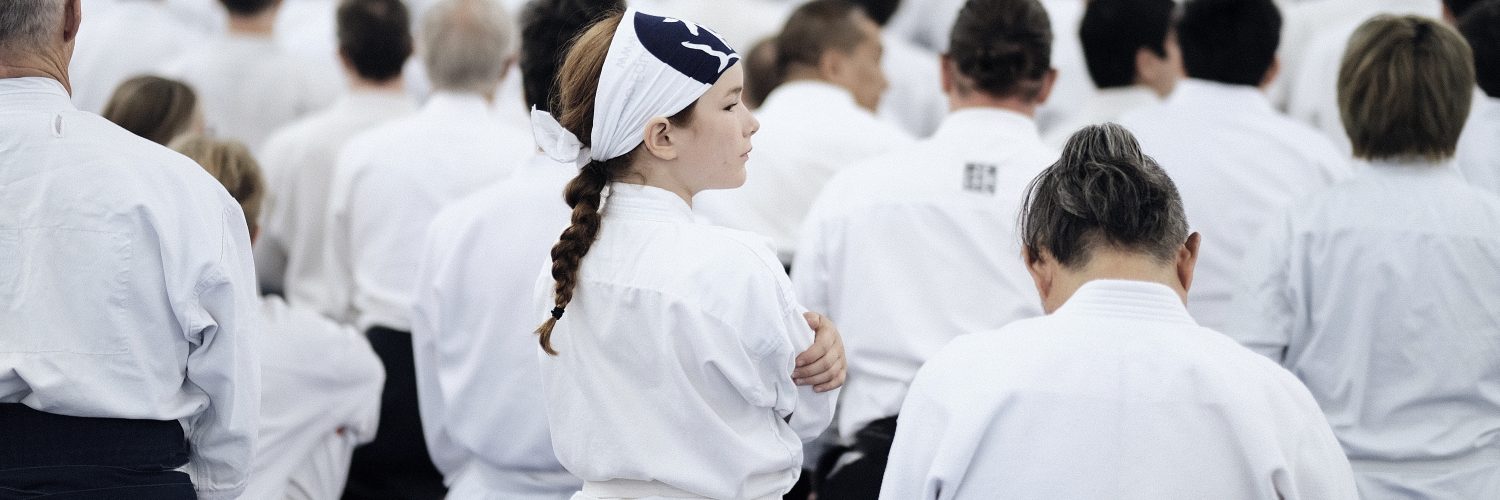
 Josh Gold
In this new series of articles, our contributing editor, Jay Gluck links aikido with other arts and activities, many of which he has personally studied, and offers the suggestion that many of these might be used to expand the range of subjects taught in aiki dojos outside Japan. This is the second part of a two part article. Read the first part here.
Part Two: Dance as martial art
When my sons attended the Canadian Academy international school in Kobe, Japan, their Japanese language teacher took her classes to the next city to see the world’s most flamboyant theater, kabuki. The kids fell in love with it and soon organized their own performance which, over several years, evolved into a professional-quality troupe with annual performances in a real theater in town and appreciation and assistance from the Shochiku kabuki professionals. Their story is recorded in a Japanese book by the teacher, Mitsuko Uno, and its English translation, Challenge of Kabuki, plus a collection of translations by the students of the classical plays performed: You Mean to Say You Still Don’t Know Who We Are? Quite an accomplishment for high school kids!
During the course of rehearsals, the teacher-director had trouble getting the typical teens to walk and move correctly, with delicate strength, so she called on a dancer-friend to teach some basic Nihon buyo (traditional dance). The macho teenage guys rebelled, but out of respect gave in. Some were on the basketball team, some the gymnastics squad. After several weeks of dance all reported noticeable improvement in their sports performance—timing was greatly improved, speed was better and coordination especially so. Not an Oriental oddity—movie tough-guy Jimmy Cagney was not only a real-life fighter from a tough neighborhood but also a professional tap dancer, a Broadway chorus boy.
The kids took more interest in Japanese arts. My tea master donated a full formal tearoom and chadogu (tea-making equipment) to the school and some of the kids took tea lessons, “like samurai.” And we asked Tohei Sensei to send down an English-speaking aikido instructor during summer break for a few weeks of intensive ki and aikido instruction in my friend’s palatial samurai mansion—three hours daily before noon for the kids, and three hours daily afternoons for interested adults. Paul Cascarot came down and was a great success. He so won the kids’ respect that they scrambled for the privilege of walking behind him to arrange his shoes when he kicked them off to enter the house. They even turned their own shoes, “samurai style” to be able to slide right into them in the event of a hurried exit.
With this classical education in conduct and self-discipline, their school performance also benefited greatly. Some time later we decided to get an aikido instructor again, but Paul had gone back to Arizona. Another American aikidoka was looking for an opportunity to get to the area, as his fiancee’s mother owned a beautiful dojo 20-minutes’ train ride away and they were having trouble with the people running it. He moved down with Tohei’s blessing and taught aikido at the school’s Japanese Culture Club and to interested adults, while he worked on taking over the troubled dojo. He succeeded in the latter, with much help, and became dojo master, which wangled him a much higher dan when he switched from Tohei to Hombu. But the kids did not appreciate him and they no longer scrambled to rearrange the sensei’s shoes.
Seminar for samurai
In my guidebook, Japan Inside Out, (Introduction “Learning About Japan” P.87) I write:
Omoto Seminar in Traditional Japanese Arts: hot, but not hottest, June-July weeks near Kyoto in old castle town at religious (folk-Shinto) foundation HQ. For non-religious training in religiously intensive two hours daily each of noh-dance, martial art, brush calligraphy and painting, chado—all complementary ki-generators, basic to understanding why and how Japan makes good cars. Highly recommended preface to any further serious study of Japan. Shinto meditation (not that different from Zazen), Tantric Shingon-Buddhist “Moon Meditation” evening lectures and much interaction by students in age-range 16 to 70. Work in teams of 6-10 students. Room (2 per, couples together, single option extra), Spartan Western and Japanese board, uniform, kimono and martial arts gear included, $1,750 for 4 weeks (1990).
Non-sectarian-Catholic priest, Protestant clergy, (no rabbi yet), Zenists, Sufis, Tibetan lamas have done. Science-mystic Lyall Watson did it as boot camp before taking on Tokyo establishment to end whaling, beat them at their own game peaceably, effectively. Originated by China author-Japan esthete David Kidd with Omoto family scion Kyotaro Deguchi; David captained for 10 years, now Kyotaro-sama directs. This is the program by which all others must be judged:
Write—Traditional Arts Seminar, Omoto Foundation, Kameoka-shi, Kyoto-fu 62, Japan.
(They prefer hand-written application letter with brief bio., intent, enclose snapshot.)
Zen Arts Seminar: (Are arts Zen, or is Zen art?) patterned after Omoto above—US domestic sampler by Omoto alumna, May (first session ‘87) at Green Gulch Zen Center near San Francisco. Good preview to your intelligent tour of Japan. Write—Kenner, 526 Ashbury Ave., Santa Rosa CA 95404; tel 707-578-8014.
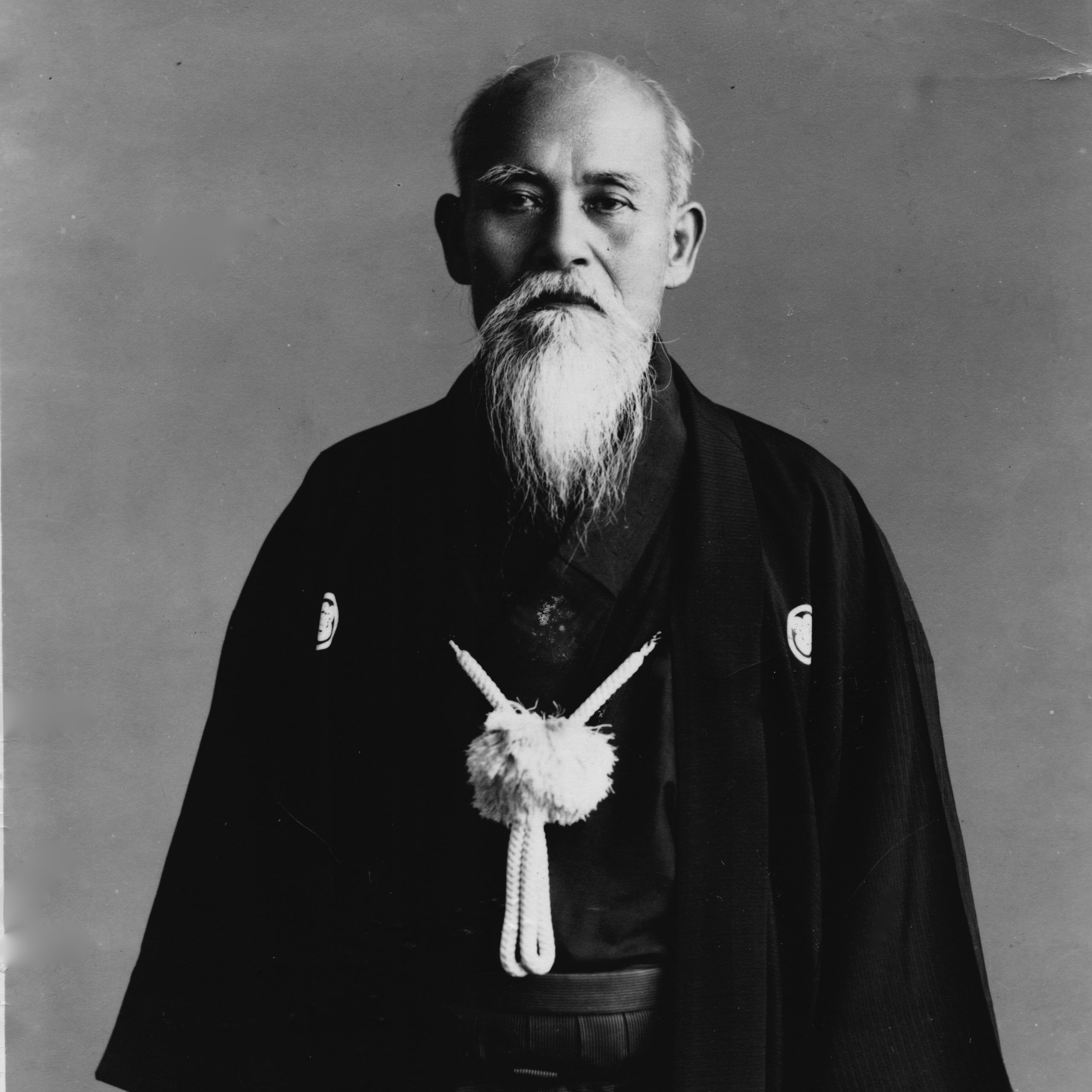
Omoto is well known to readers of Aikido Journal, as O-Sensei was a follower. They base their beliefs on the dictum, “art is the mother of religion” and consider practice of art to be prayer. Followers regularly do aikido, jojutsu and kyudo.
Program ideas
Were I running a dojo, I would offer a holistic program similar to Omoto—both for a fully rounded system and a way of keeping my floor space producing income. No dojos really make money. Even in Japan there are no martial arts senseis in the annual listing of high income-tax payers. The ones that are financially well off have sponsors, usually either charitable corporations whose founders slammed the mats in their youth (and perhaps still do), or political organizations who need military reserves for muscle diplomacy. And there’s no income from putting your brand name on athletic shoes.
With this classical education in conduct and self-discipline, their school performance also benefited greatly. Some time later we decided to get an aikido instructor again.
I would offer use of the mats for rental to other budo, understandably perhaps refraining from helping any that might be competitors for the limited student pool, but perhaps not. A helping hand has a way of proving fulfilling; favors return favors. But for a dojo offering hand arts (aikido, karate, etc.) I would put in kyudo and kendo and/or bojutsu even if it was necessary to add personnel (on ‘sharecropper’ basis). These require minimal additional equipment.
Kyudo needs a makiwara target bale. A real one is romantic decoration though non-importable as it is made of easily verminized straw, but an attractive substitute can be designed by an imaginative bushi. The bows are handsome decoration and Asahi Archery of Tokyo still makes traditional compound yew and bamboo masterpieces at more than you care to pay (unless you have developed an archer’s aesthetic). But they have developed student-quality substitutes of modern synthetic that are visually identical and take far less hand care—an important aspect of budgeting. There is enough instruction in my Zen Combat to get you started. Asahi Archery’s founder, the late grand master Hideharu Onuma, with his American uchideshi Dan DeProspero have an excellent detailed illustrated English book, Kyudo, Essence and Practice of Japanese Archery (Kodansha.)
Kyudo has an educational bonus in that if you don’t extend correctly and get your ki turned on you suffer the teaching of “the sound of no-hand,” the slap on the cheek of the incorrectly released bowstring. You will do anything to avoid repeating this form of instant enlightenment—even to the extreme of doing things correctly. It is a superb teaching tool for ki control.
From massage to smelling roses
A dojo also makes a good shiatsu-massage hall. I refrain from saying massage parlor as that has seedy connotations and it may take some PR work to shake that image. Always call it shiatsu-massage and use “certified practitioner.” Equipment needed is just two or three futons, some plastic mats, and several beach-towel sheets. Massage is done through one layer of clothes. If you want to be fancy, get yukata (informal kimono), but you’ll have to launder them after each use — more expense. Have more than one futon, as the patient should lie still a while after treatment, and it’s better to have witnesses to the absence of hanky-panky. Kiatsu is a subtle aikido version of shiatsu.
A form of psychic aikido is Silva Mind Control, which sounds like a spooky way to control others, but is a system for controlling one’s own mind. With knowledge of aikido for the physical “you” and Silva for the mental and psychic, you’re on the way to becoming a super-lad or girl. It is a system of meditation, control of your brain waves, aiki-like projection of your whole self (not just ki) and ongoing developments that can lead to out-of-body experiences controlled to where you can make telepathic observations, and more.
There is a quality paperback Silva Mind Control by my friend Phillip Meile that covers Mr. Silva’s fascinating biography from poor Mexican-Texan TV repairman to pioneering theoretician and wealthy patron of Texan university research. Teachers are all licensed independents and share the tuition with the HQ, which provides all necessary teaching materials. You can locate a seminar teacher and schedule by writing to the Institute of Psychorientology Inc, Laredo, Texas.
This is the second part of a two part article. Read the first part here.
Jay Gluck Profile
Jay Gluck is a native New Yorker, educated in New York, England and at five U.S. universities. He was one of the first two “freelance” American students to go to Japan during the last days of the Occupation, when he lived in Kyoto. He has traveled extensively and researched combat forms in many cultures, particularly those of Persian origins. He is author of the popular guidebook to Japan, Japan Inside Out. His 1958 book Zen Combat introduced the Japanese martial arts to a worldwide audience. The revised (1996) version of this book is reviewed in this issue of Aikido Journal.




Add comment