
 Josh Gold
“That’s not what I said at all. Don’t put words in my mouth!”
 Sometime back I wrote an article titled “Sunao — Being honest in training” that elicited a fair amount of feedback from readers. Summed up briefly, the article suggested that an uke who uses his foreknowledge of the technique being practiced to alter his attack and purposely block nage’s movement is acting in a dishonest manner, and hindering his and his partner’s progress.
A number of readers reacted favorably to my remarks, but there were several who took issue with what I had written. Somehow they read into my article that I was advocating that uke “simply fall over or give his balance away because that is what is expected,” as one commenter put it. I was quite baffled by this reaction, and so I reread my article in search of where I had suggested such a thing. I found nothing at all because that is not what I think about the matter, and came to the conclusion that these people had not carefully read my article in the first place.
Still, I must hold myself responsible for this misunderstanding since several people had similar reactions. For the sake of clarity, let me offer my viewpoint on how I think uke should conduct themselves in training.
As I see it, uke should present a strong resistance when initiating an attack. This means that uke should be honest or “sunao” in his attack and act with a pure mind. In other words, uke should understand the nature of the attack he is supposed to be executing. A grab is a strong “pure” grab in the sense that uke does not preplan to block the movement that he knows nage will attempt. When striking, uke strikes with vigor to the target he is aiming for without purposely deviating to one side or the other merely to prevent nage from executing his technique. For a humorous example of what can happen in such a case, see the reference to Kenji Futaki described in my earlier article.
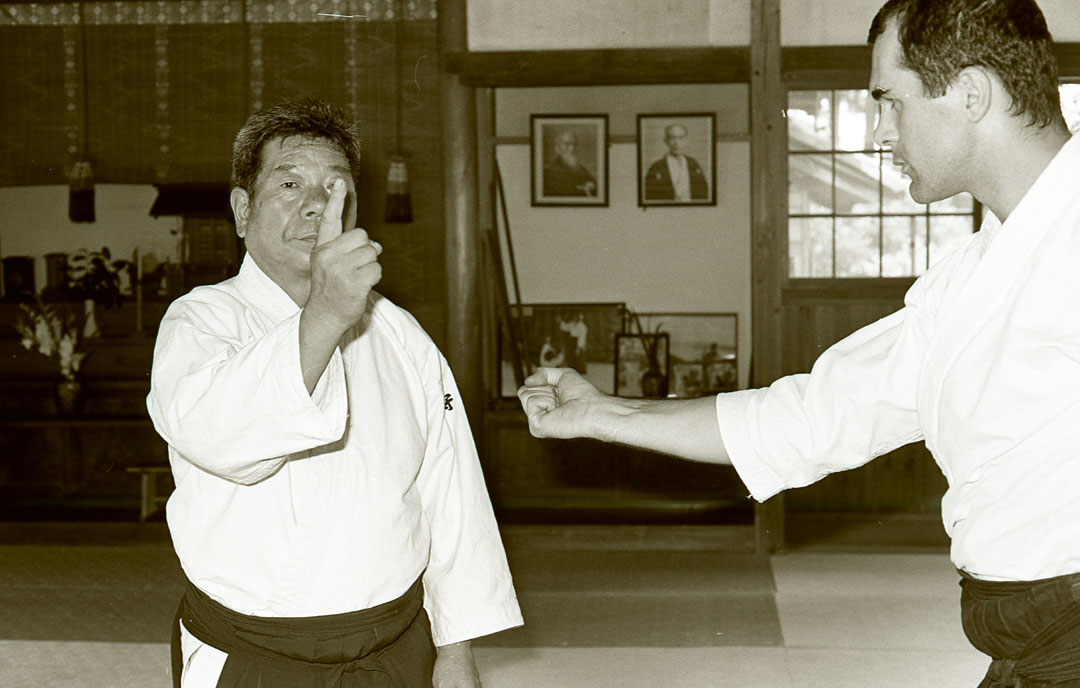
Personally, I will sometimes joke with my students when demonstrating tai no henko, and tell them to “pulverize” my wrist when grabbing, the point being to give a strong, honest attack for me to work with.
In closing, I would ask readers who wish to submit comments to avoid a common pitfall that is one of the common tactics of trolls. I refer to what is known as a “straw man attack.” In case you are not familiar with the term, here is a partial quote from Wikipedia:
“A straw man… is a type of argument… based on misrepresentation of an opponent’s position. To “attack a straw man” is to create the illusion of having refuted a proposition by replacing it with a superficially similar yet unequivalent proposition (the “straw man”), and to refute it, without ever having actually refuted the original position.”
Exactly this situation occurred when several commenters took me task for suggesting that uke should act in a compliant manner and “fall down” for nage, something I did not at all imply in my article. Nor is this what I think uke’s role should be.
As far as possible, we try to create a friendly atmosphere on our websites where intelligent people can exchange ideas for the benefit of all without fear of being subjected to personal attacks. It’s kind of like how an aikido dojo should be in my estimation. What are your thoughts?
—————————————————–





I can see where the confusion would arise. I tend to grab quite strongly, and I have had some senior dan ranks complain about it when they couldn’t execute techniques under under the guise of the ‘sunao’ argument you used. I think if you have had people use this argument dishonestly in that manner, you tend to be quick to react against it without actually thinking through why you are reacting.
Interestingly, I had an incident in the dojo this morning of a similar nature to what you described. We were practicing morote-dori kokyu-ho, and everyone in the dojo knows that I like uke to really try to lock me out if they are able. On this occasion, though, uke was not very experienced, and rather than holding strongly, they jerked their arms to the side as soon as I started to move. On one occasion, all I had to do was blink, and my arms were jerked sideways. I’m sure that this is what you are trying to prevent. In this instance, I changed what I was doing and it became an irimi-nage. Uke was not impressed at hitting the mat quite that hard. I then explained what had happened, and uke understood.
I think these are issues that really need to be addressed with regard to ukemi. I think people seriously underestimate how difficult it is to be a good uke, and misunderstand what a good uke actually does. I think I might write a short piece on it some day, if I have a free day or 2. I will send it to you if I do.
Robin
http://john-hillson.blogspot.com/2011/10/ukemi-rant.html
I took your comments to agree very much with my own thoughts.
I’m confused. My sense was always that the “dishonesty” that can happen in the kinds of Japanese training drills that Aikido folks favour comes from an over-emphasis on unnaturally rigid and committed ukes. I was often unimpressed in my Daito-Ryu training when a person required that my whole body be rigidly locked in the grab in order to be able to effect kuzushi. It was like their bodies were so naturally tense that only by making myself even tenser were they able to gain an advantage on me in a prearranged kata. Whenever I would just grab with firm intent but without so much force that my whole body went hard nobody could effect a technique on me in one dojo – not even the head teacher – in another dojo the teacher and senior students would be put me on the floor in short order anyway. So I left one and spent more time at the other.
My habits from other training modalities is to NEVER give someone full force commitment as you’re just reducing your options and giving away your centre. The problem with this kind of training is that using this kind of force becomes an unconscious habit – and a potentially dangerous one if you’re in a real defence situation as your muscle memory could be counter-productive. This might also explain some of the issues with martial relaxation you described in your seminar Stan. If people who only train in these two-person kata drills grow up in their understanding of martial arts building motor programs where every encounter is “full tension” then this is like to affect their movement when they’re on the nage end too. A lighter grip is one I’ve always found more challenging and more realistic because as an attacker, if I’m grabbing you its not so that I can stand there rigidly and hold you and go “HA! Now your wrist is mine, punk!”, it’s generally to have the option to use that point as leverage for a strike or takedown and so full commitment would be counter-productive by reducing general mobility.
I’m intrigued by this suggestion that “honest” training is training that is based on excessive tension in attack rather than moderate tension. One of my goals as a martial artist is to become an expert in PRODUCING tension in my opponent’s body, without his compliance. This is one of the goals of combative striking. If someone grabs in such a way that I can’t get at their centre effectively I have only to use a strike to cause them pain and distress and their body will tense up defensively thus facilitating whatever method I am using to bring them to the ground and pin them. I find this to be a central component to martial training if it is to have any effectiveness and I am often distressed at what I see in many Japanese approaches where uke is instructed to lock themselves out for the nage – this is prevalent even in very senior instructors I think. Anyway thats my little lunchtime thought. Would be curious if anyone had something to add to that.
I had another thought that is in keeping with my earlier one. I’ve often wondered why, when I have trained with people with a long history of practice in Japanese methods, they are so powerfully affected by pressure point techniques and joint locks. Does anyone know what I mean? Unless someone’s really skilled and hits them very hard, I never feel overwhelmed by any of the usual pressure points that for many Japanese practitioners generate instantaneous tension and compliance.
This was a source of a great deal of discussion amongst my old Japanese training group who found that amongst themselves, these points were devastatingly effective. I think the difference is that I have spent a great deal of time training myself to always remain physically and psychologically relaxed – it is kind of the basic foundation of my training. Not only were my Japanese training friends (as in Japanese methods, not just Japanese nationality) lacking in this essential component but seemed to be rendering themselves increasingly tense and vulnerable to the kinds of techniques they were learning through this emphasis on maximal tension when serving as uke.
This might explain some of the rather cramped physical appearance I’ve noticed in a great deal of (but by no means all, or even a majority) senior Daito-Ryu and Aikido practitioners. You all seem to have an excellent understanding of spacing, position, timing, sensitivity to how to manipulate joints, but I often see a kind of deep residual tension in the body that gives the impression of a very tall and very finely built tower but without a properly wide and deep foundation. That’s just some musings but its something that has bothered me for some time about some of the approaches that are essential dogma in this kind of training.
I believe that there is a big difference between giving an honest attack vs. “blocking” a technique. Blocking involves both having and abusing the foreknowledge of what is about to happen and intentionally (or unintentionally) taking advantage of the slow-motion training scenario that beginners need in order to learn.
An honest attack is an attack that proceeds in its original intentions and with the force and speed appropriate for the level of the nage.
Of course, no one benefits from an overly-compliant uke that just falls down in an unrealistic way. There is no point to that. The same can be said of an uke that wants to prove that they can block a technique. If an aikidoka ran up against resistance, they would just change technique midstream to use the resistance in a new way.
I am in perfect agreement with what you’ve written. Thank you.
Agreed. An honest attack should be in full serious, sincere intention with the appropriate force
and speed for the level of the uke.
Just grab your opponent give them something to work with, a little less if they cannot move, and let them learn and evolve. Not that hard is it? Sadly personal ego gets in the way all the time.
I just cringe at the so called “higher ranked” Aikidoka, that I have met worldwide, who turn their backs on you expecting you to just blindly follow them to try and grab their offered wrist. That is not “leading your attacker”, that is just plain foolishness and suicidal. If you offer your back on the street when someone comes at you aggressively, then you deserve the wake up call that you will surely get.
Enjoy the journey
Paul
If nage can “pulverize”your wrist, you are not doing tai no henko… yet. Keep practicing!
This referred to uke grabbing nage’s wrist very strongly.
Dear Stanley,
I totally agree with all your insights. I would like to add that the Uke’s attack simulation should be accurate as
possible and with proper Maai and to the right target. In addition for the sake of learning, the strength and speed should take into
account Nage’s level. Also important, allowing Nage’s success in applying the technique if he is doing it reasonably right.
In other words, no brutal or violent attack, but a closer to real as possible, with the heart open for the partner’s success.
One reason uke can anticipate and pre-emptively counter nage’s action is that very often the uke has no clear intention when he/she brings his attack, and the attack is a pure abstraction. No one will grab your wrist unless it is to either secure you for an attack with the other hand or to pull you to them, into an attack with the other hand, or to sequester you (pull you out of sight or into a vehicle). When uke attacks, he/she should be focusing his/her intention on the second part of the attack (the punch, stab, kick, choke, pull etc.), not the grab itself. Uke is grabbing in order to accomplish something, not so you can do your technique. Mindful practice in this way can mitigate the unconscious (or conscious) tendency to frustrate technique, and lead to a more practical application of martial art.
Very interesting comment, Michael!
Dear Mr. Pranin, we all have students who hear only what they want to hear and do only what they want to do. Your explanations were quite clear. It doesn’t prevent those who “read” only what they want to read from missing your point. However, it’s also an indication that some of us might have missed something and that we need to go through a second or third reading.
Patrick Augé
Thank you, Patrick Sensei!
Hello all,
A very beginner’s question,
Can this be fixed in randori? In contrast to standard practice, uke will not have prior knoledge of nage response and then will reallize that, mainly for his safety, “striking where nage might be” is worse than an honest attack. Thank you
I would want to think this through when talking about randori attacks. I’m focused on basic techniques here. Thank you for your input!
Dear Stan
I am so on the same page with your view point of Uke attacking properly. At our dojo, we have it broken down into levels of resistance from 1 – 10. Depending on the aikidoka who are practicing together they set the level of resistance they will use with each other so they can gain the most out of the technique they are learning as the technique improves they up the level so that they can challenge themselves.
Best Always
Alex
I think that’s exactly as it should be! Thanks, Alex.
I have seen similar problems in other kata based arts like jujutsu and judo. Some of this I think highlights the limitations of kata in general.
A more open ended exercise, such as having no predetermined attack or defense, or some type of randori, I think lends itself to a more adaptive mind and ultimately everyone being more honest. Uke has no idea what the counter will be so he/she can’t game the attack to make it more difficult. Tori has no idea what uke will do so he/she must be flexible and adaptive. In the case of randori, of course, uke and tori concepts don’t really apply.
The other problem here is ego. Sadly, I think even randori does not eliminate this up front, it takes time and maturity. Although to move without ego is to adapt.
This is what we do. In our dojo our jiyuwaza consists of uke attacking in whatever manner he/she likes and nage will perform whatever technique (or part of technique) comes out. And, if nage gets locked up, they are expected to flow into another technique more appropriate to the situation to gain control.
I had an instructor say “Uke is the input to nage’s output” as well as “garbage in garbage out.” He had us practice given some real attacks: grabbing shoulder with force to move them, aim a punch properly and not overextend to the point of falling over. We then found it easier to move and harness that energy for technique.
I often see uke (especially beginners) who don’t close distance when grabbing or give a yokomen or shomen attack way off target. Maybe it’s a mental block; fear of hitting and hurting your partner. I try to work through that by giving proper aim and intention to my attacks, but only putting in enough force to nudge them.
Kudos to you Stan for tirelessly sharing your insights and experiences, in a forum where there are more opinions than answers and everyone feels their opinion is the best one. This article like everyone of your articles that I have read seems to promote and foster the integrity of the art. When I read your posts I start with the lens of this guy’s only agenda is to support high caliber training.
I appreciate the kind words.
Kime is the focus and intent Uke should strike or attack with.
Allowing Tori to properly condition the brain to react as if it were real…
If Uke fakes the attack then at best Tori will have a “fake” defence!!!
Without overdoing it, you can still help Tori in developing the proper reaction with an honest and sincere attack. Otherwise, we put the brain to sleep… which becomes Aiki-dodo! Zzzzzz
Dear Mr Pranin:
Thank you for this important point. Of course we must always attack according to our partners level or just above. If we do not, it becomes a relaxing mutual dance, if we attack aimlessly with an iron grip and the intention to block, it becomes painful and frustrating. As we attack slightly challenging our partner, he/she is always being challenged and will improve. If we are challenged we will get stronger and improve with every attack. As Uke we must be continually aware and challenging just enough to encourage improvement and not to frustrate.
We become good at what and how we practice. If we are serious and mindful both will grow.
Thank you,
My experience in Daito Ryu is the grab must penetrate the core of nage. This encourages nage to use their body correctly to affect kuzushi on uke. The gripping of uke is an art in itself that takes a long time to correctly condition the body in order to effect the grip. Regarding the previous comments on Daito Ryu training: I can only refer to my own experience, but the correct training should result in an extremely relaxed yet powerfully unified body on the part of both nage and uke that can effect kuzushi on contact. This is achieved largely through cultivating the correct intent through the body in training. Unnaturally tense and stiff bodies is a sign of incorrect training and not the development of “aiki”.
Dear Mr Pranin,
Although I am still at Kyu level, I would like to tell my own story, one of frustration and confusion at the way I see Aikido being practiced.
I have been struggling quite a lot with this issue of “honesty” and of resistance.
As is the case with many other people, I have practiced many other different arts before Aikido, including (but not limited to) Karate, Judô, Ninjutsu (aka Budô Taijutsu), Wushu and Taiji. Never at high level, just enough to learn a few helpful tricks. As a result, my personal repertoire of techniques and reflexes is more of a hodgepodge than anything systematic, but I do have a couple of moves that work quite well in sparring (never tested them in real life though, and never hope to have to).
Now in my current Aikido club, where we practice very standard Aikikai Aikido, the Yûdansha have been admonishing me for quite some time to give up my stiffness and resistance. I have been making every effort to follow their advice but I keep finding myself in situations where they will urge me to stop resisting at moments when I genuinely don’t feel I am doing so. The fact is that I just don’t down when nothing is actually making me go down. In the end, I always feel I have to give in and be nice and let them have their result. Sometimes I get comments of the following kind : “If you don’t follow the movement, then from this position I could break your arm so it’s natural that you should go down” or “Here I might punch you so in order to avoid it your only solution is to follow the movement”. Well, I’ve gotten punched in Kumite and I’ve rarely flown into Ukemi to avoid it!
Yet, I’m still trying, with genuine sincerity, to see if there is something to this way of training. I am far from knowing everything in the art, so my assumption is that the Yûdansha must know more than I do. But boy is it frustrating and does it go against the grain of everything I had done before.
For the moment, I have managed to keep this frustration in check in two ways:
1) I consider technique practice as Kata, i.e.. as “scenario practice”. I follow the more complicated (dare I say convoluted?) technical sequences not as actual techniques but as exploration exercices meant to teach body placement, body mechanics, tactics, pacing, flow, etc. Intros way I don’t get tied up in mental knots, trying to deconstruct the technique or to find all the points where it could have gone differently if, as Uke, I hadn’t had the expected reaction.
2) I try to learn as much when I play Uke as when I play Tori. I still don’t “go down easy” and I always put intent in my attacks, but now is much softer than what I used to put in the beginning. Most importantly, I always try to maintain a listening space inside me, a part of my awareness focused on feeling what Tori is trying to do to me, how their technique is meant to manipulate my body and in which mays my intent is being (or supposed to be) broken/redirected/dispersed…
Still, even thus, there often come moments when I don’t go where they think I should, and they end up telling anyone who could be visiting from another club “Oh yeah, it’s Erwan. Don’t worry, he just did other martial stuff before…”
To conclude, I’m still giving Aikido the benefit of the doubt, but I’m not fully convinced yet. I haven’t challenged any of the Yûdansha to receive a couple of really fully sincere full speed attacks, letting them handle them with any unannounced technique they desire. I’m not sure how that would be taken. I do enjoy the practice and the challenges it provides, I like the people and I don’t want to be rude.
I would just love to let them prove to me that their Aikido really works…
Hi Stan,
All good stuff thank you. I think there is a little more to this than most have responded to/with.
I struggled for years without knowing how exactly to attack. Having also previously practiced other martial arts, such as Karate one cannot just simply understand how to attack in the Aikido way. For instance in Ippon Kumite, you announce the attack and you go for it. Its that simple. It’s nage’s prerogative to get out the way and block and counter. Sure you tone it down based on their level, but its a pretty cut and dried affair.
So coming to Aikido and doing shomen-uchi or tsuki or any grab I applied the same principle. An attack is an attack is an attack right? Of course, this didn’t work at all.
For grabs for instance there are at least 3 ways to grab: push, pull or static/neutral. Each of which might (or should) elicit a different response from Nage. It should be made clear to the beginner what type of attack is required. The problem with a lot of Aikido dojo trying to be too Japanese and austere like is for the instructor to demonstrate, no-one allowed to speak or ask questions and to just watch and do. In the beginning I didn’t always see exactly the intent of the attack so I often had to guess. Point of this being that this issue goes on for every beginner in every dojo, so it should be the responsibility of the instructor to make it clear what the attack is. You can’t assume all beginners are born with the knowledge of how to attack. There have been countless times I asked – “Well how exactly should I attack?” and been met with shrugs, blank stares, etc. But it’s clear that in many cases both the Nage and instructors can’t even answer that question efficiently or even at all.
The next issue is that in Karate the attack is simple. If I announce Jodan Oi-Tsuki I step forward and punch towards your face. It’s simple and obvious. When it’s demonstrated it’s obvious and easy to understand what has to be done.
In Aikido the attack goes on from the start to the end of the kata and this is where it gets more difficult. Let’s assume we are doing Shomen-uchi Iriminage, Aikikai style. If I had a real sword and I attacked I step forward and cut – end of attack. From a Karate background I step forward and cut down – end of attack. In Aikido I have to continue after that cut – and that’s where it becomes a guessing game, sense of frustration, cause of many debates and arguments, etc. So I attack (making an “honest” attack as you’ve discussed), but now Nage will start his blend, move off the line, pivot, etc. My initial attack is over – now what do I do? In a slower or lower grade scenario I might just stand there leaving myself for Nage to complete their part of the kata causing him all sorts of frustration.
Nage starts his turn, cuts my arm down, and I need to follow the spiral to the ground with the correct leg and distance and timing. Nage has me pinned down and releases to allow me to come up and still spiralling. Now as I stand up, Nage has innumerable options on how to complete the throw and I too have different options on how to take the fall. But as part of this whole spiral I as a good Uke have to keep giving resistance (especially in the Yamaguchi lineage world), otherwise I am not giving Nage anything to work with. We have to flow and dance together to ensure the kata can be completed.
This flow and dance is necessary to make a good kata, otherwise it becomes a fight. But this is a double-edged sword. It is a fight, but it’s also a kata, it’s also a learning process and many things in between. It’s about Uke knowing how to move beginning to end to enable Nage to complete the kata in a graceful way. Without this co-operation we can’t learn a lot things like maai, kuzushi, timing, blending, balance, spinning, spiralling, ukemi, etc., etc. If we don’t co-operate well enough we don’t get to be Uke to higher grades, people will avoid us, etc.
Playing Uke and taking ukemi, knowing how to keep the attack, flowing from beginning to end, knowing how to give resistance, knowing how to relax, knowing how to blend is hard and takes effort. I still say being a good Uke is sometimes harder than being Nage.
If you aren’t blessed with a supple body, a flexible mind and a good teacher who can explains the ins and outs of attacking Aikido style it can be very frustrating in the early years of practice. This is partly why I think in Aikido it takes so much longer to reach shodan level as you have to learn a myriad of other “soft” skills aside from just attack and throw.
Thank you very much for the excellent comment.
Pranin Sensei,
Thanks for another well written & well argued post.
I come from a BJJ background & we are just as prone to the “what if” debate, but the Straw Man has no joints to be broken & no neck to be choked. I was motivated to write you b/c some of the earlier comments were pretty rude & one in particular.
I am very new to aikido but have been training in MAs off and on for over 15 years & the one thing we must always keep in mind & near the forefront is to maintain civility & honor. Men & women who train martial arts are doing so to pursue the True Budo for themselves & we must conduct ourselves as such. We all train in our disciplines of choice for a variety of reasons & that should be respected. Hopefully none of us are ever attacked & we face a life or death situation since the potential consequences for everyone involved will be far more serious than any technical debate.
I want to close by thanking you personally Pranin Sensei for this blog, it was the first I discovered as a fledgling Aikidoka & continues to be among my favorite Martial Arts blogs/sites PERIOD. Your passion for Aikido is crystal clear & though you probably would do it anyway out of your deep love for the art, you could be spending your time & money doing many other things.
Thank you!
Thank you very much, Jason, for your comments and kind words. 🙂
Dear All,
I am very sorry that my comment came out as rude and I sincerely apologize to anyone who has felt offended by my comments, especially to Mr Pranin.
I would just like to clarify my words:
1) I am no way expressing disrespect for Aikido (although upon re-reading my comment, I do feel that my choice of words was clumsy and could bring the reader to get that impression). I am very enthusiastic about the art, which I find fascinating as well as very challenging.
2) I live in a very rural and isolated area (small tropical island paradise, wonderful but very isolated) so I only have access to one dojo. No other possible choice. I am stuck with the way Aikido is practiced there, and sadly, I am not totally satisfied with it, since it consists only of kata practice. No sensitivity drills, no randori, very little insistance on kuzushi, etc.
3) I posted a comment in this thread about “honest attacks” since this is an issue I have been struggling with since the beginning of my Aikido practice. I was simply expressing regret at the way my questions, which I think are honest and practical, tend to receive only dogmatic answers at my dojo.
Mr Pranin’s work has always been very enlightening for me and are a big factor in my continued interest in aikido despite my disappointment at the way it is practiced in the only place currently available to me.
Sincere regards to all,
Erwan