
 Josh Gold
“Aikido techniques will fail to throw a balanced opponent. The opposite is also true. Aikido will work consistently to control and throw an opponent — big or small — whose balance has been compromised”
Sometime back I participated in a seminar in northern Italy. I was one of three instructors sharing the teaching duties. At one point during the weekend, I had a chance to join in the training, not as a teacher but a simple participant. I ended up practicing with two black belt ranked students, both of whom were very pleasant to practice with. Let me describe what happened.
We worked as a group of three alternating the execution of the technique. Both of my partners were able to execute the techniques shown by the instructor on each other. Some of their movements were a bit hesitant depending on their familiarity with a particular technique. I could see a close sense of cooperation between the two. At no point did I see any resistance applied to prevent nage from completing a movement. There was an unspoken agreement between the two to work together cooperatively.
When it was my turn to serve as uke, I would grab firmly but make no attempt to anticipate or block their movements even though I of course knew the technique being practiced. Here’s what happened consistently. Their first movement would maneuver me into a position to throw. However, I would end up merely standing, without resisting, still facing my partner at the moment the throw should have been taking place.
They would find themselves in awkward position of not being able to complete the throw while at the same time I was not offering any resistance. It was clearly befuddling for them to know what to do next. Their response was to stop their technique altogether and ask me what was wrong.
I have experienced very similar things nearly every time I find myself in a training situation in a seminar context. Let me tell you how I interpret what is happening.
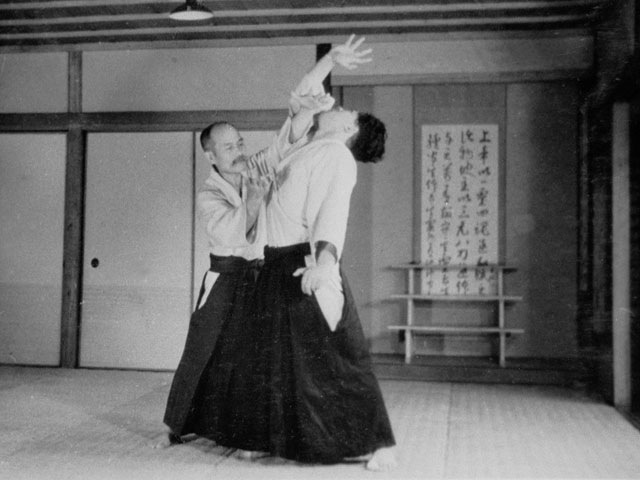
What is wrong is that nage is failing to unbalance uke at the beginning of the technique. It’s just that simple. As a result, at the moment of the throw, uke is facing a stable opponent with control over his posture and balance. What happens next is indicative of one of the pervasive problems I see in aikido today. Uke, still retaining his balance, offers no resistance and just takes the fall. This is repeated throughout practice with different partners.
I think in a lot of cases uke is only partially conscious of what is happening. Rather than view the arrangement between nage and uke as a form of collusion, I believe the prevalent attitude is something you might call a “spirit of cooperation”. That is, a desire to accommodate uke with an aim to progress together. Unfortunately, this leads to weak attacks without a sense of commitment. What I have described here can be see even in top-level performances at the All-Japan Aikido Demonstrations each year in Tokyo.
In my view, this is counterproductive and detrimental to the development of aikido. Further, it retards students’ progress and results in aikido not being viewed as a serious martial art.
What is the solution? My suggestion is that instructors begin to study deeply the structure of the human body and learn its strengths and weaknesses. We are after all bipeds whose balance is delicately maintained unlike four-legged animals. As a result, the principles involved in understanding balance of the human body are few and easily understood. You just need to pay attention and learn and apply a few simple maneuvers.
Remember this: Aikido techniques will fail to throw a balanced opponent. The opposite is also true. Aikido will work consistently to control and throw an opponent — big or small — whose balance has been compromised.






In Aikido and Aikijujutsu, Aiki is the action of taking the opponents balance. A study of the biomechanics of Aiki has resulted in a definition:-
“Aiki is a method of unbalancing Uke that reverses the rotation of a muscular torque which Uke depends on to maintain his balance”
Examples of applying this definition of Aiki to explain the unbalancing phase of techniques demonstrated by well known sensei can be found on aiki.simdif.com