
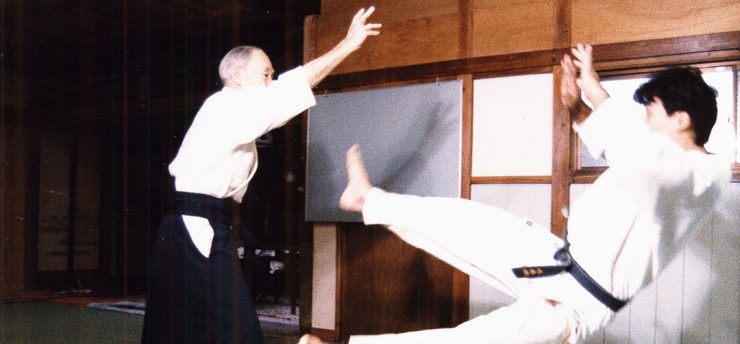
 Josh Gold
“When we talk about “Aiki” it all boils down to semantics. There are too many people
who have used the terms in different historical eras to arrive at any consensus.”
One of our readers have asked me to offer my opinion on the meaning of “Aiki”, a term bantered about frequently in and out of aikido circles. This was as a consequence of a discussion provoked by the article I published recently titled “Are you an unwitting participant in the demise of Aikido?.
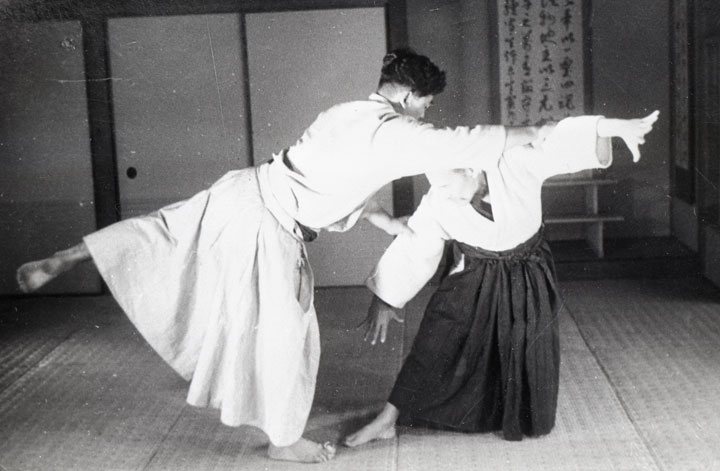
“Aiki” is most often associated with “Aikido” the modern martial art founded by Morihei Ueshiba. However, the term has an earlier origin even preceding Ueshiba’s main teacher, Sokaku Takeda, who referred to his art as Daito-ryu Aikijujutsu during the latter part of his career. For this reason, several of the branches of Sokaku’s art use “Aiki” as the central principle of their school but have used the term in different ways.
Let’s start with the mainstream of the art, loosely used to refer to the mainline emanating from Sokaku Takeda. Sokaku Takeda => Tokimune Takeda (his son) => Katsuyuki Kondo (Soke Dairi) are the central figures in this line although Kondo Sensei’s role as successor of the tradition has been disputed by some.
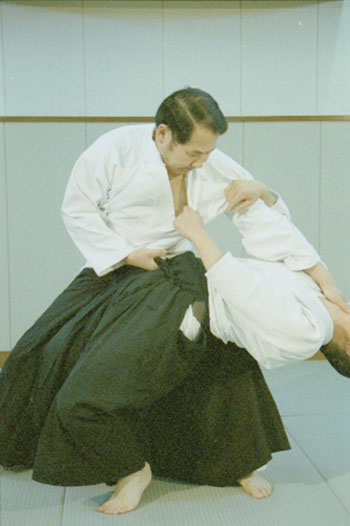
In the mainstream context, aiki has the meaning of perfectly sensing the precise moment to intercept and control an opponent. It can also refer to the explosive expression of energy that can stop an attacker in his tracks. This is my understanding after engaging in numerous conversations and observing many demonstrations by schools of the Takeda line.
The rest of the Daito-ryu world fragmented into many subgroups starting long ago. The most famous and most successful art whose roots stem from Daito-ryu Aikijujutsu is aikido itself, as we have mentioned was created by Morihei Ueshiba and officially named in 1942. Morihei Ueshiba himself often used the term “Aiki” merely has a shorthand for “aikido” itself”. In an aikido context “Aiki” has similarities with the term “ki” popularized by Koichi Tohei Sensei.
The attitude of Daito-ryu practitioners toward Morihei was ambiguous as he was both praised and vilified for his decision to distance himself from the person and techniques of Sokaku Takeda. He made many modifications to the more physical and jujutsu-like techniques of Daito-ryu and devised more circular, softer movements that relied on relaxation to achieve their effect.
For many in the Daito-ryu, Morihei was a traitor to the cause. Others with a broader viewpoint gave him credit for being one of the finest exponents of the art and the man who wrested Daito-ryu Aikijujutsu from oblivion through the phenomenal success of his aikido. Where would Daito-ryu Aikijujutsu be today without aikido?
From here on, it becomes very challenging to describe the many uses of “aiki” and I honestly don’t know if I’m up to the task. I will briefly tell you what I saw directly during my 20 years in Japan and mention figures I had direct dealings with including being physically thrown. My remarks that follow will not adhere to any strict order or attempt to weigh the importance or success of any individual style.
I’ve already mentioned Katsuyuki Kondo Sensei — who is a close personal friend of mine — who heads the organization one of the largest memberships and described how they view the concept of “aiki”. His art is very powerful and precise in nature and is combined with physical force. Interestingly enough, he has mentioned to me privately that he has become much softer as he ages.
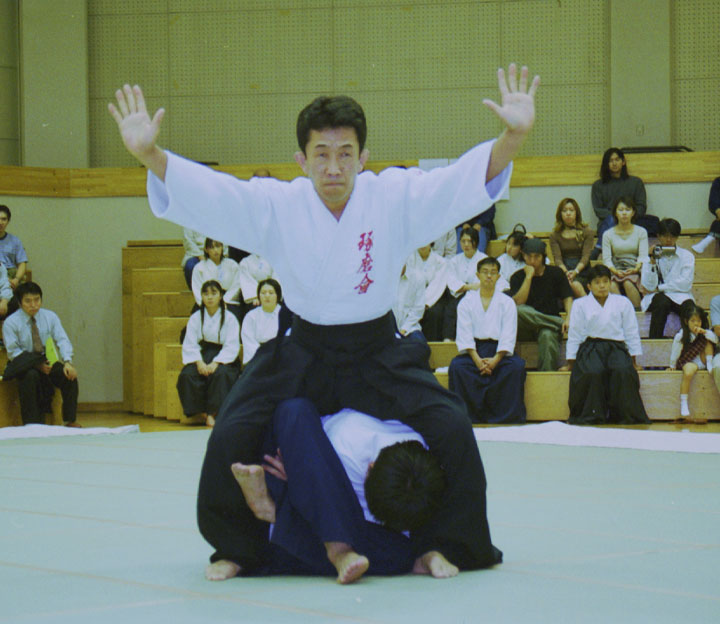
Next, we can consider the Daito-ryu Aikijujutsu Takumakai, also with many member dojos whose roots trace back to Sokaku Takeda, Morihei Ueshiba, and Takuma Hisa. When I had contact with the Takumakai, Hakaru Mori was the organizational head and one of the leading exponents of this style. I think it would be correct to say that the Takumakai had a similar understanding to that of the mainstream organization headed by Kondo Sensei. Some members such as Mori Sensei and Takeshi Kawabe Sensei were experimenting with softer techniques.
Going back in time, you have a number of groups whose curricula began to deviate from the techniques of Sokaku Takeda according to the personality and preferences of its central figures.
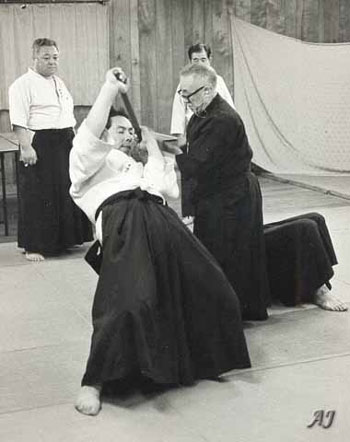
One historically important group — although numerically few in numbers — was the Kodokai branch of Daito-ryu headed by Kodo Horikawa (1894–1980). This group developed a soft, sensitive approach to techniques. Their aiki is something akin to an ability to mindread the opponent and then through hypersensitive movements tie him up in a knot. Kodokai demonstrations are very odd to observe since many of the techniques tie an opponent up like a pretzel and leave him stuck in that position until he is untwisted at the end.
The Roppokai is an outgrowth of the Kodokai headed by Seigo Okamoto Sensei whom I knew quite well. Not suprisingly, his techniques resembled those of the Kodokai in various respects. His timing was impeccable and he was capable of producing powerful results. Okamoto Sensei was taken lightly by many observers, including myself at first, but after being easily thrown and manipulated by him he won my respect. His use of the term “Aiki” had much in common with the Kodokai interpretation.
I will next mention the group headed by Yukiyoshi Sagawa (1902-1998) whose successor is Tatsuo Kimura Sensei. Yukiyoshi Sagawa whom I met on two occasions was an excellent technician and a stickler for physical fitness. He claimed to be Sokaku Takeda’s most skilled student and was highly critical of Morihei Ueshiba both as a person and an exponent of Daito-ryu. His dojo located to the west of Shinjuku in Tokyo was attached to his house. He taught in Tokyo for more than 50 years.
Sagawa Sensei’s group was secretive and disdainful of outsiders, especially foreigners, a number of whom unsuccessfully attempted to join the dojo over the years. It was commonly considered within the dojo that Sagawa Sensei had exceeded the skill-level of Sokaku Takeda and was the premier exponent of the art, bar none.
When I visited the Sagawa Dojo in the late 1980s to observe his demonstration and conduct an interview I was left with some strong impressions. I disliked the treatment I received and I was never allowed to be thrown by Sagawa Sensei. Nor was I permitted to freely ask questions. My Japanese companion was allowed to jot down a few notes which were immediately inspected by Kimura Sensei. The content of the published interview was heavily edited by Kimura Sensei. We were not allowed to take any photos while there either.
The term “Aiki” was freely tossed about in the Sagawa Dojo. Often when Sagawa Sensei would execute a throw on senior members they would shout out “Magnificent!”, “Fantastic”, etc. I found this very strange since in my training experience being powerfully thrown by a skilled teacher would elicit a gasp, not profuse words of praise.
Upon Sagawa’s death, Tatsuo Kimura Sensei became the leading figure in the group, a position he maintains to this day. I had the feeling that present-day members of the dojo consider Kimura’s skills to have in turn surpassed those of Sagawa Sensei.
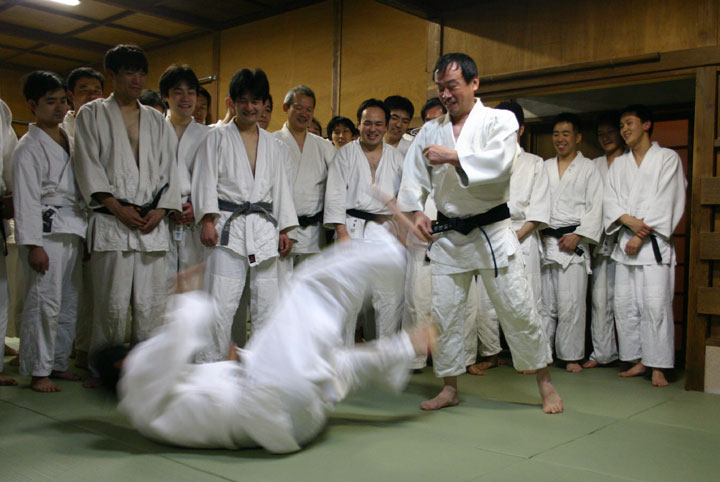
Kimura Sensei is very powerful and skilled, and like his teacher before him, very physically fit. He demonstrates an exquisite sense of timing in the execution of his techniques. I was thrown by him many times especially on one of my several visits. His techniques were explosive and executed mostly from a frontal position.
The atmosphere in the Sagawa Dojo was never to my liking due to the secretive, even arrogant, nature of the group. Nor did I enjoy listening to the criticisms of Morihei Ueshiba, a man who succeeded far beyond what Yukiyoshi Sagawa achieved on the world stage. Oddly enough, the small Sagawa group would be almost totally unknown had it not been for aikido’s success and a rekindling of interest in Sokaku Takeda and all forms of Daito-ryu.
Other groups have appeared on the scene in the years since I left Japan and I don’t feel qualified to speak about them as I do not have first-hand knowledge of their approaches.
I would like to add something of a personal nature at this stage. In recent years, I have become very active teaching my “Zone Theory of Aikido” approach to aikido. I think some of the principles I consider important overlap with ways in which the term “Aiki” is used. I would have to compare what some of the Daito-ryu and aikido people are actually doing now and see to what extent we have things in common.
I have chosen not to use terms like “Aiki” to describe my methods because I am now dealing primarily with a western audience. I try to explain my ideas in terms of physics, angles, positioning, softness, proactiveness, and similar principles. I find myself constantly looking to Aikido Founder Morihei Ueshiba and my personal teacher, Morihiro Saito Sensei, for inspiration and guidance. I have come to appreciate more and more as I mature their amazing abilities and their depth of mastery of what some might call “Aiki”.
When we talk about “Aiki” it all boils down to semantics. There are too many people who have used the terms in different historical eras to arrive at any consensus.
Step on to the mat and feel the techniques of these “Aiki” experts. Some I understand are at a very high level. Whether or not they are following in the footsteps of Sokaku Takeda or Morihei Ueshiba, I do not know. If you are interested in these subjects, seek out these teachers and come to your own conclusions. Aikido Journal offers the Daito-ryu Learners Package which will allow you to explore the various interpretations of “Aiki” within the Daito-ryu context.





Stan,
Thanks for putting this topic out there.
During my time with TC and other Aikido sensei the concept of Aiki was “vaguely explained”.
I often confused it with kokyu.
I hope to see more discussion on this topic.
Bob M.
Pranin Sensei,
Thank you yet again for your thoughtful reflection on this important topic. The unifying thread regarding “Aiki” that I notice in my own observations of groups like the Kodokai, Roppokai, and Sagawa’s lineage is the simple exercise of the lifting of the hands when both wrists are grabbed. In aikido it seems to most often be called “kokyu dosa”, Akuzawa Sensei calls it “age-te”. In Daito Ryu I have heard it referred to as “Aiki-age”, implying that the proper execution of this technique is a demonstration of Aiki. Regardless of tai sabaki, of which Takeda, Sagawa, and O-Sensei were described as masters; exclusive of individual techniques or pins; this simple exercise is a hallmark of someone who has Aiki. Kimura described this in his book “Transparent Power” as a sort of litmus test for the competency of a student, one which Sagawa used on one of O-Sensei’s attendants (and perhaps O-Sensei in private) during one of their meetings.
So my simple interpretation of Aiki is: Can you do this without using external muscular strength? The person who can do it and on whom it cannot be done is the one with the most Aiki.
This is the reason for the popularity of instructors within Aikido like Gleason Sensei, and outside like Dan Harden and Akuzawa Minoru. Their application focuses around developing the body and training internal development that will give a person the ability to execute Aiki-age correctly.
As always your feedback on this and continued discussion is a benefit to all who practice the Aikido and like martial arts.
I recall from somewhere that the term “Aiki” was original used as follows, “Do not be Aiki-ed by your opponent.” Also that the word “Aikido” is more likely “Aiki-Do” than “Ai-ki-Do” as I originally believed. I would therefore suggest that “Aiki” was a term that referred to the “meeting of ki” or even the overused “harmony of ki”. I would further suggest that in its origins “Aiki” meant the instant apprehension of the enemy’s intention, energy and physical clues (I-Ki-[kotowa]Ri) not in an intellectual way but in an intuitive moment of clarity simultaneous with one’s actions. Those of us who have had any violent, interpersonal incidents will know that moment. Today the term “Aiki” must be expanded to include O-Sensei’s ethical and technical insights and his purpose of uniting all persons or even all creation. I fear we will never come to a good description of “Aiki” any more than Christian preachers have ever exhausted the meaning of “agape/love”.
Nice article Stan, though I am not sure anyone I’ve met is glib when it comes to their practice of Aiki or Ki or Dantien or whatever one wishes to call it. In that context how am I supposed to think using terms like physics or ‘zone theory” is any different?
Very Respectfully,
William Hazen
I believe the term is used casually and imprecisely all the time and with little understanding of the historical context, hence my use of the term. I believe this fits the meaning of the word.
1- When an action results from blending mental and physical energy together (being in the here and the now), there is Aiki,
2- When meeting our attacker’s Aiki with our own, we have Aiki.
Then Dô is the way to cultivate Aiki.
(A Yôseikan point of view)
Patrick Augé
Good perspective, Patrick. Thank you!
Thanks very much for this article. Apart from your historical knowledge, you have had a unique exposure to many prominent Daito ryu and aikido parcticioners, and your personal recollections of these are invaluable. Yoroshiku onegaeshimasu.
I am really surprised that there are so much misunderstanding to this day, even among long time practitioners, what aiki is. Aren’t you practicing Aiki-Do? Its ALL about aiki! ,without understanding it deeply, all you do is practicing series of someones kata forms, which most likely works only inside cooperative environment, and you completely missing the point of aikido. Aiki is a broad term , firstly there is aiki principle in martial arts, then aiki outside martial practice, and finally aiki as binding, uniting power of the nature itself, of which Ueshiba sensei talked exclusively a lot. There are no magic involved or some kind of secret electrical nature of aiki, which enables practitioners instantly throw opponents with little to no movement at all upon touching them lightly, as seen in some daito ryu styles. So, such martial principles as kiai, kokyu, kuzushi, atemi, ki musubi, awase, zanshin are all part of AIKI strategy in martial arts. All aiki really is, is CONTINUOUS MIND CONTROL OF THE ATTACKER even before attacker moves and after it is all over! Its because mind drives and controls the body, and if the mind is controlled… That’s what aiki is all about.
This is an excellent definition of Aiki of a personal nature. You define the term in a broad way. Various flavors of Daito-ryu define it much more narrowly, more like a strategic concept. I wrote this article to describe this wide discrepancy and the fact that there is no general accepted meaning for the term. Groups define it to fit their conceptual perpspecives.
If i could add some more Stan. That’s not just my own definition of aiki of personal nature. I been studying it enthusiastically for a long time. Nothing less than authenticity satisfies me.. The definition of aiki by mainline daito ryu of Kondo sensei is quite broad and essentially the same as o sensei(there is an excellent dvd by Kondo sensei named ”what is aiki?”), except that o sensei talked about aiki in yet broader terms, connecting to cosmos and kami through aiki, etc.,
Stan,
Unfortunately, Modern Aikido and Modern Daito ryu is not a trustworthy source for understanding “aiki”. Your extensive body of research upholds that to be true. There’s a thread over on a forum called Rum Soaked Fist that talks about Modern Aikido, Ueshiba, and aiki. I quote your extensive research among others on that thread. Starting from Page 3, it gets interesting. The thread is here:
http://rumsoakedfist.org/viewtopic.php?f=6&t=23254&st=0&sk=t&sd=a&sid=cbdca5f10abeed2f20d5acccc10c0bc5&start=30
So, I do disagree with one of your points above. You wrote, “When we talk about “Aiki” it all boils down to semantics. There are too many people who have used the terms in different historical eras to arrive at any consensus. ” Takeda, Ueshiba, Sagawa, Horikawa all talked about the same “aiki”. When the pre-war students stopped into the Tokyo dojo after the war, they pretty much made the remark that what was being done there wasn’t aikido. The aiki that they knew. Ueshiba ranted to the Tokyo students that they weren’t doing his aikido. The same definition of aiki that all the others (Takeda, Sagawa, etc) had. Sagawa passed this aiki to Kimura … not many others. Horikawa passed this same aiki to two people … not many others. Ueshiba created several pre-war giants who had this same aiki.
Based upon your research and others’ research (an example would be the Aikido Sangenkai articles), all those people who actually had aiki defined it much the same way. All those people who came later, especially Modern Aikido, started defining “aiki” using semantics, word play, etc but never in the same manner as those aiki greats did. Doesn’t that make you wonder why?
That doesn’t mean that Modern Aikido is without value. Millions of people have given it special value. But, we must start acknowledging that there is a great difference between Ueshiba’s aikido and Modern Aikido. Aiki being the prime difference.
Mark
Mark, I don’t buy your main thesis. I personally experienced the “aiki” of several of the people you mentioned and found great differences. I maintain my original position.
Mark,
Do you base your opinions on experience or theory and the opinions of others? Your statements come across as very simplistic. There’s a whole lot more to the subject than you seem to be aware of.
Thanks for this post, Stan. It is nice to hear you weigh in.
In my couple of years training in mainline Daito ryu, I think you’ve got it. Aiki is a state where uke is unable to do what they want, and that gives nage an opportunity to act to maintain dominance. This state is achieved by simple movement and requires perfect timing and sensitivity. I would argue that the “physical force” you refer to is better simply described as “jujustu” – locks and throws and such to end the encounter. Good jujutsu involves the smallest amount of physical force possible. But the kata certainly don’t feel pleasant.
My Aikido teacher, Mitsugi Saotome Sensei, speaks mostly of “Aikido” and very seldom uses the term “aiki.” He emphasizes the psychological relationship between uke and nage, where nage can achieve something that is very similar to one of Daito ryu’s subtle unbalancing techniques. On the level of physical technique, Saotome Sensei has talked a lot about how you must “use all the energies” and how you can get uke to do what you want them to do, softly, by essentially smoothing around the angles rather than trying to cut across them.
So its clear to me that “aiki” is an essentially hyperbolic term – if you think you’ve got an understanding, there is more to understand. If you think you can do something repeatedly, there are bigger things to work towards. I think this goes back to how Takeda chose to take his art on the road and disseminate it in seminar format. The idea is always so big you can’t see it all. And nobody wants it to be otherwise – nobody wants the curtain peeled back. So we have folks who are always seeking for something deeper, whether or not its there. I think that’s what makes people in the aiki arts special.
Great observations, Cliff!
The problem here is trying to verbalize an experience. It either is or isn’t. It isn’t words. Even, in the English translation I’ve read, O Sensei distinguishes HIS aikido as different, though the term was an old one. My take on your title is, if aikido is a martial art, then you are faithful to the lineage if your work has martial efficacy. If you leave that criterion aside, then just exactly what are you doing? My cynical take on that is self aggrandizement and paying the rent. I know a guy, even like him, who is off on a path. Like me he doesn’t worry about paying the rent. Though he rents space I doubt it pays for itself. That which he is exploring probably only works on the mat. “In real life” his large size and other training would probably see him through. So there we are again. He is experiencing something. He calls it aikido and has a sign on the door.
Of course Yagyu would say that even with the best skill, no martial art guarantees victory. Kano Sensei said, “On any day, anyone may win.” In Hagakure it says that with thirty years of martial arts training, you are only an artist. Well, I resemble that remark, I guess. Once upon a time Nadeau Sensei said, “I’m just in it for the magic moments.”
I prefer the most literal and least metaphysical definition of aiki, which is “joining energy”, i.e. joining our own movement to uke’s movement, “blending” with uke’s movement as opposed to blocking or resisting uke’s movement. I feel that this literal, physical meaning comes first before any philosophical or metaphysical interpretations. To apply “aiki” most effectively requires good timing or kokyu, but I think that kokyu is a different concept.
Ki comes from the ground.
It’s created by lifting the spine up against the force of gravity. This is the meaning of the dot in the centre of the circle we see in O’Sensei’s drawings.
The energy of the centreline.
The reason we’re are always told to relax is because muscles must hang off the structure created by the lifted spine.
It takes sensitivity and relaxation to feel ki.
Feeling your ki has nothing to do with martial arts ability.
It’s about connecting consciously to the energy of the earth (gravity) as it continuously pulls you. You have to create the upward lift (ki) which frees the spine of tension.
This is the interplay of water/yin (gravity) and fire/yang (ki) we read about in O’Sensei’s words. Water flows down and fire up.
Gravity is felt as relaxation and ki is felt as effort.
Find the balance between effort and relaxation.
When practicing, continuous attention must be paid to the centreline, relaxation and breathing.
Mr. Watkins’s comment makes sense.
When we make a habit of blending with Uke’s movements (as long as there is “intention to attack”), we develop anticipation. Awareness is a by-product of concentration. It takes daily practice in and out of the Dôjô.
Mochizuki Sensei emphasized training ourselves to be aware of the environment through the use of our senses, individually and combined together.
For example when listening to sounds, listen to far sounds as well as near and internal sounds. Then we can identify sounds that have no meaning to other people and be aware of what is coming.
Thanks to this kind of practical training which he received from Ueshiba Sensei, Mochizuki Sensei was able to escape before being caught by Mao Tse Tung’s soldiers in 1945.
There are many opportunities to train in daily life. Another example consists in training ourselves when driving: be aware of other drivers needs and anticipate their movements and the possibility that they may make mistakes.
We can do that only if we see ourselves as a part of the whole, sharing the road together…
I was at the dentist’s a while ago and we talked about Budô after the treatment was over. I remembered that the previous time I was in his clinic, he was asking his assistant for needed tools while this time he wasn’t saying a word. When I asked him about it he said that this assistant was Japan-trained and that she knew exactly what he needed before being asked. That is Aiki, isn’t?
Another fact I remember: At the Aiki Expo in Las Vegas, during registration time, students who had arrived early were helping setting up the place and transporting the tatami to the different rooms. Help was greatly needed, but few paid attention as they were busy chatting and immediately returned to their hotels.
Then Kenji Ushiro Sensei and his students arrived from Japan. In spite of the long trip and jetlag, they immediately sensed the need for help and joined the team. They were also among the last ones to leave after cleaning up the place once the Expo was over. What kind of training did they receive that made them different from other students?
Does anyone have suggestions for practical training in daily life?
Patrick Augé
“aiki has the meaning of perfectly sensing the precise moment to intercept and control an opponent”
I respectfully disagree, I would call that “kokyu”, or timing.
” It can also refer to the explosive expression of energy that can stop an attacker in his tracks.”
I respectfully disagree, I would call that “kiai”, which is an aspect of kuzushi.
Aiki is “joining energy”, or “blending”. Aiki is combining our movement to uke’s movement. This is an important principle of every jūjutsu (gentle martial art), but Aiki-jūjutsu and Aikido take this “blending” to another level.
Stan and All:
Our everyday language (and its corresponding conceptual paradigms) does not “speak well and richly” to the half of Life which is subjective, deeply personal, and intuitive.
Advanced physicists often speak of having a flash of insightful brilliance and then struggling for months, years, sometimes decades to find a way of ‘languaging’ it terms that are coherent within the rational, logical, and linear Domains of Knowing.
In fact, sometimes like Sir Issac Newton, they invent a whole new ‘dialect’ of mathematical language to better express their hypotheses and theories. Newton invented calculus to help him explain the elliptical orbits of the planets. Something which had already been observed, but still remained ‘unexplained’ within the mathematical thinking of the day.
So, how do we approach the phenomena of ‘ki’?
And our very special interest in “aik”.
We can appreciate it historically as interpreted by many different traditions and individuals. We can examine it scientifically, in terms of physics, anatomy, and the dynamics of kinesiology.
And we can gain some insight through the the ‘subjective’ doorway via poetry, psychology, art, and religion.
My own sense is that the terms ‘ki’ and ‘aiki’ must be approached in an integral and holistic way if they are to be not merely intellectually understood, but, even more, if they are to be appreciated, theoretically and practically … and to serve a truly salutary benefit for us.
Despite what some aver, I do not believe that there is any single perspective or explanation that adequately covers it all. That is for each of us to work out for ourselves … standing on our own two feet and relying on our own experience.
~ ~ ~
One helpful approach for me … as a kind of initial doorway is to compare ‘aiki’ with the Taoist concept of ‘Wu Wei”.
Wu Wei or non-doing as it is translated in to English basically means going with the flow, it is the path of least resistance and effort, for there is no action without reaction, no desire with out restraint.
It does not mean to do nothing, it means to find that path of least effort, for whatever we do always has a reaction. Do not seek to force something to happen.
That we can come to see/sense/feel that the essential ‘nature’ of Nature (The Tao) is Aiki.
That the Universe is complete and perfect in itself as Itself, with nothing out of place. Even what we humans call a ‘mistake’ is merely a momentary manifestation of the Great Harmony Of The Cosmos unfolding exactly in its own way.
Turns out, we’re the one critter who can choose, consciously and deliberately, whether we are going to ‘become one with our own universe’ or resist it.
Any Aikidoka worth his/her salt knows the difference … in their bone marrow.
Abayo,
~David Brown