
 Josh Gold
“Since if uke knew how to resist — and many did — no one could actually execute this ikkyo technique if strong resistence were offered. What to do? “
 I have written about this topic before and mentioned my intense dislike for the Katatedori ikkyo technique over the years. The way I learned this technique in Iwama in the late 1970s and early 1980s was to extend my arm fully and fill it “Ki”, step to uke’s side to unbalance him, and then execute ikkyo.
The fly in the ointment for all of us training was what was meant by Ki. We interpreted it to mean put full power into your extended arm to execute the lateral movement designed to unbalance uke. Only the really big, powerful seniors in the dojo could get the technique to work that way. But their strength advantage was only temporary. Soon even serious beginners began to see that they could anticipate nage’s intent and stop him cold in his tracks. It was terribly frustrating!
This created an interesting dynamic. Since if uke knew how to resist — and many did — no one could actually execute this ikkyo technique if strong resistance were offered. What to do? Well, most of us settled on an unspoken agreement to grab lightly enough to allow nage to make his initial move and go on to execute the ikkyo. Our training partner would then extend to us the same courtesy.
I hated this way of practicing!
I felt frustrated that seniors who had been training for decades had to compromise the integrity of their practice because they had no solution to how to perform Katatedori ikkyo against an uke who really resisted strongly.
In the last several years, I did a great deal of experimentation on ikkyo using my students — several of whom possess a great deal more physical strength than me — in an effort to find a solution.
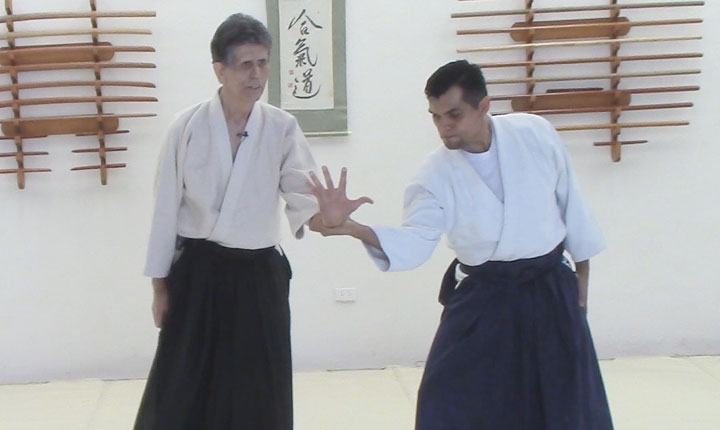
About two years ago, I finally came up with a workaround using the “cupped hand” and a relaxed arm that led to consistent success. I was elated!
In fact, this new way worked so well, I had to insist that students not move too quickly because the whip-like movement created could actually be dangerous and completely upend uke! If you relaxed and moved properly it worked reliably on anyone, big or small.
But I wasn’t fully satisfied with my solution because it involved altering the basic form of Katatedori ikkyo that Morihiro Saito Sensei was teaching. I kept researching the technique to see if I could find an effective solution that used the basic form. I knew the answer would involve making internal changes that would not be obvious from the outside. I found the answer in the summer of 2015 in San Miguel de Allende, Mexico.
Here is a video from a seminar I gave recently in Tucson, Arizona. I demonstrate Katatedori ikkyo omote the way I do it now which I find far superior to the methods I was taught earlier in my career. If you can relax and setup as though executing shihonage from your opponent’s blind spot you will learn to consistently throw even the strongest uke. No physical power is required.
If you would like to find out more about my thoughts on Katatedori ikkyo and many other aikido techniques, I discuss these subjects in my “Zone Theory of Aikido” course.




Stan:
I look forward to seeing your discovery of the key which has unlocked this conundrum for you.
Kudos to you and your inner drive and outer determination to never become complacent and to always be on a quest to perfect your waza and yourself. I believe the Japanese have given this attitude a name, “kaizen”.
When truly practiced as an ‘inner Art’, Aikido is a marvelous “Way” to assist us as we travel the “WAY”.
As a kind of teaching and learning paradigm, there is continuum from AIKI-jitsu to AIKI-budo to AIKI-do to AIKI. This stream flows both ways and when integrated, is a seamless expression of the greater dimensions of matter-energy-time-space.
This is my current best understanding of O’Sensei’s declaration that the space of AIKI is simply the space of our universe. And to consciously and deliberately align ourselves this way is to, in fact, come into greater and greater accord (read ‘harmony’) with the processes of the Cosmos.
The great challenge for beings such as ourselves is continually discover deeper inroads into this mysterious, yet knowable, way of understanding and being.
Thus, the fascination with discovery and revelation. We humans are sometimes described as the “problem solving animal” and it has been shown that our brains trigger the release of endorphins when we successfully solve something as trivial as a crossword puzzle.
When Harold Carter first peered into King Tut’s tomb, his sponsor Lord Carnarvon became impatient and finally said, “What do you see?”. Carter said, “Wonderful things. I see wonderful things!”
I look forward to seeing your ‘discovery’.
Respectfully,
~David Brown
Thanks so much for your kind and insightful words, David!
It will be interesting to understand your studies here. I always found the Yoshinkan approach to katate mochi ikkajo osae ichi clear enough and working well with a resistant uke.
Wow, I am really looking forward to see the promised video! I did find your previous “cupped hand” solution extremely helpful in certain situations, but it did trouble me how the form were different from the form expected on belt exams… also, I am very curious how you managed to “internalize” the initiating step of the cupped hand version… thank you for your work Stan!
Mochizuki Sensei used to say that “Robuse” as it was called before, was the most important basic technique. “If you master it together with Tehodoki and Taisabaki, you can rediscover all other techniques. It’s the mother technique!”
I am looking forward to learning more about this technique.
Thank you for sharing, Pranin Sensei.
Patrick Augé
Hello Pranin Sensei,
Oh, how you’ve whetted our appetite with your announcement! Now we are expecting your big revelation quite impatiently.
Is your discovery one that can be taught to any beginner or is it one that only experienced practitioners will be capable of grasping?
Thank you for all your dedicated work.
Erwan
Stan, it sounds like you have gone full circle and returned to Tohei’s KI Aikido.
The way you describe is how we taught.
I too learned from Koichi Tohei Sensei for several years. I rely less on the description of the execution of a technique and more with how it’s practiced in the dojo and the degree of success of learners of the method. In my early years, we could describe ki as applied to technique but either allowed our arms to go limp trying to relax or end up tensing up like other styles. That’s why it took me so long to find workable alternatives. I’m not saying Tohei Sensei explanation of the technique was wanting but that most of us developed ineffective technique.
Another point that Mochizuki Sensei was emphasizing:
Since Robuse (Ikkyo) was the first technique taught to beginners, it had to work as it would become their reference to the effectiveness of Aikido.
Power can flow freely (Ki) only through Tori’s body alignment and placement of his feet according to Uke’s stance in order to produce Kuzushi. This applies to all techniques.
Power starts from the hips and explodes towards the limbs, feet and hands (back leg extended for support as in Zenkutsu-dachi, thus redirecting the smooth flow of power to the upper body and the arms by maintaining all joints aligned at a 90degree angle with Uke’s arm and feet).
Mochizuki Sensei explained this technique in detail at his seminars in Montreal and Ottawa, Canada, in 1979. He insisted on moving behind Uke’s shoulders’ line (or Uke’s blind zone as Pranin Sensei named it) with a Hokotenkan (change of direction) generated from the hips, elbows down, which resulted in causing Uke to raise his elbow sideways and neutralized his ability to resist with his shoulders.
This requires knowledge and understanding of Kuzushi through Tehodoki (Hand-release to destabilize Uke’s wrist, a practice abandoned by mainstream Aikido after the war), Taisabaki (positioning one’s body by aligning the feet with the direction of the technique and bringing Uke’s head below his center of gravity) and Kake (completion of the technique by either throwing or pinning Uke.
This technique is simple but requires years of practice and polishing. It should be studied with many different partners in order to develop the ability to adapt to a variety of body types at the moment of contact.
A police officer once said that it was the only technique he could rely on to securely bring a suspect down and handcuff him as compared to what he had been taught at the academy.
Please continue to search and share your findings with us. Thus Aikido will evolve and regain respect in the Budo community.
Patrick Augé