
 Josh Gold
“Morihei gradually distanced himself from the techniques of Daito-ryu Aikijujutsu over a span of more than two decades”
When did Morihei Ueshiba make the transition from the techniques of Daito-ryu Aikijujutsu to modern aikido? A study of the available historical records suggests that Morihei gradually distanced himself from the techniques of Daito-ryu Aikijujutsu over a span of more than two decades beginning in the 1920s.
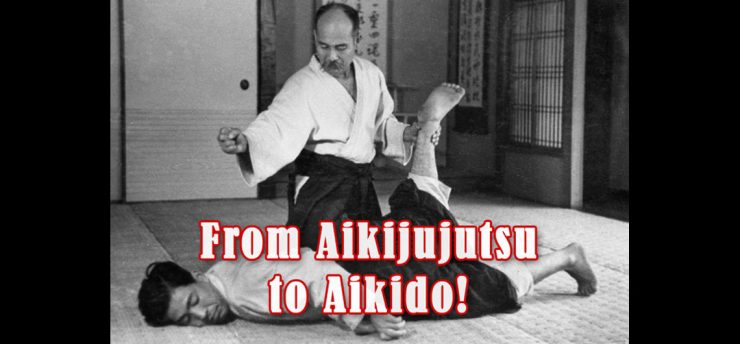
Fortunately, we have an amazing pictorial record in the form of more than 1,000 photos taken that provide a snapshot of this transformation as it unfolded. These photos were taken in 1936 in Tokyo at the Noma Dojo by Hisashi Noma, one of Japan’s all-time kendo greats, using an expensive Leica camera.
Hisashi Noma was the son of Seiji Noma, the founder of Kodansha, Japan’s largest publishing company, and a friend of Morihei Ueshiba. These priceless images, known as the “Noma Dojo” photos, reveal the Founder to be a master of the intricate jujutsu techniques that comprised the Daito-ryu syllabus.
This visual record provides the “smoking gun” demonstrating the dominant influence of the Daito-ryu school’s curriculum on Morihei’s art. At the same time, the Noma Dojo photos already have begun to reveal Morihei’s modifications to the somewhat rigid Daito-ryu techniques toward more circular, flowing, and expansive movements.
There exists a tendency to discount the significance of historical documents such as these photos from the prewar years by claiming that Morihei abandoned these techniques in his later years. While there is a grain of truth in this observation, few realize that Morihei continued his vigorous training and technical experimentation well into his 60s during the postwar period in Iwama.
Due to the devastation of World War II and the widespread poverty in Japan following the war, there is little documentation from the early Iwama years unlike the abundance of evidence from the prewar era. Nonetheless, a study of the vast body of techniques taught by the Founder in his country dojo in Iwama, including his practice of the Aiki Ken and Jo, makes it clear that his refinement of the techniques of Daito-ryu was an ongoing process that spanned decades.
Morihei was fond of pointing out that his art was constantly changing, and that he would continue practicing his entire life. That being said, many regard the birth of modern aikido as coinciding with O-Sensei’s “Takemusu Aiki” of the Iwama years dating from the late 1940s into the 1950s.
Certainly, it was Morihei’s art from this period that inspired many of the talented instructors who spread aikido, and led to the international dissemination of the art.
Click here to discover the secrets of the highest level of aikido to accelerate your progress!






Good article Stan, it is quite important topic. My personal research suggests that contrast between prewar and postwar aikido techniques are not so great as most tend to think. Most notable difference being, that in his later years O’sensei seems to have omitted the more complex and exaggerated techniques, abbreviated some others, made more refinements to avoid clashing with opponents strengh as much as possible, further incorporated and perfected weapon techniques. As the founder was constantly training and had more time after the war, it is only natural that in postwar years his aikido has become more refined and harmonious. I have made a video about this point. For those interested here is the link https://www.youtube.com/watch?v=NOd4WmdjbAI .
Marius, you’ve done a wonderful job. You’ve demonstrated something I’ve long suspected in a convincing manner. It was very clever of you to juxtapose the 1935 Asahi News film with the 1954 8mm film where O-Sensei is still doing a lot of recognizable techniques. Very creative!
Marius, this video is breathtaking in its scope and beautiful in its plain presentation of the truth.
O-Sensei’s Aikido was O-Sensei’s Aikido.
Thank you so very much!!
In the copy of Budo that I have, John Stevens had also said much the same thing.
To quote Stevens, “For the sake of comparison, several sequences of photographs are taken in Wakayama in 1951, when Morihei was sixty-eight years old, are included throughout this section. The differences between Morihei’s execution of the techniques in the pre- and post-war periods is often contrasted, but as we can see by comparing the Noma Dojo techniques (1936) and Wakayama (1951), the essence of Morihei’s art remained the same.”
When I travel to seminars or other dojo, when a conversation comes up about O Sensei’s technical evolution, the theory of growth and evolution is used to justify a disavowal of history and other lineages. We don’t need to know where we came from, because now we are better. Don’t look back; you’ll only be looking at second rate stuff and you’ll be the worse for it.
I guess for me the real question is why it was so darn important to insist there was a big technical evolution. Prewar students with ranks in Daito Ryu and Aikibudo could now be denigrated and there was no reason for the post-war students to acknowledge their sempai as “they didn’t get the real up to date stuff?” With a change in name and the myth of the enormous changes in style and curriculum, all of the students of Kano Jigoro who trained with O Sensei could be discounted, any prewar greats were no longer sempai and no longer outranked anyone? If any prewar student corrected a post-war or taught differently, it became proof that they were not of the generation who benefited from the latest fruits of O Sensei’s constant refinements?
The events of the second world war, and modern warfare, made the training in traditional martial arts, for the battle largely redundant, ie. man against man, as war became machine against machine. O sensei”s change comes from the need to put his training into the changed world, and use martial training for the development of the” self” on all levels .