
 Josh Gold
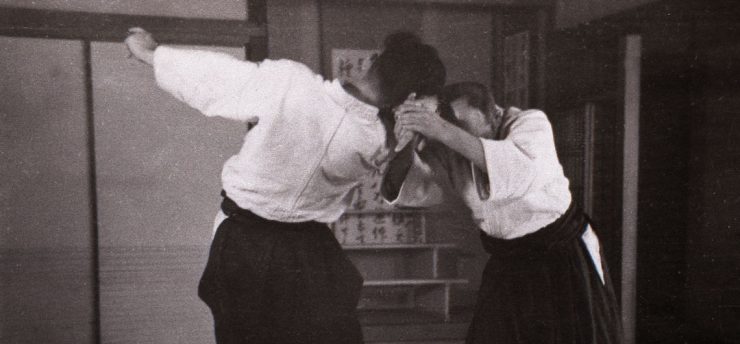
Shihonage is known as aikido’s “four-corner throw.” It involves securing a partner’s wrist, a rapid pivot resulting in a powerful control of his arm, followed by a throw. Shihonage is practiced in many different ways which vary according to stylistic trends. Few people study Morihei Ueshiba’s approach to shihonage as exemplified in his 1938 training manual titled “Budo” and the Noma Dojo photo collection. The above photo is from the latter collection and clearly demonstrates a powerful, controlled application of the shihonage throw.
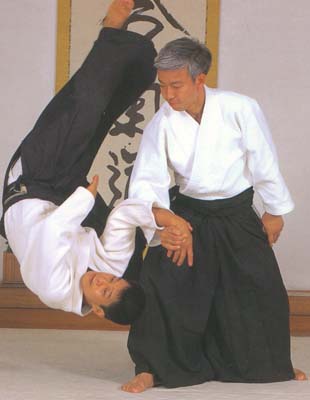
Like anything else in aikido, there are a variety of different approaches to performing the technique. Although the basic application calls for holding your partner’s hand firmly with two hands, it is customary in many dojos to finish the technique holding your partner’s wrist with only one hand.
This is frequently seen in aikido demonstrations where an attacker is quickly dispatched with a shihonage, controlled through a single hand. Usually uke will take a spectacular high fall, which never fails to impress an audience.
I think that we often forget the mechanics of basic techniques like shihonage and gravitate toward executing throws in a more eye-catching manner which leaves a strong impression in the eyes of the beholder. It is important to keep in mind that there is a strong element of collusion at play in a demonstration context.
What happens in the dojo when strong basics are emphasized may be less impressive but is far more effective and martial.
What if we consider shihonage as a powerful tool to allow us to subdue and control an opponent? What would the technique look like then? Here are some examples starting with the photo of the Founder above where shihonage is applied with both hands controlling the opponent. Uke is locked in a backward falling position with no chance to escape or execute a counterattack.
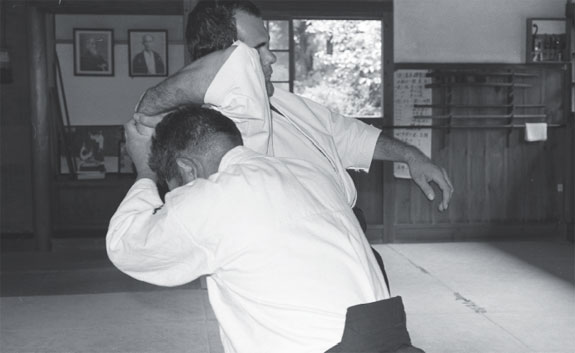
How you practice shihonage and the other core techniques of the aikido curriculum will likely be determined by the approach of your direct instructor and the technical guidelines of your organization. Whether shihonage is executed with martial intent, mechanically or casually is something we “inherit” from our teachers and seniors.
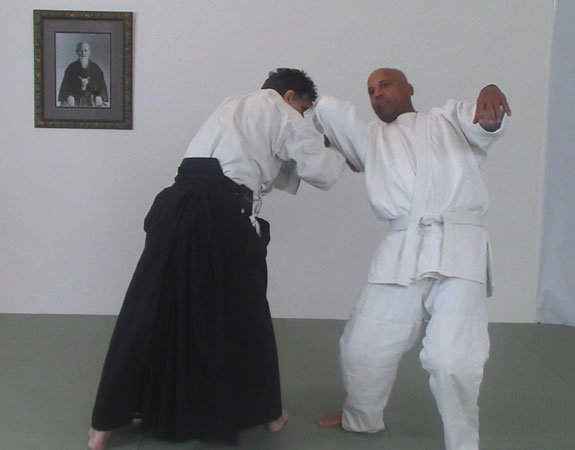
As we mature, and if we wish to question the specifics of the techniques we have been taught with an eye toward improving effectiveness and ease of application, the Founder Morihei Ueshiba and those preserve his techniques accurately serve as excellent models for further study.
As a reference source, here is Morihiro Saito, 9th dan, executing shihonage ura.
This video is excerpted from Saito Sensei’s “Complete Guide to Aikido” course.




I agree about the two hands being stronger – and this is also true for Kotegaeshi, Nikyo, and Sankyo. I had to strictly learn these as two handed movements as basics.
Later, doing this holding a weapon, or disarming someone else, doing an atemi in the middle of the control. The Yoshinkan pin does a two handed take down, but then controls with one hand so a finishing blow can happen. The technique then requires I learn to express each hand fully.
After I’ve learned to express each hand fully, then how do they fit together so that the two hands aren’t fighting each other but instead add to each other’s power. I was shown to do the hands in the final cut in Shihonage moving at 90 degrees to each other, that it was weaker to move like I was in handcuffs.
The big hiccup I find in teaching this is how we teach the footwork. Tenkan is 180 degrees, irimitenkan is 180 degrees on a single crack in the mat. The shoulders and hips can’t line up with both hands comfortably taking control in center mass, so one shoulder falls back instead of the foot moving so that both hands can do their job.