
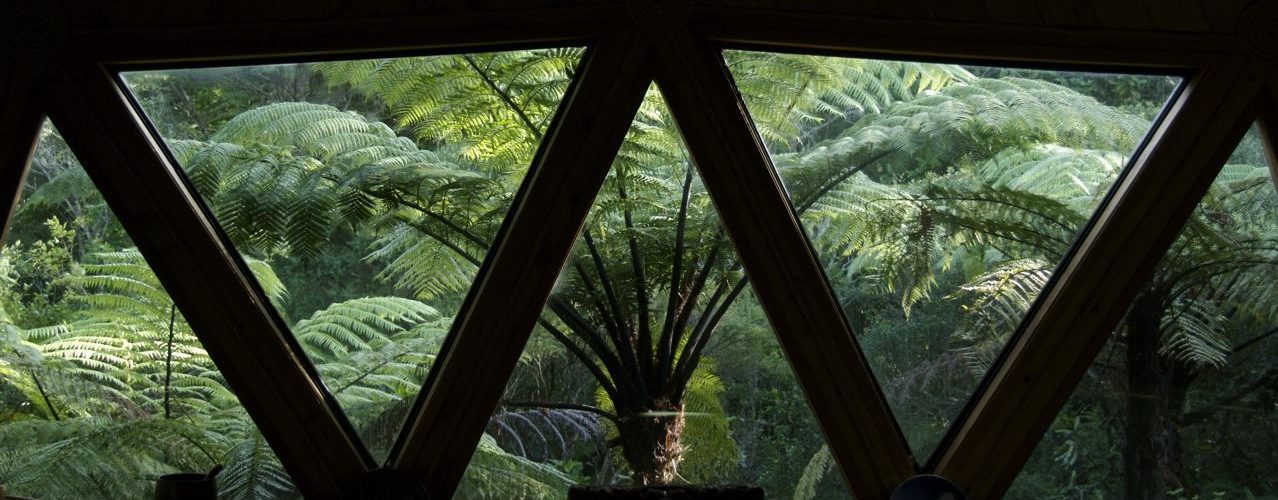
 Josh Gold
Retired to the country, a hundred miles from the Auckland dojo I supervise, I only get to train once or twice a week.
But I do have time to think, and to present some of these thoughts, for better or for worse, in writing:
Lynch Sensei is past his peak;
He’s down to training once a week;
But writing time he can afford;
His penis mightier than his sword!
Despite the above, I do take aikido seriously, and plan to get back into daily training as soon as we have built our new “bush dojo” here in Whitianga. But I take humor seriously as well, as I feel it is one of those essential human values that distinguish us from the lesser creatures — apart from the laughing hyena, of course.
Humor is a useful tool for exposing some of the “sacred cows” of aikido for what they are, and for pricking some of those inflated egos that are all too common in the dojos of the world. Sometimes, too, there is nothing else for it but to laugh when we encounter, on our aikido journey, something, or someone, totally frustrating and abstruse.
If I were inclined to write a book on aikido (which I am not), it would have to be a book of jokes or cartoons. To write a book on technique and philosophy, without merely repeating what someone else has said and without slipping into dogma, would be a major challenge.
Besides, all the good titles are taken: “Angry White Pajamas” is a classic; the title says it all! Another ingenious title was, “What is Aikido?” which was cleverly followed by the sequel, “This is Aikido,” thus paving the way, no doubt, for, “This is Aikido Too” and “This is Aikido Too — 2,” and so on.
A book on the various training travesties I have witnessed, called, “This Isn’t Aikido” would probably come across as a trifle too negative so, yes, it would have to be a book of jokes: “Happy Black Hakama” or something along those lines; something to reflect the human side of aikido and counterbalance the inhumanity, egotism, and plain stupidity; something more in keeping with O-Sensei’s admonition to, “always train in a vibrant and joyful manner.”
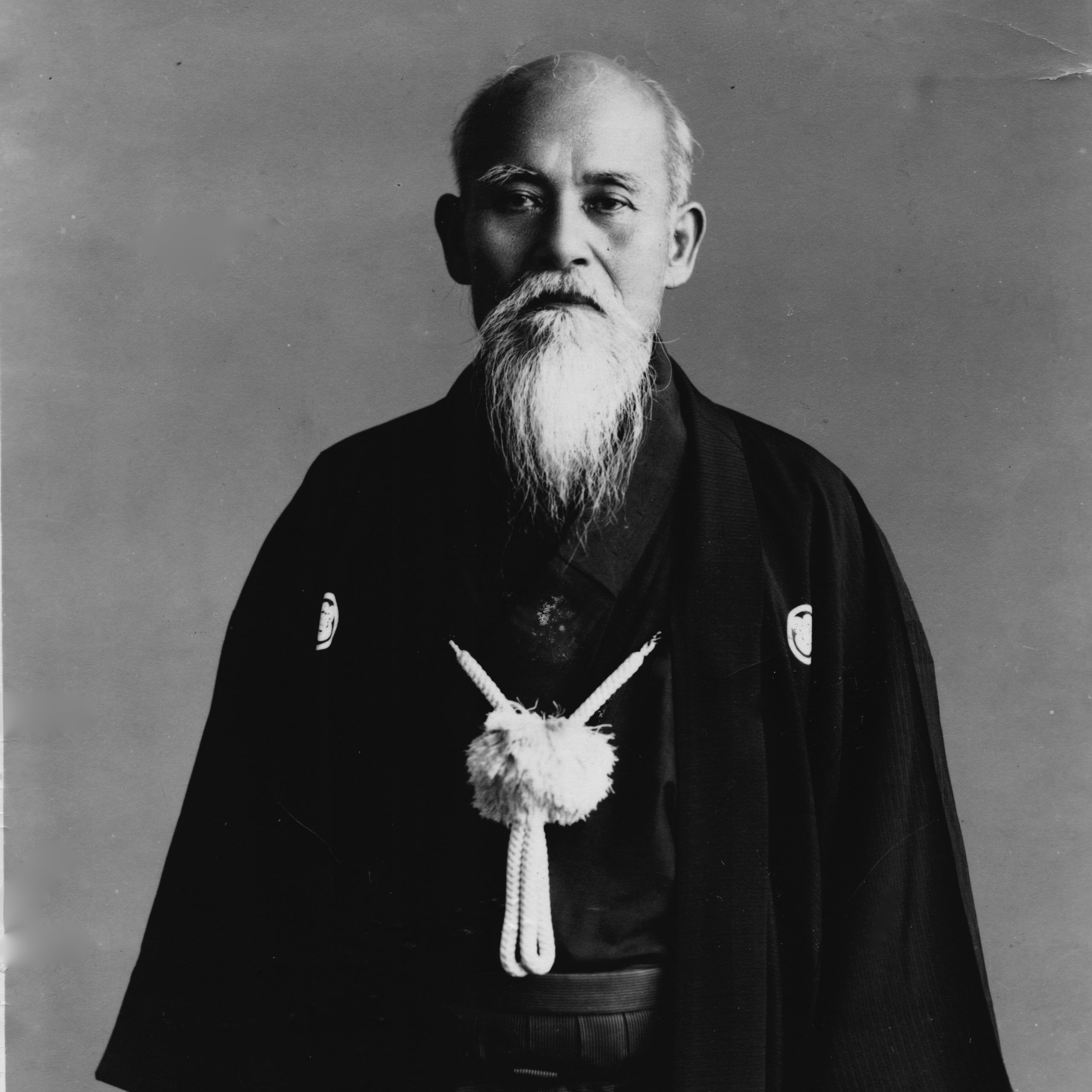
Unlike the brutal sempais described in the pajama book, the founder of aikido himself obviously had a sense of humor, judging from the old movies where you see him playing a lighthearted “cat-and-mouse” game with his ukes.
A judo friend of mine experienced this at first hand in the early 60s when he was invited by O-Sensei to attack him “any way he liked.”
Realizing he would probably be recognized as a judoka (the cauliflower ears were a giveaway) he decided to use the element of surprise, and to attack with a karate kick — but he never saw or felt what happened! He just flew through the air and landed with a thud. When he got up, slightly dazed, O-Sensei had apparently vanished! He turned this way and that, but could not see him — for the simple reason that the old man had sneaked in behind him and was turning around with him, in perfect sync, much to the amusement of the onlookers. It was only when my friend received a tap on the shoulder that he realized the joke was on him.
If that’s isn’t a sense of humor, at the highest level of aikido, I’d like to know what is.
And yet there are some dojos in which training is taken so seriously that laughing could get you expelled — while in others you are encouraged to smile and relax at all times, the better to “extend ki.”
Humor is a useful tool for exposing some of the “sacred cows” of aikido for what they are, and for pricking some of those inflated egos that are all too common in the dojos of the world. Sometimes, too, there is nothing else for it but to laugh when we encounter, on our aikido journey, something, or someone, totally frustrating and abstruse.
I have no doubt O-Sensei could also be deadly serious, but, to me, it is the mark of a true master to be able to issue such an open-ended challenge and then treat the attack so lightly. Clowning around in that way could be fatal to lesser mortals like us. Nevertheless, I feel there is a great need to lighten up a little in our training, and I am convinced nothing is lost, in terms of “martial effectiveness,” in so doing. (Why are some people so intent on proving, “my sankyo is stronger than your sankyo?” It makes no sense to me.)
Laughter is a universal language, but jokes are extremely difficult to translate from one language to another. I was once called upon to interpret for a government minister who suddenly departed from his speech and cracked a joke. I knew that by the time I had translated it into Japanese the joke would have assumed the consistency of a lead balloon; so I said, “I’m sorry, but the Honorable Minister has just made a rather pathetic joke which is scarcely worth translating, I would appreciate it if you would laugh.” The audience roared!
Laughter can be a spark that bridges the culture gap and reminds us of our common humanity. If some senseis fail to appreciate this, some of their students, unfortunately, carry their rigid attitudes to the extreme. When I first joined the Ki no Kenkyu Kai, I wrote enthusiastically of my impressions to an aikido colleague in the U.S., only to receive a ferocious reply telling me that if I ever mentioned “ki” again it would be impossible for him to continue corresponding with me! He belonged to one of those “no-nonsense” dojos — poor sap.
To ki or not to ki, to smile or not to smile, to grovel or not to grovel? These are just some of the challenges facing us non-Japanese aikidoka, as we tackle an art that originated in a culture very different from our own and that is peopled with personalities ranging from the perfectly pleasant to the plainly paranoid.
Some cross-cultural situations provide rich comedy material, and I had a taste of this myself once when a well-meaning friend gave an impromptu speech at one of our dojo functions. He rose to his feet and said my students were lucky to have a teacher who was a “shodan” in, not one, but several different styles of aikido. Obviously, he knew that “shodan” meant “black-belt” (which already put him ahead of the game in terms of cross-cultural savvy) but he did not know he was speaking of the lowest rung of the ladder.
And yet there are some dojos in which training is taken so seriously that laughing could get you expelled — while in others you are encouraged to smile and relax at all times, the better to “extend ki.”
You may picture a red-faced Lynch clawing the air in dismay, as one of the few people in the room to spot this faux pas, yet unable to correct it! The story illustrates the sort of comic scenario than can arise when you transfer something as Japanese as the aikido hierarchy to another culture, where the mention of “6th-dan” may well be treated, not with endless groveling, but with complete indifference. Although based on ignorance this reaction can be a useful leveler, and a reminder not to take ourselves too seriously.
Aikido instructors (of whatever rank, race, or stature) do not have a monopoly on respect, and a white belt is just as worthy of this as a shihan.
There was the high-ranking sensei who marched into a private dojo in the U.K. and announced he was “in charge” by reason of superior rank. Imagine his chagrin when he was told, “No you’re not, this is not your dojo, you can bugger off!” This little cross-cultural contretemps couldn’t have happened to a better person, given the reputation for sheer arrogance of the sensei in question. We all know of Napoleons of Nikyo and Hitlers of Hijishime who try to convince the world of their importance by dishing out pain and suffering to their cooperating ukes. This is such an obvious breach of trust, they deserve to be dismissed with a laugh, though I appreciate that this may not be the most practical option if you are the uke.
A regular source of amusement can be found by reading between the lines of some of the stories about O-Sensei that are published as the gospel truth.
Like the one about the time he invited his students to attack him with various weapons, only to vanish from their midst, like a “stream of air,” and reappear half way up the stairs 20 feet away. When asked for further demonstrations of this extraordinary routine he said, “Are you trying to kill me? Each time one performs such techniques his life-span is reduced by ten years.”
The skeptic with an eye for the ridiculous might ask how he knew this? How would anyone arrive at this figure?
If O-Sensei had practiced this move less often, we could ask him ourselves. Assuming he had done it half a dozen times, which might be the minimum to master such a difficult feat, he would have sacrificed 60 years of his life; whereas, if he had only done it once, he would have lived to the ripe old age of 136! This would give us the opportunity to ask him about these mysteries, and sort out a few other controversial matters, any time up until the Year 2019, when he would finally pass away.
Even so, ten years of one’s life seems a ludicrously high price to pay just to show off to one’s students.
I suppose the “life-shortening waza of Morihei Ueshiba” will no doubt remain a mystery, just like the incredible shrinking bonsai trees that defy nature by growing downwards!
To ki or not to ki, to smile or not to smile, to grovel or not to grovel? These are just some of the challenges facing us non-Japanese aikidoka, as we tackle an art that originated in a culture very different from our own and that is peopled with personalities ranging from the perfectly pleasant to the plainly paranoid.
Moving from the ridiculous to the sublime, I want share with you my dream for the creation of the “bush dojo” mentioned above.
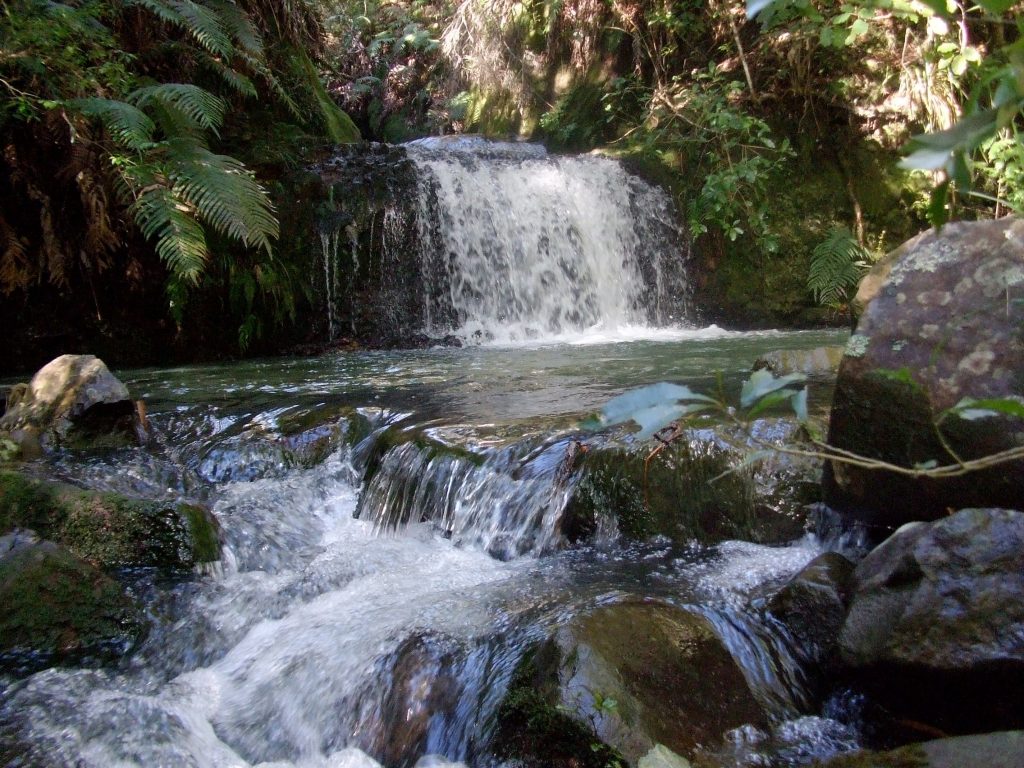
The idea is for a retreat where aikidoka from anywhere in the world (and from any ‘style’ of the art) would be able to practice in idyllic surroundings, far from the maddening crowds, under the “Blue Dome of Nature,” as it were. A place where they can breathe our unpolluted air, bathe in our crystal-clear stream, sit under one of our waterfalls, meditate beside our 200-year-old kauri tree, or visit any of the numerous deserted beaches that surround us. It might not be an absolute “Heaven of Earth,” but it could be the next best thing.
It is a bit presumptuous raving on about something that is still on the drawing board, but I have a feeling there are many aikidoka out there who have “dojo dreams” like I do. Our unspoiled natural surroundings here only serve to stimulate this tendency, and I beg the reader’s indulgence.
We are thinking of geodesic dome construction, and we have cleared a site, surrounded by bush, with a hill behind and a river in front, in compliance with the principles of feng-shui, or if you prefer, hogaku, the ancient Japanese “Science of Direction.”
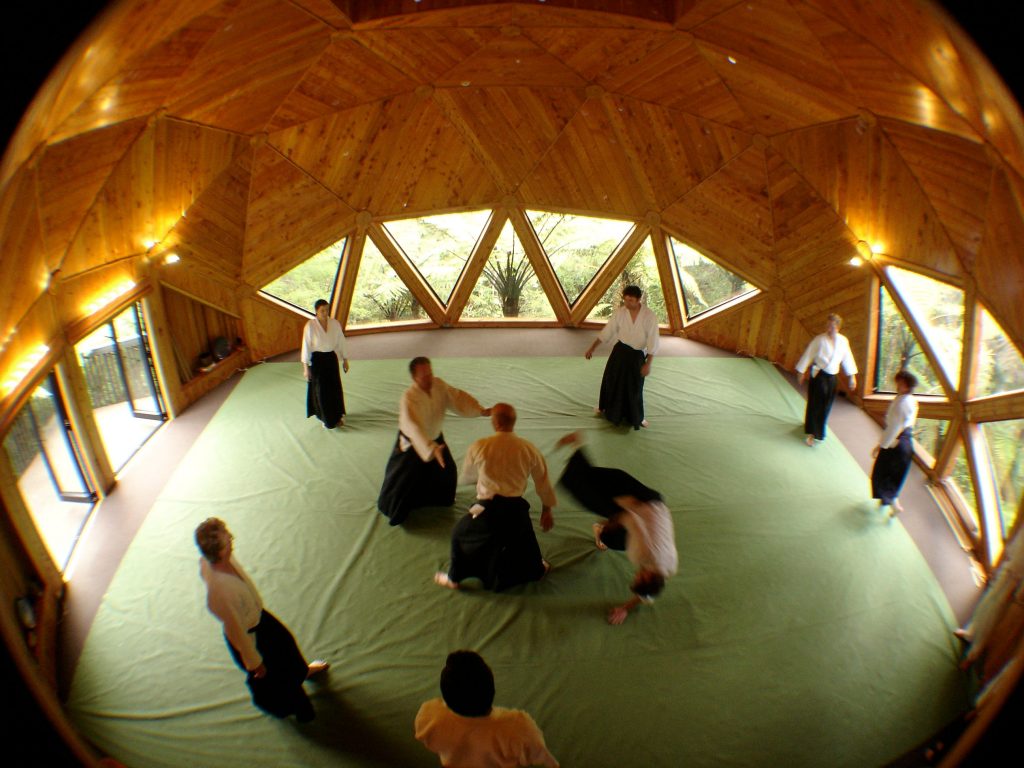
The advantage of a wooden dome is that it can be erected without having to use a crane, which would be difficult to bring onto the site without destroying the bush. But this construction method has other interesting features too. The dome is made up of “triangles”, the base perimeter is a “circle,” and this will house a “square” mat area. In other words, the “dome-jo” would incorporate all three of O-Sensei’s esoteric aikido symbols. Call me superstitious if you like, but I believe the “Aiki Dome” would have a unique atmosphere which would draw enthusiasts from far and wide and create a little “Center of the Universe” right here.
If this concept fails, we may just have to establish a “domesday cult” instead. I jest, of course, but the vision of hundreds of bald-headed believers leaving all their worldly wealth with me for safe keeping, before they file into the Dome, does have a perverse appeal. I can see myself droning, “’Dome’ arigato gozaimasu,” as they unload their valuables and cash.
But perhaps I am suffering from delusions of grandeur, as a result of having too much time to think, and to dream. Perhaps I will come to my senses one day and face up to reality.
Meanwhile, the dream, though vivid, is behind schedule, as we have failed to sell a block of land which was supposed to finance it — so if there is anyone out there looking for an 18-acre chunk of paradise, let’s hear from you.
I am confident we will make it one of these days, and we just have to be patient in the meantime.
After all, “Dome wasn’t built in a day.”





Appreciate the humour and the good intentions! Thank you and good luck with this wonderful idea of an aiki dome .