
 Josh Gold
“At the Center of the Rift between Morihei and Sokaku Takeda”
This is the first of a series of screencasts titled “Focus on History” by Aikido Journal Editor Stanley Pranin. This video provides detailed information on the “kyoju dairi,” or teaching certification, awarded to Morihei Ueshiba by Sokaku Takeda in Ayabe in 1922. This award was made during a six-month long visit of Sokaku to Morihei’s “Ueshiba Juku” located near the headquarters of the Omoto religion.
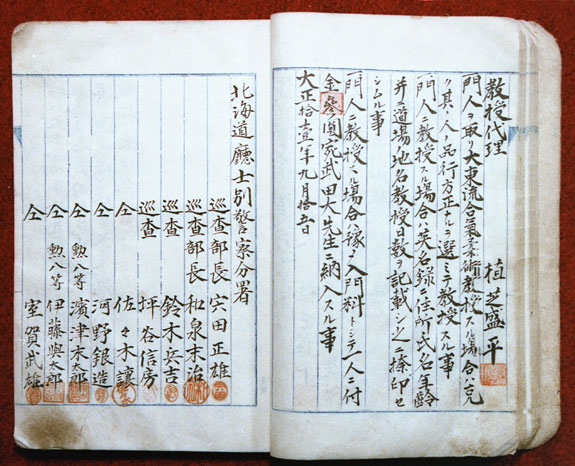
The actual photo of the kyoju dairi entry in Sokaku Takeda’s eimeiroku (enrollment book) is shown and explained. The nature of the conditions imposed on Morihei as a certified Daito-ryu instructor, and the vagueness of the financial arrangement specified was a major cause of the eventual split between the two men dramatically altering the course of aikido history.
video/focus-on-history-episode00001-moriheis-kyoju-dairi-handbrake.mp4,640,480,false,false






Nice presentation Stan.
Some questions regarding the three yen fee and licences.
Was this payment required from other kyoju dairi holders and was it the same amount? Is there any fee associated with the menkyo kaiden?
And where does this fall in the order of kyoju dairi licences? Was it the first, an early one, or in no interesting position?
Thank you.
The 3 yen amount was consistent in the kyoju dairi certifications. I’m sure there was a fee paid with respect to the menkyo kaiden but I am guessing it was left up to the recipient. There were only two given, both in 1939.
For more on this subject, please check this link: http://members.aikidojournal.com/encyclopedia/kyoju-dairi/
Very interesting. Thank you for sharing it!
I had understood that Sokaku Takeda was illiterate. If so, is it known who wrote this document and how well Sokaku Takeda understood the terms at the time?
Sokaku was illiterate in the sense that he could not write. We do have reports that he would “read” the newspaper. Remember that newspapers in those days used furigana (phonetic characters) alongside kanji in many printed texts. Illiterate or undereducated people could thus get the gist of simple texts. Many people wrote for Sokaku, a few are known, most not. He certainly did understand the financial implications of what was specified in the kyoju dairi conditions.
You imply that the motivation for changing the name to “Aiki-jujutsu Daito Ryu” could have had religious motivations because it occurred when Sokaku Takeda at Omoto-kyo headquarters. I have also heard that the principle of aiki has a longer history in martial arts to describe a strategy using awase. Was “aiki” used in other contexts in Omoto-kyo?
Thank you for presenting this information.
Actually, there was no implication of a religious motivation in what I was explaining. It may be that there was a desire to soften the tone of the art’s name by including the term “Aiki” which is an old term rich in meaning depending on the context. This is a point that is unclear historically, and there is no hard evidence or consensus on what actually happened.
Dear Stanley,
Wow. I really enjoyed your first screencast, and of course I’ll tell everybody I know about it.
My Gibeaut
Hi Stan,
Thanks for this great presentation.
It illustrates well the point made on aikiweb.
Hope to see another focus on history soon.
frederic
Thank you very much, Stan!
I have a question regarding Sokaku Takeda and religion. Didn’t Takeda learnt the Oshiki-uchi from Tanomo Saigo, a priest? Was there a change in his way to consider religion?
Thank you.
Sokaku’s older brother was a priest who died at a young age. Sokichi Takeda, Sokaku’s father, tried to me Sokaku succeed him and he actually went to live in a temple for a short while. However, Sokaku soon rebelled and left to pursue is martial studies. He is known to have disliked religion and Sokaku and Onisaburo disliked each other as well.
Hey Stan great article. Who was the other person the receive the teaching certificate at the time O sensei got his?
I’m pretty sure the other person to receive the kyoju dairi when Sokaku Takeda stayed in Ayabe in 1922 with Morihei was Vice-admiral Seikyo Asano. I’ll have to double check it. You can read up on him elsewhere on this website.
This is a wonderful presentation. I wonder would it be possible to get a screen cast of the buki waza mokuroku that Saito Sensei used to hand write? I’ve always been curious as to the contents of them.
Dear Stan,
Thank you for a superb presentation as always. Thank you also for your on going pursuit of the truth behind Aikido history and its roots in ju jitsu the more we learn about O’sensei the more we realise what an incredible human being he was and how lucky we are to have his legacy.
Thank you, Stan, for sharing this very interesting document. Nevertheless, what is not so clear with the 2 pages from “Eimei-roku” according to you, is the context or intention for Sokaku TAKEDA to write them down (or, more precisely, to have them written down). Whom was the right hand page intended to ? To Morihei UESHIBA ? If so, are they the instructions that Sokaku gave to Morihei, his Deputy Professor, who accepted the content on appending his seal ? Rather, were they merely Sokaku’s personal records in teaching management ? Does the previous page, not presented here, allow us to know better the context, an important element ?