
 Josh Gold
One of man’s greatest satisfactions is the sense of having achieved a measure of immortality. Parents leave this world feeling comfort in the fact they have transmitted their wisdom and the essence of their lives’ experiences to their children. A writer does the same through his works knowing—or at least hoping— that somewhere, somehow, some unknown person will be touched by his words and enriched by the encounter. A painter aims to cast aside the veil of time revealing his artistic message through images on canvas.
What is the headmaster of a classical martial school to do to fulfill with honor his role as the keeper of a tradition and ensure the survival intact of his art? This is the dilemma faced by the heads of the few remaining classical martial art schools in Japan today. It is not a new problem as these historical ryuha have been in decline since well before the Meiji Restoration (1868) when the death knell was sounded with finality for the samurai caste.
For the most part, these historical curiosities have not fared well as most of them have disappeared all together or survived in a state of ossification. Those schools still in existence have survived in many cases by piggy-backing on the success of modern budo such as judo, kendo, aikido, iaido, naginata and a few others, most of which now have a sporting component. Even this tenuous situation is no guarantee of long-term survival as is illustrated by the examples of Tenshin Shinyo-ryu jujutsu and Kito-ryu jujutsu—the arts that form the historical basis of judo—which today totter on the brink of extinction despite the international success of judo.
As I see it, the real challenge for Daito-ryu is the preservation and dissemination of the art without a further dilution of its technical heritage. Since none of these groups is large in size compared to the bigger aikido organizations, a great deal of effort will be necessary to insure their continuance well into the next century.
The status of Daito-ryu Aikijujutsu—the technical precursor to aikido—represents a somewhat special case. The claim that Daito-ryu is a classical martial art actually is quite open to debate. My personal research has led me to believe that it is really a hybrid art based on the extensive personal training of Sokaku Takeda in the late 19th century. Setting aside that issue, what will the future hold for this art which was the source for most of the techniques of modern aikido? Certainly there is no immediate danger of the disappearance of Daito-ryu as is the case with the majority of the still surviving classical schools. The continued growth of aikido as a worldwide phenomenon has guaranteed a constant stream of interest in this precursor art.
Sokaku Takeda, of course, taught on a wide-scale for about half a century. On the other hand, his son Tokimune, although highly skilled, did not pursue Daito-ryu on a professional basis and the main locus of his activities was Hokkaido. This being the case, Tokimune’s ability to transmit his technical knowledge was severely limited. Even before Tokimune’s death in 1993, the mainstream school of the Daito-ryu he headed began to fragment. Today there are two pretenders to the title of headmaster, each self-appointed.
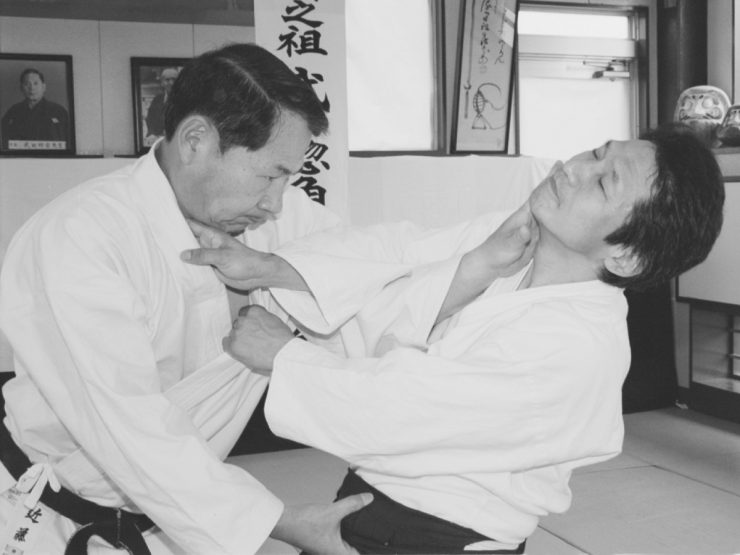
Daito-ryu’s most widely-recognized figure who has now assumed the position of Hombu Dojo-cho is Tokyo-based Katsuyuki Kondo Sensei, one of Tokimune’s most talented senior students. Kondo Sensei was the only person to have received the menkyo kaiden from Tokimune. I personally have seen his scrolls and certification that bear the headmaster’s seal. In addition to Kondo’s organization, there are several splinter groups that have broken off from the mainstream tradition and built up modest followings.
Three other large groups representing different Daito-ryu traditions are the Osaka-based Takumakai headed by Hakaru Mori Sensei and Takeshi Kawabe Sensei, the Kodokai headquartered in Kitami, Hokkaido led by Yusuke Inoue Sensei, and the Roppokai, an offshoot of the Kodokai, started by Seigo Okamoto Sensei.
I believe the single most important effort to be undertaken by these groups will be the development of a strong core of teachers. What are the ingredients necessary to attract the future generation of instructors? I would say that the creation of dynamic dojo filled with enthusiastic students from Japan and abroad is essential. Such dojo would feature frequent practice sessions as well as outside training and activities designed to develop an esprit de corps. The publication of videotapes and technical manuals to record and disseminate the school’s curriculum will go a long way toward preserving the technical integrity of the system.
As I see it, the real challenge for Daito-ryu is the preservation and dissemination of the art without a further dilution of its technical heritage. Since none of these groups is large in size compared to the bigger aikido organizations, a great deal of effort will be necessary to insure their continuance well into the next century.
How can this best be achieved? There are various schools of thought on this subject, but before I broach this I would like to point out several important points. We must keep in mind that the samurai caste were in effect members of private armies of regional lords. They enjoyed high social status and their livelihood was taken care of by their masters to whom they were subservient. The warrior class had a primordial role in maintaining the socio-political order in a feudal society.
In the Japan of today, the samurai, his noble tradition and military skills are mere relics of a distant past distorted in popular literature, movies and television. By contrast, the would-be martial artist of today is more likely interested in getting a bit of exercise or learning some self-defense. Most enrollees will train infrequently and discontinue practice after a short time.
The obvious fact is that we are looking at two entirely different sets of social conditions. Today’s martial artists, even serious ones, cannot be like the bushi of the past. There are no wartime conditions involving close-quarters combat using what can now only be considered technologically-primitive weapons. Today’s warrior is more likely to be seated in a chair in front of a computer screen or operating a piece of machinery than on foot in a battlefield.
Although some classical schools assert that they are practicing techniques unchanged for hundreds of years, only the naive would believe that the integrity of their curricula has been preserved unaltered during all that time. It is easy to see this using the relatively modern example of Daito-ryu Aikijujutsu. Sokaku Takeda taught only a fraction of what he knew tailoring his instruction to match the tenor of the times. He mostly taught jujutsu in a private-seminar format and spent much of his time traveling about. The inescapable fact is that there has already been a significant dilution in the technical content of Daito-ryu in the 57 years since Sokaku’s passing.
The other factor essential to the health of the older schools will be the creation of organizations. Although I have been and still am critical of many aspects of martial arts governing bodies, I must admit they do serve some important functions necessary for success on a large scale. Surely, bureaucracies will develop and a tendency towards centralization of power will occur over time. I don’t see any escape from this.
The most we can hope for is to document to the maximum extent possible information about his life and teachings. The richest sources of this body of knowledge were his son Tokimune, Yukiyoshi Sagawa, Kodo Horikawa, and Takuma Hisa. Now they are all gone. The only one of these teachers to leave a book was Hisa and its contents are kept within the inner circles of the Takumakai. In this case, the secretive nature of these arts works counter to their chances for survival in these inhospitable times.
I believe the single most important effort to be undertaken by these groups will be the development of a strong core of teachers. What are the ingredients necessary to attract the future generation of instructors? I would say that the creation of dynamic dojo filled with enthusiastic students from Japan and abroad is essential. Such dojo would feature frequent practice sessions as well as outside training and activities designed to develop an esprit de corps. The publication of videotapes and technical manuals to record and disseminate the school’s curriculum will go a long way toward preserving the technical integrity of the system.
Moreover, it is desirable that the principle teachers travel abroad with some regularity. The reason I say this is that it is my firm belief—along with that of none other than Morihiro Saito Sensei, I might add—that the future of Japanese martial arts lies abroad. This is because modern-day Japanese are not, except in rare cases, able to devote the time and energy required to attain high skill levels. Besides this, professional martial artists in Japan do not enjoy a high social status and, in fact, carry a stigma left over from the attitudes surrounding the nation’s defeat in World War II.
The situation in foreign countries is very different. It is quite possible for a young person to take several years off to travel to Japan or devote himself to intense training as a live-in student in his own country. The opportunities to become a professional are plentiful. The image of oriental martial arts has been glamorized in the mass media and carries with it an exotic aura. In such a context, with a bit of business sense, it is certainly possible to succeed as a professional dojo operator. It is these full-time professional dojo that offer classes several times a day, most every day of the week that are turning out the best students. It only makes good sense that this should be the case.
The other factor essential to the health of the older schools will be the creation of organizations. Although I have been and still am critical of many aspects of martial arts governing bodies, I must admit they do serve some important functions necessary for success on a large scale. Surely, bureaucracies will develop and a tendency towards centralization of power will occur over time. I don’t see any escape from this.
There are those who will immediately criticize this suggestion that the best way to preserve the old martial schools is through their growth and popularization. They are of the belief that such an attitude is doomed to “cheapen” the art. They will talk about the need to keep the dojo small and turn out “a few good students.” I’ve heard it all before. One has only to look at the history of these systems which once existed by the hundreds all over Japan. Show me a school that has adopted this approach and I’ll show you a school which no longer exists or which is rapidly on its way to extinction!






Add comment