
 Josh Gold
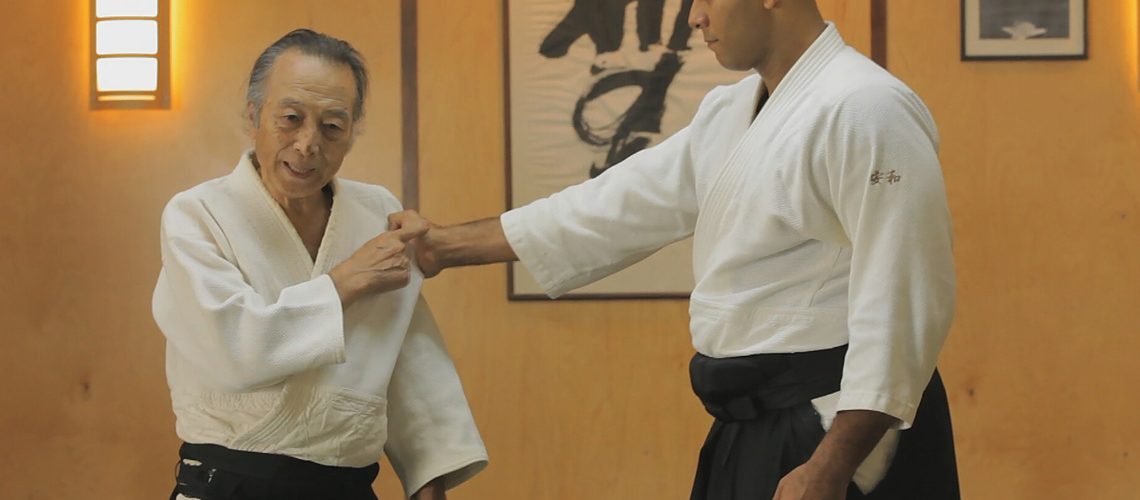
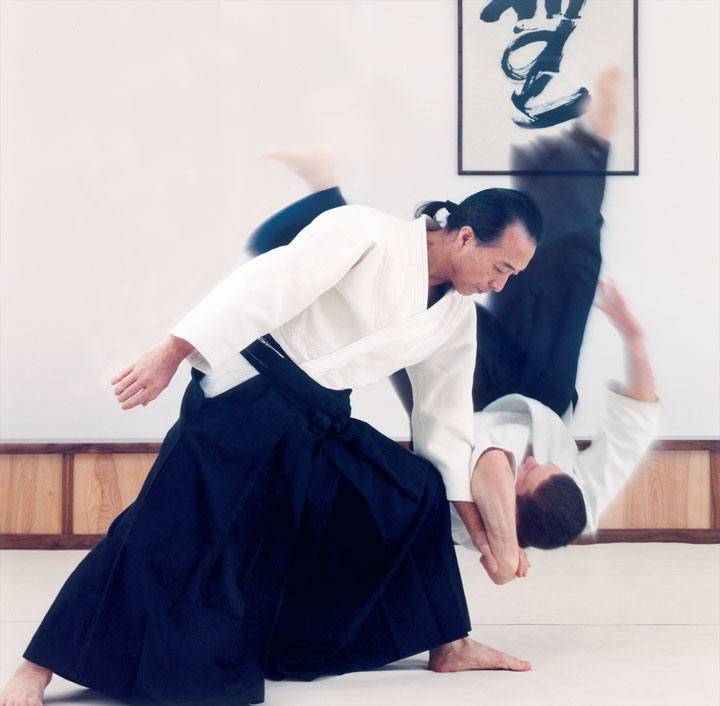
Shizuo Imaizumi was among the last generation of students of the Founder Morihei Ueshiba at the Aikikai Hombu Dojo on the 1960s. He later joined Koichi Tohei as a senior instructor for the Ki Society when the latter resigned from the Aikikai. Imaizumi relocated to New York City where he has taught for some 25 years. He is now chief instructor of the Shin Budo Kai, an independent organization he founded. This is the first part of a two-part interview; read part two here.
Editor: Sensei, many Japanese who began aikido in the early days did so after first practicing some other martial art such as judo or kendo. What were the circumstances of you beginning aikido?
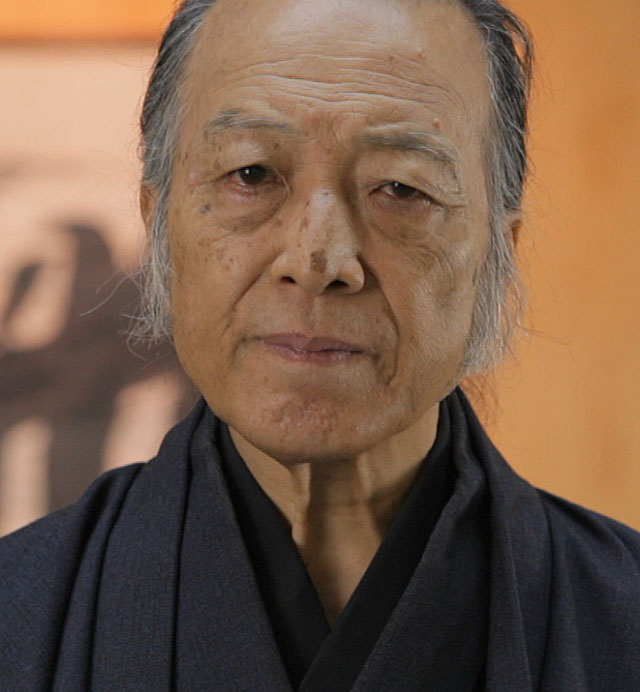
Imaizumi: I mainly played baseball as a boy. I was born in Tokyo on December 13, 1938 and started playing baseball at the age of seven after World War II ended. Around 1951, I enrolled in the Kodokan on the introduction of my sixth-dan uncle, Eiji Yoshida, who was one of the coaches of the Nippon University Judo Club at that time.
Where was the Kodokan located in those days and what was the atmosphere like?
The Kodokan was located in a building situated on a corner in front of Suidobashi station on the Sobu Line. After my elder brother and I signed up, my uncle guided us to the men’s locker room. Then we entered a large dojo. I was surprised by the enormous size of the dojo because I had only seen a small local dojo before. Anyway, my uncle taught us falling and several basic judo techniques for about an hour. My uncle said that we would have to ask someone in the dojo about judo techniques at our next practice session there. The atmosphere was relatively quiet because the dojo was not very crowded.
How long did you practice judo at the Kodokan?
At that time I was living in Aoto in Katsushika, Tokyo and attending junior high school at the Hinode Gakuen located in Ichikawa, Chiba. It was quite inconvenient practicing judo at the Kodokan so my brother stopped training within a month. I continued practicing judo for about six months although I didn’t go there every day.
When did you start aikido training?
In April 1957, I enrolled in Waseda University where I majored in commercial science. As a freshman, I took judo as a required subject for physical education. There were several judo instructors at Waseda University. My instructor’s name was Yamamoto Sensei. When I became a junior in April 1959, I took another required subject as physical education. I chose judo taiso (exercises) taught by Kenji Tomiki Sensei. I bought his textbook with the same title, Judo Taiso. It was then that I heard of aikido for the first time. Soon, I learned where the Aikikai Hombu Dojo was located. It was only about a 15-minute walk from Waseda University to the dojo. On May 2, 1959 I enrolled at the Hombu.
What teachers at the Hombu Dojo most influenced you during your early days?
I mainly practiced in the 3:00 to 4:00 pm class. Then I would remain in the dojo for free practice with the other students until the start of the the 5:00 pm class. Occasionally, I would attend the second class, too. As I recall I studied under Hiroshi Tada Sensei and Nobuyoshi Tamura Sensei more often than the other instructors. I also learned from Kisshomaru Ueshiba Sensei, Koichi Tohei Sensei, and Kisaburo Osawa Sensei in the regular classes. Morihiro Saito Sensei used to come from Iwama to Tokyo on Sundays. I remember attending his morning class in the summer time.
There were several young uchideshi in those days…
Those I remember are Masamichi Noro, Yasuo Kobayashi, Yoshimitsu Yamada, Seiichi Sugano, Mitsugi Saotome, Kazuo Chiba, Mitsunari Kanai, and Yutaka Kurita. They would all practice in the afternoon classes. As I didn’t attend the morning classes in those days I don’t know the names of the other uchideshi.
When did you first see the founder Morihei Ueshiba?
One afternoon in May 1959 I had the opportunity to watch an aikido demonstration by O-Sensei at the Hombu Dojo during an afternoon class I was attending. In those days the dojo was in an old wooden building that connected to the private house of the Ueshiba family through a corridor. O-Sensei often appeared in front of us from his home.
I believe you were one of the founders of the Waseda University Aikido Club. Would you please describe how it was that the club was established?
 There were several Waseda students who were practicing aikido at Hombu Dojo. In the spring of 1960, Akira Kuwamori, Tsuyoshi Takahashi, Tadaharu Wakabayashi, Kin’ichi Iwasaki and I decided to set up the Waseda University Aikido Dokokai on behalf of the Aikikai separate from the Tomiki-style group at Waseda. We consulted with Kisshomaru Ueshiba Sensei who was a Waseda graduate. Then we asked Hiroshi Tada Sensei, another Waseda graduate, to become our regular instructor. At that time, the Keio University Aikido Association already existed under the guidance of Koichi Tohei Sensei who graduated from that university.
Where there any particular books on aikido you read at that time?
When I started at the Hombu I bought Kisshomaru Ueshiba Sensei’s first book titled Aikido published in August 1957 by the Kowado publishing company in Tokyo. There, for the first time, I could read about aikido history. In September 1959, Tohei Sensei, then 8th dan and the chief instructor of the Hombu Dojo wrote his first book Shashin Kaisetsu Aikido (Aikido Through Photos) published by Toto Shobo in Tokyo. Master Tempu Nakamura, president of the Tempukai, wrote a wonderful preface for his sincere disciple. I bought the book when it was displayed in the book case at Hombu. Through this book I could study more fundamental subjects including ki principles, aiki exercises for the coordination of mind and body, as well as fifty aikido techniques. This book influenced my mental attitude toward aikido practice.
Are there any episodes you recall from those days?
On May 14, 1960 a public demonstration was held in Yamano Hall in Yoyogi. I went to watch the demonstration and felt I would like to practice aikido much harder. In August of that year, Koichi Tohei Sensei was promoted to 9th dan. I remember that I attended the celebration of his promotion as one of the assistants at the reception desk. Then on February 28, 1961 I went to Haneda Airport to send off O-Sensei who was about to leave for Honolulu. This trip turned out to be the first and only one O-Sensei made to the United States. Many people came to see him off. Nobuyoshi Tamura Sensei accompanied the founder. Koichi Tohei Sensei had already left Japan for Honolulu in preparation for O-Sensei’s trip.
As I recall I studied under Hiroshi Tada Sensei and Nobuyoshi Tamura Sensei more often than the other instructors. I also learned from Kisshomaru Ueshiba Sensei, Koichi Tohei Sensei, and Kisaburo Osawa Sensei in the regular classes.
In March 1961 I took part in the first spring training camp of the Waseda Aikido Club. We stayed at the Kumano Juku Dojo in Shingu, Wakayama Prefecture owned by Michio Hikitsuchi Sensei for about a week. Although we attended Hikitsuchi Sensei’s regular classes every day, Tada Sensei taught us during the day. I graduated from Waseda at the end of March. After that, in April, I got a job at Kobe Steelworks, Ltd. and moved to Kobe immediately.
Did you continue practicing aikido in Kobe?
Yes, I joined the Kobe branch dojo of the Aikikai. We met two days a week at the judo dojo of the Sannomiya Police Station on Wednesdays and Saturdays. On Sundays we used the kendo dojo owned by Kazuo Yamahata, the director of the Kobe dojo, which was located next to his house in Ishucho, Kyogoku in Kobe. Mr. Yamahata had gradually become involved in teaching aikido to the students coming to practice there because there was no professional aikido instructor at the Kobe Dojo.
Did anyone from the Hombu Dojo come to teach at the Kobe Branch?
I was in Kobe from April 1961 to December 1964 and Tada Sensei visited Kobe and taught us on two or three occasions. Kisshomaru Ueshiba Sensei also came to Kobe. The highlight was an unexpected visit of O-Sensei to my class at the Sannomiya Police Station one Saturday afternoon. Do you know a Mr. Bucchi? He was the president of Alcan Asia Co. and a student of Hirokazu Kobayashi Sensei at the Osaka Branch dojo. I think Mr. Bucci invited O-Sensei and Kobayashi Sensei to Kobe on that occasion. After the special session by O-Sensei, I was invited to Mr. Bucchi’s house where a party was held for the founder. Mr. Bucchi was living in a scenic spot just above my company dormitory. After partaking of the cocktails and buffet there, I walked down the steep slope to my dormitory in about five minutes.
When did you become an instructor at the Aikikai Hombu Dojo?
In November 1964, I learned that Tada Sensei had left for Italy to spread aikido there. I also found out that Nobuyoshi Tamura Sensei had started to publish the Aikido newspaper in 1964. After he left for France, Norihiko Ichihashi Sensei and Iwao Tamura Sensei took over the publication of the Aikido newspaper. Soon, I joined them and we worked together. By the way, Ichihashi Sensei was teaching US servicemen at the aikido club at Camp Zama while Tamura Sensei taught at the Asaka Camp. I took over teaching for Sugano Sensei at the Tachikawa Air Force base in April 1965. All three of them could speak English. You are familiar with the Japanese system of teaching English. Besides studying English in junior and senior high schools and then at the university, I joined the Business English Association, one of the clubs at Waseda University. I studied typing, writing and speaking there.
Are there any recollections that particularly stand out in your mind from those days?
Let’s see. Kenji Shimizu Sensei and myself were the only instructors to attend the 6:30 to 7:30 class at the Hombu at that time. I got up at 4:30 am at my parents’ house in Aoto in Katsushika and went to the Hombu Dojo every day except Sunday. I did this for about a year and a half until I rented an apartment in Yochomachi, Shinjuku near the Hombu Dojo. When O-Sensei was in Tokyo, he used to appear at the first class. Kisshomaru Ueshiba or “Wakasensei” as we called him, would immediately stop teaching and make the students sit in seiza. O-Sensei would bow to the shomen and turn toward us. After exchanging greetings with us, he would begin his own morning exercises while talking to us. I often helped him do his exercises. Then he would start showing techniques. After O-Sensei retreated to his home, Wakasensei would hastily teach the class as if trying to make up for lost time.
Would you tell us more about O-Sensei?
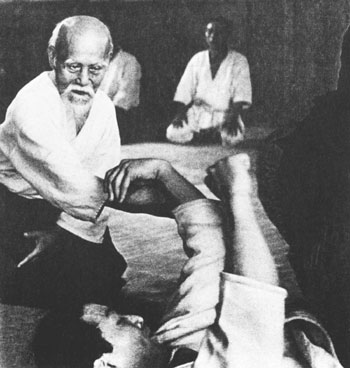
There was a small office next to the old Hombu Dojo. O-Sensei often came into the office through the dojo. I used to stay there after the morning classes until I rented an apartment room nearby in 1966. One day in spring 1965, O-Sensei came in and asked me to find something he liked in a newspaper. In those days, the office had a subscription to the Hochi Shimbun. I would read a novel serialized in this newspaper every day for O-Sensei in a loud voice. The title of this novel was Niwaka—Naniwa Yukyoden written by Ryotaro Shiba. It appeared from May 1965 to April 1966 and was published in July 1966 by Kodansha. O-Sensei loved the hero of this novel. His name was Mankichi Akashiya as a boy and then he became Sahei Kobayashi as a man. So when O-Sensei came into the office he would always ask me what had happened to Mankichi! He would laugh heartily at a particular interesting event in his life.
Did you ever accompany O-Sensei on any trips?
I served as his attendant (otomo) from 1965 to 1969. There are three kinds of attendants. The first assisted him at aikido demonstrations or special practice sessions. The second would accompany him on overnight trips to other prefectures. Finally, the third helped him in his private activities. Most of the instructors liked helping in the first case, but not the remaining two activities. I did all of them. I will skip over talking about the first category since many instructors have already described various episodes involving the founder at demonstrations or special sessions.
In August of that year, Koichi Tohei Sensei was promoted to 9th dan. I remember that I attended the celebration of his promotion as one of the assistants at the reception desk.
I took my first overnight trip with O-Sensei on a visit to a dojo in Yamaguchi Prefecture around 1965. O-Sensei and I left Tokyo for Osaka and stayed at Seiseki Abe Sensei’s home. As there was no bullet train in those days it took a long time to go from Osaka to Yamaguchi. On our arrival, O-Sensei visited the house of the late Aritoshi Murashige Sensei and reminisced with his widow. He demonstrated at the Yamaguchi dojo and we returned the way we had come
I went with him on another overnight trip about 1966. As you know, O-Sensei was a devout Omoto believer. One day, an invitation came from a certain Mr. Takano, a believer who lived in Kofu, Yamanashi Prefecture. We departed for Kofu and stayed at Mr. Takano’s home. His entire family was eager to hear from O-Sensei about the teachings of Onisaburo Deguchi, the spiritual leader of Omoto. The next day we held an aikido seminar at his home. It was rare for O-Sensei to teach aikido to the general public in a seminar setting. After that we were taken to Shosenkyo, one of Japan’s finest scenic spots, by Mr. Takano and his family.
On one other occasion I accompanied O-Sensei on an overnight trip that was especially important to him. I think it was about 1967. He had been invited to Kogakukan University located in Ise, Mie Prefecture. When we arrived at Ise we checked into a Japanese inn near the Ise Shrine. The next morning we prayed at the shrine and then went to the university gymnasium to demonstrate aikido. Professor Tsuji Sato, a famous philosopher who had long been acquainted with O-Sensei and Shigenobu Okumura Sensei, made a speech as the representative of the university. First, the students of the university club demonstrated. Then Okumura Sensei used me as uke and showed some basic aikido techniques. Finally, O-Sensei demonstrated aikido and weapons techniques using Okumura Sensei and me. On our way back to Tokyo, O-Sensei suddenly insisted we stop over at the Atsuta Shirine in Nagoya. We got off there and prayed before returning to Tokyo.
What was it like to serve him in his private life?
When O-Sensei would return to Iwama, someone had to accompany him. It was easy to do, but it took a long time because you had to go back and forth between Tokyo and Iwama. Kisshomaru Ueshiba usually didn’t ask an instructor to handle this. When I went to Iwama with O-Sensei for the first time, we went to Ueno Station by taxi and then took the Joban line up to Iwama. When we arrived at Iwama Station, O-Sensei started to walk fast because he knew his way back home. I had to run after him because I was carrying his bag and some souvenirs he had received.
As I mentioned before, he was a sincere Omoto devotee and would often visit the Tokyo branch of the Omoto religion. It was located near the Shinobazu Pond in Ueno, Tokyo. I visited there with O-Sensei several times. We would go by taxi from Hombu to the Omoto location. After he worshipped in the sanctuary, O-Sensei would make a donation at the office.
There were many interesting episodes…
Here is another one. There was a dentist whose name I have forgotten who, according to O-Sensei, was one of the best in Japan. He never charged at all for treating the founder. I used to accompany him to be treated by the dentist. We caught a taxi from the Hombu and went to his office in Itabashi. As you know, the roads in Tokyo are complicated and crowded and it took us a long time to reach there. We passed through Ikebukuro and went up onto the Kawagoe Highway and looked at the beautiful Kumano Shrine on the left side of the highway. O-Sensei clasped his hands in prayer toward the shrine from inside the taxi as we passed by. We finally got off the taxi near the dentist’s office. I should not be critical, but the dentist’s office was a very old building and I could not believe this was where his teeth were to be cared for. I went with him there several times until he completed his treatment.
One other time I saw O-Sensei’s naked figure. One day Saburo Sugiyama, a member of the the board of directors of the Aikikai, invited O-Sensei to try out a whirlpool bath at the clinic he owned in Nihonbashi. In those days, it was very rare for a person to have a whirlpool bath. As you know, they are very popular now. We took a taxi to the clinic from Hombu Dojo. When we arrived we were led up to the whirlpool room. I helped O-Sensei take off his clothes. He was dressed in nothing but a loincloth and entered the bath by himself. While I was waiting for him to return to the dressing room I watched him through the glass because I had to remain alert in my capacity as his assistant. It seemed to me that he was enjoying this new experience. When he came out, I began to prepare a bath towel for him to dry off. I was surprised at how thick his chest was. His breasts were hanging down like an old woman. Although he was in his eighties at that time, I could imagine that he had muscles of iron in his prime. If you doubt my story, you should look at the photograph of O-Sensei naked from the waist up on page 20 of Budo—Teachings of the Founder of Aikido by Morihei Ueshiba published in 1991 by Kodansha International, Tokyo.
How active a role did the founder play at the Hombu Dojo during your years there?
As Kisshomaru Ueshiba Sensei handled all daily matters both inside and outside the dojo, the role of O-Sensei seemed to me to be that of the symbol or spiritual figure of the Aikikai. He did whatever he wanted. His only concern was the future of aikido under the Ueshiba family as he was the kind of man who would follow the old ways. O-Sensei would often refer to the art as “Ueshiba-ke-no-aikido,” that is, Ueshiba family aikido. In the same way that the Shinkage-ryu or Itto-ryu sword schools belonged to the Yagyu and Ono family, O-Sensei believed that aikido should belong to the Ueshiba family as he himself was its founder. So O-Sensei believed that the Hombu Dojo should be controlled by the Ueshiba family. I think that Kisshomaru Ueshiba Sensei, as the founder’s son, and O-Sensei’s grandson Moriteru Ueshiba have firm control over the daily matters of the Aikikai in accordance with the wishes of the founder.
It is my understanding that you were close at the side of the founder during his final days. Would you describe your memories of those difficult moments?
In March 1969, O-Sensei physical condition took a sudden turn for the worse. Kisshomaru Ueshiba Sensei ordered the instructors to make a daily schedule of duties for taking care of O-Sensei at his bedside by staying up all night from around 10 pm to about 8 am while the daytime nurse was resting. All of us offered our available dates and filled in a large sheet of paper. I stayed up at O-Sensei’s bedside five times on March 26, April 4, April 9, April 16 and April 24. O-Sensei passed away at 5 am on April 26, 1969.
At about midnight on April 24, O-Sensei suddenly woke up and began to stand. I thought he was going to the bathroom. I helped him from the side. Then he suddenly started to raise his voice and said: “I must go to the Omoto right away. Get me dressed!” Since his voice was so loud, Kisshomaru Ueshiba Sensei, his wife Sakuko, and the nurse came into the corridor where we were standing together. I didn’t need to explain to them what was happening because everyone had heard O-Sensei’s loud voice. This may have been the last thing he uttered. Then we gently moved him back into his bed and he fell asleep again.
After the funeral services in Tokyo on May 2nd and Iwama on May 13, I believe you also went to Tanabe.
Yes, two more services still remained. One was to be held in Ayabe, Kyoto Prefecture where O-Sensei lived with his family for a time. The other was in Tanabe, Wakayama Prefecture where O-Sensei was born and the Ueshiba family plot existed. I was chosen to go along with Kisshomaru Ueshiba Sensei and his wife. This was literally my last trip as O-Sensei’s attendant. His bones contained in a square wooden box would be finally laid to rest in the cemetery of the Ueshiba family in Tanabe.
Let me describe these two occasions in detail. On May 15, 1969, the three of us left Tokyo Station for Kyoto on the 6:40 am Tokaido bullet train and we arrived in Kyoto at 9:30 am. A private chauffeured Mercedes-Benz met us there as several people gathered. They took us immediately to the Omoto headquarters in Ayabe. On our arrival, Naohi Deguchi, the eldest daughter of Onisaburo and his successor, received us in a private room. Then we were invited to a lunch service. After that, we went to the cemetery where O-Sensei’s mother and young sons were buried. A lock of O-Sensei’s hair was buried there. Later we left Ayabe for Kameoka where Onisaburo Deguchi was born. Finally, we reached the Royal Hotel in Osaka at 6 pm. Several instructors from the Osaka branch dojos were waiting for us and invited us to dinner.
On May 16 we left Tennoji Station for Tanabe on the 8 am express train and we reached Tanabe at 10:40 am. First, we went to the hosue where O-Sensei was born. Masatake Fujita Sensei had already arrived there from the Hombu Dojo to assist with the funeral service. That afternoon, we visited Kozanji temple where the Ueshiba family plot was to meet the Buddhist priest Sogabe who would conduct the service as the officiating priest. A vigil of the Ueshiba family was scheduled to be held that evening at O-Sensei’s house at 7 pm. The funeral was to be held the next day at 1 pm at the temple.
Finding a bit of spare time that evening before the vigil, I went to the beach near O-Sensei’s home. The founder’s father often took his son Morihei there and had him do sumo wrestling with the fishermen’s sons. The tide was gradually rising and I could see a beautiful sunset beyond description. Thinking that I might be tracing the same steps on the beach as O-Sensei when he was a small child, I returned to the house where he was born.
After the founder’s passing, did you note any significant changes at the Hombu Dojo?
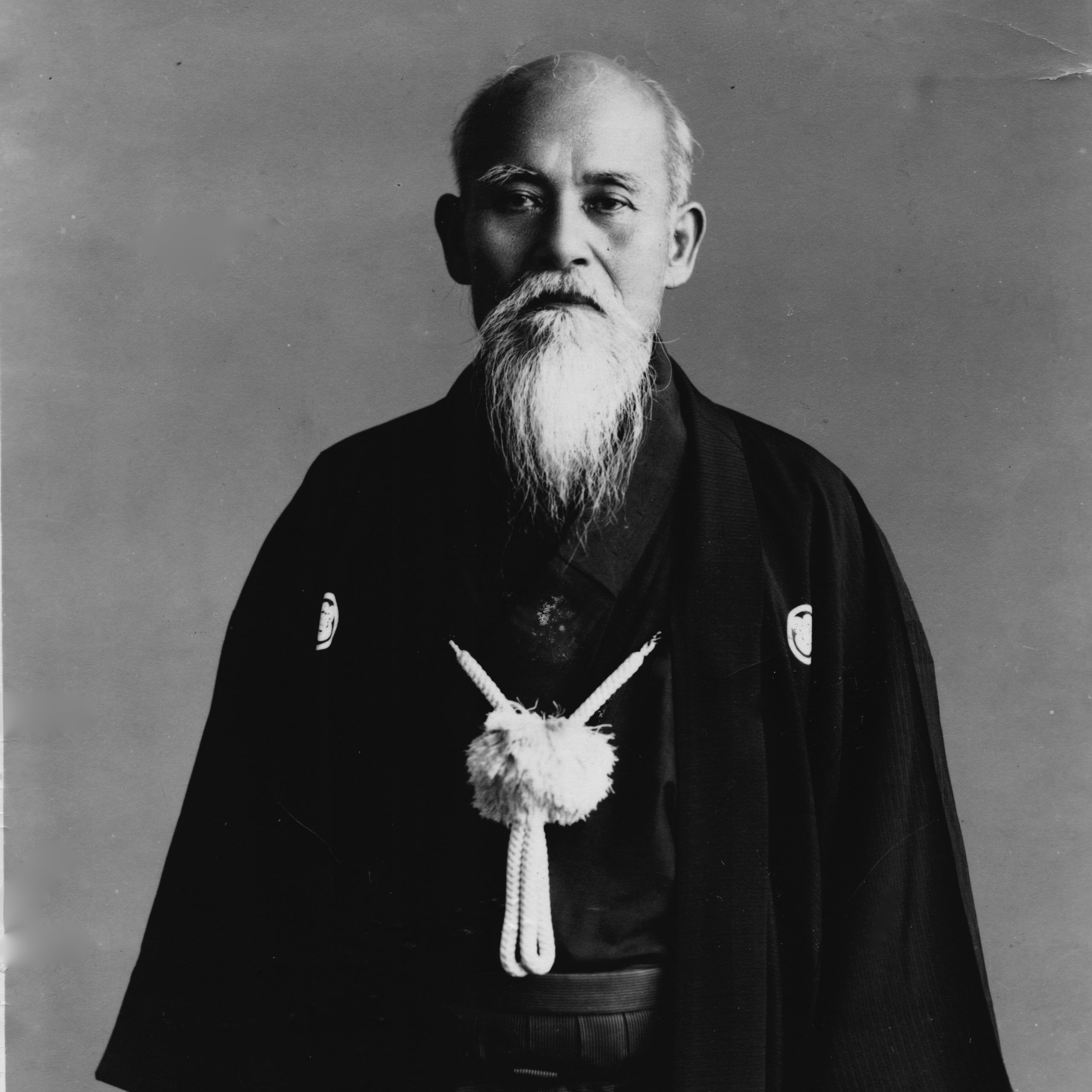
The policy of the dojo remained unchanged after the founder’s death because Kisshomaru Ueshiba Sensei had firm control of the dojo operation for a long time. Even though O-Sensei had passed away, his importance as the symbol or image of the Aikikai increased. I think that even now all around the world, O-Sensei’s photograph is found in many dojos as a symbol of aikido beyond organizations.
How did the role of Kisshomaru Ueshiba Sensei evolve after he assumed his position as Doshu?
Apart from the second Doshu, the three most important persons at the Hombu Dojo were Koichi Tohei Sensei, Kisaburo Osawa Sensei and Shigenobu Okumura Sensei. It was a matter of common knowledge to us that Tohei Sensei was the brother-in-law of Doshu since the latter married the younger sister of Tohei Sensei’s wife. The bottom line is that both of them should have had a good relationship with one another. As Tohei Sensei emphasized more activities at the Hombu Dojo, Doshu should have appreciated his efforts in that regard. Osawa Sensei became the Assistant Director (Dojo-cho Daiko) of the dojo because Doshu should no longer hold both titles, and because the role of Osawa Sensei had increased. He came to the office every morning to help Doshu. In those days, Okumura Sensei worked at the revenue officers’ school, but he attended the first morning class every day. Both of them were good advisors to Doshu. On October 1, 1969, a meeting of the senior teachers was held at the Hombu Dojo. They decided that a morning class for beginners would be given on the second floor from 6:30 to 7:30 am Monday through Saturday. Okumura Sensei was to take charge of these beginner classes. After that, I was also ordered to teach the Friday beginner class.
Obviously, Tohei Sensei as the Chief Instructor had a major role in determining teaching policies. How was Tohei Sensei, with his strong emphasis on ki, viewed by the other senior instructors?
When I became an instructor at the Hombu Dojo in January 1965, Koichi Tohei Sensei had been teaching aikido in the United States. I heard that he left Japan in September 1964 and would return in the fall of 1965. On his return, Tohei Sensei offered special instruction sessions for Hombu instructors at his own dojo in Tochigi Prefecture at the end of December when the Hombu was closed. He couldn’t use the dojo because O-Sensei was living there. I won’t tell you who went to Tohei Sensei’s residence in Tochigi because I must protect the privacy of my former colleagues who still work for the Aikikai even now. This special personal gathering was held at Tohei Sensei’s home dojo almost every December until 1969. I participated in all of these sessions and it was well worth the time.
I would read a novel serialized in this newspaper every day for O-Sensei in a loud voice. The title of this novel was Niwaka—Naniwa Yukyoden written by Ryotaro Shiba. So when O-Sensei came into the office he would always ask me what had happened to Mankichi! He would laugh heartily at a particular interesting event in his life.
After O-Sensei passed away on April 26, 1969, Tohei Sensei’s role increased. Although he left for Hawaii on June 15, 1969, he shortened his trip and returned to Japan on June 30 because Hatsu Ueshiba, O-Sensei’s wife, passed away at 3:20 pm on June 26. On July 25, Tohei Sensei conducted his seminar for the Police Academy at 1 pm at the Hombu Dojo. This kind of seminar was one of the things Tohei Sensei did best because he was already experienced in teaching the police in Hawaii.
On August 17, Tohei Sensei invited Sadaharu Oh, a baseball player of the Yomiuri Giants, to the children’s classes at the Hombu Dojo and asked him to sign autographs for the kids. Tohei Sensei often helped Mr. Oh when he was having trouble with hits or homers. That was the reason Mr. Oh was delighted to accept Tohei Sensei’s invitation without charging any money.
By the way, the children’s classes at the Hombu Dojo were set up by Tohei Sensei in 1968, the year of the completion of the new dojo building. Koretoshi Maruyama Sensei, Iwao Tamura Sensei, Fumio Toyoda Sensei, Minoru Kurita Sensei and I assisted Tohei Sensei at the children’s classes. For example, the present belt colors for kyu ranks in the children’s classes at Hombu were chosen by Tohei Sensei. Although the yellow belt from 10th kyu to 9th kyu is used at the Hombu Dojo now, the original colors as chosen by Tohei Sensei still remain unchanged. The orange is for 8th kyu to 7th kyu, the blue for 6th kyu to 5th kyu, the purple belt for 4th kyu to 3rd kyu, and the brown belt for 2nd kyu to 1st kyu.
On October 10, Tohei Sensei’s aikido demonstration was telecast live on Nihon TV in the morning. On October 11, the aikido demonstration was held at the Budokan for the first time. Then, on October 11 Tohei Sensei was interviewed live in the morning on Nihon TV. I mentioned Tohei Sensei’s activities at the Hombu Dojo and on television to explain that what he wanted to do next at the dojo was open ki classes for those who would not practice aikido, but would like to study how to coordinate mind and body.
On January 12, 1970, Tohei Sensei left for Hawaii and returned to Japan on May 1 of that year. On May 21, he conducted a special ki session for the baseball players of the Hiroshima Carps while they were staying at the Shoheikan Hotel in Yotsuya. On August 23, 1970, Tohei Sensei requested that we attend a meeting for the Aikido Seishonen Ikuseikai (Aikido Youth Education Association) at Hombu. There he explained his project which was to spread aikido among children by organizing a financial support group. The donation would be 10,000 yen per person, which is equivalent to about $80 at the current exchange rate. A badge would be given to members. As this was not an Aikikai activity, I took charge of collecting monies and depositing them in several savings accounts at different banks. We were permitted to use a small room next to the parking lot of the Hombu Dojo after a small accessway was built which allowed entry without going through Hombu Dojo. On September 4 of that year I met with the salesman of a Ginza jewelry store and ordered the first one hundred badges costing about $40 each. On September 30 the badges which bore individual serial numbers were delivered to me. Tohei Sensei chose number 100 which stood for his 10th dan.
In Summer 1971, Tohei Sensei said he would teach ki principles to non-aikido oriented people outside of the Hombu Dojo because the dojo officials had rejected his proposal to hold ki classes in the Hombu. Tohei Sensei wrote abut this incident in detail on page 90 of his book Book of Ki: Coordinating Mind and Body in Daily Life which was published by Japan Publications in Tokyo. In any event, Tohei Sensei asked Mr. Katsumi Horizoe, a Keio University graduate and a member of the Tempukai, to let him use the meeting room of his office once a week temporarily. At that time, Mr. Horizoe founded a non-profit organization for young workers located in the Marunouchi district. Most of the guests were members of the Tempukai and were highly impressed with Tohei Sensei’s instruction. Then, the Ki Society started officially at the Olympic Center in Yoyogi on September 16, 1971. Tohei Sensei’s position at the Aikikai remained unchanged even though he became the president of the Ki Society.
This interview was conducted jointly by Stanley Pranin and Marc Abrams. Imaizumi Sensei can be reached through the Shin Budo Kai.






Add comment