
 Josh Gold
Aiki News is pleased to present this first of fifteen installments of our exclusive on the Omoto religion. One of Japan’s foremost “new religions,” the Omoto sect has had a turbulent and fascinating history. More important to practitioners of aikido, its belief system had a profound influence on Morihei Ueshiba, founder of aikido. Read part two here.
A Brief History of the Omoto Religion
Of the so-called “new religions” of Japan, the Omoto religion is one of the most significant, with over two million believers prior to its suppression by Imperial government authorities in 1935. The “Omoto” or “Great Source” has also given birth to a number of successful derivative sects that draw heavily on its doctrines for their ideological bases.
The birth and spread of the Omoto religion is due principally to the combined efforts of two charismatic figures, one an illiterate peasant woman named Nao Deguchi (1836-1918), and the other, a self-taught, eccentric genius, Onisaburo Deguchi (1871-1948).
Nao Deguchi led a destitute and tragic life having lost her husband and several of her children at an early age. She was a devotee of the new religion of Konkokyo which worshipped a folk-god called Konjin. In 1892, at the age of 56 when pushed to the brink of despair by a life of unspeakable misery, Nao entered into a trance state for about two weeks. She was reported to have been possessed by a benevolent spirit, who was above all other deities in origin, power, and universality.
Although illiterate, Nao began to take dictation from this spirit in a script she herself was unable to read. Her character became extremely bizarre and she was confined to her room as a lunatic. Her writings, known as the ofudesaki, were penned over the last twenty-seven years of her life. They were full of revelations concerning the spirit world and contained a continuous stream of social criticism. Mankind was urged to mend its ways and create new structures of social justice while developing a new value system. Nao’s vision was based on a universal deity which regarded all human beings as equals. This ideal was in conflict with state Shinto which placed the Imperial family at the center of worship and revered the Emperor as the highest god.
Nao had begun to gather a considerable following when Kisaburo Ueda appeared on the scene in 1898. Kisaburo married Nao’s daughter Sumi in 1900 and adopted the name of Onisaburo Deguchi. Onisaburo was a self-taught man with a keen interest in shamanism. As a young man, he had been a student of the noted spiritualist Katsutake Nagasawa for several years. After the death of his father, Onisaburo had a series of trance experiences on Mt. Takakuma near Kameoka during which it was revealed that he had a spiritual mission to fulfill as a savior of mankind. After joining forces with Nao Deguchi, Onisaburo set about systematizing the Omoto teachings and strengthening the church organization. Nao died in 1918 at the age of 81, leaving her daughter, Sumi, Onisaburo’s husband, as her successor.
Due to its progressive religious doctrines and extensive social influence, the Omoto sect became a source of constant irritation to government authorities. Onisaburo also adopted a number of frowned-upon practices, such as riding a white horse, a privilege normally reserved for the Emperor alone, which eventually led the powers-that-be to act against the church. In February 1921, the military-controlled government brutally suppressed the Omoto sect and Onisaburo was indicted for lese majesty and violation of the Press Law. Omoto buildings and shrines were destroyed and Onisaburo and other church leaders imprisoned. Onisaburo spent four months in jail. After this experience, he began dictating his famous Reikai Monogatari (Tales of the Spirit World) which eventually filled 83 volumes.
Despite the extreme measures taken by the government, the sect grew even more rapidly after the First Omoto Incident and was especially popular among farmers, who wielded great political influence. The religion also controlled a large daily newspaper with over one million readers. Onisaburo advocated the use of the Esperanto language as a means of uniting the world’s religions and the Omoto church achieved international recognition through the establishment of the Universal Love and Brotherhood Association.
The huge success of the religion with its staunch opposition to the Imperial system and anti-war stance propelled it once again on a collision course with the prewar military regime. In December 1935, a large contingent of police descended upon the Omoto religious and administrative centers in Ayabe and Kameoka and arrested Onisaburo, his wife Sumi, and many other family members and their relatives, along with sect leaders. The mass arrests were followed by the systematic destruction of Omoto buildings and property and the disbanding of the numerous church organizations and associations.
The government had effectively neutralized the Omoto movement and Onisaburo spent the next seven years in prison until his release on bail in 1942. After Japan’s defeat, the religion resumed activities in February 1946 under the name of Aizen-en. Onisaburo’s death in January 1948 took some of the momentum out of the religion’s resurgence and leadership of the church passed into the hands of his widow, Sumi. She was succeeded upon her death in 1952 by her eldest daughter Naohi whereupon the religion again became known as Omoto.
The Omoto religion today has some 200,000 believers and operates from its two centers in Ayabe and Kameoka, near Kyoto. The present-day Aizen-en is a group headed by Yasuaki Deguchi, eldest grandson of Onisaburo and Sumi, which separated from the main Omoto sect in 1986. Also headquartered in Kameoka, the Aizen-en cites the bureaucratization of the Omoto church and lack of emphasis on Onisaburo’s teachings as reasons for its split from the main organization. The Aizen-en regards Onisaburo Deguchi as its founder, worships the Shinto deity Susano-no-Mikoto, and regards the Reikai Monogatari as its sacred text.
Morihei Ueshiba and the Omoto Religion
The founder of aikido first met Onisaburo Deguchi in late 1919 on his way back from Hokkaido to his hometown of Tanabe in Wakayama Prefecture to see his dying father. So impressed was Morihei by the personality of Onisaburo and the depth of Omoto teachings that he moved his entire family to Ayabe in 1920 following his father’s death. He settled into a life of ascetic practices in the Omoto community and became one of the inner circle of believers closest to Onisaburo.
For his part, Onisaburo recognized the exceptional martial abilities of Morihei and encouraged him to provide instruction to Omoto believers while continuing to develop his skills. Morihei later accompanied Onisaburo to Mongolia in 1924 on an ill-fated adventure to establish a Utopian community. Their involvement in political activities nearly resulted in their execution by Chinese authorities.
Back in Japan, Morihei’s fame as a martial artist grew and he was eventually drawn to Tokyo, with Onisaburo’s blessing, to expand his teaching activities. Among his early students were prominent members of Japanese society, including many political and military leaders. Morihei maintained dose ties with the Omoto religion and Onisaburo sought to further promote Ueshiba’s activities by establishing the Budo Senyokai (Society for the Promotion of Martial Arts), an umbrella-organization of the church, in 1931. The Budo Senyokai was headquartered in Kameoka and branch dojos were set up all over Japan, usually in conjunction with Omoto chapters.
Due to his dose association with the Omoto religion, Morihei was forced into hiding for a brief period after the outbreak of the Second Omoto Incident in 1935. He was spared arrest thanks to key connections in the police establishment, who shielded him from harm. Ueshiba was forced to separate himself from the disgraced religion, but remained a believer in private life.
Ueshiba resumed open association with the Omoto church following the war and remained a believer until his passing in 1969. Morihei’s humanistic interpretation of the martial arts draws heavily upon the teachings of Onisaburo and the ethics of modern aikido are based directly on Omoto principles.
Stanley Pranin
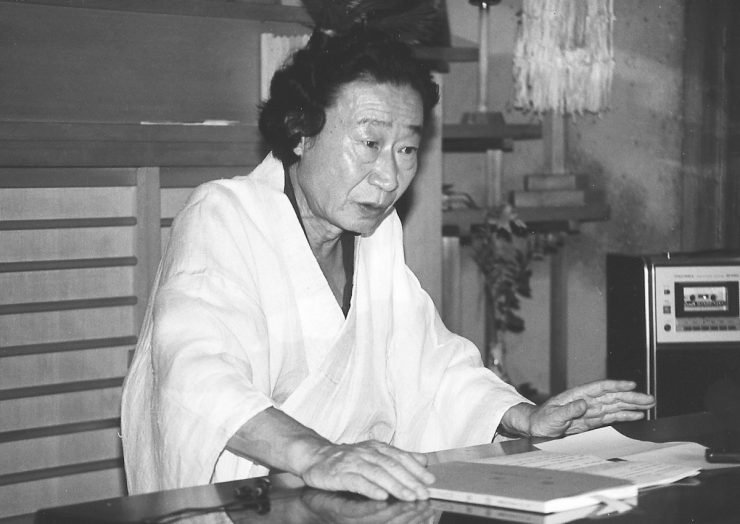
The following lecture was given by Yasuaki Deguchi, grandson of Onisaburo Deguchi, in Kameoka on August 6, 1992.
Second Omoto Incident
[At midnight on December 8, 1935, a party of 500 armed police gathered in more than 20 places in Kyoto, boarded darkened buses and set off to Ayabe and Kameoka.]
This year marks the forty-fourth anniversary of the passing of Onisaburo Deguchi and there are only a few people alive who had the pleasure of knowing him in person. Tomorrow [August 7, 1992] is the 50th anniversary of Onisaburo’s release from prison on bail. In order to commemorate this event I would like to offer reminiscences about my grandfather and those times as seen through the eyes of a grandson.
I was five years old when the Second Omoto Incident occurred. My grand parents were out teaching in Matsue. My father, Uchimaru Deguchi, was on a business trip in Tokyo. That night, I was sleeping with my mother Yaeno, Onisaburo’s third daughter, and my brother in the Koshoden [the headquarters of the Jinrui Aizenkai] within the Ten’onkyo, an area where many of the Omoto buildings were located. At dawn, a band of armed police entered without even troubling to remove their shoes, having been signaled with the shout “Fire!” Although I was only five years old, the unusual and tense atmosphere of that moment is indelibly impressed in my mind. Although I don’t remember this, according to my mother, I grabbed at a policeman and shouted, “Get out of here!” I was told that my uncle Hidemaru [husband of the eldest daughter of Onisaburo and Sumi] who was sleeping in the next room was taken away, mumbling.
My mother was detained at the Kameoka police station. Although she was 26 years old then, she had the mind of a fifteen-year-old. Taking advantage of Onisaburo’s hands-off policy with respect to the education of his children, she had lived completely according to her own whim.
My father was a close confident of Onisaburo and had a great deal of responsibility within the Omoto sect. He was so busy that he had almost no time to sleep, or to think of his family. My mother had me when she was 21 years old, but she placed me under the care of the wife of Yasukuni Doi, an Omoto leader and former public prosecutor. The only time my mother took on the role of a mother was when she breastfed me. Even when she wanted to say something about raising her children, my mother could not hold up her head in front of Mrs. Doi, whom I called my “auntie,” and who had been a head nurse at Tokyo University Hospital. So my mother took advantage of this fact and was always visiting with her friends. She was not conscious of being a mother or wife, nor was she interested in the activities of the Omoto church.
She didn’t understand at all why she was arrested. One after another, believers whose faces she knew were also brought in. The jail was small and cold and, on top of that she was sleepy because she had been awakened early in the morning. When a young man named Kodaka, an Omoto believer, was brought into the same cell, she asked him to lend her his lap and she went to sleep using him as her pillow. Although my mother still has not matured, she had a lot of nerve and was very easy going. She was arrested on a Sunday when she had planned to go to Kyoto with friends to see a newly-released film. I heard that she said, “If they don’t let me out of here soon, I’m going to miss the movie!”
Onisaburo and Sumi, the second kyoshu or spiritual leader of the Omoto religion, had eight children, but two boys died in infancy. The fourth daughter, Hifumi, died at the age of 16. The other five daughters adopted husbands into the Deguchi family. When my grandfather, father, uncles, and the Omoto leaders were all arrested, the eldest daughter, Naohi [later third kyoshu] was taken, together with Sumi, to the Gekkokaku in Ueno in Ayabe and was placed under the supervision of six guards. Onisaburo’s second daughter, Umeno, was confined in her home Chokyukan in Anao [Kameoka-shi, Sogabe-cho]. Onisaburo’s third daughter, Yaeno, fourth daughter, Hisae, and fifth daughter, Suminoe, each of whom had two children, were taken to Zuigetsuan in Ten’onkyo, the house of my uncle Michimaru Deguchi. In all, three women and six children were detained for five days.
I was very young so I couldn’t understand the sudden turn of events. I felt very uneasy and asked where my grandfather had gone and when my father would come home, but no one would listen to me.
On December 13, 1935, we were able to rent a place at the foot of Mt. Nishiyama and the three families began to live together in a five-room house. Since my mother and aunts had never cooked rice, one female servant was allowed per family. One manservant was also allowed, so all together we were thirteen. The main gate was fastened with nails and a bamboo fence was built around the house. The only door which would open was the one at the back. We drew water using buckets from the river near the temple behind the house to boil water for the bath. We were under strict police supervision and received a minimum monthly allowance from the police taken from the Deguchi family assets. We lived that way for about two weeks. In February 1936, uncle Hidemaru had a mental breakdown under police torture at the Gojosho Police Department and was taken to Nisseki Hospital.
On Friday, March 13, eight Omoto-related groups were ordered to disband and eight people, including Onisaburo and my father, were indicted. Of course, we children weren’t informed of the situation, but we were constantly unsettled by our mothers’ whispers and gloomy faces.
On that same day, the Ministry of Internal Affairs issued an order to forcefully destroy all of the structures of the headquarters and regional facilities. Onisaburo and Sumi were required to bear the cost of the demolition work. This order was issued even before they had been convicted. The Omoto leaders were treated very badly—this could not be considered the action of a constitutionally governed nation. Christ was said to have borne the cross on Golgotha on Good Friday and Onisaburo too bore a heavy cross. They forced Onisaburo’s group to sell their furniture, household goods, and machinery before demolishing the Omoto buildings. The government even required them to sell their belongings for practically nothing. I think this was so that Onisaburo would not be able to afford legal fees. Each day, in the precincts of the Omoto religion in Ayabe and Kameoka, all objects of worship, the altars, and calligraphy and drawings done by Onisaburo, his belongings, and many books published by the Omoto were burned.
After these effects were destroyed, starting on May 18, the destruction of Ayabe and Kameoka began, lasting until June 12. Apparently, some 9,934 people were involved in the demolition, which gives an indication of the scale of the operations. There were also some 6,785 policemen who supervised the work and they took unusual precautions.
Each day, when we looked toward the Ten’onkyo where we used to live, we could see plumes of black smoke rising in the sky, probably smoke from these fires. I could feel in my gut the sound of the dynamiting which destroyed the Gekkyuden.
Uneasy Days
On June 9, 1936, before the demolition work was over, the three families of Yaeno, Hisae, and Suminoe were removed to the house known as Kumano Yakata, my present residence, in Nakayada Farm. In those days, the neighborhood consisted of rice fields and there was also a pond called Kagoike. This name originally meant the “pond to protect the house.” Today the pond has been filled in, and National Highway #9 has been built. For a long time, I thought Kagoike meant “basket pond” because in dry weather it would become empty for a short time like a basket.
Nakayada Farm included rice fields and cultivated fields for other crops that occupied about two-and-a-half acres. It was purchased by Onisaburo on January 15, 1927 and it was named the Omoto Risosha Farm [Idealistic Omoto Farm]. On the property was a two-story, wooden house with a floor space of 2,500 square feet and a large dirt floor. A man named Yoshito Sasahara supervised the Omoto Farm. From 1932, Kunitaro Fukushima, the eldest son of Hisako Fukushima, third daughter of Nao Deguchi, succeeded Sasahara.
The farm supported five families of Omoto believers who had leased the land before the outbreak of the Second Omoto Incident. At first, the government planned on forcing the sale of the Nakayada Farm along with the land in Ayabe and Kameoka, but it was the daily bread of the Deguchi families and they would not have been able to earn a living without it. Consequently, members of the religion worked with lawyers to persuade the government not to sell the farm and barely succeeded in saving it. The Kumano Yakata, where we lived at first, belonged to Jisaku Suzuki. We dismissed the three helpers and our three related families lived together.
The Kumano Yakata was a large house, but it was built of old wood and the foundation was small and low and so when it rained heavily it would flood. We somehow managed to keep the house for six years by repairing the floor. But we children, who had been confined in the small rented house, were happy to move into a large home and I ran about the rundown corridors with my younger brother and cousins.
At that time, people seemed to be very interested in the Deguchi family. According to my mother, when she went to Kyoto to see movies with her sisters, they would run newsreels showing the condition of our home. They showed scenes of us children dressed in rags peeping through holes in the shoji doors. My mother was very ashamed and smiled a bitter smile. My mother and aunts were the type of women who did not mind what their children wore even though they liked to dress up themselves.
Nakayada Farm was always under strong police guard. Whenever I would go out, a sharp-eyed man would come and ask me questions. He would ask, for example, “Where did your mother go yesterday?” or “Who came to visit you?” Since I was a child, I answered honestly. The man was a special secret-service policeman. When I came home, my mother and aunts told me that he was a bad man and that I shouldn’t say anything to him. This secret policeman represented my first concept of evil.
On March 14, 1936, my grandmother Sumi, the main support of the Deguchi family at that time, was taken from Ayabe to the Gojo Police Station in Kyoto. After that she was imprisoned for six years and four months.
One by one my mother and aunts were taken away and my anxiety increased. On June 17, 1936 my mother was led away to the Kawabata Police Station in Kyoto. As could be expected, she was not able to answer the police questioning satisfactorily. The only thing that she did when not being questioned was to fall asleep, astonishing the police officers who were said to have marveled at how well she slept!
On June 22, 1936, Aunt Umeno was taken away to Kameoka Police Station and then to the Gojo Police Station for questioning. Her beauty became the talk of the police station and the officers came to the detention room in turns to steal a look at her. My mother and Umeno were detained for almost a month. Umeno could not stomach rice boiled with barley, so she ate less than the standard prison meal. Meals consisted of 70% barley and 30% rice. When she was allowed to go home, she was so thin and weak that she could not move from sitting on the porch of the Kumano Yakata. She did not go directly to her residence in Anao, but to Kumano Yakata.
On June 29, Aunt Naohi was taken away to Ayabe Police Station and interrogated severely. She was pregnant at that time, and her three daughters who were left at home fell ill with the measles, but the police ignored these circumstances. A doctor who was an Omoto believer appealed to the government and she was allowed to go home for a while after being detained for ten days. My aunt Hisae and Suminoe were ordered to go to Kameoka police station for a week. During that week, they were interrogated every day.
The date Naohi was due to give birth neared and Aunt Umeno moved to Ayabe to assist her. The government considered that the name of the house in which Aunt Naohi was living at that time, Gekkokaku, was disrespectful and so she was forced to move to another location. In late November, she moved to a house at the foot of Mt. Terayama in Ayabe. It was called Zassokyo, “the house of weeds.”
The only good news during those uneasy days was the suspension of the indictment against Onisaburo’s five daughters. This was a relief.
Child of “Wani-san”
In April 1937, I reached school age. However, on the morning of the entrance ceremony, supposedly an enjoyable occasion, for some reason I was full of anxiety. The Nakayada Farm was, in a sense, a place where the Deguchi family hid as the events surrounding the Second Omoto Incident unfolded. I might have been feeling anxious about having contact with the outside world for the first time because I had been brought up in an overprotective environment. Also, I may have instinctively sensed the danger that lie ahead. In fact, during the entrance ceremony I was conscious of the cold eyes of the parents focusing on me.
Among Onisaburo’s first grandchildren were Naomi, the eldest daughter of Naohi who was born in 1929, and Misao, the eldest daughter of Umeno, Onisaburo’s second daughter. They were students at a school in Ayabe. I was one year younger than they, and was the next to start school. I was Onisaburo’s first grandson. Therefore, I was the first grandchild of Onisaburo to attend Kameoka Elementary School, which made my presence even more unusual. People whispered and pointed at me. In Kameoka, the Omoto headquarters was located at the site of the remains of the castle of Mitsuhide Akechi, and Kameoka was Onisaburo’s birthplace, so the people showed great interest in me.
Until that time I had not been informed of the whereabouts or fate of my grandparents, father, or uncles. However, after entering school I learned the facts for the first time from my teachers and classmates.
My grandfather’s name is correctly read as “Onisaburo.” But usually, he was called “Wanisaburo,” which means “crocodile.” Although I was the grandson of Onisaburo, my friends mistook me for his son and called me, “Wani-san’s son.” This was the most humiliating name they could have called me.
In Japanese history class, the teacher explained that Onisaburo Deguchi was worse than Takauji Ashikaga [1305-1358, a rebel who successfully opposed the Emperor to become Shogun] and Yuge-no-Dokyo [a Nara Period priest who unsuccessfully attempted to succeed to the throne]. In my calligraphy class, when I wrote my name at the end of the paper, the teacher showed it to everybody saying, “A child of a social outcast signs his name like this.‘That’s the way it was all the time.'”
The media published government propaganda belittling the Omoto religion and Onisaburo, and the children who heard stories from their parents exaggerated these rumors to their friends after which they would reach my ears.
The hardest thing for me was that I myself believed that I was the child of a traitor. I thought I was a shameful person so I naturally allowed the other children to bully me. Those who bullied me did so with a sense of justice. It wasn’t like the present situation where bullying is done slyly. It was an honor for them to attack the child of a traitor.
On the way home from school, the children would chase and throw rocks at me. The town people looked coldly upon me. My place of refuge was the house of Auntie Doi who had raised me until the Omoto Incident occurred. The Doi house was located just across from the back gate of my school.
Since I was afraid of encountering people on the street I used to get up early in the morning when it was still dark, before the paper delivery man came, and would hurry to my aunt’s house. When I softly tapped at the front door, Mrs. Doi opened the lock as if she was looking forward impatiently to my arrival. I would sneak into the futon [bedquilt] warmed by her body and sleep for a while, and then would pass through a hole in the wire entanglements of the back gate before school started and enter the schoolyard. I would stay at the Doi house until after dark before returning home.
I often was absent from school, feigning illness, and would stay with Mrs. Doi. If I think of it, it was similar to the trend today of children refusing to attend school. My aunt accepted it and would happily go to school to inform the staff. We kept it secret from my mother and relatives at home. I especially hated Sports Day and hardly ever participated in the activities. I used to be absent on that day and would watch the event in the schoolyard from the second story of the Doi house.
I often stayed overnight at my aunt’s house. When I sneaked into her futon, she would take out the Reikai Monogatari which was hidden in the closet under the futon. She would read the books to me in a soft voice. In the beginning, to make me interested in the Reikai Monogatari, she told me the story of people going into the stomach of a huge serpent. When I asked her to read that part to me, she had a hard time trying to find the volume containing that story! I used to go to sleep listening to these stories. When I woke up in the middle of the night, she would still be sitting in seiza reading. When I asked her to go to sleep, she said: “No, I’m reading this to your spirit. Go back to sleep!” So starting from the time I was an elementary student I listened to these stories while half-dreaming.
The problem was that my aunt’s love for me was too strong. She came to school to see me on any pretext and whenever she found me she would call me “Yasuaki-chama.” Of course, none of my friends would be called “chama” [a diminutive form of “sama,” a variation of “san” and a form of address, used towards small children of high social standing] and this gave them further cause to ridicule me. I asked her many times not to come to school but she would steal her way in. It seems that at first my mother and relatives tried to separate me from my aunt, but they soon gave up.
Martyrs of the Second Omoto Incident
Many police guards remained and so late at night visitors used to secretly enter from the backyard of the Kumano Yakata and knock on the sliding door.
At that time, my mother and aunts did not use the family name of Deguchi when they wrote letters to people who were not associated with the Omoto religion. Aunt Naohi used the names Kei Kuzuhara and Yuki Tachibana, and my mother and other aunts used the family name of Nogami. When I was awarded the Oruyomimono Best New Detective Story Writer’s Prize [Yasuaki Deguchi authored a book titled Kyoto (Outlaw)] in 1963, I used the pen name of Ryu Nogami because I could not forget the impression left by the events of the Omoto Incident.
In September 1937, Aunt Naohi bought the Arita family house on the west side of Nakayada Farm and added on to the residence. She then moved to Kameoka from Ayabe. Aunt Umeno left Ayabe for her home in Anao. Aunt Hisae bought the Mikumo home in Nakayada Farm, and Suminoe bought the house of the Takagi family. They each moved to their respective houses and so only my family was left in the Kumano Yakata house.
When Naohi and Umeno moved to Kameoka, my cousins Naomi and Misao changed primary schools. In 1938, my younger brother and cousin Asako entered my school, and after that “the grandson of Onisaburo’‘ was not so much of a curiosity anymore. Most of the hatred toward “Wani-san” seemed to have been focused on me so my younger brother and cousin were apparently not bullied as I was. Sometimes seeing Misao come home from school crying, I was jealous that she could express her feelings, because out of pride I had never revealed that I was being bullied at school. I thought it was very shameful for a boy to weep so I never cried no matter how difficult things became.
My mother was so absorbed in getting through the hard times resulting from the Omoto Incident that she could not afford to pay attention to her children. Nonetheless, she would sometimes get dressed up and come to school to observe classes. On those occasions, I would show my courage by purposely misbehaving in front of her. I could not bear the thought of her seeing that I was depressed. My idea was to show her that I was as naughty as the other boys. When she came home and said, “I was very ashamed because Yasuaki behaved mischievously,” I felt very proud.
In school, I particularly disliked the morning assembly. All of the students used to gather together to hear the principal’s lectures in the schoolyard when the weather was fair, or in the lecture hall on rainy days. I was of average height but no one would stand beside me and my classmates would keep pushing me out of line.
At Nakayada Farm, I was the leader of the children and I could not allow my younger brother or cousins to see me bullied. This would have meant my fall from power, so I misbehaved on purpose to make myself shunned. I think I must have been an overly self-conscious, unpleasant child.
There was one boy who smelled of garlic who was ostracized by his companions and always forced to the end of the line. Even this boy would not stand next to me. I was left alone at the rear which made me feel ashamed and miserable and prevented me from listening to the lesson of the principal. I could only think about how to endure these humiliating hours. When the weather was good in the summer, I would gaze at my shadow on the ground and then look up in the sky to see my white shadow reflected in the sky. I thought to myself how pleased I would be if this white shadow were real and I was its shadow. I could not bear the strain and often fainted and was carried into the doctor’s office. I suppose my teacher thought I was suffering from sunstroke because I was weak.
In October of 1939, my uncle Michimaru, who was suffering from tuberculosis caused by the unhealthy circumstances of prison life, began coughing up blood and was sent home by the police. Aunt Hisae, who loved him very much, nursed him carefully. He was my favorite uncle and had graduated from Tokyo University with excellent marks. He spoke in an authentic Edo-ben dialect that seemed very manly. I was often at his bedside with one excuse or another even though I was forbidden to do so to avoid becoming infected. We always listened together to sumo broadcasts. After he regained his health, he even taught me kendo.
Uncle Hidemaru, who had been hospitalized after being diagnosed as schizophrenic, was also released for treatment. He left the hospital on October 27, 1939 and returned home. As Hidemaru’s wife, Naohi was living in a small house, we exchanged residences with them. Naohi’s family moved into the Kumano Yakata and Hidemaru was confined in a house next door, the house which is now occupied by Misao. Hidemaru was nursed by several male Omoto believers.
Those were really difficult times. He would often disappear, naked, from the house and no one knew where he had gone. Whenever he would disappear, we would form search parties to find him. I was very scared when Hidemaru had a severe mental attack. Hidemaru named his house Yuhikaku, “the house of sadness.” He carved many characters and scratches on the pillars arid the walls of the house.
In May of 1940, the authorities let him return to Kyoto University Hospital fearing an accident if the Emperor should visit the Kansai district. However, in November he left the hospital. During these days, many Omoto leaders committed suicide or died in prison because they could no longer bear the torture.
Father comes home
[The first trial of the Omoto defendants was held in August 1938 in the Kyoto District Court. The Omoto side insisted that there was no incidence of disrespect or forming of secret societies. However, in February 1940, all of the those indicted were found guilty of violation of the Public Order Maintenance Act and lese majesty.]
On February 29, 1940, the first sentence was handed down in Kyoto District Court. Fifty-five people were convicted. Onisaburo was sentenced to life in prison. My grandmother received ten years, and my father fifteen years. These were quite heavy sentences. The defense counsel submitted a request for an intermediate appeal. The newspapers described this decision as “a guilty verdict against the heretic religion,” and, as a result public opinion became even more critical. In April, soon after the first sentences, my mother came down with a cold which turned into pneumonia. The defense counsel appealed to let my father go home to see her for one day. My brother and I, my paternal aunt Tomoe Saga, and Uncle Michimaru went to the Nakagyo prison to pick him up. When my uncle asked my father whether he wanted to go home by train or taxi to Kameoka my father answered, “Since I haven’t seen the outside scenery for a long time, I’d like to take the train.” He put on a fukaamigasa (large woven hat) to hide his face and two policemen accompanied him. My father jokingly remarked, “This hat is useful because I can see them but they can’t see me.”
When my father arrived at Kameoka Station, a crowd of people were waiting. I stood far away from him, as though I were a stranger.
It was the first time I had seen my father in four years, but since my mother was ill, it wasn’t a happy family gathering. Although he wasn’t expected back in prison until nine o’clock the next morning, my father, who was a very earnest man, hurried back to his cell, saying that he was afraid of causing problems by being late. It was as if he was going home!
The next day, the 18th, early in the morning, my grandparents and my father were transferred from the prison in Kyoto to the prison in Kita-ku, Osaka.
Four days later on April 22, my grandmother was also allowed to visit my sick mother for one day. On this occasion, we took a picture of the entire family and her cheerfulness made us laugh for the first time in several years. It seems that when my grandmother was about to leave she quipped, “Thanks to Yaeno’s being sick, Uchimaru and I could come home. For the first time, you have been a good daughter!”
The decision was made to retry the cases in the Osaka Court of Appeals. My mother often took me along to the courthouse. Naturally, children were not allowed in the courtroom so I remained in the corridor and watched as my father wearing his woven hat and my grandparents went in and out of the court. My father always stared straight forward and never looked at me though I stood near him. My grandfather would look all around to see who had come. Sometimes he would raise his hat exposing his face. My grandmother, like a great actress, never allowed the smile to disappear from her face. Each of the three of them behaved in a different way.
On the way to and from the court of appeals, we would often go to the law office of the Hokkoku Newspaper Company in Nakanoshima. Some close friends of ours were working there in preparation for the trial. We stayed overnight several times. We slept in a room full of bedding populated with fleas and bedbugs, but everyone was kind and I enjoyed myself very much.
Clearing of Ten’onkyo
While my father was in prison, I had a chance to meet with him once more. On May 27, 1940 my paternal grandmother Shinayo Saga died. The Saga family ran a hotel at Osu in Ehime Prefecture. My father was the eldest son. Shinayo was a very pious Omoto believer and when Onisaburo asked her permission, she allowed her only son to enter the Deguchi family as an adopted son. When Shinayo heard the false rumor that her son, Uchimaru, might be released, she was not pleased. Far from it, she was disappointed and said, “I wished my son could be together with Reverend Deguchi the entire time. I’m sorry he has been released so early.”
Since my grandmother had died, my father was allowed to go home to attend her funeral. On the evening of the day of the funeral, my mother and I and younger brother and uncle Shin’e went to see my father in prison and we all set out for Shikoku. As usual, two detectives from the Tenma Police Department followed us. On the ship to Shikoku, my younger brother and I asked my father to play with us and we played Japanese chess with him. This was the only chance I ever had to play with my father. We stayed at Osu for two days and, on May 30, my father returned to prison.
In June, the war situation worsened and the government encouraged people to increase food production. In Kameoka-cho, people decided to tear the site of the Ten’onkyo to grow more crops. Primary school students were mobilized. Five years after the Second Omoto Incident, I entered the barbed-wire encircled site of my old home, Ten’onkyo. It was a heap of rubble and there wasn’t even space to set a foot.
We cleared the site of the Banshoden, an Omoto building that was located between Itchodai and Nakanoshima. At first, we dug up stones and piled them in one location. I worked alone apart from my schoolmates because I was afraid of being buried by them. When I saw a gargoyle that had been dug up from the ground, I was terrified because I imagined that the crest engraved on the gargoyle was the Imperial chrysanthemum. Actually, it was the Toyonomon, the Omoto crest, but I could not distinguish the two at that time.
I had heard my schoolmates saying that “Wani-san put the crest of the chrysanthemum on his nightclothes and pillows.” It was a groundless rumor but I believed it. I thought I saw evidence of its truth then. I ran to the deserted Nakanoshima, carrying the gargoyle and threw it into a moat. Then I fainted. I don’t remember anything after that. I was really shocked. Fortunately, when I came to I heard my schoolmates chatting cheerfully and was relieved that nobody knew what had happened.
I kept this incident secret for a long time. When I grew up and learned about the Omoto religion I realized that the crest on the gargoyle was the Toyonomon of the Omoto [a circle surrounded by nine cirdes]. I had been so possessed with the idea that it was an Imperial crest that I did not check for sure.
Release of my grandparents and father
[In July 1942 the second verdict was delivered and all the defendants were found guilty of lese majesty, but not guilty of violation of the Maintenance of Public Order Act. In August, Onisaburo, Sumi, and Isao Deguchi were released on bail after six years of confinement.]
On July 31, 1942, the second decision was handed down against the 49 defendants in the Osaka Appeals Court. It seems that all of the seats in court were filled with spectators even before the session began. At nine a.m., Chief Justice Takano declared the court open and read the verdicts for two-and-a-half hours. The principal decision, concerning violation of the Maintenance of Public Order Act was that all of the defendants were not guilty, but that they were guilty of violating lese majesty and the Press law. Apparently, the courtroom observers were quite moved when the not guilty decision was handed down as it was the main part of the government case against the Omoto religion and had been used to justify its oppression.
Eight people, including Onisaburo, were found guilty of lese majesty and violation of the Press Law. Onisaburo was sentenced to five years imprisonment but as he had already spent 700 days in detention, less than two years of confinement were left. The other seven were given lesser penalties.
However, the Omoto side was not satisfied with the decision and on August 2, they appealed the sentences in a higher court. Then on August 3, the public prosecutor also appealed the decisions, disagreeing with the not guilty verdicts.
After my grandparents and father were found not guilty of having violated the Maintenance of Public Order Act, their lawyers sought to have them freed on bail. On August 7, at 3:40 pm, they were released. They rested at the Sanukiya Inn near the prison and met with their lawyers who had come to see them. They conducted a press conference attended by reporters of the Asahi and Mainichi newspapers. At the conference, Onisaburo was very outspoken. It was amazing that he could talk so freely at such a time because his freedom could have been rescinded at any time. The three of them arrived by train in Kameoka at 6:40 from Osaka. They then proceeded to Kumano Yakata by car.
This was an unforgettable day for me. It was so difficult to have been branded as a relative of “Wani-san!” I hated him very much. But I could not forget him having loved me before the incident I loved him more than my parents and used to follow him around calling out “Seishi-chama.”
The time had come for me to judge for myself which image of him was the real one. One image perpetrated by the public was that of an evil scoundrel, and the other was the “Seishi” of my early memories. Since I knew Seishi liked fresh-water fish, I caught some in the Tera River and expectantly awaited his arrival.
My grandparents and father arrived home at about seven in the evening. My grandfather and father returned after an absence of six years and eight months, and my grandmother after six years and five months.
In the living room adjacent to the front entrance, leading Omoto believers were waiting for them. They exchanged greetings with the believers and then they went into a back room down a corridor. The grownups remained in the living room, but since I was only twelve years old I followed them.
In spite of being imprisoned during wartime, my grandmother had put on weight. Shaking her overweight body she said, “What a good opportunity to do ascetic practices I had in prison. It was the best training time I’ve ever had!” Hearing that, I felt relieved because I thought she was able to change herself into a good person.
She said this sincerely. For example, she wrote a letter to my mother in which she conducted, “As I always say, I would like you to go to see your father or husband rather than come to see me. You need not worry about me. I am so pleased now because it seemed like I was spiritually awakened while in prison even though I have done ascetic practices since I was eleven years old when my mother was possessed by the kami. I am so sorry I cannot meet with my children whenever I want, but I am satisfied and think that my life in prison is good training for me.” What she said about life in prison reflected her true feelings.
She wrote a poem at the end of her letter to Aunt Suminoe as well. “I thank and I am thankful for my thanking self. I know no words other than thanks.” Is there anyone else who can compose such a poem while in prison?
As soon as Onisaburo heard what his wife had said, he exclaimed, “What are you saying! They locked me up! I’ll never go into a place like that again! Japan will lose the war because they released me from prison!”
When I heard that, I was truly struck and thought Onisaburo was a traitor as people said and I felt relieved because my teachers and schoolmates did not hear these ominous words.
The other day, I met with Mr. Nishimura who has been a believer for a long time. He told me some of his memories of those days. A few days after Onisaburo’s release, Mr. Nishimura went to see Onisaburo. At that time, Onisaburo wrote a poem on a strip of fancy paper, “The sky is as clear as the sky in May and the sun shines on the world.”
Onisaburo said, “From now on I’ll watch with folded arms as events transpire according to the wishes of the kami.” This was his way of saying that he had done as much as possible and that all that was left was to entrust the future of Japan to the kami.
My grandparents began to live on the second floor of Yuhikaku which was next to Kumano Yakata. Yuhikaku was, as I said before, the house where Uncle Hidemaru was confined. He had been living at the Chokyukan in Anao since his release from the hospital in April 1942. I think that living on the second floor might have been inconvenient for my grandparents because their legs had weakened during their prison fife.
At that time, I was in the fifth grade of primary school and I think I must have been in high spirits because of Onisaburo’s release from prison. In those days, primary school students used to go to school in groups after gathering together. On one occasion, I challenged two naughty boys to a duel even though I had been bullied. They were quite astonished. At that time, I thought I no longer had to hold back now that my grandfather had been released from prison. I was driven to think that I preferred to die rather than continue to be humiliated.
The site of the duel was Kagoike. The bottom of the pond was dry and cracked. It was located much higher than the road so no one could see us.
At that time, at Nakayada Farm, people cooked in communal style and the kitchen of the Fukushima family was the common kitchen. Children were sent from each family to pick up their meals.
I was so impatient that day, that to pass away the time, I dropped into the communal kitchen where they were cutting up a large watermelon. I loved Yasube Horibe [one of the heroes of Chushingura]. Yasube Horibe ladled himself up a drink of sake and quaffed it before going to a duel to assist his uncle. I followed his example and bit into a watermelon instead of drinking sake and heroically spat out the seeds on the ground and proceeded on to the Kagoike.
When I started grappling with the two boys they struck at me with their sword guards. I was unarmed. I blew up and shouted, “That’s not fair. I’ll go get Mikuni-chan.” Mikuni-chan was the eldest son of Kunitaro Fukushima and a sixth grader in our school who was the leader of our group. When they heard, that they ran away.
I believed that I had become strong because of my first duel and went home feeling good. A while later, my father called me. He said, “Seishi asked me if something happened to you and told me to go and find out. Did something happen to you?” I could not say I had a duel because I was shy, so I said that nothing had happened. My father looked puzzled. At that time, my grandfather was on the second floor of the Yuhikaku so he could not have known about the fight. I thought he had a sixth-sense.
Read part two here.






Add comment