
 Josh Gold
Dr. Lee is an outstanding figure among Tomiki Aikido practitioners outside of Japan; not only does she bring firsthand experience with both Tomiki Sensei and Ohba Sensei to her aikido, but she is also able to incorporate the understanding of human physiology of a medical doctor and acupuncturist. The first woman within the Tomiki system to be promoted to the rank of 7th dan, she is also one of the few who has broadened her studies into other Japanese martial arts. Aiki News editor Diane Bauerle talked with Dr. Lee on one of her annual visits to Japan.
Sensei, you began to practice aikido over thirty years ago in England. Could you tell us how you got started?
I had some friends, a brother and sister, who were very interested in budo of any kind. They were going around to various dojos to look at each teacher’s method of instruction, and they found Senta Yamada Sensei. They came to me and asked if I would join them because there really weren’t enough students in those days to make up a class as such, and they were going privately. If I went along, it would make it less expensive for them, though it didn’t cost much in those days. So, I went along. And I agreed with my friend. Yamada Sensei was very, very good. Many of the things he taught me are still with me now. So I think perhaps what people see me do now is a little bit different from some of the others who are doing Tomiki Aikido because I retained some of the movement and some of the ways of my first teacher.
Since Yamada Sensei left Japan before Tomiki Sensei developed tanto randori, I would suppose what he taught was different from what we practice today.
Yes. It was much more closely linked to the Ueshiba style.
Can you tell us a little more about Yamada Sensei?
He was a 6th dan in both aikido and judo, and he came over to England in around 1958 or 59 to teach judo. Tomiki Sensei asked him to also introduce aikido to any of his judo students who were interested. So that’s how Tomiki Aikido got started outside of Japan. He was the first Japanese teacher Tomiki Sensei sent overseas.
Where is Yamada Sensei now?
Back in his own hometown, Fukuoka.
Is he still teaching?
He’s gone back to his old village judo school. I don’t think he’s really teaching much. He gave up budo a long time ago, nearly 15 or 20 years ago I think, when he returned to Japan.
So you met Yamada Sensei, and started to study with him. What made you continue to practice aikido?
I played tennis, and badminton; I really enjoyed sports. But I had a problem because, you see, in England you really can’t play tennis in the evening because it’s too dark.
You don’t have lighted tennis courts?
Not in those days. Now there are, but they’re very expensive. So I could practice aikido in the evenings. I think I enjoyed the discipline somehow. It was also just something I found that I liked; it suited me somehow. I’m competitive, and I found it a challenge to work with all the fellows, trying to make techniques work with them. In those days, we didn’t have competitions but there was a lot of competition when you trained.
Did you encounter any problems, not only being a woman, but not a particularly tall one?
Yes. I couldn’t make techniques work half the time. But I think when you first start in aikido, you tend to use what strength and power you have, and if somebody’s bigger and stronger it just isn’t going to work. It takes a long time to develop the proper power and strength for aikido. If it hadn’t been for Yamada Sensei, I might have given up, because I couldn’t see how I could make it work.
He showed you?
Yes, and so I didn’t develop strength and power.
So, that was an advantage for you; having the right sensei, and not being big, because you couldn’t start out relying on your strength.
We really had one of the best teachers… I mean if you start with a teacher who’s 6th dan in judo and 6th dan aikido in those days, it’s really the very best situation —not like nowadays when people will start teaching even before they’re a first dan. That’s no problem if they’re humble enough and understand their own limitations. But too often, people start teaching, and believe they’ve reached the pinnacle, you know, and stop working on their own improvement. Sometimes you really haven’t got the opportunity to improve, because of time or distance or job or whatever. But when you instruct people, you should be honest and say that you can lead them up to a certain point, but beyond that, if they have the opportunity, you should encourage them to go to another dojo, or go to Japan. That to me is the mark of a good teacher, whatever his or her level.
You, in fact did just that, and went to Japan to study with Tomiki and Ohba Sensei. What are some of the things you can remember about training with them?
It was 20 years ago that I met Tomiki Sensei and Ohba Sensei, but prior to that I’d already been training for ten years. I can’t really lay claim to knowing a lot about them, because I was only in Japan for a short time. I think I was quite privileged when I did come because I had a very good instructor to watch over me while I was here, Takeshi Inoue Sensei, who was one of their proteges. He didn’t start in his university days like most of the others, but began training when he was 9 years old. His father, who was a colleague of Tomiki Sensei, had practically offered him to Tomiki Sensei as a sort of permanent disciple to do whatever he wanted him to do.
He was a 6th dan in both aikido and judo, and he came over to England in around 1958 or 59 to teach judo. Tomiki Sensei asked him to also introduce aikido to any of his judo students who were interested. So that’s how Tomiki Aikido got started outside of Japan. He was the first Japanese teacher Tomiki Sensei sent overseas.
Ill never forget the time I met Tomiki Sensei —at that time I think he was already 70. We went to this tiny little house, where he taught on Tuesday and Thursday evenings. It was lent him by a friend, so you see how poor they were, they just didn’t have any place to practice apart from Waseda Dojo. It was an old Japanese house, with about 10 or 12 mats in it. It wasn’t built to be a dojo, and it had very low ceilings. I’ll never forget, going that first time along some dark roads and alleyways, following Inoue to this place. It was my first exposure to Japanese style training. The men were all changing in the room, and I had to go with the other two or three girls, and we changed in one corner that had a curtain rail around it. I made sure in the future that I never had to go to the toilet there, though usually I’d want to go before I trained because the one there was pitch black, and was only a little room with a door on it and a hole in the ground. So if you made a mistake you might fall in. It was quite strange to come from England in those days to a place like that. But you forget all those things because the training is too short. I couldn’t have enough of it. When Tomiki Sensei did wakigatame on Inoue, he didn’t show power, but Inoue just went flat on his face. Afterwards, when we went home, Inoue said to me, “Do you know, for a man his age, I can’t believe his power. He’s still got it.” Inoue at that time was a fifth dan. Tomiki Sensei had fantastically long arms and fingers. I think that’s how he could do the techniques that most of us find impossible to do. Especially the locks.
Of course, I’ve heard that Ohba Sensei had wrists like small trees, so Tomiki Sensei probably needed those long fingers to work with him.
Well, the story is that Tomiki Sensei could do his wrist lock on anyone’s upper arm. It was unbelievable. If you look at some of the old photos of him, and see his hands, you can see how long his fingers were. He had a very large wrist bone. The other thing I admired was how he sat in seiza. Most of us are rather high up, because our calf muscles stop us from completely contacting the floor. But he was stuck to the mat. He was truly a master. But now, having seen photos and films of his younger years, I know that when I met him he was moving as an older man would move. So we have to take all those things into perspective when we watch films, and not necessarily copy every aspect of the movement.
You’d never catch them out, him or Ohba Sensei. Never. In those days, we’d practice twice a week in the mornings with Ohba Sensei, and twice in the evening with Tomiki Sensei. Those are the only practices I went to. I didn’t want to go to any other practices. There wasn’t any point.
That’s good enough, I would think.
I didn’t want to have other things taught by other people to confuse me from what they were teaching. The morning practice was Ohba Sensei’s and it was murder, because it was from 7 to 8 in the morning. He had put that time aside for people who worked, salarymen, so they could continue their aikido and still get to work. That was how dedicated he was. Of course, some of us didn’t have to go to work, and we’d stay on. So we were left with about three or four of us, Sakai-san, Yamagata-san, and me, and sometimes one or two of the fellows.
We used to train until 9 or 9:30. Then you really got the best training. Ohba Sensei would never end the class just because it was 8 o’clock. He would stay behind to watch us, and come over and correct us, and start doing things with us.
That dojo in Aoyama was the only dojo where we had an excuse to wear dirty trousers. We’d get black, oily marks on our knees because it was a wrestling hall used by sambo wrestlers. We used the place courtesy of Ichiro Hatta, who’s dead now, a very good friend and sponsor of Ohba Sensei and the Tomiki system.
Fancy training with the snow coming through the roof, and the rain dropping through when it rained. You’d forget about it, because when you really started training you didn’t stay cold. I’ll never forget those fellows, the ones who stayed behind. They got a shock when I wanted to do some tanto randori with them. When I went to Japan it had already been introduced in England, and we were used to it. Tsunemitsu Naito brought it over in 1968.
So Naito was the one who actually brought randori to England?
Yes, he introduced randori, in place of Inoue. You see, Inoue was supposed to have come that year, but for one reason or another he couldn’t come quite at that moment. So rather than waste the opportunity they sent Naito first. Then Inoue came nine months later.
What year was that?
Inoue came in 1969. Most of us had been practicing Yamada Sensei’s way. But he left London in 1965, so we didn’t have a teacher. Then I heard that there was another Japanese teacher over, so I rushed along. I was completely amazed because I was a nidan then, and Naito put us through hell — physical torture, if you like. He brought Waseda University’s training ways, 100 breakfalls and 200 pressups and all that kind of thing. Within two weeks the club’s membership had been decimated by 50%.
Yes. I couldn’t make techniques work half the time. But I think when you first start in aikido, you tend to use what strength and power you have, and if somebody’s bigger and stronger it just isn’t going to work. It takes a long time to develop the proper power and strength for aikido. If it hadn’t been for Yamada Sensei, I might have given up, because I couldn’t see how I could make it work.
But the ones who stayed…
Were good and ready when Inoue came to really put the cream on. We’d gone through the physical hell, you see, so we were ready for the technical teaching he brought. Naito didn’t really teach us a lot technically, he just put us through it physically. But he did bring the seventeen techniques [randori no kata] over.
You hadn’t been doing them?
We did fifteen, the old style kata.
Like in Yamada Sensei’s book, The Principles and Practice of Aikido?
Yes. But the techniques are not really that different. Certain approaches, and certain final presentations are a little bit different, but that’s all. Naito never treated me as anything but part of the club, whether I was a girl or not. That was the problem. You see I got shattered. He threw me miles away, all over the place. I said to myself, “I’m not going to take this lying down though,” and came up for more. Not only that, I thought, “Well, if I’m a second dan, I’m jolly well going to prove it. I’m not going to back out like the others.” And that’s what made me continue. Because if you go through something with that kind of determination, it’s something you want to keep. I still think that it’s a good thing to do for younger students. At that time I was a university student, so I wasn’t that old. I think until you are thirty you can still put up with that kind of physical torture, if you like. You feel great if you can do it, because you feel as if you’ve conquered yourself.
So when Inoue came, he introduced the koryu no kata?
Yes. The koryu no kata, as the translation, “traditional/classical kata,” implies, are just that. I can only assume that since up to that time we had only practiced the modern randori no kata and since Yamada Sensei had taught techniques individually rather than as a set, Ohba Sensei felt that we would not lose the traditional aspect if the techniques were gathered together in sets rather than loosely practiced individually. The passage of time has proved his wisdom in doing so as there is a tendency to ignore the value of these techniques because some appear to be rather impractical and therefore many Tomiki aikidoka would prefer to avoid practicing them and perhaps learn something from such a study.
Could you tell us something about your Yawara Centre?
I started the Yawara Centre because I wanted to practice Tomiki Aikido in a certain way, and since the Centre was my own, I could control its direction. I was fed up with the politics controlling dojo practice. I believe I have succeeded in not allowing politics to interfere with the aikido which we practice. Of course, there is and always will be politics whenever ranks start to become more important than practice, and with that usually comes the temptation of thinking that one is superior and therefore can tell someone else what to do.
That dojo in Aoyama was the only dojo where we had an excuse to wear dirty trousers. We’d get black, oily marks on our knees because it was a wrestling hall used by sambo wrestlers. We used the place courtesy of Ichiro Hatta, who’s dead now, a very good friend and sponsor of Ohba Sensei and the Tomiki system.
I have regular black belts who run their own dojo but still make time to practice at Yawara because they enjoy practicing for themselves and do not feel the need to prove themselves, but just want to find more meaning in their practice. There are also those who make occasional visits but feel under pressure if they are not up to their grades and therefore do not come again. These visitors have not benefited because they have not understood the spirit of our practice. Our members don’t really care about what belts they wear, but focus rather on how they practice. If someone genuinely desires to study with us, that is all that matters.
Also, we do not specifically train according to the examination syllabus, but eventually all the syllabus is covered if one attends regularly. Again this is difficult for many to understand as many clubs train only in conjunction with the examination syllabus.
You sponsored several visits of Ohba Sensei to England. Do you have any memories of those times that stick in your mind?
There are too many memories of all those visits for me to cover in any one interview, so I can only give you a few.
On his very first visit after I took him and his assistant Shinohara-san back to my flat, despite having just traveled for 15 hours or more, he played his shakuhachi as an expression of his thanks for my inviting him. Later, after we had some light refreshments, when he asked politely if I would take him to his lodgings he was relieved to be told that he was staying with me.
Every practice session with him was an eye-opener, especially those that continued well after midnight, after everyone else had gone home after the usual end of practice. Of course, I wasn’t the only one who stayed and practiced. There were usually about six of us—the ones who had privately financed Ohba Sensei’s trip to England.
He had a remarkable sense of humor and frequently had us in fits of laughter, especially on the relaxing outings we arranged for him during weekends during the ten weeks of his first visit. For example, at that time my Japanese was very limited and his assistant Shinohara-san was supposed to do the interpreting, but it always ended up with Ohba Sensei speaking first in English, then saying, “You should be doing this, Shinohara-kun, not me!” I know he never forgot all those times we spent together because he talked about them especially on my last visit to him in Yokote prior to his death.
Fancy training with the snow coming through the roof, and the rain dropping through when it rained. You’d forget about it, because when you really started training you didn’t stay cold. I’ll never forget those fellows, the ones who stayed behind. They got a shock when I wanted to do some tanto randori with them.
You were promoted last year to 7th dan, and now are the first female 7th dan in Tomiki Aikido. Do you have any thoughts on the role of women leaders in Tomiki Aikido or any advice to your successors on how to avoid the pitfalls that a woman teacher might face?
I have never thought of myself as a “woman leader in Tomiki Aikido” but time has caused many women to drop out and I must be one of only a handful left now who still practices as well as teaches. Most definitely I am the first female to have attained the rank of 7th dan, probably in any style of aikido, although I have never looked into this. My only thought on this is that I should be an inspiration and good example to other women that they too can reach this level if they persevere. My advice is that they should emphasize their own natural body capabilities, such as flowing movements, soft power and hip power, rather than trying to teach or practice like the men, or match them, as men naturally use more muscle power and weight in their aikido practice or teaching.
You are both an anesthetist and a practitioner of acupuncture. How have these two fields influenced your understanding and practice of aikido?
My being an anesthetist and practitioner of acupuncture means that I am a doctor and therefore have an understanding of the human body’s joints and weaknesses. I can therefore appreciate the applications of aikido points more quickly than a layperson. Also, I take care of my partners when I train or teach, since I know in detail the consequences of my actions.
You’ve written three books on Tomiki Aikido. Can you tell us something about them?
I wrote the first two books [Tomiki Aikido: Book 1&2] with the help and guidance of Takeshi Inoue Sensei in 1978, because I felt that Westerners needed a reference book on the kata (both randori and koryu) since we do not have the time to practice everyday and therefore cannot remember everything without a prompt, so to speak. They are not intended to replace a teacher because the only way you can learn aikido is to physically do it. Therefore you must first practice it, then in later years, refer to the books when you have occasionally forgotten the sequence or exact techniques. However, the books are not a bible to rigidly adhere to but you should remember that to improve yourself, you should keep an open mind and keep up with any vanations/changes which the Japan Aikido Association, the founding organization, may introduce. You don’t have to agree which variations are best, but you should try them and only if you are good enough can you actually form an opinion either way.
The third book, Tomiki Aikido, Past and Future, was dedicated to Ohba Sensei who had asked me to write about why we train in randori [free fighting], as well as the kata way, and how to go about doing these kinds of training. I think he felt that I could express better than others to Westerners the principles of randori and kata training.
You are also the secretary of the European Aikido Association. Could you relate some of it’s history and background? When did it start?
In 1986. The clubs that formed the European Aikido Association had already been in communication with each other long before the formation of the organization. We were just three clubs at the time.
Which three?
Well there was Frits van Gulick’s Ryodokai [The Hague, Holland], and Eddy Wolput’s Shobukai [Antwerp, Belgium], and myself over here at Yawara. We’d been having courses back and forth. As we grew, we all had more students, and students from other clubs started coming as well. The main impetus was that both Eddy and Frits were starting to supervise members who had started their own clubs, So we thought it might be time to give some kind of official name to our small group of clubs, and function more as a whole rather than as individual clubs.
I have never thought of myself as a “woman leader in Tomiki Aikido” but time has caused many women to drop out and I must be one of only a handful left now who still practices as well as teaches. Most definitely I am the first female to have attained the rank of 7th dan, probably in any style of aikido, although I have never looked into this. My only thought on this is that I should be an inspiration and good example to other women that they too can reach this level if they persevere. My advice is that they should emphasize their own natural body capabilities, such as flowing movements, soft power and hip power, rather than trying to teach or practice like the men, or match them, as men naturally use more muscle power and weight in their aikido practice or teaching.
We still have the individual clubs but we now have the extra combination of all of us together as an organization for events and for other things that may need it. It’s also useful to back up smaller clubs if they need to go to local authorities to rent halls and such. It looks better when it appears on paper that they have a bigger organization behind them.
It was mostly a friendly network that just took one further step and became a formal organization?
Yes. We used the name European Aikido Association to encompass countries rather than just one place and since we already had three countries it was good enough to start.
Do you have special problems because you are an international organization?
Yes. The main problem is distance. The other problem is that each country has their own slight political problems as far as budo is concerned, particularly about what is recognized and what isn’t. One of our main aims is not to interfere with each country’s way of running budo but rather to assist our members so that they can continue to practice Tomiki Aikido without being disturbed. Apart from that, we wanted to set a standard throughout our own clubs so that in general the members have a reasonable technical level. For that reason we hold our dan gradings only once a year, where all the senior members get together and we have a panel instead of leaving the decisions to one person. It eliminates favoritism or discrimination. We do this grading the day before our annual competition, as we feel that somebody who has been training to get their grading should be allowed to do it in one piece. Because during competition sometimes accidents happen and it’s just not worth it to compete when you have a grading afterwards. All the clubs have their own internal control for kyu-grades, and if they’re not very good at getting the level of their kyu-grades up, it will soon tell when they come for their dan grade exams. That’s all there is to it really.
What’s the purpose of the organization, it’s goals…?
The goals are to promote Tomiki Aikido, but also in the process to make a lot of new friends. We don’t just go to the country or the clubs or the seminars or events for the purpose of aikido alone. We tend to have family—spouses and children —with us and we all can meet each other.
What are your views of the place of competition in Tomiki Aikido?
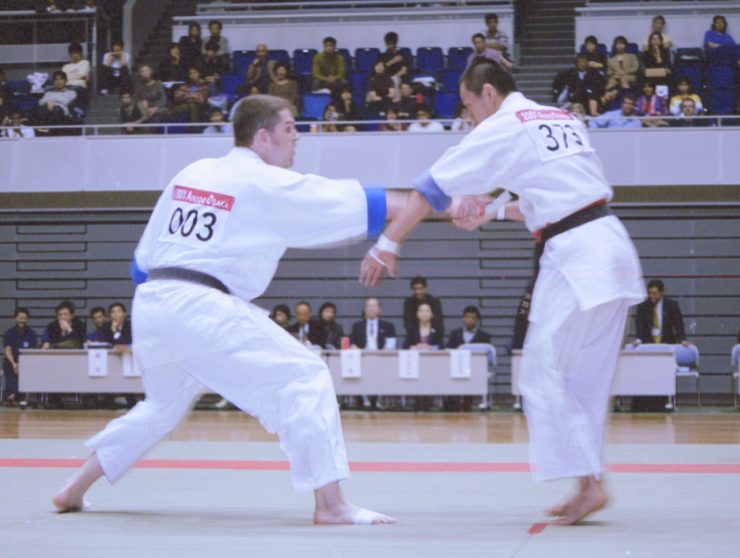
I think that the fact that competition is offered is what sets Tomiki Aikido apart from other styles of aikido. As long as we remember the word, “offered” or “available”, and do not think of it as compulsory. But having said that, we have to look into the reasons why it is offered and not just think, “Well, if it’s not necessary I won’t bother.” My conviction is that we need it to test our spirit, not necessarily just our techniques alone, but our spirit. When you enter competition, you’re entering into an unknown sphere. It’s very different from a dojo practice, no matter how hard you practice in a dojo. In a contest atmosphere all sorts of things happen to your spirit, and that is what we should look for, what is it doing to us. And we should learn from each competition that we enter, if we do enter, so that we can do better at the next competition, not necessarily in terms of winning, but in what happened to us during a bout. For example, if your cool breaks down, and you find yourself trying to use power and strength even though you know through all of your training that these are really the last things to be used. Competition also tests out your reaction speed. If you resist a technique, when it does come on you’ve got to have double the speed to do an ukemi to get yourself out of trouble. It very certainly sorts out the men from the boys and the girls from the women. There is no doubt that you do need some stamina.
But I think we must be sure not to forget what competition is about, which is to improve our aikido in situations of stress. If we don’t try and show our aikido training, then we will be giving ammunition to the decriers or detractors of Tomiki Aikido who say that it is not aikido. I think the moment we allow competition in Tomiki Aikido to become less like aikido, then that is the end of Tomiki Aikido, quite honestly. We have to remember that the actual word at the end is still aikido.
That’s a good point.
I feel that Tomiki Sensei really was an excellent teacher, leader, and innovator. He felt that aikido could be practiced competitively, despite what everybody else said. It requires a very brave man and a very knowledgeable man to back such an idea up, to show that it can be done. Tomiki Sensei’s answer was to produce the 17 techniques of the randori no kata, which theoretically take out many of the danger points of traditional aikido. But having said all that, we have to practice the traditional aikido, the koryu, because some of us may in fact be able to apply techniques from them in competition as well. I know that at our end, we are working on those because I have seen flashes of koryu techniques coming out during competition.
What do you think about the current state of competitions in the EAA?
I would have to compare it to when we first started this kind of competition 12 years ago. We started with 4 clubs competing against each other, the Dutch, the Belgians, and one British club—friends of mine — plus my own club. I’ve been keeping an analysis of the scoring, not of wins and losses, but of what techniques or tanto [rubber knife] strikes or penalties have been occurring. It has been very informative because it transpired that those who only practice competition and don’t pay much attention to aikido or the rules even, had more penalty points than positive points in their very first meeting with us. They didn’t manage to get many tanto strikes either. Those who had been training in basics, amongst our group, were actually adding up a very high number of tanto strikes, which showed that the other groups hadn’t been practicing tai sabaki [avoidance]. And I’m pleased to say, after so many years, every year the number of penalty points has diminished as a whole through the entire competition. The tanto strikes have become fewer, and I would like to think that it is due to better tai sabaki, but unfortunately, the number of ippon [full point] techniques hasn’t increased.
What about the future of Tomiki Aikido—where do you envision it going?
I don’t want it to veer away from being aikido in the first place, and secondly the competition and the randori aspect should be closer to aikido, and not consist of just knocking someone down. The quality of competition aikido depends on the guidance of the various instructors at all levels and what they want their students to achieve from competition. It also depends on the quality of the judges and referees because if these “officials” are not knowledgeable, competitors will soon get cheesed off as they cannot respect decisions which are inconsistent or, worse still, not based on sound knowledge, which I must reiterate can come only from practicing yourself. I particularly believe that only ex-competitors make good judges and referees because they have been through it and therefore can understand the spirits of the competitors. Certainly a senior dan grade does not automatically make you a good judge or referee.
Dr. Ah Loi Lee Profile
Born in Hong Kong, 1940. Raised in Singapore. Anesthetist and acupuncturist. Began aikido under Senta Yamada in London in 1962. Trained in Japan under Kenji Tomiki Sensei and Hideo Ohba Sensei in 1972, and was host to Ohba Sensei’s visits to England in 1976 and 1979. Promoted to 7th dan by the Japan Aikido Association in 1991. Also 5th dan iaido, 5th dan jodo, and practices kendo. Founding member and secretary of the European Aikido Association. Travels regularly to Japan and conducts seminars both in England and on the Continent. Author of three books, Tomiki Aikido (1 & 2) and Tomiki Aikido: Past and Future. Owner/operator of the Yawara Centre.





Add comment