
 Josh Gold
I believe you began your martial arts training in your native Germany. Please describe your early involvement in the martial arts.
I have been interested in all things Japanese and martial arts as long as I can remember. I don’t know where this interest came from; it was always there. I started my formal training in 1957 with H. Steffin in Germany. There was a great deal of contact before the war between Japan and Germany. There existed quite a strong jujutsu and old-style judo community in Germany until after the war when martial arts were outlawed. From what I could see there was a style very similar to Daito-ryu that the “old timers” were doing. In my time—it was only 10 years or so after the war that I started martial arts training—we had several teachers from the Kodokan instruct in Germany, France and Switzerland. Besides judo, these teachers seemed to have all trained in a form of jujutsu. Our understanding was that this jujutsu came to the Kodokan through Shiro Saigo and was kept alive by a small group in order to provide a traditional center for judo, or something to this effect.
One of the judo teachers who came to help us in our training was Nagaoka Sensei who was teaching there until his untimely death in a car accident in 1959. There was also Kondo Sensei who was teaching in Switzerland where I trained with him for a year. Those were the early years when champions like Anton Geesink—who later became a world champion—were just beginning to appear on the scene. I attended and won several championships in southern Germany and Switzerland and competed in October 1959 at the Grand Championships in Hamborn. Shortly thereafter I left for France to train there. The first three winners—we where all good friends-won a trip to Paris, France to train at Salle Pleyel dojo where most European champions trained at one time or another. It was there that I met Anton Geesink and several other first class martial artists. Of all European countries, France had the most dojos and interest in martial arts at that time. In Germany, martial arts were was relatively unknown and exotic.
How was it that you decided to relocate to the USA?Hawaii
In 1960, after I left France I decided to move to the United States. Martial arts were much more popular in the States and most anything I read about judo and other arts was in English. The first worthwhile book I read on judo was Mifune Sensei’s The Canon of Judo. I still treasure my copy. It opened whole new horizons for me.
What was the aikido and martial arts scene like then?
I arrived in mid-1960 in LA and started training in Harold Sharp Sensei’s dojo. Gene LeBell, a superb judo player, trained there at times and several future champions came from this dojo. LeBell was a remarkable judoka and would whip my butt every time I got smart and thought I could take him down. I slowly learned not to try any more! I will see him this fall at a judo function where he is a guest of honor. It has been 35 years since I last saw him. We will have a lot to talk about.
At the same time, I started karate with Hidetaka Nishiyama and kendo with Miahara, Sr. and Torao Mori Sensei. The latter was very important as a swordsmanship and kendo teacher. I met him at the old dojo of Miyahara Sensei. He was about the best swordsman I had seen. I remember one time in a match he lost his shinai. Without a second’s hesitation he used his right hand to pull of his left kote and, like in a sword-draw, he threw it at his opponent. The opponent tried to avoid the kote and Mori Sensei threw him with osotogari! It was one of the most natural, unthinking reactions I have ever seen.
Please talk about the early days of aikido in the Los Angeles area and your association with Isao Takahashi Sensei.
I met Takahashi Sensei in early 1961. I believe he had just moved to California from Hawaii to teach aikido. Aikido was relatively unknown at this time and I had never heard of it. After watching Takahashi Sensei I decided that this art was the next logical step after judo and I started my training with him.
His style and background were very much based on Tohei Sensei’s style and teachings. Because of Tohei Sensei’s interest in ki, ki training was very important in our practice. But Takahashi Sensei was also a very good swordsman and kendoka and this is what made his approach a little different. All this talk lately about aikido and the sword is something we were doing way back then already. We were very much interested in the study of the sword, technique and history. I was President of the Japanese Sword Society in the early sixties and we had quite a few people that were deeply involved with swords one way or the other.
Over the years—this is between 1961-1967—Takahashi Sensei and I became very close. I remember spending a lot of time at his house and I was fortunate to receive much individual instruction from him. Rod Kobayashi Sensei came around often and we did a lot of good training. Sometimes I would train with Takahashi Sensei in the backyard of his house or his garage; he would go through a particular technique over and over, picking on the smallest details until he was satisfied. He had me close to tears out of frustration several times, but still I remember those classes very fondly. He was a teacher with incredible patience and a very soft but powerful style. I was uke at many of his demonstrations and was always surprised at his power and effortless technique.
In 1960, after I left France I decided to move to the United States. Martial arts were much more popular in the States and most anything I read about judo and other arts was in English. The first worthwhile book I read on judo was Mifune Sensei’s The Canon of Judo. I still treasure my copy. It opened whole new horizons for me.
Besides those classes he would come over to my house and we would spend many hours talking about aikido, calligraphy, and swords and do some training in my small 16 tatami private dojo. Regular classes were held three times a week at a Buddhist Temple and Japanese Community Center in the San Fernando Valley.
In 1963, I also met Kisshomaru Ueshiba who was called “Wakasensei” then, and had the opportunity to take some instruction from him. Koichi Tohei Sensei visited us several times and taught at our dojo. Tohei Sensei would come over often to California and stay for a couple of weeks to teach us. He always stayed at Takahashi Sensei’s house so I saw him a lot. He liked German beer and food and we always took him to our favorite German restaurant where we drank a lot of good beer!
Tohei Sensei was a very happy and personable teacher and you could not help liking him. I don’t think aikido would have taken root as it did in the States without him. He was probably the most important person in the early history of aikido and his contribution is not recognized as it should be. Even the names of techniques, the system of teaching and testing procedures to this day go back to Tohei Sensei. I still use most of the ki techniques he showed me for teaching and convincing skeptics. He was very young then and it was amazing what a great job he did. It is too bad that aikido politics and ego competition forced him away from the Tokyo Hombu Dojo; he gave a good part of his life to spread the teachings of O-Sensei and deserved better than that.
Please talk about some of the interesting figures you came across in your early days, such as Don Angier.
The aikido federation was just beginning to take shape and we tried to get as many dojo and senseis signed up as we could; that is how I met Don Angier Sensei. He was teaching Yanagi Ryu Aiki Jitsu in the San Fernando Valley and I visited his dojo to persuade him to sign up. We practiced together quite a bit. He came to our dojo and I went to his. We also did a lot of live blade demonstrations that are still talked about.
I mentioned Gene LeBell earlier, I met Kazuaki Tanahashi Sensei at Takahashi Sensei’s house. Hayward Nishioka also comes to mind. We worked together for a little while. Kensho Furuya Sensei would come to our dojo now and then. I believe this was about the time I also met Stanley Pranin (the interviewer), who was an early student of Takahashi Sensei.
Willis M. Hawley was a close friend and mentor to me at this time; he had an incredible collection of swords and other Asian art and a Library to die for. Willis was partly responsible for my joining and subsequently becoming president of the Nanka To Ken Kai. He taught me kanji and seal carving and my wife Hana and I spent many hours at his home studying and discussing swords and art in general. I helped him with the two volume book Japanese Swordsmiths that I saw advertised in your last issue (#118), that is what reminded me of him. One of them I believe, has a sumi painting of a samurai in the back I did. He also helped organize a show of Japanese swords at the Barnsdale museum (a Masamune was sent from Japan and the Japanese Ambassador was at the opening). I painted the Takeda samurai that was used as a cover for this catalogue.
At the same time, I started karate with Hidetaka Nishiyama and kendo with Miahara, Sr. and Torao Mori Sensei. The latter was very important as a swordsmanship and kendo teacher. I met him at the old dojo of Miyahara Sensei. He was about the best swordsman I had seen. I remember one time in a match he lost his shinai. Without a second’s hesitation he used his right hand to pull of his left kote and, like in a sword-draw, he threw it at his opponent. The opponent tried to avoid the kote and Mori Sensei threw him with osotogari! It was one of the most natural, unthinking reactions I have ever seen.
Around 1966 or 67, Takahashi Sensei came to my house and persuaded me that I should go for a year to Japan while O-Sensei was still alive. At first, I did not want to go but he persisted. I am ever so glad he did and I listened! I sold my house, put my affairs in order and was ready to go. I was dealing in Asian art then and had a business called “Art Treasures of Asia.” A very short time later, armed with an introductory letter from Takahashi Sensei to O-Sensei, I departed for Shinjuku, Japan.
Please describe the highlights of your experience in Japan doing aikido.
I suppose my fondest memory is meeting O-Sensei the first time. In those days when aikido was so new to us and we were so very dedicated, meeting 0-Sensei was like being a catholic and meeting the Pope! When I arrived at Haneda airport in Japan, it was late afternoon and I took a taxi straight to Shinjuku. I asked the taxi driver to take me to the Aikido Hombu Dojo and was surprised he had never heard of it. We arrived in the neighborhood and he asked several people walking on the street for directions and nobody seemed to have heard of the place. I finally walked up Wakamatsu-cho—it was too narrow for a car—and saw a small sign stating that this was the Aikido Hombu Dojo.
Since it was evening by now I walked right in thinking a class would be in progress, but nobody was in the dojo. Just as I was closing the sliding shoji door Wakasensei Kisshomaru came across the mat and saw me. I was very surprised he remembered me and he was very friendly and helpful. He said classes were in the morning not evening like we were used to. Across the narrow alley was a place called “Wakamatsu-cho Apato.” This was where many aikido students had a room. I was fortunate to be able to get a little room and settled in. The next morning I started my classes; O-Sensei came in later and I was taken by one of the seniors to his office. The door was so low you had to walk on your knees to enter. I gave him my letter from Takahashi Sensei and he talked for a long time, but I did not understand much of what he said. It was translated to me as he spoke. Nevertheless, it was a fantastic experience and a dream became reality.
When I was leaving shortly before O-Sensei’s death, I made an appointment to say good-bye to him. He wrote a scroll for me and autographed his photo in my Tohei book. The scroll which says “Ame no murakumo kuki samuhara no ryuoo” I gave as a gift to the Hawaii Hombu Dojo where it still hangs today. Those are the things I most vividly remember.
How was it that you took so many photos of O-Sensei and other shihan?
After I was there for a while and befriended some of the other students, some of us decided that since there was nothing published on aikido (in English) but Tohei Sensei’s small book it would be a great idea to take a lot of pictures of 0-Sensei and Wakasensei for future use and records.
The aikido federation was just beginning to take shape and we tried to get as many dojo and senseis signed up as we could; that is how I met Don Angier Sensei. He was teaching Yanagi Ryu Aiki Jitsu in the San Fernando Valley and I visited his dojo to persuade him to sign up. We practiced together quite a bit. He came to our dojo and I went to his. We also did a lot of live blade demonstrations that are still talked about.
Who were the other teachers at the Aikikai that left a strong impression on you and why?
I am very bad in remembering names, and it was a long time ago. I trained mostly in Wakasensei’s classes, took some of Shigenobu Okumura Senseis classes, and O-Sensei’s whenever he came in. And I remember Kenji Shimizu Sensei; he was a very nice, polite and helpful person.
Did you practice any other arts while in Japan or see any other famous martial arts teachers?
In my free time I would go and visit calligraphy (shodo) teachers and exhibits. I visited the Kodokan a couple of times to train and at one of Tomiki Sensei’s dojos. I meet the Soke Dairi of Katori Shinto-ryu and saw Donn Draeger at a demonstration. I studied sword with Inami Hakusui and did a little kyudo, Japanese archery. Some of my time was spent antique hunting in the country.
Would you describe the situation in Southern California at the time of the separation of Tohei Sensei from Hombu Dojo.
When I left California for Japan in 1967, Tohei Sensei was still officially chief instructor at Hombu; I knew Tohei Sensei well and there was no indication of anything being wrong at the time. There were some rumors, but we, or at least I, paid no attention. I suppose some people were positioning themselves for the coming political period. I never was much into the politics of aikido. I thought it was more important to train. Politics and the desire to be in control have done much damage to aikido. Everyone talks about harmony but I see much disharmony, jealousy and competition in aikido today. I just wanted to train and become a better human being. My quest was for enlightenment and not political power.
A short time later at Hombu I found out that Tohei Sensei and O-Sensei did not see eye to eye. Again I figured it was none of my business. I was there to learn.
Where were you located in the 1970s and 80s?
I was doing aikido at Suzuki Sensei’s dojo in Hawaii until the Tohei/Hombu separation became official at which time I choose to stay with Hombu. This was not a political choice; it was a matter of personal loyalty to Hombu and the Founder, who was no longer alive. I liked Tohei Sensei a lot and in retrospect should have stayed with him.
After making my decision, I joined Sadao Yoshioka Sensei’s Hawaii Hombu Dojo which was affiliated with the Aikikai. After the breakup of this dojo into several groups, I again stayed with the Tokyo Hombu under Robert Aoyagi Sensei. I was also teaching fencing at this time.
How was it that you decided to relocate to Montana?
We had a very successful art business in Hawaii and I decided I could afford to retire. Hawaii was getting a little crowded and I wanted to start an Arabian horse ranch. Montana is very beautiful and it seemed a logical choice for a ranch.
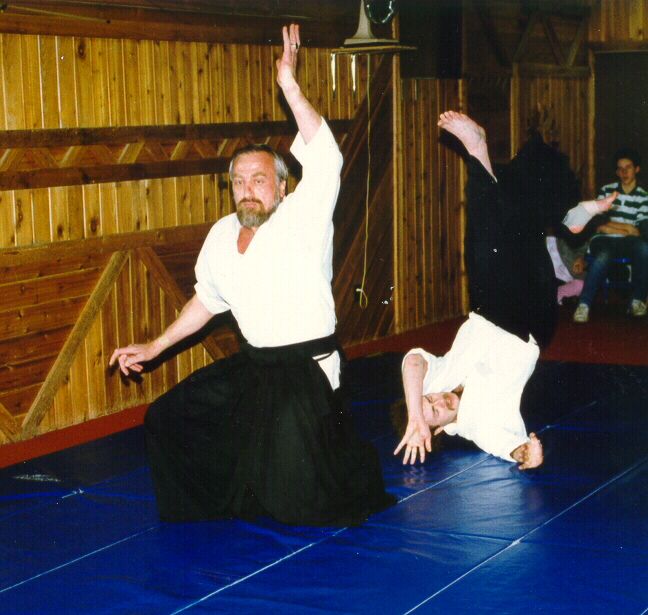
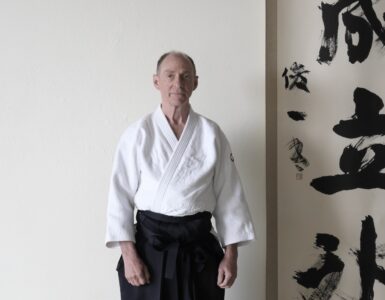
My wife Hana and I are living here on our ranch. I operate the Sandokan Aikido Dojo with about 30 students where I teach aikido, kendo and iai, I do a lot of shodo and Japanese-style painting, collect wine and art, and am very happy with my life.
Tell us about your aikido dojo.
Our ranch is about 14 miles out of a town with 18,000 people. The dojo is in town and, as I said, has a membership of about thirty students, which is quite a lot in such a small place. I don’t need to make any money on the dojo, so I don’t accept just anybody as a student. We are an independent dojo affiliated with the USMA (United States Martial Arts Association) which is an umbrella organization sort of like the Budokan in Japan. It is there to help and promote the arts. Before I arrived in this area aikido was virtually unknown.
My teaching style at my dojo is pretty close to the way I learned it from my teachers. After all those years I suppose all my teachers’ styles somehow congealed and became my own way of expression. In principle, there is no difference between what I learned and what I do. I am probably somewhere between the old Hombu and Tohei style. I suppose that we all have some favorite techniques and directions we spend more time on than others and this slightly changes the picture of the overall system.
But then this could be said even about O-Sensei who did the same with Sokaku Takeda’s teaching. The principle stays the same, but the expression is a personal preference. In order not to be misquoted I must add that this of course does not apply to anyone with a few years of training who has not yet understood the principle. It is a natural process that takes decades, not years.
When I left California for Japan in 1967, Tohei Sensei was still officially chief instructor at Hombu; I knew Tohei Sensei well and there was no indication of anything being wrong at the time. There were some rumors, but we, or at least I, paid no attention. I suppose some people were positioning themselves for the coming political period. I never was much into the politics of aikido. I thought it was more important to train. Politics and the desire to be in control have done much damage to aikido. Everyone talks about harmony but I see much disharmony, jealousy and competition in aikido today. I just wanted to train and become a better human being. My quest was for enlightenment and not political power.
We do some sword and weapon work the way Takahashi Sensei passed it on to me and some iai in the Toyama Ryu style. Personally, I am also involved with tameshigiri (test-cutting with a sword) but do not teach it. Our classes are three times a week, two plus hours each for advanced and twice a week for basic and beginners.
Sandokan is a name derived from my Buddhist name “Sando.” In 1968, after ten years of study, a Buddhist priest named Reverend Hara gave me this name when I became a Koji or Buddhist lay monk. The kanji for Sando are San, “mountain,” and Do, “way,” or “path, in case anyone is interested.
Please mention something about your work and involvement in artistic endeavors.
As I mentioned at the beginning, I have been interested in all things Japanese since I was a child. I read every book on Japanese art I could and started painting sumi-e and shodo about the same time I started martial arts. Takahashi Sensei was a real inspiration for shodo; he was a fine calligrapher himself, and I still own some pieces he wrote for me. Tohei Sensei also wrote some things for me and I took some instruction from Tanahashi Sensei. Not too many people were interested in this art form then, but it intrigued me and I continued to practice. Since then I must have sold literally thousands of calligraphies and paintings. They are in collections all over the world including G. Ariyoshi, Governor of Hawaii, the City Hall of Takamori in Japan, etc. Most of my work is for budo, Zen and tea-type people.
But then this could be said even about O-Sensei who did the same with Sokaku Takeda’s teaching. The principle stays the same, but the expression is a personal preference. In order not to be misquoted I must add that this of course does not apply to anyone with a few years of training who has not yet understood the principle. It is a natural process that takes decades, not years.
I started painting very early in my life; in 1956 or 57 I saw a exhibition of the famous Chinese artist Chi Pai Shi in Switzerland, I believe he was in his nineties then. His style impressed me so much that I decided to work in this style and media until I had mastered it. I am still working on this project.
I work mostly in sumi and transparent watercolors and in the last ten or fifteen years have pretty much followed the tradition of Zenga and the great masters of Zen calligraphy. Some of my larger abstractions are modern but all show the essence and feeling of this training and style. In the late 70s I painted a series of Native Americans and worked on this for about six or seven years.
The most important theme or aspect in my work is to express the principles of Zen, aikido and the Great Middle Way. It is very hard for a painter to talk about paintings, that is why he is a painter not a writer. Perhaps looking at some of my works would explain it better; as they say, a picture is worth a thousand words.
Do you have any closing comments you would like to make?
Yes. Ever since the departure of Tohei Sensei aikido politics have bothered me a great deal. O-Sensei talked about all mankind as one family, non-competition and harmony; what happened after his death? Today’s aikido is separated into many groups, each one selling the true thing and all others being not quite as legitimate as the one that speaks. It is nice to have diversity, but it is not necessary to have the “product competition.” I suppose there is a lot of money at stake now. Harmony does not seem to be very high on the aikido list today. Each “style” seems to be involved in a competitive race to see how many franchise dojos it can get. Ranking is used more often than not to control those franchise dojos and their loyalty. It would be nice if we could follow the teachings of the founder and leave this petty small mindedness behind.
Aikido was meant to set one free and to find enlightenment, not to become a serf in some ancient feudal system under some petty feudal master. That is why I stepped out and mind my own business. Some people seem to resent this fact.
The ranking system was established by Jigoro Kano for judo. Judo is competitive and it is easily established who is who; Aikido does not have this measuring device, so the competition becomes political. Although O-Sensei did adopt the ranking style from Kano, I don’t think he took it all that serious as can be seen by how casually he handed out ranks as he felt like it. That was after all a part of Tohei Sensei’s reason for leaving. Such advanced ranks, as I see it, are strictly honorary and show that a certain individual has served many years and put a lot of effort into his art. That is all. Today ’s competition is silly and egotistical. All aikido politics start there.
I would like to see aikido people working on self-improvement and becoming better human beings by working hard on themselves, not by cutting down others. After all, one cannot get taller by cutting other peoples heads off.




Add comment