
 Josh Gold
“All martial arts have the same inherent conflict: Art is about beauty / Self defense is about survival – and real survival is rarely pretty or easy.”
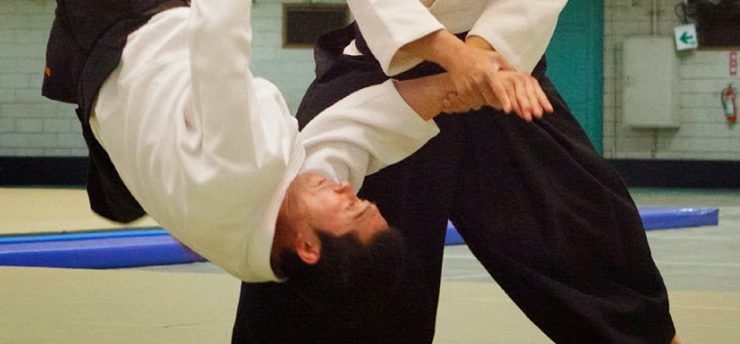
 In re-reading the 1992 article by Stan Pranin “An End to the Collusion,” I was struck by the timeliness and increasing relevance of his honest comments about the choreographed nature and artificiality of most aikido demonstrations and much of our aikido practice. Stan also has us confront the casual and sloppy manner in which aikido is often practiced. This increasingly popular “aikido lite” with lots of eye candy and sorry imitations of the Founder is supposed to be expressing harmony and non-violence.
I love the art of aikido as I know Stan does, and when lax, casual practice passes for harmony, and when training with effort and intensity is considered “violent” then we have surely lost the Founder’s Way. We have trivialized what is profound, and made superficial that which should have depth, the Founder’s earnest struggle to learn and understand, and find new possibilities in conflict. Our modern culture attempts to make everything light and easy, even O’Sensei’s work of a lifetime.
We have all seen the cooperative choreography Stan described in which uke does what is expected of him, and when in doubt – falls down. I am often (sadly) amused when old training pals who are now Senseis perform ultra subtle-seemingly effortless movements that send the uke flying! Their first attempt often does not work well or at all – but after that (when uke knows what he is expected to do) – it works like magic! Our capacity for self deception seems to have no bounds. If these fellows would admit what they are doing has nothing to do with self protection and is purely fun, play, art, and performance that would be fine. But it is presented as “traditional aikido,” which is dishonest and demeaning to both aikido and to the Founder.
I do not mean to oversimplify the problem. All martial arts have the same inherent conflict: Art is about beauty / Self defense is about survival – and real survival is rarely pretty or easy. Real fighting is ugly, violence is ugly, period. To make an “art” out of such a thing is a rather strange creation really. But God help us there is something about it we love. O’Sensei clearly struggled with this through much of his life.
Aikido is partly the study of how to make violent situations less violent, and each aikido class/every technique is a search for alternatives to fight or flight/kill or be killed. For this practice or demonstration to be so artificially easy and showy trivializes violence. Violence is a horror, it is life changing in the worst way. We have no right to trivialize violence. We should use the danger and intensity of authentic martial training to sharpen our awareness, self discipline and energy.
Another inherent conflict in martial arts is between safety and reality. The more realistic the practice – the more dangerous the practice. My teacher in Iwama used to urge us to practice “dangerously carefully,” meaning do the most effective movements, and do them powerfully, but with full awareness of the profound consequences one lapse of judgement, one moment of inattention may have. Training in Iwama was intense, sometimes scary, but injuries were rare.
I have found that the more “real” and practical my practice, and the more powerfully I move – the more slowly I must practice, unless with a very advanced and trusted training partner. Yet even following these guidelines practice can never approach real combat. Those martial artists who believe their practice or competition is like “real fighting” are fools. In the projects of Brooklyn someone is often shot or stabbed in the first few seconds of a confrontation, weapons seem to come out of nowhere. The threat from the front is often a mirage, the real attack often comes from the rear.
So for every thoughtful student and teacher of the martial arts the tension between art and martial integrity will always exist. There is room for those at either end of the spectrum, but with martial intensity absent, reflected in lifeless or artificial attacks, light strikes, light grabs, and foolish demonstrations of “advanced technique,” dishonesty and self delusion pervades the practice. This gets people hurt in the real world, and for earnest new students believing they are studying a valid self defense art it is a misleading fraud. And to most outside observers, to the uninitiated, the emperor clearly has no clothes and aikido is seen as an obvious farce.
As I begin my 23rd year in law enforcement it’s not hard to understand why some degree of practicality in my aikido training has been important to me. But as I approach 60 years old I love my aikido training most for its effect on my body. With all the bumps, bruises and occasional sprains my body – especially knees and back are closer to that of the average thirty year old, I have no doubt regular intense aikido practice has given me that gift. I believe aikido to be the best and most powerful form of yoga ever invented, and I fully understand and respect those who do martial arts primarily for health.
But teachers whose only interest or skill is in the health, beauty or performance aspects of the art should be open and up front about it. If you do not know for sure if your technique would work outside the dojo, be honest and say so. If you are not clear which techniques are practical and which are purely training exercises, say so. If what you do doesn’t work when someone holds you tight or strikes you hard do not blame the attacker for being too violent and not having the right aikido spirit. No, thank them for showing you the truth. If aikido as you practice it is not really a martial art be up front about it, let your students know that, because that critical knowledge may save their lives.
—————————————————–
Get Tom Collings great new book on Amazon: Searching for O’Sensei: Learning and Living the Wisdom of the Warrior





So well said and in the best way possible. By the way you look really young for your age. There’s a case for Aikido’s rejuvenating powers, but you’d have to be the very best example. How do you do it?
As the author’s former student I can personally attest to all he has said, as it was often said to me and the small group that had flocked to him when he had returned from Japan. During my seven years with him we trained hard and there were few if any injuries. As for the “lax” practice, I often remember the admonishments we got whenever we visited other dojo and “grabbed” too hard or didn’t fall down easily when taking ukemi. It’s sad that these folks never really got the message. If we are to follow in the Founder’s footsteps, it has to be on the physical plane as well as the spiritual.
Beautifully said & spot on. Aikido has earned its reputation as a touchy feely new age pursuit for the misguided & misled. But not always. I am fortunate enough to have come up under a sensei who “has it,” through a system that is aikiDO, is still focused on honest intent & martial integrity.
But it is aikiDO, a martial way, not aikiJUTSU, a combat system. Our attacks are classic sword derived (shomenuchi, yokomen, mune tsuki) & wrist grabs. Our ushiro attacks involve looking in nage’s eyes & trying to run around him. Open to criticism from the eat-or-be-eaten realm, to be sure.
A martial art need not be street fighting to be effective or of worth. Is kyudo not a martial art? Iaido? Tai chi? We stretch the definition. Irimi nage was designed to break the attacker’s neck, using his momentum & body weight to his disadvantage. “Broken neck from irimi nage throw” is still the most common serious aikido & aikijutsu injury. Some dojos teach that we must walk the line of fear & injury to make our training real. That’s good for them. I don’t want any part of that.
That’s just me. I’m old now. I got into this at 40 & now I’m over 60. My ukemi skills were never that great & now I can’t go to the floor. I can take the fall (maybe), but I can’t get back up. Not 5 dozen times a night like training requires.
But I’m still out there. In a reduced smaller way, yes. I teach kihon, not street effective combat, but realistic attention to uke’s other weapons, reversals, and escapes. Attention to kuzushi, shikaku, centered energized hands, and generating power from the hips. Ignoring that negates martial integrity.
There’s room for touchy feely aikido, as long as they own it & admit that’s what they’re doing, as the author said. The worth lies in training constantly and making it a compass in your life. If you can take out the bad guy, good for you. Long as you never forget the real bad guy is within.
I really like your last sentence : ‘ Long as you never forget the real bad guy is within’. This real bad guy might get you injured or killed unnecessarily.
…was in a Bob Nadeau class once upon a time and heard Nadeau sensei muttering something like ‘…I’ll tank for you. You tank for me, and we’ll call it harmony…’ lots of people go to him and are really clueless about what he’s about. his students advance slowly, as a rule. techniques are extremely simple, but the timing and distance considerations are equally subtle. appreciate that among the CA gaijin teachers, he’s probably the most tolerant.
Tom, first let me thank you for discovering the finest gin cocktail known to man.
“…with martial intensity absent, reflected in lifeless or artificial attacks, light strikes, light grabs, and foolish demonstrations of “advanced technique,” dishonesty and self delusion pervades the practice.”
I enjoyed reading your essay, but I feel that your assessment of what makes great training is idealistic. I am going to state in this comment what I believe to me more realistic. I also find your words “dishonesty and self delusion” to make your writing piece here actually seem steeped in both. Although written excellently with good points, this essay comes across as though it needs deeper thinking at times.
All else being equal, I concur that training with the most serious intent leads to better technique, so what are some reasons why most Aikidoka don’t always train with such intensity? All else isn’t equal.
Gil: “Some dojos teach that we must walk the line of fear & injury to make our training real. That’s good for them. I don’t want any part of that.”
I agree with Gil here. Self-defense is for avoiding the intense pain and injury of an attack. If every Aikido class is full of moderate to severe pain and mild injuries, that seems counter-intuitive to me.
Lack of complete intensity during training could result from highly common scenarios of more seasoned and skilled Aikidoka training with those less experienced.
Even though there are many wonderful people in Aikido, within a dojo there are occasionally those who sadistically enjoy instilling pain in uke. Since Aikido is open to everybody, unless he or she gets clearly out of line in class and sensei sees it, there is not a perfect trust among Aikidoka just because we wear similar uniforms. Up against (training with) a pain-monger, it only makes natural human sense for uke to move before the pain is felt and would quickly become excruciating.
Sadists aside, sometimes beginners who are good guys and girls are unpredictable. Even if they are rather humble, and yearning to learn, full strikes from them can be even more dangerous than those from a veteran.
I could probably think up other scenarios, but I am satisfied with this comment so far. I remember taking macroeconomics and microeconomics in the same semester. I feel like Tom has presented a good macro view, but the micro view must be added to visualize the complete picture.
Well said!!!
I enjoyed your article very much and concur with your points of view!
Lot of slants here that could be taken here.
Collusion is defined as a “secret agreement or cooperation especially for an illegal or deceitful purpose.” In Aikido class the agreement is not secret but open, communicated, and reinforced every time we bow to each other. Certainly, there is nothing illegal or deceitful here. If the audience thinks that nage catapults uke through the error against uke’s will, well then this is not nage’s deceit but the audience’s misinterpretation. Certainly, if by collusion you just meant cooperation, then it (collusion/cooperation) couldn’t be removed from practice without degenerating that practice to the level of a street fight. If by collusion you meant absence of resistance, then there should be some non-collusion, some degree of appropriate ki in uke’s body which is unlike a dog waiting to perform tricks for it’s owner for a treat. On the other hand, I see as much inappropriate resistance (because it’s risky to uke) as inappropriate non-resistance (uke crashing to the mat ahead of the technique).
I don’t like the unnecessary flashy stuff we do see a lot of in demos. I don’t expect my ukes to take breakfalls for me but often they do anyway — just for the practice of it or perhaps because they want to put on a show either for their own benefit or mine. On the other hand, so long as uke engages (maintains the connection with nage), whether uke needs to take a roll or breakfall depends on nage. If in the demonstration of a specific technique a Sensei misses a timing, then many good ukes would take some kind of a fall anyway so as not to embarrass their Sensei. Call that collusion if you like but there is no need to demean it. Most of the time, the audience won’t see the gap. Course uke having to fill that gap should be the exception rather than the rule. Also, there are some Sensei’s you fail to take a fall for at your own peril. In the end, it’s all too easy to criticize someone else’s Aikido (or some other dojo’s Aikido).
Hello aikido friends!
🙂
My comment is just to stress one thing that is for me the base of aikido.
In the words of Gil Gillespie:
“If you can take out the bad guy, good for you. Long as you never forget the real bad guy is within.”
Uke’s is not the oponent….. our mind is….
aikido is the art of selfcontrol….
If you control your mind you can “control” your world….
We can be the best fighter in the world, but we are not safe from a kid with a gun.
The only thing we can train is to control ourselves
greetings from portugal
sergio nuno 5kyu
🙂
Just wanted to say that every time someone wirtes an article about separating the MARTIAL (WAR) from the ART, people come out of the woodwork to say primarily 2 things (1) They agree with the person (2) They get all philosophical about AIKI this and that and usually throw in an O-Sensie quote for good measure. IF everyone agrees that training should be about life and death and awareness how come when you walk into any Aikido dojo NO ONE is training that way. Then if you were to bring it up you get the standard philosophical response about aiki this and O-sensei said this and blah blah blah. At our dojo we had a guy actually tell me that their was no punching and kicking in Aikido. REALLY? People forget that when asked Shioda sensei said that O-sensei stated that AIKIDO was 80% HITTING and 20% THROWING and yet I have NEVER seen on video, demo, book, etc. any grandmaster, 10th dan, doshu, master, shihan or whatever doing that. Yet people want to live in a FANTASY world about look how beautiful my technoque is and how little effort he uses and look how they just send that person flying without even doing anything. Finally, MARTIAL ARTS is about “Effortless Effort” but notice that effort is in their twice. Training should be simple if it happens in a fight you should train it like a fight. You will fight like you train and once you get that part down THEN you can get all fancy with it and philosophical, but if you can’t fight PLEASE stop saying that you practice AIKIDO or Martial arts.
I think a side aspect of this worthy of some consideration is distancing. How often do you see practice begin at ranges closer than the typical ‘ma-ai’? Toe to toe? Face to face?
Hi Sensei, For some reason have been thinking about you and the Chi Gung teacher you had for a day back in the Nassau Dojo in Valley Stream and wonder if you remember his name. Asian guy pretty tall probably 70 or 75 by now as that was 12 or 14 years ago. You probably won’t see this but I apologize for quitting you and Cliff and Joe. Thanks for the thoughts on Aikido practice Dick Hampton
I am in total agreement with the author. With 20 years of training law enforcement 13 of the years as Chief Instructor at the academies. I had to make sure the techniques I taught would work. Like Stan and the author Tom my mind set is that aikido is effective and does work well in the street. I state my views over and over on youtube and I stand by them. Great job on the article Tom and thanks Stan for putting it up.
Alex
Dear Tom,
Thank you for sharing your thoughts. I agree wholeheartedly. You so eloquently describe the difficult balance we must develop; not getting lost in the beauty of the dance or becoming so hard core that we become killing machines. I would imagine a career in law enforcement brings the realities of life in the street up close and personal. Thanks again for sharing. I really appreciate your writing. Please do more.
Aloha,
Ken
A good contribution to an ongoing debate, thanks all.
The main dilemma with any from of collusion is that each of us has, so I believe, an almost infinite capacity for self-delusion, or self-justification. This comes about because firstly, to me, I believe I know the truth of the matter, and secondly that truth is obvious (to me), thirdly I believe that that truth is based on real data, and fourthly, I will be the sole arbiter of what is real data and what isn’t. Unsurprisingly, the data I believe to be real and cogent is all the data that supports my point of view while all the data that supports alternate points of view is spurious or just plain wrong. Given this, why would the world of Aikido be any different?
Starting with the myths around the name, apparently aiki was added to many other forms of practice after WWII, aiki ikabana for instance. It was part of what we now call Aikido because it was innoffensive.
Coming from a Shodokan Aikido dojo I find the debate somewhat complicated as I only have experince of You Tube as regards Aikikai, which I know is a demo. Our first five kata are atemi as strike and they are formidable. They are also practiced gently, with a great premium put on the attacker being able to be fully connected with the receiver so they can adjust their force so as to avoid injury and relate to the abilities of the receiver/attacker. And the practice is designed to allow stronger and stronger delivery up to full-on speed. I doubt I will get there in this life, at 57, but I get better. And my fear of receiving gets better, my response to strong attacks improves, and my ukemi gets better, and I a keep fit.
We have a relentless Sensei who never tires of encouraging us to move faster, be more accurate, do aikido rather than wave our arms around, be accurate, stay in centre, keep good pusture, maintain eye contact, keep good maii, and on it goes. Recently we returned to some simple movements and he encouraged us to step rather than launch. retraining my body is complicated, but I love it.
No idea how I will go in a fight. I don’t feel confident, though Sensei assures me and discusses which techniques work well in different situations, from first hand experience. He is also pragmatic. “If they bend over like that knee them or punch them”. I am not a fighter, though I am learning to stand and act like I am one. It is slow going, but I am not in a hurry.
Cheers all
Peter
Very well thought and written essay, Mr. Collings. I am recommending that all Yoseikan students should read it.
Why is that collusion continuing, why is it selling? Like pro-wrestling, everyone knows it’s fake, but it’s popular! Ignorance is bliss!
In Japan things change only as a result of foreign pressure. As long as money keeps flowing into honbu dojos’ coffers, nothing will change. It may take decades, but change is on the way… Initiatives and leadership from teachers like you will do it, though we may not be alive to see it!
Patrick Augé
Dear Tom,
A much belated thank you for a most welcome contribution to the solution of an apparently ongoing problem. Having practised several other martial arts over the decades in addition to aikido, I can, sadly, attest to the ubiquitousness of this dilemma.
When I was young, I practised some of the time with a group of people under the guidance of a Sempai with a very keen eye for efficacy. This meant that sometimes, we practised getting the feel for the flow, while at other times practicing very firm grips, and sometimes very aggressive attacks. Those of us belonging to this fraction were unendingly fascinated – but quite a few others, some with high rank, refused to participate is this form of practice, coining the term ‘negative aikido’ to describe anything not entailing willing complicity from uke.
Try as I might, I never did manage to convey the nuances or the positive vivacity of this way of approaching practice. What really struck me – and remained ever since – is the sad fact that this limitation seems so unnecessary!
In this approach, there is no less cooperation or team spirit than in the complicity version – you really have to be caringly mindful of your partner when coming at him full force, being ready to minimize damage if something goes awry. And certainly, this is no less of a workout than other forms of aikido – especially in regard to healthy posture, without which the techniques simply cannot be made to work, when aikido is approached in a realistic fashion.
So I wonder: Why the illusion that you have to choose? Aikido greats like Saito Sensei and Matsuoka have proven time and again that by practising realistically, you can have it all, and at the same price, too 😉 : Combat training, calisthenics, posture and structural integrity, true friendship and joint growth, also on a personal level …
Truly, the treasure trove of aikido is unending!
Have never read a more perfect description of high quality training. Thank You.
Best Regards, Tom
As a practical matter, unbalancing an opponent is a powerful, practical technique. If they don’t fall, it costs them significant time to re-acquire their balance. If they do fall, The Force (gravity) delivers more power than almost any punch or kick. How you do it is a question. Aikido is an efficient way. Efficient is measured by the time and effort needed to get the result. The best technique, then, gets the most time or injury for the least effort. Please avoid any diversion into attack, defense or fighting. They are not, imo, going to help you. Granted, things tend to deteriorate into those paths, but how? Again, imo, by the involvement of our egos, the enemy within.
This, of course, is looking strictly at physical results. I think it was Sun Tzu who said something like the highest strategy is to defeat your opponent’s will. The next best is to defeat their plans. The least good is to defeat their army. If you are very good indeed, nobody will be tempted to attack you. Love actually works pretty well as a technique at that level. Why can’t you love your neighbor? Really? In the odd case, your awareness allows you to derail their plans. On a really bad day, I hope your training hasn’t involved a lot of choreography.
Then there are the Romans. ‘Vis pacem, para bellum’ (if you want peace, prepare for war). Fabius Maximus saved Rome from Hannibal with ‘Never fight… except in extreme necessity or with overwhelming advantage.’ I would put forth that consistent training follows the first Roman maxim. Consistent training again, in the Fabian Strategy, should stack the deck in your favor, or at least provide you the cleanest path to regaining the initiative and control of the situation.
There is a vital spark here. In Hagakure it is said, “Why do martial arts for 30 years? You’ll only become an artist. You can be a samurai right now…” No amount of technical training will surpass clarity and fighting spirit.
I have not read the comments yet, but I found your essay illuminating and worth a lot more study and thought. Thank you.
Robert Kravetz
Aikido in Fredericksburg
Hi Tom,
I am loving your book and I’m only a little over half way through it. I’m a slow reader and may reread stuff. I really like the place where O’Sensei told the guy who became the Buddist priest in Iwama, I’m sorry I don’t remember the name exactly, but you wrote O’Sensei told “Come to Iwama. The Aikido being taught here in Tokyo is for exercise, what I am teaching in Iwama is for the battlefield.” I’m going to use that quote for what I’m trying to teach.
I’m not teaching the pretty flying stuff and quite often I have incorporated what I see in so much of Nishio Sensei’s techniques. I am causing Uke to twist when I break the balance. I have also incorporated always thinking about my power zone and Uke’s power zone. I want to be about in the center of mine and have Uke’s power zone compromised as much as I can. When I’m in the middle of my power zone and throwing an Uke who is terribly off balance the techniques are nearly effortless. To me, that’s the best stuff.
I’m almost always thinking of using this for real on the street, so I encourage strong attacks like what is taught in Iwama and then resolving things with what I have stated above. It’s most often Iwama form with Nishio influences, sometimes more Nishio and less Iwama. One of those influences is moving me or causing Uke’s movement to result in Uke’s compromise almost immediately and testing to see if Uke can hit back as the movement happens. In our advanced classes I look at them as more Aikido Lab rather than just teaching various techniques.
I would love to practice with you and sit down to share our experiences of Japan. I made so many great friends there. Lots of them came to my retirement ceremony on the USS Independence.
Tom Huffman
Gainesville, Florida
Thank you Tom! Incisive, honest and correct.
Statistics reveal more and serious injuries happen showing off with soft fake candy kido and very few happen with honest firm realistic training.
We train safely in order to survive, not impress.
Train hard, so you can fight easy is real.
Deception, both self deception and of others is performed by jackasses who will one day have a rude awakening. Training methodologies exist to augment natural survival instincts which are already there to be brought to life.
Good article revealing field experience!