
 Josh Gold
 The article below has been selected from the extensive archives of the Online Aikido Journal. We believe that an informed readership with knowledge of the history, techniques and philosophy of aikido is essential to the growth of the art and its adherence to the principles espoused by Aikido Founder Morihei Ueshiba.
After practicing and researching aikido for a number of years I gradually arrived at a hypothesis that went against conventional wisdom and the testimonies of numerous shihan who claimed to have spent long years studying at the side of aikido founder, Morihei Ueshiba. I had over the years attended numerous seminars given in the USA by Japanese teachers and also made several trips to Japan where I had seen and trained with many of the best known teachers. My theory was simply that aikido as we know it today was not the art practiced and taught by O-Sensei, but rather any one of a number of derivative forms developed by key students who studied under the founder for relatively short periods of time.
LOOK AT WHAT YOU GET WITH A 2-YEAR SUBSCRIPTION OR RENEWAL!
The Aikido Journal archives now include more than 800 articles in twenty different languages and numerous video clips. We are constantly adding new articles and translations in our effort to document aikido and related disciplines past and present. If you would like to support us in this effort by taking out a subscription to the Online Aikido Journal we welcome you to do so by clicking this link. Remember that if you subscribe or renew for two years you will now receive both the Aiki News / Aikido Journal Archival DVD and Stanley Pranin’s latest book Aikido Pioneers-Prewar Era absolutely free of charge. Don’t pass up this special offer! Click here to read entire article.





This makes perfect sense. The simple case is that O Sensei is no longer with us. Nor is there anybody with whom I’ve ever trained who was his equal. Bob Frager once said, “O Sensei was like the ocean and everybody brought their cup. In order to get an idea of what O Sensei did, you have to look in all the cups.” But who actually does that? And if they did, would they finish their fifty year aikido careers with? A rank of shodan? So, what we seem to have is a large number of people with more or less similar technique who affirm a loyalty to the Ueshiba family. The Founder’s family, in turn, continues one of many instructional styles and accepts the fealty of a selected number of those who express their loyalty. Modern aikido can be said to be inspired by O Sensei. It is created person by person, day by day and place by place as it is practiced.
First, respect to all who have honest and well thought out opinions. They must bear the freight of upholding their end in any discussion, so no need for my criticism or approval.
The “father” of any discipline, whether it be psychology, physics or its sub sections, medicine etc. will always be succeeded by following generations of devotees of the science or system of thought and action. If one wants to call successive theories “modern” versions of the original, that remains their right to do so. I doubt, most seriously, that they can justify or explain such a notion.
Why? An original is simply that, an original. Copies will never match the original, even if they are judged to be superior. Over time, what invention or discovery will not benefit from the extra time to improve or upgrade it? This does not mean that it is a “modern” form of it, does it?
The Founder went to the ocean of Aiki, to draw out those elements with which to create his Ueshiba Aiki, and subsequently, his Aikido. All others who follow, direct students or not, have the same opportunity to go to the major source of Aiki, compare what they find to the Founder’s version of such Aiki, and proceed to create their very own. This, I believe, was the admonition of both the Founder and his astute son, the late Doshu, that all who would willingly pay the price of daily training in the Ways of Aiki, could and should create their own versions eventually and successfully.
Let us give the Founder his due. Let us not presume to think that we could improve on his masterpiece. Rather, let us exalt his memory as the premier pioneer of Aiki, and do our individual best to create one doing our very best.
Sometimes I wonder if people really remember all the bad things that were said and thought when O’Sensei was alive?
No one is invincible, as the example of O’Sensei chasing bullies away from his grand-son and slipping and falling on his butt goes to prove … we are all human.
No one is the Single Creator of anything … we all take from nature and people around us our ideas and then we combine and modify so something new seems to be created, but we are just doing the best we can with the brains we have.
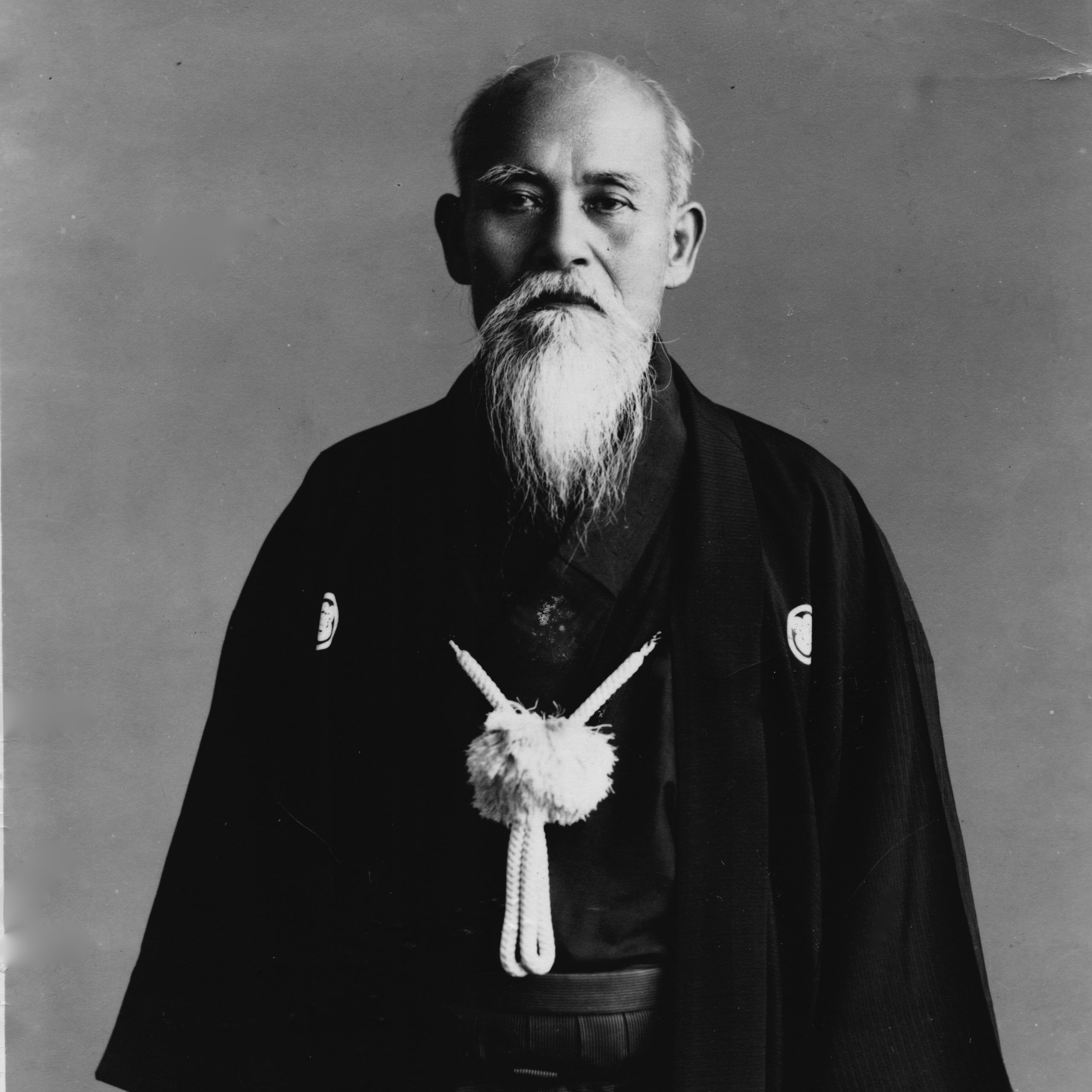
I remember … what people used to say when this little Japanese man, this teacher of a strange and wonderful martial art practice .. was alive .. even if I never met him when he was alive. He was a strange little old man whose peaceful existence was unimportant in the affairs of the world at large, and you must realize … it is you own imagination that creates any more importance than this.
He was a man who lived his life, lived his times of war and peace, and survived to pass on some skills to students, friends, and even some strangers.
My point is simple, Thank-you O’Sensei for trying to find a way of peace beyond the old ways of war and destruction. Thank-you for trying to be a better person than ever could be and inspiring people around the world to try be better than then ever thought they could be. Rest in peace old fella, we who live today will try to practice and pass on what you have passed on to us.
Mr. Pranin,
Do you have any thoughts on the theory that personality affects how techniques are performed and, if you believe it’s true, then wouldn’t that support your belief that most do not perform identically to O’Sensei?
After years of Aikido i started reading the lives, the paths of the most important “students” of O’Sensei.
Atfer war many of them left Japan to expand this art and they have formed different associations with different styles, so we now have different options: from Aikikai to Iwama ryu, ki-aikido, waraku aikido….
At a first sight i may say that each of us has a personal style, a personal view of what a martial art should be, and so: if i master it, i can create my own style.
This is perfect, but since Aikido means Harmony, Join, the above point of view has no more worth.
This split leaves the main path of what “AI” should mean.
Once we are at the top we should master all the aspects of this art, otherwise we must delete the “AI” word.
When i started 13 years ago i did not worry about the style, or the federation i was going to join, for me was simply AIKIDO.
I would like to learn all of the aspects of Aikido, but i know that this is almost impossible.
So my simple question is “Did O’Sensei failed in his mission?”
Can we compare the actual Great Masters to O’Sensei?
I agree with Stanley, we now practice just a derivative form developed by the key students.
But we also have to remember that few hours a week is an amount of time not enough to learn Aikido.
Morihei Ueshiba was pivotal in continuing something of immense value. What we do with it, and where we take it, is up to us.
I too began as a student and was taught about the ‘founder’ as if he was a single source, an origin. Only later through study did I learn that he was himself a student absorbing and developiong from his teacher Takeda Sogaku. This teacher also was responding and adapting to the kata system of Jigaro Kano. Indeed, improving and refining the warrior is a key concept of martial arts throughout the Tokugawa period (1603 to 1868). So, in my view, there is no fixed point of origin, rather an evolution over time.
I would agree with Alex that in some ways there has been a fragmentation of the harmony from the various styles. I was confused for some time by the various branches. However, one can also argue that Aikido is of the moment and therefore its characteristics are of that time and place. Your personal style adapts for novices compared with dan grades, and from dojo practice to street situation. Even Ueshiba’s Aikido varied as he aged!
I personally don’t think Ueshiba is the be all and end all of Aikido – and I confess I was underwhelmed by the current Doshu at a recent seminar. I understand the reverence to Ueshiba as etiquette but have come to believe that there excellent Aikido practioners who develop outside of Japan. As a dynamic and supposedly formless art it cannot be a closed and finite system. I view Ueshiba’s guidance as an introduction to the endless possibilities we are invited to explore.
Thanks for the interesting debate.