
 Josh Gold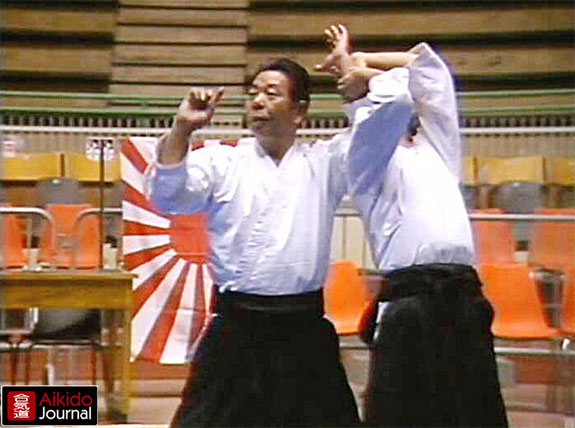
“From nage’s point of view, a grab is the gift of an arm
and hand which might otherwise be striking.”
 Ukemi is vital to aikido. Falling is only part of it. Yes, it’s important. Do it badly and it will hurt. But if your attack isn’t serious, why should anybody take the trouble to throw you? Right. In my mind I remember Bob Nadeau, “I’ll tank for you. You tank for me. We’ll call it harmony.” There was a touch of disgust in his voice and he’s possibly the most tolerant of the Northern California “founders”.
Atemi have been dealt with on a number of occasions. From a dojo ukemi point of view it shouldn’t be too hard to learn to do tsuki. I encourage you to learn how to put power in the last few inches of your moves. Without power, speed will only allow you to tap your target. From the point of view of nage, that may be sufficient. I recommend the makiwara for developing power. Heavy bag is also fine, especially for learning the difference between a tap and a punch. Shomen and yokomen uchi owe a lot to sword. Funny thing about that. Heavy bag might be the best training tool. As for other strikes and kicks, have fun. They’re all good exercise. And never know when some might come in handy. Also good to know your limitations. I should never try to kick for effect above waist level. I’m not built for it. There’s a lot of power in leg muscles. You can trash your joints. Kicking air is probably more physically sustainable than anything more solid, especially if you’re over 30.
What I really wanted to talk about is grabs. Atemi are pretty obviously aggressive. Grabs, like most joint manipulation techniques are more subtle, at least if done well. From nage’s point of view, a grab is the gift of an arm and hand which might otherwise be striking. We do so many techniques from grabs. A person might be inclined to wonder why anybody would be so dumb. Well, a lot depends on how dumb their grab is. The dumbest grab is the “You can’t move me or do the technique. Nyah-nyah-nyah.” Almost invariably a fancy technique is unnecessary for those. Outside a dojo such an uke can hang on as long as they can take the abuse of nage’s atemi. When they loosen up, techniques become available. There are other options for dealing with rigidity, depending on how much attention it actually requires.
So, let’s move on to smarter grabs. How about morote dori? Done astutely morote dori is a species of old style ikkyo; sword grip, elbow joint locked straight, shoulder thereby controlled. Fine, the shoulder is immobilized. So what? Well, pretty obviously a move is to pin the shoulder down. Game over. There are lots of other possibilities. I recently came up with transition to a pretty conventional transport technique involving a hammer lock and a strangle. Interestingly that came from a real encounter which started with a kotegaeshi. Long story.
The theme I would like to propose is, “Give up no hand and arm without gaining an advantage thereby.” Morote dori gives a rapid and decisive advantage. How? Joint lock. So, consider how to grab with one hand to achieve that. Katate dori is pretty easy, one handed sword locking the elbow and affecting the shoulder. Hiji dori is harder. Surprisingly, kata dori is harder yet. Ushiro kata dori is a bit easier, placing the hand just behind the armpit and taking control of the shoulder blade with your tegatana. Self protection is an important element in any of these. Mostly I keep the person grabbed at a distance from which it’s inconvenient to strike. Now, aikido has no monopoly on ways to struggle out of a grab. Except for morote dori which has the possibility of instant success, I like to think of grabs as “place holders” which give you time to do something which will be decisive. Gyakute tori, for instance, is a convenient transition to a wide variety of ushiro grabs, or, more decisively, strangles. As nage I think of atemi as place holders too.




Thank you for those thoughts. Because I trained aikijujutsu first, you always atemi. From experience this is usually enough. I like grabs because it helps you learn how to take balance from strikes. If you learn how to control your partner from a grab (musubi i think-please correct me), then you can apply with a strike. The one thing I have learned is a grab will help you work on your movements first. Later when you receive a punch or kick then you are better able to deal with it.
Sometimes, one must deal with new students, always ask, but i can do this or that. Just train, don’t worry about what ifs? It will be enough. If you want to test yourself, go to a mma gym and train and enter competition. There is no other way to test your ability. Aikido is for some self defense but more for fun. But train aikido first then try other martial arts, so enjoyable when you already know how to conserve energy.
Especially with popularity of Bjj, so much fun if you train aikijujutsu or aikido first…
Enjoy your training and have some fun, don’t take it too seriously. And never ever have just one teacher…