
 Josh Gold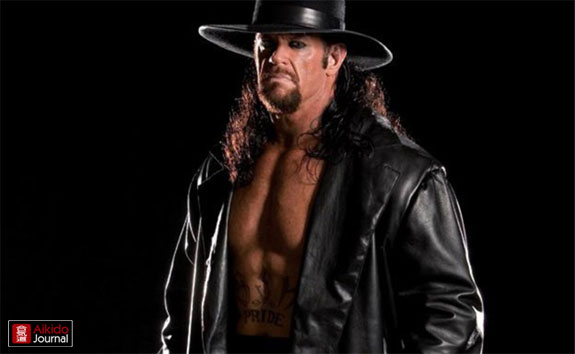
“He saw O-Sensei through the eyes of a
professional athlete and masterful performer.”
 Sitting alone in my dojo late one night, I received a call from a fellow named Mark. He said he was a professional wrestler looking for a new trainer. As a kid, I used to watch pro wrestlers all the time on TV, and even got my dad to take me to some arenas. Those guys seemed like big mindless hulks, but they sure put on a good show. When I got older, and learned it was “fake”, I lost interest and stopped watching it. The guy on the phone could not be one of those guys; he was bright, articulate, humble, and a real gentleman.
We talked for a long time about martial arts training. He was particularly interested in the skills of falling, avoiding injuries, and how to keep an aging body together. He asked a lot of questions about O-Sensei and martial arts masters I had trained with in Japan. Mark was fascinated by how good aikido black belts executed powerful joint techniques and dangerous throws without injuring their training partner. He clearly had great respect for that.
I still lived a little like a monk back then, and did not watch much TV. When he mentioned his stage name was “The Undertaker”, it meant nothing to me. I laughed and said, “that’s good, I like that.” I figured he was a martial artist contemplating a wrestling career, since his humility gave no clue who he was. I was completely ignorant of the fact he was already a legend, at the top of his game, and that he had turned “The Undertaker” into a multi-million dollar enterprise. Perhaps it was refreshing for him to speak with someone not star struck. Someone who did not want anything from him.
The next day I asked the first student who walked in, “Have you ever heard of a wrestler called The Undertaker?” I quickly learned just who this guy was. What was most fascinating to me was his martial arts knowledge, and his depth of understanding. He had a unique point of view on so many things. When he watched the old films of O-Sensei, Mark Calaway did not see an old man with magical power tossing around helpless attackers, as most aikido students do. Neither did he not see a phony, choreographed performance with make believe attacks and guys just falling down – as some do.
What he saw was an amazing interaction between people. He said he saw the tremendous concentration and energy, and how precisely attuned one was to the other’s every movement and nuance. Where others saw magic or collusion, Mark saw high level teamwork, and masterful coordination. He was thrilled to watch such excitement, energy, and drama – without injuries. He saw O’Sensei through the eyes of a professional athlete and masterful performer.
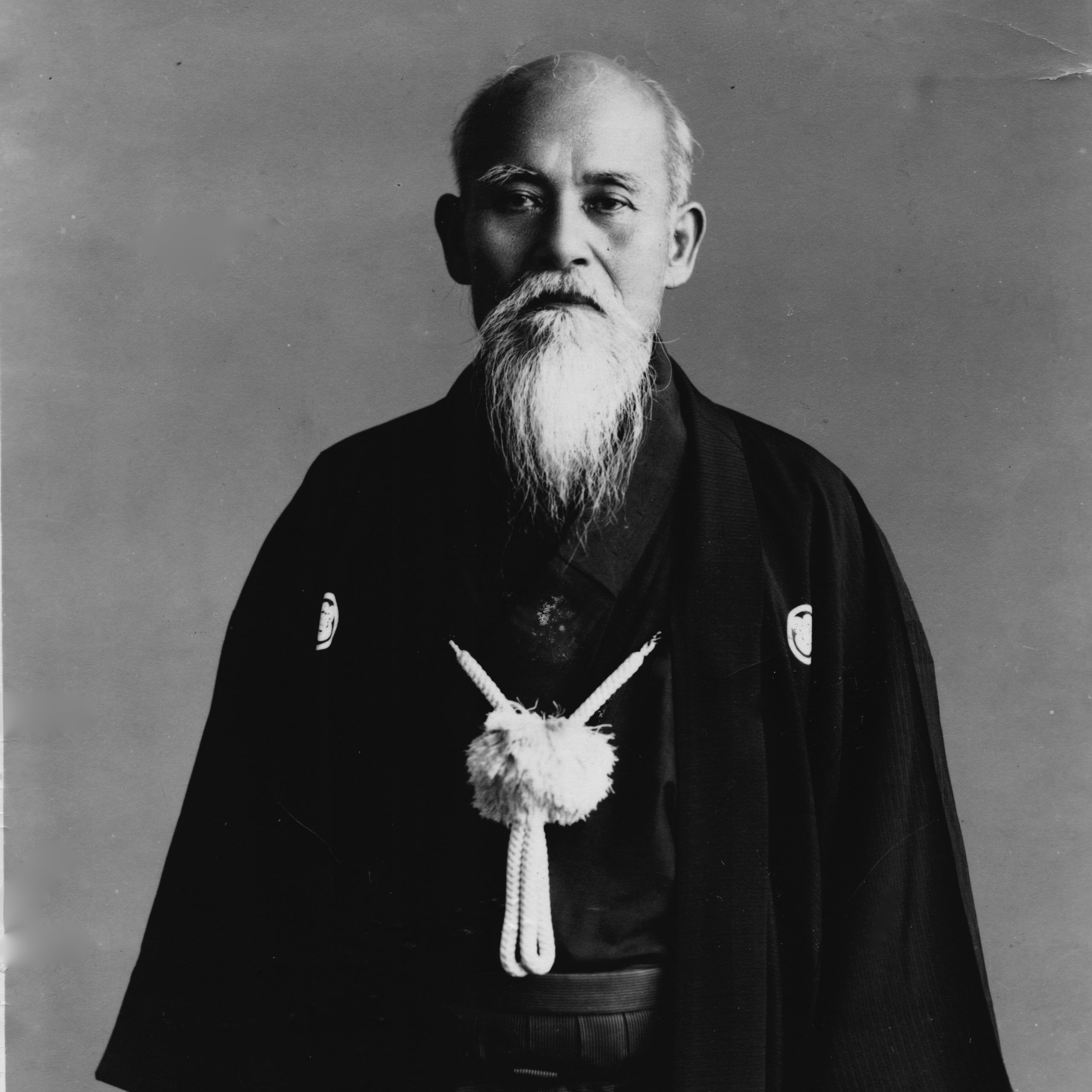
Our dialogues explored the level of interaction between two people where communication and coordination reaches spontaneous – unrehearsed action. This was natural for O’Sensei, but rare for the rest of us. In Asian disciplines, this is first practiced as “ki musubi,” or tying together of energy. When mastered it becomes “takemusu aiki”, spontaneous – creative – responses.
I related how a paired sword form at a fundraiser demonstration had evolved from prearranged kata to something approaching Takemusu Aiki. I had practiced the kata hundreds of times with a friend who is a skilled Yagyu swordsman. During the demo, while cutting at full speed, I inexplicably began cutting in totally different ways from the practiced form. It could have been a disaster, ending in serious injury. Yet, my partner spontaneously improvised – flawlessly matching my every movement. As if we had practiced that way a thousand times. How did he do that?
I doubt anyone watching believed all those cuts and parries were spontaneous and unrehearsed. I found it hard to believe myself. How did he so perfectly and unexpectedly adapt? These were strange esoteric Asian concepts to me, but not to Mark. You cannot send your three hundred pound body flying fifteen feet across a wrestling ring, from the top of five foot high ropes, onto your opponent’s throat – without a unity of interaction approaching ki musubi and Takemusu Aiki.
Mark knew I had taken falls for O-Sensei’s son, grandson, and other masters during my years in Japan, so he figured I must know something about avoiding injury. “When you get some success, it’s easy to get lazy and complacent,” he said. This guy must have been reading my mind, because I had been telling myself, and my black belts students that for years. He asked if I was available for private lessons, saying “I can pay whatever you want.” That I had not heard before. Assuming he was just another martial arts bum like me (unaware he was a multi-millionaire) I said “don’t worry about money. I have a day job, so come by anytime and we’ll train.” I also gave him the names of one or two guys who were better than me.
These days, I watch him snarl, growl, and radiate his dazzling insanity before the cameras, and appreciate what an amazing actor he is. I also know how much incredibly hard work and intense training goes into his wrestling matches. Those guys are not only great showmen, but amazing athletes and very good martial artists.
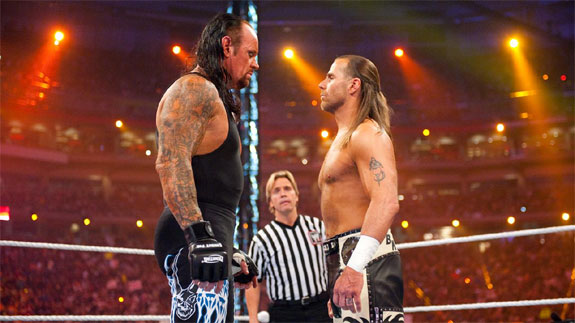 That The Undertaker remained at the top of his game for decades, outlasting almost everyone else, is no accident. One reason he has been able to take such brutal punishment well into middle age is because he is a master of ukemi. This term usually denotes the ability to fall, but at the highest level it is a form of masterful cooperation, or “becoming” whatever is being applied to you. At this level, both participants create the outcome. And this skill is not just for show – it allows the hardest, and most dangerous training to safely happen. Very few martial artists understand this.
Kaeshi waza, or “reversal techniques” in martial arts are really not techniques at all. It is an attitude of nonresistance, where joining can become escaping, leading, or reversing. It is becoming an “active participant” in whatever the aite (“partner-opponent”) is attempting. When you give up the concept of winning/losing, nothing can be done “to you,” only with you. The difference is huge. It is a kind of cooperation that makes you nearly indestructible. As close to injury-proof as it gets. This allows a sixty-three year old guy like me to train hard with young guys, and love it.
I once assisted an extraordinary Chinese martial artist to prepare for a national tournament. In my mid fifties, I had no interest in sparring, but none of his students had enough falling skill. None of them could handle his incredibly powerful throws and sweeps. It was great to discover I had no difficulty handling such power; I felt like a leaf riding the winds of a storm. Leaves don’t break – they just get blown around. I stayed light, and let his power send me airborne. It was great fun. He was doing all the work – and I got to fly!
Giving a training partner the opportunity to blast out uninhibited power is about the best gift one martial artist can give to another. Our training was fantastic, until I decided to be a “good competitor”. I decided I should offer some resistance. Big mistake.
As his lightning fast leg sweep exploded under me, I dug in and held my position. I stayed strong and grounded. That decision cost me a $5,000 knee surgery, and six months of rehab. He won the tournament, and thanked me for my help. But, I got more out of that training than he did. The lesson was learned deep in my bones that day – you must give up your position to be indestructible. I never made that mistake again, and have had no serious injuries since. Those who attacked O-Sensei said he just seemed to “disappear”. The great Professor Cheng Man-Ch’ing taught: for real strength you must “invest in loss.” They were both teaching us that our greatest strength lies in resilience.
Learn falling skills, then adopt an attitude of nonresistance. Finally, go beyond nonresistance to “active participation” in whatever throw, sweep, pin, or attack is directed at you – so that NOTHING is ever done TO you. ONLY WITH you.
It is ironic – while most martial artists seek to win by resisting being thrown, The Undertaker does the opposite. He uses nonresistance and cooperation. It is the secret to his success and longevity. He reminded me that we age, falling becomes my most important physical skill. My mother never recovered from a fall. Hospitals and nursing home are filled with bodies broken from falling. This is so unnecessary.
We must follow the lessons of small children. They fall a thousand times learning to stand and walk, yet rarely get injured. The more they fall, the better they fall. Yet, an old person falls – and it is frequently catastrophic. Why? Because somewhere between childhood and old age, we stop falling. Then, we forgot how to fall.
So, please excuse me now – I am not young anymore, so I must get to the dojo for training. Like my friend “The Undertaker”, I have to get in my hundred falls before supper!





What a wonderful opportunity. I know people who think the epitome of martial arts is to become unthrowable. One can barely walk. I was incredibly fortunate to have a few minutes with Terry Dobson who didn’t want to do koshinage so gave me a micro-lesson in sutemi waza.
Great read and a left of field story. Gives me ideas for the marketing of aikido.
I started my learning process back in 1966, in Jiu-Jitsu and Judo with some of the best teachers.
After the first year I learned reversals with every technique that I learned.
I learned to change direction while I was in the air, so as to make my LZ my choice and not the person doing the throw.
This has been my savoir for all these years that I have been doing the Arts.
But in Aug 2013, I had to have a Reversed Shoulder Surgery done, as the joints were separated by almost 3/4 inches and the tendon in the arm was bad. Too.
I can do everything except take falls and rolls.
The up side of it is that I can still teach and every one I have shown how to relax and control throws, and save there body so as not to get hurt have been able to do it, Its in the MECHANICE of the body.
Great story about Aikido happening via keeping and creating good relationship with body and mind.
Thank you Tom, that was really insightful… never knew these aspects of ‘The Undertaker’