
 Josh Gold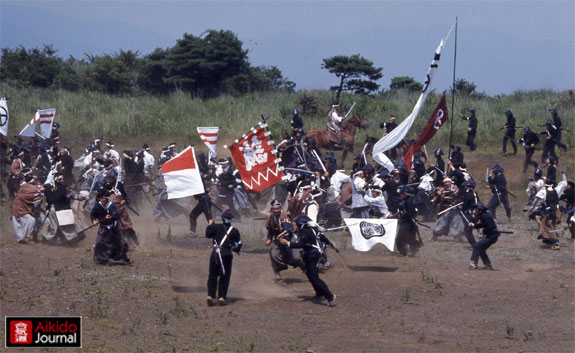
“We need an Aikido which does not sell illusory hopes of any kind; an Aikido that recognizes how vulnerable and fragile and worthy we are.”
Death is a taboo in the contemporary Western world: the bourgeois socio-economic system sells and instills the illusory possibility of being able to consign death to oblivion, avoiding it as much as possible and thus ensuring a continuous flow of compulsive consumers. The contemporary Western bourgeois class lives as if it will never die.
This illusion permeates Western culture, even infuses the areas where death should be a logical presence, at least in hypothetical terms. One of those areas is the practice of martial arts in general, and Aikido in particular. I use the term “martial art” in a narrow sense, referring to those arts that claim to be the embodiment of the Way of the Warrior, and not including the sport oriented ones. In this case, the martial practice is shaped to this illusory vision, and embodies the possibility to definitively escape death, which means basically, “if you do this or that, you’ll be able to come out victorious in an eventual fight”.
In the specific case of Aikido, which proclaims to be a martial art in a strict sense, we observe a set of techniques, methodologies and concepts that seems to mix up the aseptic place of training with the place of life in its most obvious sense: that which is being observed by death. Aikido and its practice are aimed towards victory over a real enemy. Aikido openly assumes that by training more, the practitioner will be closer to achieve victory, that is, to cheating death.
But assuming that we are facing a real battle, the possibilities of victory are at least equal to the chance of dying. This is quite obvious, and yet that possibility never arises in Aikido training. It is assumed that, in the clash against a more or less expert Aikidoka, the enemy will end unscathed, and with the understanding that violence is unnecessary. It is assumed that the enemy will experience a kind of psycho-spiritual enlightenment that will transform his violent way of relating to the world and will lead him to abandon his aggressive intentions, in a sort of loving conversion.
But what if the enemy does not abandon his aggressive intentions? What if the enemy has lost any trace of dignity, which make him incapable of any kind of conversion? What if the enemy suffers from an absolute contempt for human life, including his own, and is willing to annihilate the Aikidoka and all his years of training in the “art of peace”? What if the hypothetical Aikidoka ends up dead? Then what? Is the current Aikido a Path to face death? If it is not, would be still considered as a martial art?
I believe that Aikido has the potential to be a martial art in the strict sense, that is, a Path that allows the one who walks it to face his own annihilation in the spirit of isagi yoku, fully awake, totally alert and aware, in a dignified, honorable way. But a transformation is required, at least at an individual level.
Although this could sound outrageous to the ears of most Aikidokas, I must say – along with one of my teachers – that a combat could be reduced to a single possibility: kill as many people as possible, until you are killed by someone else. It sounds terrible, yes, but this is war, and martial arts are the arts of war.
One may think that this prospect will lead to some kind of extreme savagery, but that would mean taking into account only one side of the problem: annihilate the enemy. The second matter, the one relative to one’s own death, puts in front of the Warrior/Aikidoka, with absolute harshness and sincerity, his own vulnerability, his inevitable transitory nature, and therefore his own value as a human being in particular, and the value of human life in general. Perhaps this recognition of the value of human life is the foundation of all virtues. Without it, how can an art be called “martial”?
In the words of Chögyam Trungpa: “If you are a warrior, decency means that you are not cheating anybody at all. You are not even about to cheat anybody. There is a sense of straightforwardness and simplicity. With setting-sun vision, or vision based on cowardice, straightforwardness is always a problem. Decency is the absence of strategy. It is of utmost importance to realize that the warrior’s approach should be simple-minded sometimes, very simple and straightforward. That makes it very beautiful: you having nothing up your sleeve; therefore a sense of genuineness comes through. That is decency.”
I think, with all humility, that current Aikido needs to return to that stark, absolute sincerity, to that basic decency. We need an Aikido which does not sell illusory hopes of any kind; an Aikido that recognizes how vulnerable and fragile and worthy we are, and whose only aspiration would be, in the harsh words of Kato Kiyomasa, “to grasp the long and short swords and die”.





If the topic here is “Death and Aikido”, I would submit that the above is slightly off-remit. Death and killing are two distinct human experiences, and one thing for certain is that while we are all implicated in former, we are by no means all implicated in the latter. Killing is a particular kind of experience, just as the ‘art’ of killing is a special kind of activity. To lump killing together with the experience of death is to attempt to romanticise the butchery of battle with one of the great mysteries of life. As a corollary to that, I would submit also that a group of serious meditators may be more ready to ‘face’ death than a group of martial artists, and with a great deal more core decency too. So please, let’s us not get all kinky with notions of killing. It is absolutely unnecessary.
Illusion is and has always been easier to sell. A corollary is that if there’s a spiffy school they may be selling illusion.
Immortality is the ultimate illusion, at least in this universe. The universe itself is mortal. Prolonging life, at least improving your odds, is eminently possible. Unfortunately the process is unattractive. Moderation is a pretty hard sell; eating, drinking and exercise in moderation. Do that, though, and you improve your odds significantly. Almost incidentally you’ll also be better prepared to defend your life in the fairly unlikely event that becomes necessary. At least in our society the likelihood of a life or death encounter is pretty small. The vast majority of people will never have one, despite all the scary news stories. Of course if you invest some exercise time in training martial technique you get a “two-fer”, fitness and preparedness. As for immortality, though, that’s in the realm of religion. Isn’t it interesting that as religious as O Sensei was, there is almost zero interest in religion in modern aikido?
So, what illusion can be sold? Well, I was the proverbial 96# weakling who had sand kicked in his face while the girls went off with the bully. So, to me victory and sex are pretty marketable. It came to me early that the only permanent victory involves killing the opponent. For a while I worked on killing. Fortunately I never killed any people, but I got pretty good with the process. If that seems repugnant, well, it is. That’s why training is important, to minimize the flinch. In the military and law enforcement they gave up round targets and went to man-silhouettes for that purpose. Having a gun is fairly unimportant if you don’t also have the will to use it with all the consequences that come.
Paradoxically, however, within the context of inevitable death, life flourishes. Patton “got” that winning war involves killing more of the enemy. If you put all the Pattons together, though, then add all the Hitlers, Stalins, Maos, Pol Pots and any other mass murderers you want to name, even Spanish Flu, the number of humans on the planet has been expanding exponentially for over a century. Individually and eventually death rules, but in the meantime life comes up through the cracks.
Back to the energy of killing. Normally it takes something to do that. Granted there are ways to distance yourself from the process, land mines, time bombs and so on, but killing is normally an act. Acts are a matter of volition. Volition involves intent. And that is the weak link. If your intent is visible, then the intended target can take counter-measures. Also, while you are focused on your target, you are pretty oblivious to your surroundings. There’s a reason snipers work as part of a team. There is also, I suspect, a reason that many of the Daito Ryu pins are not in the aikido repertory.
I won’t say that O Sensei’s only inspiration was that Aikido can remove intent from combat, but he did say he left it all in the hands of God. He also, like Pilate, washed his hands of the consequences of his art saying that if anybody was injured it was a result of their intent. These statements seem pretty strange at a beginning level. The more I train, the more I understand what he said. At the level of spontaneous, takemusu, aikido nage has very little intent. A wave flows and ebbs across a beach according to the micro-topography of the sand. There’s a pattern but no intent.
Pretty hard to pay the dojo rent with a concept like that, but, then, O Sensei really didn’t worry about it.
See the world as it Really is….not as you wish or like it to be.
Do is for peace time and for philosphical utopia. The enemy faced is the one within, the most probably conflict faced is the ones of verbal or mental kind. You oversimplify the concept of enemy. Bujutsu is the science of war. Budo has another target.
Or as my sensei once said “if he does not give up by then, drop a knee to his face” (in a shihonage lock).
Nice article. I often reflect on the idea that martial arts has combative roots which are sometimes less emphasized but the real reason i train aikido is because it is fun. Thanks for those thoughts.
Great post.
It is really through acceptance of what it is, that we can progress.
Thanks to everybody for the feedback! Just for the record, I’d like to add I live in Mexico. You know, 20 000 murders a year, so real death is everywhere. I wonder here if current Aikidô has the potencial to help us to face that (stupid, meaningless, terrifiying) daily presence of death, or hasn’t… What do you think about it?
As a person who is trained in aikido for 14 years, I would like to respond. Aikido is not about avoiding death, or causing death. Aikido is about living. The question is how are we going to live? If I live with the idea of having to defend myself, I am living in a world of fear. Aikido is about connecting with the energies around us, both human and nonhuman. An effective life is one that is based on compassion, understanding, and tolerance for others. It doesn’t have much to do with defending myself.
How many of us will find ourselves in the midst of a battle? Very few indeed, I think. If I find myself in battle, an assault rifle would serve me better than shihonage. How many of us, however, find ourselves at odds with our spouse, our friends, and our bosses? Aikido gives the practitioner the ability to respond appropriately to whatever life has to offer.
That’s a really good answer! Thank you very much! I agree with you in almost every point. Yes, Aikidô is about living a worthy life. But I humbly think that one can’t really appreciate the worth of life without perceiving how fragile our life is. From that perception, you can create a life of true compassion, because you see your same own frailty in the eyes of every living being. Aikidô is about living, yes indeed, but is also about dying. Martial arts are about death, and we -as martial artists- learn to die in order to learn how to live a meaningful life. I have never been in a battle (and I hope not to be) but I have been in countless fights and I had see violent death in front of my eyes a couple of times. I have painfully learned that no matter how hard I can practice, how many techniques or principles or tricks I can learn with no matter who, I will never be invulnerable. This is especially disturbing when you live in the most violent country of America. Fear? Yes, here we live in deep, bitter fear. I wonder how can we have a good life despite that; I wonder if current Aikidô (the real one, on the mat, not the book’s aikidô) has the ability to conduct us beyond fear (and I really wonder who is teaching/living that kind of aikidô: I would like to know him/her right now), beyond the need to defend us. It’s not about using an AKM-47 or a shihô-nage: it’s about going beyond death, walking the Way of the Warrior as current aikidô pretend to be.That’s my quest. But now I’d really like to know your oppinion…