
 Josh Gold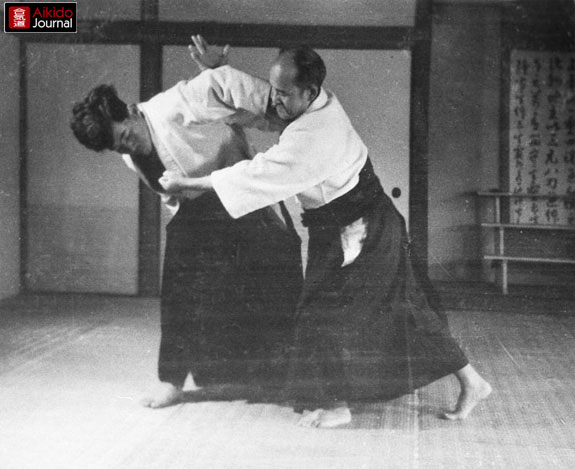
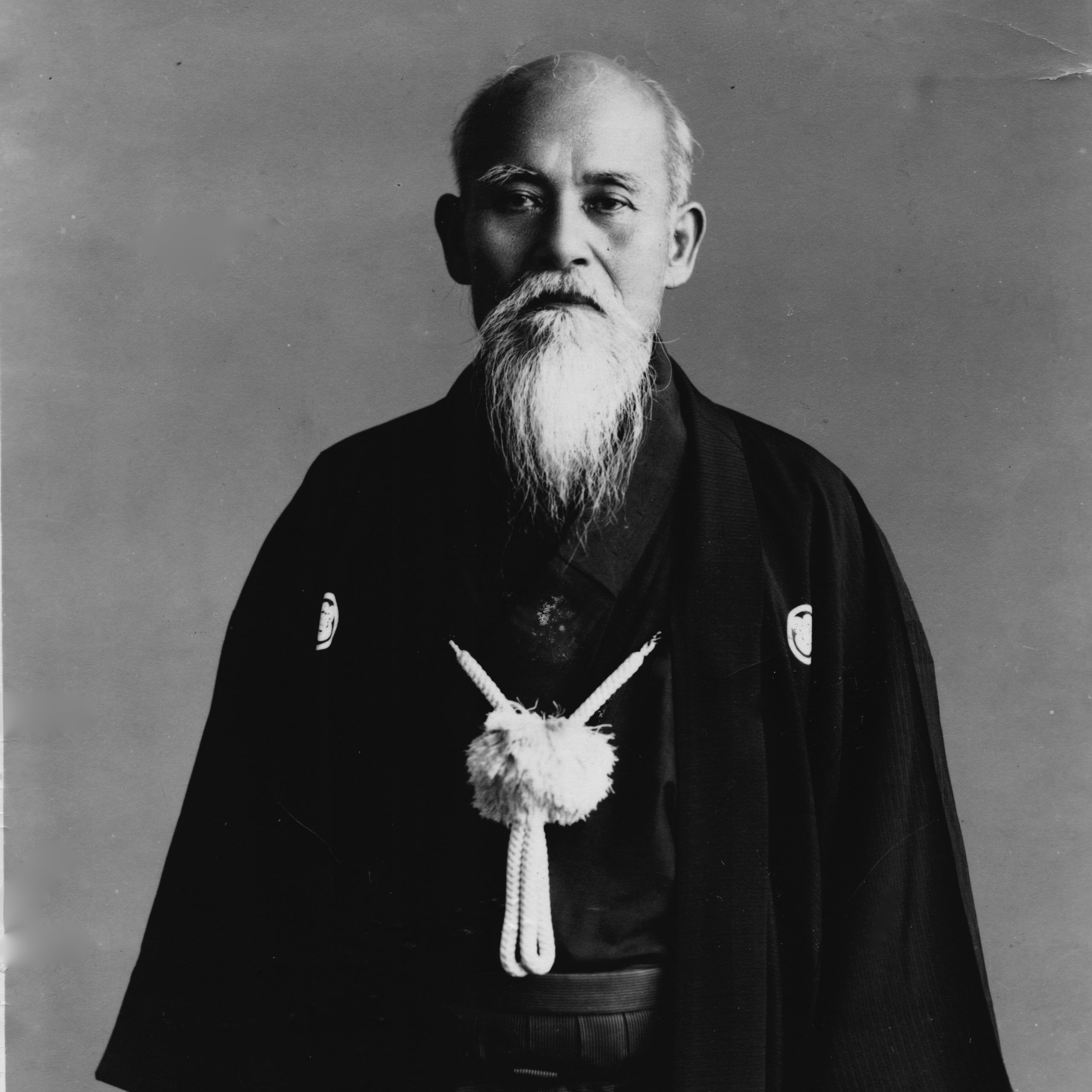
A technique with atemi strike demonstrated by Morihei Ueshiba in 1936 from the Noma Dojo photo collection.
“In reference to O Sensei’s videos, Morihiro Saito used to say that O-Sensei ‘hid’ his techniques with extra fancy movements so nobody could ‘steal’ them from him. What we see is, I believe, just a glance into his actual techniques.”
 Yesterday, a reader submitted the above comment on Facebook — which I have edited slightly — in response to a video I posted of Yoshimitsu Yamada Sensei of the New York Aikikai. Many times I heard similar sentiments expressed during my period of research in Japan. But this time seeing this idea resurrected yet again caused me to rethink the subject. Let me share with you some of my musings.
First of all, this idea is commonly voiced in reference to old martial arts masters who were making a living from teaching their techniques and wanted to stave off any competition. For example, Sokaku Takeda, Morihei Ueshiba’s jujutsu teacher, was reputed to have done the same to his students. Thus, it is not at all surprising that one would think that Morihei, a man formed in Meiji Japan, would adopt a similar attitude. One could even point to the fact that O-Sensei’s techniques of his final years became little more than abstract gestures making it virtually impossible to “steal” them.
As a historian, how should I think about this idea that Morihei would hide the essence of his techniques from students? Why would someone who thought of things on a grand scale and considered aikido as a tool for bringing about world peace deliberately hide the true nature of his art? To do so would only insure that the essence of his art and philosophy would not be transmitted to future generations, the exact opposite of his stated goal. Basically, this makes no sense at all.
Consider these historical facts.
- Morihei Ueshiba published a technical manual with line drawings titled “Budo Renshu” in 1934
- In 1936, the Founder was photographed demonstrating hundreds of intricate Daito-ryu techniques that survive in the Noma Dojo photo collection.
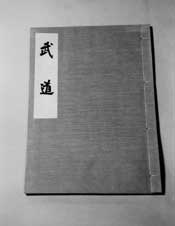
- He then published a second technical book called “Budo” in 1938 for Prince Kaya, a member of the Japanese royal family.
- Morihei reluctantly gave a demonstration before members of the Imperial family in 1941 having first declined the invitation because he did not want to show “lies”!
- Morihiro Saito, an early postwar student of O-Sensei in Iwama, learned literally hundreds of empty-handed and weapon techniques from the Founder over the course of more than 20 years.
When we look at historical events, we tend to do so from our contemporary perspective. We subsconsciously overlay our value system onto past events to try to make sense of them. Seen from a modern didactic standpoint, O-Sensei’s technical methodology seems crude and ineffectual. But the Founder knew nothing of modern pedagogical theory, and was himself taught according to traditional methods which stressed careful observation and constant repetition.
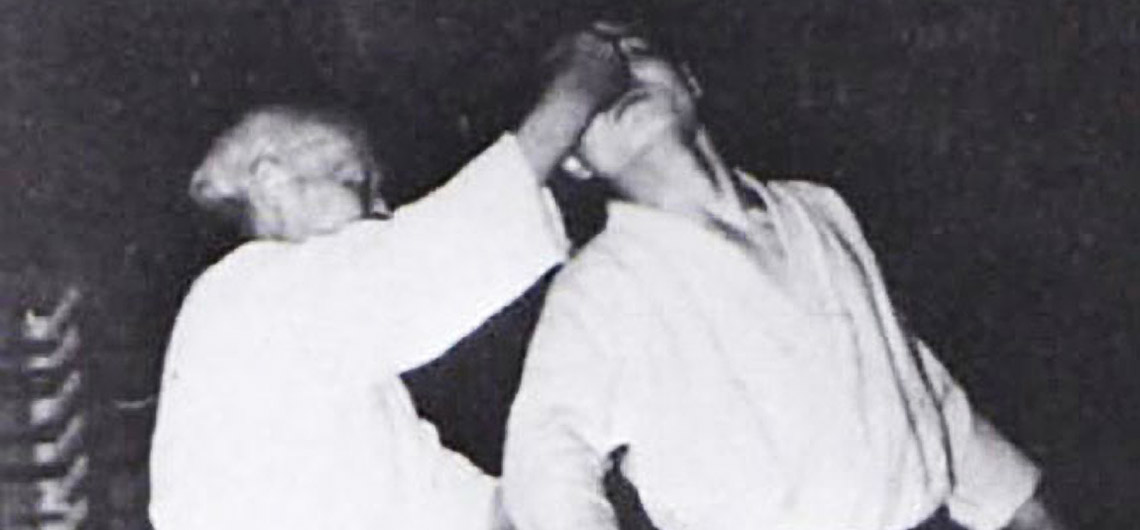 I have stated many times that Morihei’s teaching curriculum does not have much of an impact on today’s practitioners. The fact that the Founder was formed in an earlier era with totally different values that are very foreign to us as westerners creates a great gulf that must be spanned if we wish to access the nuts and bolts of his art. On a personal level, ill-equipped though I may be, I have long been involved in an effort to reconstruct aspects of O-Sensei’s curriculum that have been effectively lost to us. I find this to be a fascinating study and some members of our readership appear to be enjoying hearing about these discoveries.
As to comments like the above, we should perhaps step back for a moment and reflect on what we know about aikido history, rather than reflexively accept such views as historical fact to build upon when ample evidence to the contrary is available.
—————————————————–
Watch these videos for insights into solving the
technical problems that hold back your progress!





As you go on the way ,aikido becomes spontaneus, you exit the forms but stay within principles.
Every technique is a natural responce to a new situation,there aren’t two identical.
The more you walk on the path,you see there is no path.
I don’t think he was hidding the art ,he passed beyound the forms.
I agree with you absolutely – with little concrete information available, we do resort to “Truthiness” in Aikido. These two manuals you mention are wonderful, and like the Asahi video force me to challenge many things I assumed were truth.
I also encourage Aikido practitioners to examine the teachings of other lineages. In my own study, I find it exciting to see what Tomiki, Shioda, Tohei, Shirata and others have in common with each other, and what they do differently. Some students of the Founder developed their own understanding of what he taught, and then their own framework for passing this on to other generations.
I see younger students resorting to other martial arts to study material that is already out there in the larger Aikido world. Often, it is because of a misguided/mistaken view of what Aikido was and is, and a mistaken understanding of O Sensei (in my opinion – because I don’t know him either).
Basically aikido techniques unbalance our partner/uke/opponent. At the end of his career O Sensei could do that by subtly misleading his uke with very little physical contact. An analogy was John Boyd, USAF fighter pilot and master strategist. Once he crashed his F100. He exonerated himself by demonstrating on the ramp that a certain sequence of moves would completely overload and destroy the hydraulic system by which the aircraft was controlled. O Sensei had a whole toolkit of those for the human body.
Outside the dojo of course nobody likes losing their balance and will become defensive to preserve it. That’s a “win”.
Adonis alluded to O’Sensei leaving technique behind in later years, a stage we must all reach to make aiki truly practical. Techniques are great exercise and can be beautiful art, but only the Principles of the art – the essential core skills – are practical outside the dojo, and adaptable to every situation. The catch is – techniques are easily seen and taught – core skills can be felt but are near impossible to see.
Chuck mentioned fighter pilot and military strategist Col. John Boyd, who I consider a genius right up there with O’Sensei. He spent his career practicing and teaching “Mind Over Might. His “Initiating rather than reacting” strategy allowed him to stay one step ahead of his adversaries, keeping them off balance with misdirection and distraction. Boyd’s role in planning the Desert Storm operation is credited with saving many lives on both sides.
Good morning Mr Pranin:
Thank you very much for highlighting this tremendously important point.
You have brought forth good concrete material that we can base O-Sensei’s techniques on. I believe it is instrumental for students to choose their teachers wisely and study with and support them for life. Our best window to see and understand O-Sensei’s teaching is to study with his students, Mochizuki Sensei being one. Now our generation must study with O-Sensei’s students, students. There are some teachers with such uchi deshi experience. I am extremely fortunate to have met and to study with Patrick Augé Sensei. Augé Sensei lived as an Uchi Deshi with Mochizuki Sensei for seven years.
I remember very well, after leaving Japan to teach in North America, he returned every summer to study with Mochizuki Sensei until his death in 2003. Augé Sensei now lives and teaches in Los Angeles, but he still returns regularly to Shizuoka and meets with other senior Yoseikan Aikido teachers. This type of teacher is a rare gem but students need to do their homework and know the lineage of their teachers, and seek them out. O-Sensei’s students and their serious students coupled with the remaining material O-Sensei left us, as you have pointed out, are our best resourses to continue our study which hopefully will lead to one human family.
Thank you,
Joseph
Does anyone have knowledge of , or thoughts about, the possibility/probability that some of O’Sensei’s successors may have deliberately changed or omitted important aspects of the founder’s art–and also that bad technical and other information was passed on due to faulty translations from Japanese into other languages (which may may also have in some cases been deliberate)?
HI here it is an article which treat of the diferent methods beetween occidental teacher and oriental teachers, it’s in french but it can explain why a lot of orientals senseï (with exeptions like Saito Shihan ) don’t and didn’t explain a lot the techniques : http://fudoshinkan.eu/enseignements-martiaux-occidentaux-et-orientaux/
Also, if Osensei wanted to restrict the true essence of his technique to just a few favoured disciples, one would expect those disciples to follow suit. Yet we find that many of them (Saito and Shioda especially) seem to have made a point of trying to teach as clearly and systematically as they knew how. That makes me think that Osensei may not have been a gifted pedagogue, but he wasn’t trying to conceal anything.
I don’t think O-sensei hid anything, necessarily, but the Japanese language is far more contextual I think than we realize. It is not information rich, but emotionally rich. In other words, if someone asks “how do you do that Ikkyo” a Japanese may read the question in one or more of the following conscious or unconsciously instinctive ways: ‘who is this man asking the question?’ ‘what emotion is he using to ask it?’ ‘what level of maturity does this emotion mean?’ ‘is he egocentric, immature, doubtful, stupid or vengeful or is he kind, keen, curious, sincere, loving, even compassionate in his tone of voice?’ ‘how does he fit into our organization..?’ ‘has he been coming to classes long?’ ‘is he worth speaking to?’ And so on..
In other words, the question “how do you do ikkyo?” is not considered, as we would consider it, a universal and objective question that requires an equally universal and objective answer? In demonstrating a whole variety of ikkyos or even changing his moves in response to the question, O-sensei was saying something along the lines of “harmony is most important… this is improvised and cannot be repeated”. Now, please do forgive me if I say this, because I don’t want to upset anyone on this panel or any other, but truly what O-sensei demonstrated here is just spiritual common sense. To put what I’ve just said in modern scientific terms, please see the latest literature on mindfulness. In short, we are at a depth level, energetic streams of sensations in a constant flux. If you can sense that in yourself, then there is no moment that is identical to the next, identity is an illusion generated by an equally illusory sense of a self that endures the changes. Of course, for cataloging, delineating, curriculum design and so on, to pass on what we know, we need to elaborate what we mean in time, but the central insight, as Bergson also found, is that there is no such thing as time, except as timelessness or duree.. And, perhaps love is this endlessly extending thing without borders, no membranes. Empathy with wings!
Hi everyone,
I guess everybody’s right here…but, as usual, things seem to be complicated.
– Of course, O Sensei didn’t teach in a modern, neither occidental way.
For him, showing was already teaching and – as it was said before – he was first of all practicing.
Instead of being taught, deshi practiced with (FOR?) him.
– But, in my opinion it doesn’t mean that everything was there, “hidden in plain sight”.
What if O Sensei considered that some stuff shouldn’t be shown to everybody ? I try not to forget that well considered practice on the mat was a (tiny) PART of his training. Add misogi, prayers, weapons solo training, farm works, reading….
My 2 cents…