
 Josh Gold
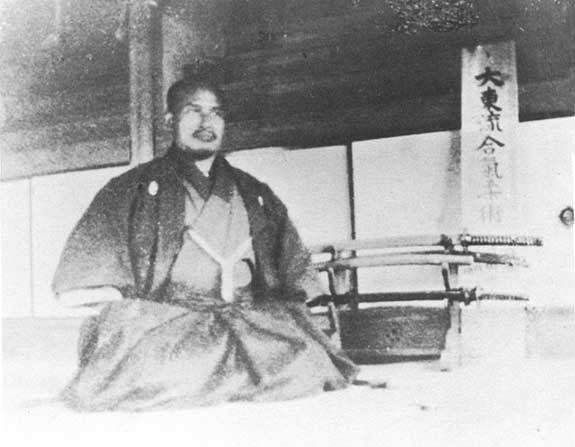
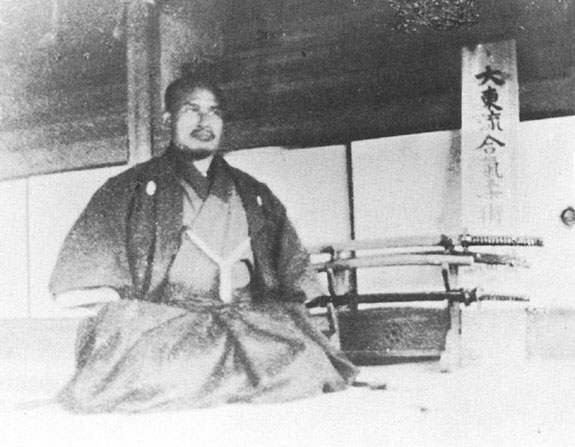
“This photo has been published in books and newsletters at least five times. Here’s the kicker. The photo appears in four different versions!”
Background
As a researcher of aikido history, this photo is one of the most fascinating documents I have ever come across. First of all, a little background. This photo was shot about 1922 inside Morihei’s home situated near the Omoto precincts in Ayabe. Morihei is seated in seiza inside the “Ueshiba Juku,” his home dojo that marked the beginning of his career as a martial arts teacher.
Immediately obvious is Morihei’s powerful physique and stern expression that convey a strong impression even 90 years after the fact. You will notice to Morihei’s left a sword stand holding three blades, certainly an appropriate accessory for a martial arts dojo. Then behind the displayed swords are a placard with kanji characters. This is where the intrigue begins…
Daito-ryu Aikijujutsu connection
What is written? The characters read: “Daito-ryu Aikijujutsu.” This, as you will recall is the precursor art to aikido that Morihei studied under Sokaku Takeda Sensei in Hokkaido beginning in 1915. If this is the dojo where Morihei Ueshiba, the Founder of Aikido, taught, why is this “Daito-ryu Aikijujutsu” placard on display there?
A fair question. You see Morihei was openly teaching Daito-ryu Aikijujutsu in his “Ueshiba Juku” because aikido had not yet come into being. In fact, he was a certified Daito-ryu instructor. Morihei was just beginning his transitional phase, technically speaking, that would culminate many years later with the creation of aikido. Also, Sokaku Takeda had recently visited Morihei in Ayabe, and they agreed that Ueshiba would use the name “Daito-ryu Aikijujutsu” to refer to his art.
Chameleon photo
Ok, but what is this bit about a “chameleon photo”? Ah, this is the interesting part! To my knowledge, this photo has been published in books and newsletters at least five times. Here’s the kicker. The photo appears in four different versions! Have a look below and see for yourself.
Four versions? Yes, the Daito-ryu placard first disappears altogether in the first publication of the photo. Then it reappears with the “Daito-ryu” characters missing, leaving only the “Aikijujutsu” characters. What’s a poor aikido historian to do? Then, the original photo you see here appears for the first time. Next, some of the characters are again omitted, but not in the same way as the first altered photo. Finally and miraculously, the unretouched photo again resurfaces, hopefully to remain intact. Strange workings of the kamisama?
Justifying the unjustifiable
Not exactly. From a historian’s standpoint, all of these “miraculous events” can be explained. Briefly, Morihei had a falling out with his teacher Sokaku Takeda that would lead to his distancing himself from his teacher. As a result of this, there has always existed a certain tension between the aikido and Daito-ryu camps despite a surface cordiality.
This reticence to give due credit to the significant influence of Daito-ryu on modern aikido has existed for many years, and was not surprisingly inherited by the Second Doshu Kisshomaru Ueshiba. These shenanigans with this famous photo took place in the period of the 1960s through the 1980s when Daito-ryu’s role in the evolution of aikido was little known. I believe this explains the psychology behind the photo tinkering. Now, I don’t believe it would be possible to do such a thing since the relationship between Morihei Ueshiba and Sokaku Takeda has been well documented.
Early in my career, I published one of these altered versions of the photo perfectly innocently, and it got me into quite a pickle!
Anyway, as Paul Harvey used to say, “Now you know the rest of the story!”
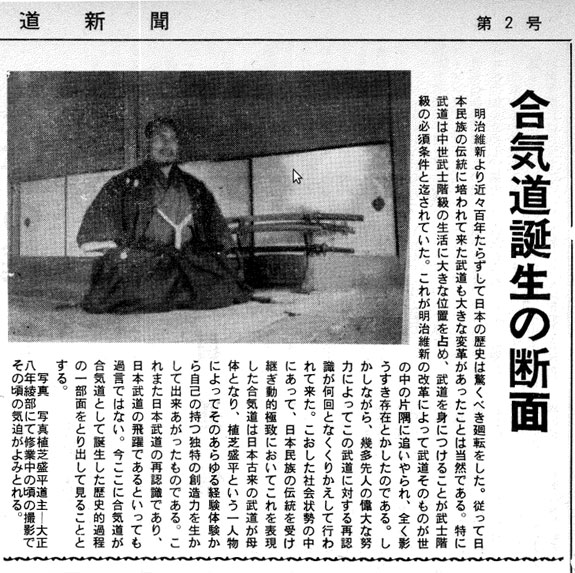
Placard reading “Daito-ryu Aikijujutsu” has been removed.
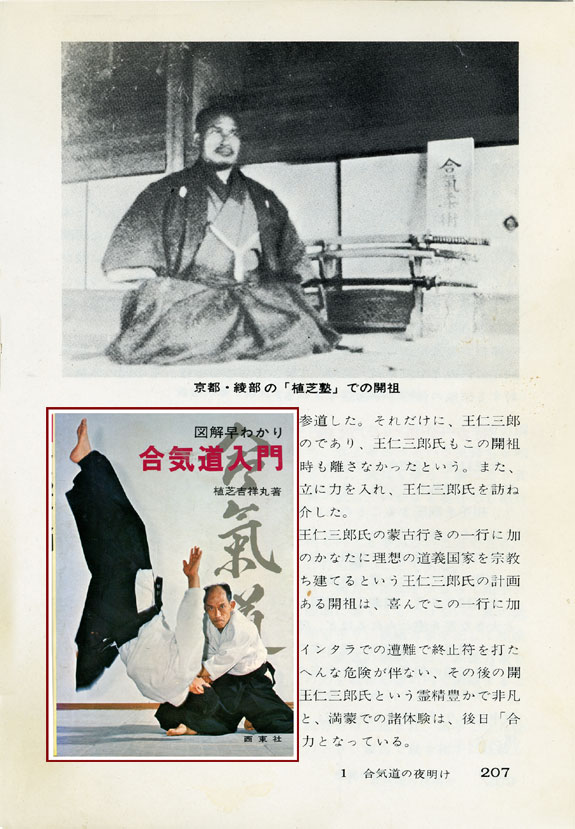
altered to read “Aikijujutsu,” the characters for “Daito-ryu” having been removed. Date of publication,
August 20, 1975.
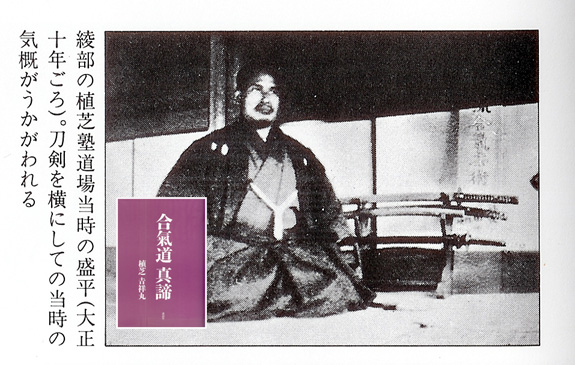
“Aikido Shintei” by Kisshomaru Ueshiba. Photo courtesy of Christopher Li
Here is yet another altered version of the photo that was published in a book titled “Aikido Shintei,” by Kisshomaru Ueshiba in 1986. In this image, yet a different alteration appears with the “ryu” character of “Daito-ryu” being cut in half, with the characters for “Aikijujutsu” being faintly visible below. The quality is very poor, and the photo quite small.

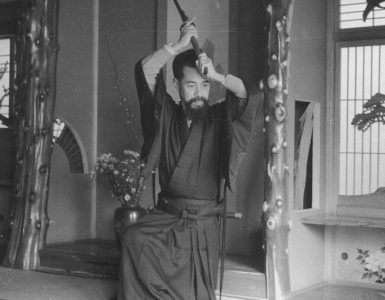
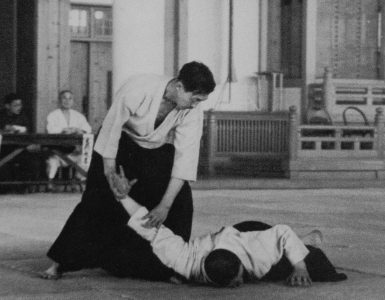
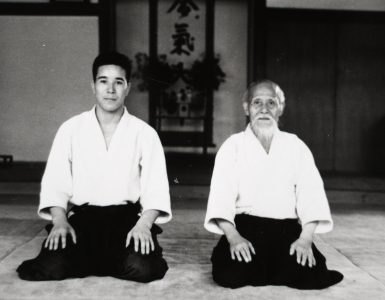




I have a copy of Aikido Shintei, I’ll take a look later.
Thank you Stan, you have a lot knowledge about O Sensei Morihei Ueshiba’s life.
Thanks for the clarification about this unique photo.
Robson
Stan I believe Chris Li sent you a copy of that missing photo? Care to put that up as well so we have all four versions?
Cheers
Dan
I was planning to do just that with Chris’s approval. Probably tomorrow.
I sitll find it incredible that this picture-taken shortly after his granting of a teaching license and his bragging to his nephew that he FINALLY was going to be a budo teacher- years later had the evidence of that life changing event….obliterated.
Incredible
Dan
Dan,
My personal take on this is that O-Sensei was not a party to the publishing of the photos. He was totally uninterested in such things, and would okay anything he was asked to approve with only a cursory glance. Also, the only altered photo published during his lifetime was the 1959 version published in the “Aikido Shimbun.” I have an audio tape where he clearly mentions having studied under Sokaku Takeda. Also, there is an unpublished interview with Morihei where he goes into more detail about their relationship and alludes to the difficulties he had with Sokaku. I think responsibility for the photos rests clearly on the shoulders of his son. I don’t know if we’ll ever find out exactly what happened. I have some other rather convincing documents which I will someday publish, but not now.
Fine with me, post away!
Best,
Chris
Stan, if not for that particular document, is there a possibility to publish the thus far unpublished interview and or audio? It’s rather ‘frustrating’ for those interested, knowing these sources exist but remain inaccessible. At least for now. Of course, I understand the possible implications and or ramifications of what is likely highly sensitive material. I guess I’m impatient 🙂
PS
Did you receive my PM?
”There is an unpublished interview with Morihei where he goes into more detail about their relationship and alludes to the difficulties he had with Sokaku”,documents like that is a real treasure, is there any chance to publish that interview in the aikidojournalmembers site?
I will publish everything but the sequence has to be part of a large plan and after I have built up the business more. I have little time for research and writing. Please be patient. I’m doing this alone.
As a former photographer, what astounds me about the various alterations of this photograph is that a perfectly acceptable portrait composition can be made by cropping out the offending calligraphy. What’s more, it would have been easily defensible later as an aesthetic choice rather than deliberate tinkering with the “meaning” and implications of the photograph.
What they ended up doing turns out to be too clever by half—illuminating more than it hides.
Indeed! My gut level reaction is that a Japanese would have been hesitant to crop the photo in this way because it would involve removing part of the swords on display.
Posted on aikiweb.com:
Stan has revised the blog and included all four photos now.
1922
In the first photo the top of the scroll (reading Daito ryu Aikijujutsu) is significantly higher than the horizontal line between top of the shoji and the wood line of the wall behind it.
1959
In the second altered photo the scroll vanishes and more of the wall appears revealing the end of the shoji panel to the right. The place where the scroll was is obviously whited out and a new uniform shading of wood appears
1975
In the third altered photo it appears they took out the portion of the scroll above that horizontal line between the wood and the shoji and also whited out the remaining bottom of the kanji for ryu. It is obvious that the scroll has no “top” ending point at all. Now only Aikijujustu remains
1986
Here is yet another altered version of the photo that was published in a book titled “Aikido Shintei,” by Kisshomaru Ueshiba in 1986. In this image, yet a different alteration appears with the “ryu” character of “Daito-ryu” being cut in half, with the characters for “Aikijujutsu” being faintly visible below. The quality is very poor, and the photo quite small.
Four different photos, spanning eighty four years. Sending at least one clear message. We want to erase his connection to Daito ryu.
Then we have the Black Dragon scroll and that calligraphy disappearing as well. Was the message as Fred suggests -to erase ties with that affiliation as well?
Since this is so obvious, and the implication clear, is it unprecedented?
Comparatively speaking many budo organization openly discuss their founders origins, leaving their founders training history intact while typically recounting epiphanies and awakenings, solo ascetic research and so forth, for their founders “uniqueness.” Some are indeed quite colorful. The histories help explain some things that cannot be hidden-which remain obvious to the more educated budoka; such as essence of movement, similar waza, use of weapons , solo aesthetic research etc., while also illuminating the departure from the past and how and why their founders changed course. Some arts- including some Koryu- have seen some dramatic changes, the origins of which largely remain held, indoors. It is even going on today with Menkyo taking in influences from outside to alter their arts.
It is in this light, that we can review these attempts to reduce or alter Ueshiba’s training history by the aikikai. By greatly reducing the influence of such strong ties and personalities that now ran contrary to their goals-it helped further the idea of a completely unique creation that the family could then own, similar to a Koryu model. Given the colorful history of Takeda and Deguchi one could argue that we can hardly blame them. It is quite difficult to be unique standing next to those two. You could also make a strong argument that it was precisely because of his past that he turned a corner into something new, thus the full story would have actually given people a greater appreciation and fuller understanding of both his experiences and his vision to see past it.
In the end he still ended up unique, but for different- and to many of us- even more compelling reasons. Budo is filled with men with skills. He had power most had never seen and made a very unique path in which to use it. In his life story, it was the obvious change in direction that I found most interesting.
Dan
posted on aikiweb.com:
Quote:
Nathan Mishler wrote: View Post
Was there a time when it wasn’t common knowledge that O’Sensei studied Daito Ryu? I ask because when I started in 2001 (yup, young’n) it was EVERYWHERE I looked that Daito Ryu was in Aikido’s past. Is this just because I came into things post-internet, as it were?
Yup
Stan Started writing about it in the 80’s.
More interesting was that no one really knew or understood that there really wasn’t much by way of prewar aikido or even what Daito ryu was. Stan more or less discovered for the Western world that Ueshiba almost solely trained in DR for over twenty years and when he opened up shop he chose to teach DR.
This was simply not known in the west.
Most of those now famous Prewar deshi showed Stan their DR scrolls and he took photos. Recent expanded interviews are also showing that Takeda actually was showing up at the dojo every 3-6 months. With that I am also finding it peculiar that we hardly EVER read first hand accounts of the interactions between Ueshiba and Takeda ..by students…who most assuredly who were there. It’s as if it never happened.
There is a history -best left out of this thread- of repeated obfuscations and down playing. I will see if I can find where Kisshomaru apologized for that at one point.
Anyway, as a capstone for me, I had a visiting Japanese Shihan tell me and a friend in 1992 that there was no more Daito ryu! This as both of us were training in Aikido and Daito ryu.
To be fair DR owes a debt to Aikido in that it’s popularity and access to it grew from Aikido. Not the least of which is that an incredible number of students came to it from aikido. Also that Ueshiba continued to grow and made significant changes to his art. Some of which I think are pretty significant and original. Some, young and old find the history fascinating, others could care less as they don’t think it helps advance their training.
Dan
This photo is indeed an eureka in the history of both aikido and Daito-ryu! I also notice that this photo is also a source of conflict about Daito-ryu’s influence in aikido. As an Aikikai-based practitioner, knowing this fact might be painful and humiliating for some, but I agreed that truth manipulation is REALLY more painful! Don’t you folks notice that a lot of opinions about aikido in comparison with Daito-ryu say that “aikido is DISTINCTLY different from Daito-ryu”? However, from this photo, I hope this would amplify or relay the message that aikido is somewhat different from Daito-ryu because of modification instead of “pure synthesis”.
Not meaning to scapegoat, is this manipulation closely related to Kisshomaru-Doshu?