
 Josh Gold
“We may all have to age, but our expectations as to how fast and to what degree
this process will occur are conditioned by what we see in society around us.”
From Aikido Journal #112 (1997)
I’ve been holding back for years on writing this editorial for fear of upsetting a segment of our readers who, I felt sure, would find my comments too harsh. However, timing is everything in life, and my decision to finally give vent to a laundry list of pet peeves has been triggered by the 35th annual All-Japan Aikido Demonstration held at the Nihon Budokan in Tokyo.
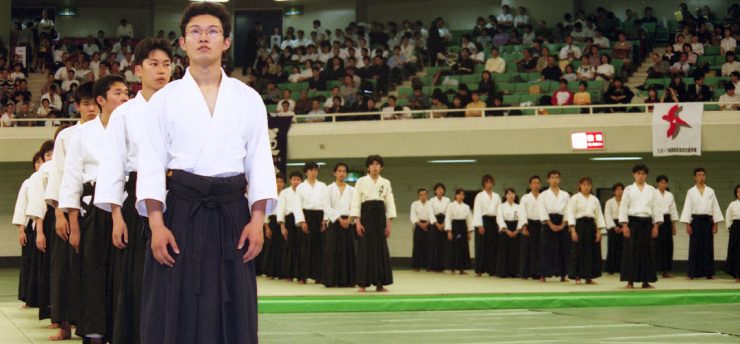
Ah, yes! The All-Japan Demo. The event of the year in the world of the Aikikai. What an amazing experience it is! In a single afternoon one can see the best and the worst that aikido has to offer and everything in between. Some 5,000 people are on hand for the demonstration, many of them participants who exhibit their skills, or as the case may be, their lack thereof. It is a world in miniature. All levels of society are represented: top shihan, aspiring shidoin, yudansha, company workers, university students, housewives, children, resident and visiting foreigners and, last but not least, politicians.
At the “All-Japan,” you can grab a seat in the upper tiers of the Budokan and enjoy, or endure, five hours of continuous aikido displays, simultaneously performed on five large, separate mat areas. Sensory overload, big time! You can applaud vigorously or perfunctorily as you fancy. You can laugh at the sublimely ridiculous exhibitions of which there are always several. You can even shout encouragement to your favorite shihan: “Gambatte, Sasaki Sensei!” But don’t even think of booing. This is Japan, a civilized nation!
What comes next will not be a recap of the highlights of the event. I will not single out any particular individual to praise or criticize. Rather, I will tell you plainly what I see and feel every year at this aikido spectacle of spectacles. Every person who steps onto the mat to demonstrate is at the same time making an emphatic statement about who they are and what kind of training they have undergone. You can see it in their posture, their movements, their centering and timing. In the same way that writers lay bare their innermost thoughts and motives when committing words to the page, aikidoka reveal the sum total of their training with every technique they execute.
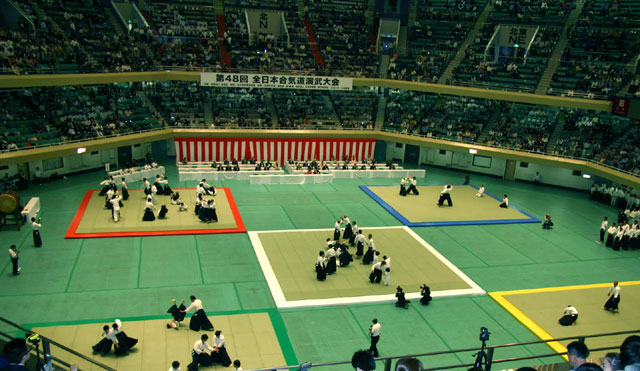
What is there to see on this third Saturday of May each year? I’ll tell you what. You can see your aikido past, present, and future at this demonstration. From the playful little children to the teetering old men, you can see the entire range of aikido experience encapsulated. If you follow the teachings of your sensei and the example of your seniors, this is how you will look at all stages of your aikido career. Neat, isn’t it? You can rewind and fast-forward through your aikido life in a single afternoon merely by allowing your eyes to scan the mats. This being the case, I have a question to ask: if I train diligently over a lifetime in accordance with the principles of aikido, how come I still end up a stiff, decrepit old man? After all, in aikido we exercise our bodies regularly over a period of many years while others lead sedentary lives. How is it that we too end up in such sad shape?
Another question. Aikido training is a give and take activity, right? My partner attacks me and I throw him. Then I attack him and he throws me and so on for the duration of the session. So at what stage of my career do I stop taking ukemi and focus on throwing? When I become a teacher, you say? Oh, I see! After becoming a teacher, my role changes. Is that it? I no longer take falls because I have now assumed something akin to a managerial position in the aikido corporate entity and stooping to take a fall is beneath me. My role henceforth is to demonstrate for my admiring students and walk around the mat meting out tidbits of technical wisdom. With the passage of time I become more and more venerable. And, I might add, stiffer and stiffer into the bargain.
Why is it that people don’t get it? If you stop stretching your body, doing your warm-ups and taking falls like you did in your earlier years of training to devote yourself to teaching, Old Father Time will creep up on you from behind and one day you’ll wake up to find yourself a creaky old goat!
“Wait! Stop this immediately! How uncharitable! The Aikido Journal editor-in-chief has gone over the edge! Everyone has to age! Who can deny this? We should accept our fate and age gracefully!”
Baloney! Excuses, excuses, excuses! We may all have to age, but our expectations as to how fast and to what degree this process will occur are conditioned by what we see in society around us. The senior citizens in our midst reflect the statistical average, the lowest common denominator. Their sorry state certainly does not represent the limit of human potential. Want proof of that? Look down from your lofty perch in the Budokan and watch the grace and agility of Mr. T. He is a gentleman of nearly 70 [now about 85!] who moves with the speed and grace of a man in his twenties. Compare that to the uninspired demonstrations of some of the shihan 10 to 15 years his junior who move like they have a stick up… you get the picture! These younger oldsters seem to convey through their lackadaisical movements a total disinterest in what they are doing. There is no fire, no passion in their performances.
Allow me to digress for a moment. A long time ago when I first began training, I met an amazing gentleman who was at that time about 35. He had a beautiful, muscular physique and was as flexible as a child. One day after training, he stood on the mat and did a beautiful back somersault followed by a front flip in equally perfect form. He was a yogi and quite a philosopher in his own way and he served as my mentor for a time. He once told me something I have never forgotten. His exact words were, “The body is the temple of the spirit.” Obviously he was not the originator of the phrase which is surely as old as the ages. But it was he who conveyed the axiom to me and I have always taken it to heart.
Thus, I have never been comfortable with the understanding and compassionate attitude society shows toward the elderly. When I see these old rickety specimens stooped over and moving at a snail’s pace, I get angry. I get really angry! Feel sorry for them? No way! These are people who have abused and neglected their bodies. They have not expended a calorie on exercise for decades. They are walking medical nightmares and a dream come true for every doctor and pharmaceutical firm. They expect respect, compassion and generosity from their fellow man as though their having survived to a ripe old age was equivalent to a lengthy career of distinguished military service on behalf of their country. They become burdens on society in their “golden years”. Their ailments and diseases brought on by years of physical and spiritual neglect consume enormous amounts of society’s resources until their premature and, I might add, costly demise. Do away with them, I say!… No, just kidding! Hear me out.
I have made this point before in earlier editorials in different contexts, but I think it is appropriate here as well. Aikido is a wonderful, exciting discipline. However, because it touches one’s life in so many ways—physical, mental and spiritual—and promises so much to those who devote themselves assiduously over the years, we easily risk being looked upon as hypocrites. By that I mean, we preach peace and harmony, sensitivity, alertness, healthy living, and a host of other admirable qualities. We practically walk around with signboards on our chests implying that we are superior beings possessed of special knowledge. Due to our own inadequacies, we fail to exhibit many of these qualities in our own lives. Therefore, at times our words ring hollow and invite derision from our peers.
We may not all achieve a high level of technical mastery enabling us to ward off the attacks of a skilled and aggressive opponent, even after many years of training. But, at the very least, we should be able to maintain a healthy life-style and keep our bodies flexible and well-conditioned even into advanced age. This is within the capacity of everyone and does not require any special genetic predisposition or extraordinary athletic skills. When many of us reach instructor level after a certain period of training, we gradually turn into passive supervisors rather than vigorous participants. We sell ourselves short by simply accepting and repeating the patterns of our teachers and seniors without examining and projecting what fate awaits us if we blindly follow their example. This is a trap that almost everyone falls into.
Don’t let it happen to you. Show the younger generation what amazing things are possible in advanced years when you stay young and flexible while at the same time enjoying the accumulated wisdom of a lifetime.
Have your cake and eat it too!
Postscript: Many years have passed since I wrote this article. I have reached 70. I still stretch, train and take falls. I still maintain that we exercise a great deal of control over how we age.





“We should accept our fate and age gracefully!”
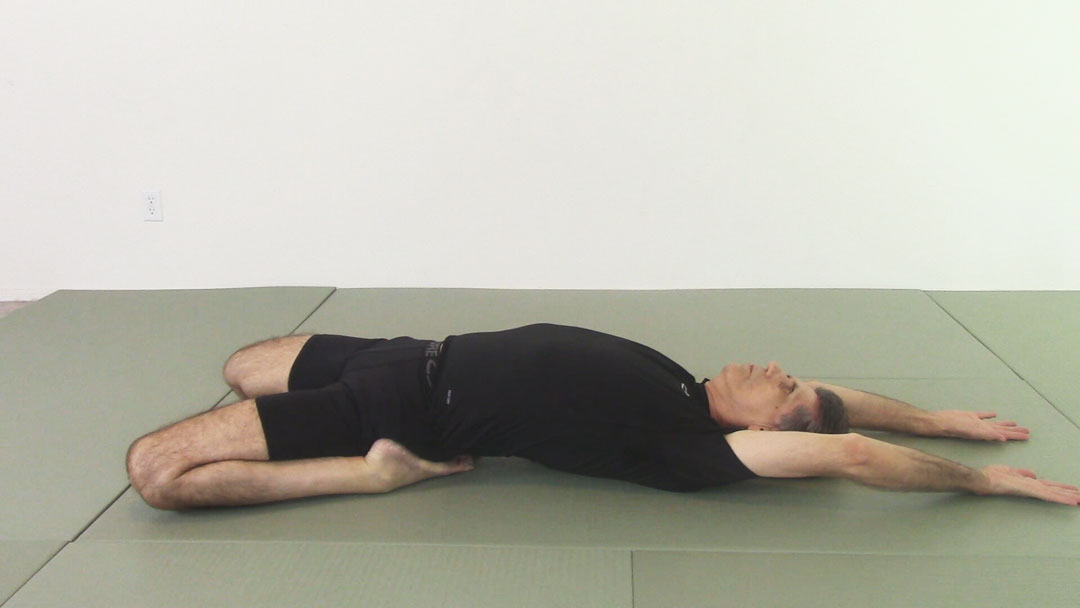
I’m a few weeks from 70, and trying to age disgracefully.
(But my wife has other ideas.)
The question isn’t whether you will get old, creaky and feeble, the questions are when, and whether you’ll die first. If you assert that you are a martial artist, then you need to keep your primary tools, your body and mind, in the best possible condition. After 40, our original cave man pull date, that takes continuous effort. Even with that effort a decline in ability is built into our body. If, again after 40, you continue to emphasize strength, that is a long term losing proposition. Subtlety is more productive. As an evolutionary tool, fighting has to do with mating. (Group violence, found also in our cousins the chimps, has to do with establishing the territory necessary to support that group.) Once you’re past mating, an inevitable concomitant of age, why not move beyond fighting? So, if you started in aikido because there are more women in an aikido than a karate dojo, there’s still room for you when you don’t care about that as much… 😉 Now, as to which comes first, feeble or fate, consider that traditionally ability carries responsibility. If your prayers are answered perhaps, having lived by the sword, you may also die by it. I suppose there are a few, but very few today, quicker and easier ways out of this life.
Stan: I fully agree. The only quibble I might have is concerning to what extent we can influence others as to the merits of not having to dumb down our physical expectation as we age. I probable represent an extreme myself, but I find that you have to be careful even in suggesting to to other (ageing) people that they shouldn’t be so afraid of stretching their envelope somewhat. As it is, the responses I get from just doing my own thing range from — you’re nuts to oh my gosh, I wish I was as fit. But I think the wisest counsel is perhaps to think to myself “Well, you could very well be as fit if you were to get off your fat ass and do something, anything, regularly” but say nothing, and only offer gentle helpful constructive advice if asked. Even then, because my opinions on the subject are so strong, I have to exert the greatest self control not to express those strong opinions in some extreme form or other during the supposed dispensing of dispassionate factual advice!
After all, the greatest beneficiary of my supposedly enlightened attitude should be myself, and perhaps that’s all I should hope for. If others might be positively influenced, well, that’s a good thing, but you shouldn’t try to make it happen.
I am simply voicing an opinion. But I expect to be judged by the same standards I advocate. I wrote this article more than 20 years ago when I was much younger. I am still active and stay flexible. If I don’t stretch and train, my body complains a lot. I don’t like pain or the feeling of being stiff. I love how I feel when I have stretched thoroughly and enjoyed a vigorous aikido class. I don’t know how long this will be the case. I did not expect this when I was younger. I’m still somewhat mystified by the body’s ability to heal and improve itself. Let’s talk again when I’m 80!
I believe that Aikido helps me maintain a youthful mindset. We have a good Junior and youth following at our dojo so we have to maintain a good degree of fitness. I am also aware that if I want the legacy of our dojo to continue we need to develop young senior dan grades. I guess this means I need to be around for a few more years
I apologize, this is my edited version. I could not agree more with the fact that social factors influencing ageing, and of course genetic. What is becoming increasing evident is the fact that diet, specifically a plant based diet is perhaps the best means and predictor of creating and maintaining a strong, healthy and comparatively youthful body. When I transitioned into a plant based diet I lost a lot of weight without trying and profoundly increased my physical endurance and strength gains, in every domain of activity.
No doubt, maintaining a physical fitness program is instrumental to achieving these goals, and many individuals have achieved high level of functionality into advanced age without regard to diet. Still, the emerging evidence makes clear that for the average person diet is a key factor to ageing graceful and maintaining a high degree of physical ability. I am more than confident that even the ‘genetically advantaged’ would absolutely benefit from a plant bases diet, as well as knowledge of, and absolute benefit of certain, and various herbs, spices, mushrooms, nutritional yeast, and essential fatty acids. As always, knowledge and direct experience convinces best.
May I suggest what is perhaps the best website for this kind of evidenced based knowledge; nutritionfacts.org. This website is video driven, and sites the relevant studies to back up the information provided. As well, participants add valuable comments to the videos and the related transcripts provided with each video. Further, nutritionfacts.org has qualified team members that answer many questions, interject corrections to certain comments, and generally expand upon the topical information related to each discussion. Yes, of course, diet is a major key to aging success. As well, I should note, moderation is one of the reasons that individuals subsisting on the Standard American Diet have managed to sustain decent levels of physical and cognitive performance. I’m just trying to help those interested in exploring the bases of my claim that a plant based diet is far superior to the SAD, (Standard American Diet), diet.
The subject of meditation, mental attitude, emotional well being, and mental practice strongly figure in this discussion; as to how one retains a relatively high degree of mental and physical functionality throughout their lifetime. My point is that these considerations must be address in individual and in essentially well established ways in order to maximize our efforts to engender and maintain the measure of control and discipline, as well as flow,(‘ease’), necessary to influence functional longevity. No doubt, insight, bread of knowledge and experience, coupled with a learned and commonsense willingness to engage in unique and challenge opinions, seemingly unfounded, yet sincere views, balanced with a ground of understanding and experience lead to meaningful and often creative realizations and possibilities that make plain the realm of human possibilities. Do you really believe that successful aging is beyond explication, understanding, or perhaps instructions or some kind? Think again or perhaps for the first time. Thank you for allowing me to participate.
Nice Discussion here Stan Sensei and fellow Aikidoka. I am at my 40’s now and the essential aspect is acknowledging the inevitable part of aging. We can not deny the fact that a lot of senior practitioners suffers from pain and lack of flexibility due to muscle stiffness, joints and skeletal problems. In addition to certain diseases such as diabetes, high blood pressure and other debilitating diseases.
Unknown to us, most of these came from etiological factors such as bad choice of lifestyles such as food, alcohol, lack of active exercises and stress in everyday life. As our age advances, our waistline also widens and thickens due to excessive food intake disproportionate to what suppose we need in accordance with our basic needs. Genetics plays an important role and contributor for these problems. Younger practitioners probably would not really appreciate what we are talking about, but seeing what is ahead is more preventive rather than on the treatment side. The evidence-based practice as stated above serves as guidelines but only a part of what need to be done to maintain a healthy and longer life.
Complementary exercises such as yoga, tai-chi, qigong in addition with proper nutrition and meditation play an important role in delaying the aging process although need more a lot of studies for evidenced-based practice in western practice. I took a note about Stan’s Sensei about taking yoga and also incorporated Yin Yoga in addition to the Tibetan Yoga and in my surprise, it did make wonders and helps a lot about flexibility and deep tendon stretches and opening. The stretching offered by Yoga, the breathing of Qigong and the Ki meditation derived from Universal Healing Tao System plays a significant change in building that confidence and facing the challenges of aging.
In conclusion, Aikido practices complementing it with other practice in health and longevity may help our future generations of practitioners in preventing debilitating diseases brought by unhealthy lifestyles and the natural occurrence of aging.