
 Josh Gold
“Official” aikido history has been shaped primarily by the Ueshiba family, particularly by Second Doshu Kisshomaru Ueshiba. This has been achieved through the publication of a long series of technical books, a biography of Morihei Ueshiba, and several volumes of personal memoirs by Kisshomaru. Many of Kisshomaru’s books have been translated into English and published by Kodansha, Ltd., Japan’s largest publishing company. Author John Stevens is the translator of Kisshomaru’s later books, and has published a number of volumes of his own which generally reflect the views of the Ueshiba family. The single main source of alternate views on aikido historical subjects are the publications of Aiki News and Aikido Journal that I have produced since 1974 through the present.
Recently, I published an article listing “Common Misconceptions” about aikido history. Really the title should have tipped off readers that the list of statements were, historically speaking, questionable. I asked readers to offer their comments in reply to my list. One reader, Larry Bardach — a friend of many years — took the trouble to reply. What follows is the original list, Larry’s replies in italics, and my additional comments in bold type.
Morihei Ueshiba’s father, Yoroku, was a wealthy farmer and councilman in Tanabe, Morihei’s birthplace. He funded Morihei’s activities as a young man. Moreover, he lent large somes of money to Tanabe families who joined Morihei on his move to the wilderness of Hokkaido. He also provided the financing of the considerable sums paid to Sokaku Takeda for Morihei’s instruction in Daito-ryu jujutsu.
True.
False. This is a very misunderstood issue that took me many years of research to unravel. Sadateru Arikawa one day many years ago provided me with the key information that I needed to finally come to terms with what happened. I questioned him one day about why Morihei Ueshiba needed to borrow money after his father’s death in order to finance his move to Ayabe in the spring of 1920 to join the Omoto community. Arikawa Sensei explained to me that Morihei’s father, Yoroku, was well to do, but that his assets mostly consisted of land and real estate. In other words, they were illiquid. This was quite common. Traditionally, when such landowners needed money they would borrow it using their land assets as collateral.
To make a long story short, Yoroku didn’t have a lot of discretionary funds to draw upon. Therefore, this casts doubt upon the hypothesis that Yoroku was a financier of the Hokkaido project, and that he was capable of paying the large sums of money to Sokaku Takeda to teach his son Daito-ryu jujutsu in Hokkaido. But there was someone who did have the money to accomplish these things. You will find the complete story here.
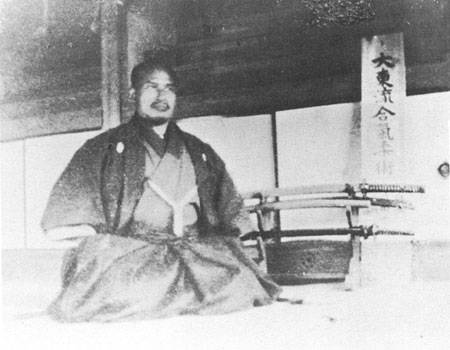
Partly true. O-Sensei studied under Sokaku Takeda over a period of about 23 years, not always consistently, who was his main technical source. He also briefly learned some sword and spear.
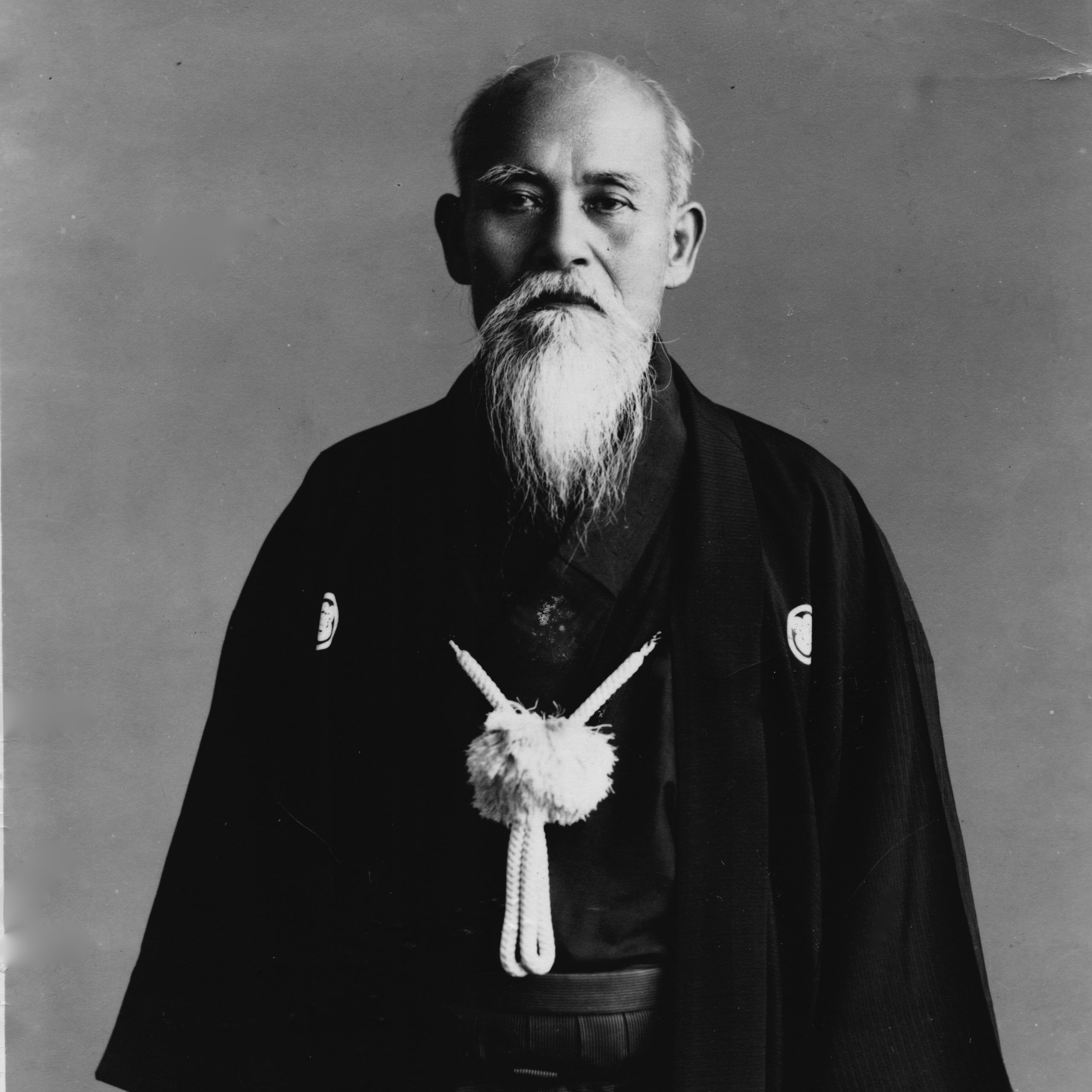
False. Morihei Ueshiba was one of Sokaku Takeda’s most skilled students. As Larry points out, Morihei met Sokaku in 1915 in Hokkaido and we can trace their association up as far as 1939. I have an unpublished interview with Morihei Ueshiba wherein he states that Sokaku was grooming him to be his successor. Kisshomaru Ueshiba, Morihei’s son, is well known to have attempted to minimize the link between Daito-ryu Jujutsu and aikido. See this article for conclusive proof of this statement.
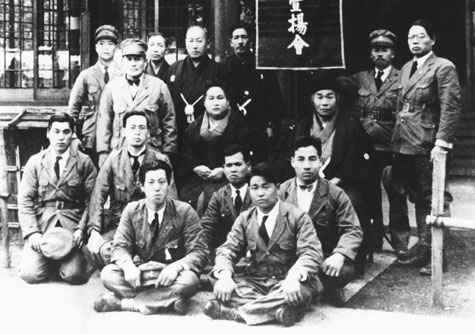
3. Morihei was not a regular member of the Omoto Sect, but rather a personal follower of Onisaburo Deguchi.
I think he was mainly a personal follower of Deguchi, not of the organization.
False.
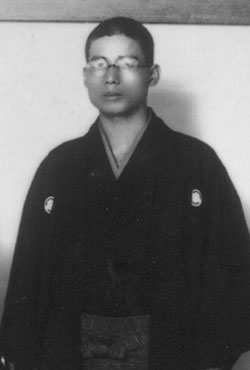
False. The person Morihei Ueshiba first groomed to be his successor was Kiyoshi Nakakura. He was one of Japan’s strongest kendoka and a legend in the kendo world. He married Morihei’s daughter, Matsuko, and took the name of “Morihiro Ueshiba”. Read his story here.
5. Morihei Ueshiba took an active role in the postwar dissemination of aikido.
False. This fell mainly to his son. O-Sensei stayed mostly in Iwama and trained. He occasionally travelled to other dojos.
False. I have debunked this misunderstanding in my article titled “Is O-Sensei Really the Father of Modern Aikido?”. Since I published this article many years ago, further first-hand witness testimony supporting my thesis has emerged. Christopher Li of the Aikido Sangenkai has published some excellent research touching on this subject including a number of interviews of key students of Morihei Ueshiba who provide critical background information.
6. Postwar aikido instructors studied directly under Morihei Ueshiba for lengthy periods in the 1950s and 60s.
False. He came to Hombu infrequently. Not many instructors visited or stayed in Iwama.
False. Please see the explanation for number 5 above as the two subjects are closely related.
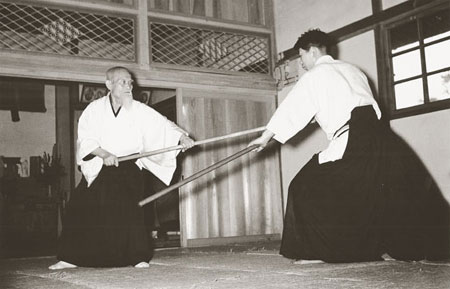
False. Aikido is a result of techniques based on the proper use of sword as well as taijitsu, as taught in Daito-ryu using aiki. OSensei’s sword was not classical sword, but was powerful due to the aiki inherent in his sword techniques. He utilized aiki-ken and aiki-jo to express aiki in his weapons.
This is a subjective call. For Morihei, training with weapons such as the bokken, jo, nuboko, and yari was an essential part of his study throughout his long career. Kisshomaru Ueshiba later decreed that the aikido curriculum consisted of the study of empty-handed techniques alone, and that weapons practice was not central to aikido. I discuss this subject at length here.
P.S. I do not enjoy publishing negative comments about the Ueshiba family or the Aikikai. However, the reality is that their influence is widespread and has shaped the thinking and beliefs of the majority of aikido practitioners. This has been accomplished in part through the publication of numerous books in Japanese, English, and other European languages. The Aikikai’s importance is further magnified by the desire of a large part of the practicing aikido population to receive its stamp of approval in the form of dan rankings. For this reason, there has been little public disapproval of some of their questionable activities out of fear of negative consequences.
What I have been doing for many years has been controversial, and I have made some enemies in the process. It is not a comfortable position to be in. But the alternative would be to close my eyes to acts of objectionable behavior and be complicit through my silence. This is not something I will do.
Aikido Founder Morihei Ueshiba lived an amazing life and created a wonderful discipline that has enriched millions of lives. To stand idly by and watch the Founder’s life’s journey, his philosophy and art intentionally distorted is reprehensible to me. I will do what I can, while I can, to present alternative views that are historically accurate and well documented. You will decide what you wish to believe and how you use this information.





Thank you for presenting the well documented facts Pranin sensei. I know that some people will be against you for telling the truth but you are one of the few who have the resources behind you to tell it like it is. I strongly agree with you about weapons training. Unfortunately, only those individuals who train with weapons on a regular basis and have made the ken riai connection (the ken riai connection is not guaranteed just because you train with weapons) can see the deficiencies in those who do not train with weapons. Keep up the good work.
And this has all been mentioned before, hence the links that are posted after every reply. The real question is why has the history of Aikido been distorted in these aspects? Also do you poses any knowledge of whether the man in this link is the same Kiyoshi Nakakura you mentioned in your article http://www.tozandoshop.com/Nakakura-Kiyoshi-The-Man-His-Kendo-p/019-spd8607.htm ? In the headline it says “Nakakura Kiyoshi: The Man & His Kendo” but in the Information section below it says “Nakamura Kiyoshi” so i don’t know if the video contains the correct content i am looking for. Thanks in advance for you answer.
Yes, this is the same man. “Nakamura Kiyoshi” is mistaken. It is “Nakakura”.
Stan:
Once again, kudos for all your efforts at investigatative jouirnalism and setting the historical record straight.
Human nature being what it is, and human culture being an extension and amplification of it, are we really so shocked and surprised that that the ‘invested-powers-that-be’ would rather shape their story to put them and their institution in the best possible light … from their own perspective?
It has been said that if you want the real story (especially the srtory-benhind-the-story) then “follow the money”. Sometimes, as in this case, we can read ‘reputation’ and ‘public perception’ or ‘party line’ for the ‘money’.
Stan, your fact-finding and, most especially, your fact-checking have revealed both the debt of gratitude that we owe Kisshomaru Ueshiba for the establishment and organization of post war Aikido … AND … the evidence of deliberate distortions of historical fact.
If I were to hazard a guess, I would hypothisize that Kisshomaru felt that he was serving the ‘greater interests’ of his father and the Art, by reshaping the truth for the sake of public acceptance and approval. He may well have been influenced by many other outside forces such as his (and others) perception that in order to accomodate the US Occupation and the post war political climate that he needed to emphasize certain facts and minimize and even delete certain others. Possibly influential donors and supporters, like all lobbyists, felt that their contributions engendered both a debt of compliance and leveraged influence on their part.
So, having increasingly corrected and established the ‘what’ of these events … is it possible to dig even further and discover the ‘why’ behind them?
Admittedly, what could be unequivocably ‘proven’ might be difficult, but informed speculation and learned discourse can still be fascinating and enlightening.
__________
ONE LAST THOUGHT DEPT:
The need to ‘doctor the truth’ is usually a sign of a need to make oneself or something one identifies with seem better, greater, and finer than what it is suspected to be … or even feared to actually be. Funny ain’t it, that O’Sensei’s grand message was to ‘open our eyes, minds, and hearts’ to the Core Truths of our Universe and become One with the Universe itself. I hear his clarion call as both an individual (personal) and collective (instiltutional) invitation.
Thank you Stan for putting not just your shoulder into this effort, but your whole body and soul as well. I salute your ‘makoto’.
Respectfully,
~David Brown
Enlightening information – it clears up some confusion I have been feeling.
Confusion (strong confusion) because I have been feeling that there are large discrepancies, between what Aikikai tends to teach (in terms of how much contact to use, the range of techniques used, and the role of weapons) – and my feelings of what application, which techniques (etc) lead down the path the O-Sensei seemed to be showing us.
I now train Aikido, for a few years, after 30 years of training TaeKwonDo and Jiu-Jitsu, and I immerse myself in it, in a natural and whole-hearted way, due to my reaction to the feeling evoked by practice, and the sense of motivation and leadership I get from O-sensei (through legend, video, stories – whatever).
Rarely has anything , any system, belief, Art or study, spoken to me so clearly and so loudly, as this path and direction, that I instinctively feel O-Sensei followed and tried to pass on. But some of the stories, and things I hear and am taught, just don’t fit in.
If I look at that path, it leads through some quite “violent” Martial practices, into the message of Peace. I feel, in a very real way, what that means – and how the Fighting Arts can lead to Peace, and an understanding of the Universe (as seen from a Human Being). The Practice of Aikido, to me, is similar to the practice of Meditation – but meditation through a very real Martial Art.
However, in my own picture that I have of the teachings, the idea of teaching totally “soft” Aikido, or Aikido completely without weapons, is anathema to the Art itself. The “soft” Aikido from some I have trained with (under Aikikai), shows that they seem (to me, in my short Aikido career) to have understood only half of the lesson. They are seeing only the icing, not the cake; they are applying the most advanced level, without the basics. Perhaps because they learned Aikido as their first Martial Art and were taught only to Blend and Harmonise, they see these as the whole Art; however, Aikido is not only these two motivations.
Blending, Harmony, etc are stressed very much, as it is them that makes Aikido different from so many other fighting arts; they are a result of a scientific approach to control (of your opponent) using their reactions, physics, and bio-dynamics against them, rather than just fighting them (wow I could expand on that for about an hour…..). And leading to an attitude toward life based on non-conflict – well, etc., etc.
But they are not the basis of Aikido. I feel (believe) that to see the basis of aikido, you look to what was the basis of O-Senseis Aikido, and what he practiced.
I practice Aikikai as that’s the training available in my area (Indonesia) – but I study everything I can, and keep my eye on O-Sensei for guidance.
It is His path I want to follow.