
 Josh Gold
“Improving safety without compromising the integrity of training!”
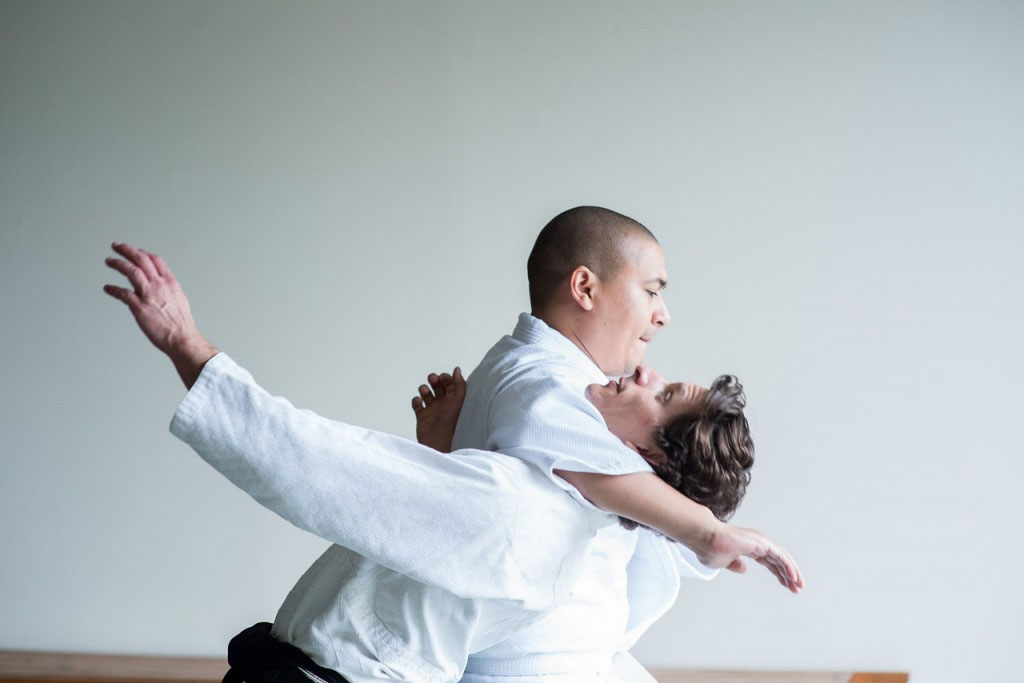 Every year, Ikazuchi Dojo compiles operating metrics to get a numerical snapshot of the dojo. We are fortunate to have enough aikido students and infrastructure to collect a meaningful amount of data.
There are many important things in a dojo that can’t be measured with numbers. But many can.
One thing that can, and should be measured, is injury rates. We think it’s important because with high injury rates, a dojo will face massive attrition or will be forced to water down its training. We don’t like either option.
Our Dojo
Ikazuchi Dojo students have fun and train in a lighthearted way. However, almost all of them take their development pretty seriously. Our average age is 37 and we have a number of students in their 50’s and 60’s. These people can really move and they can really throw.
If our injury rates were high, these students would never be able to develop in this manner. Recovery time from injuries is a major training setback and the perception of a high risk of injury inhibits trust and committed training.
Bringing Clarity to Injury Rates
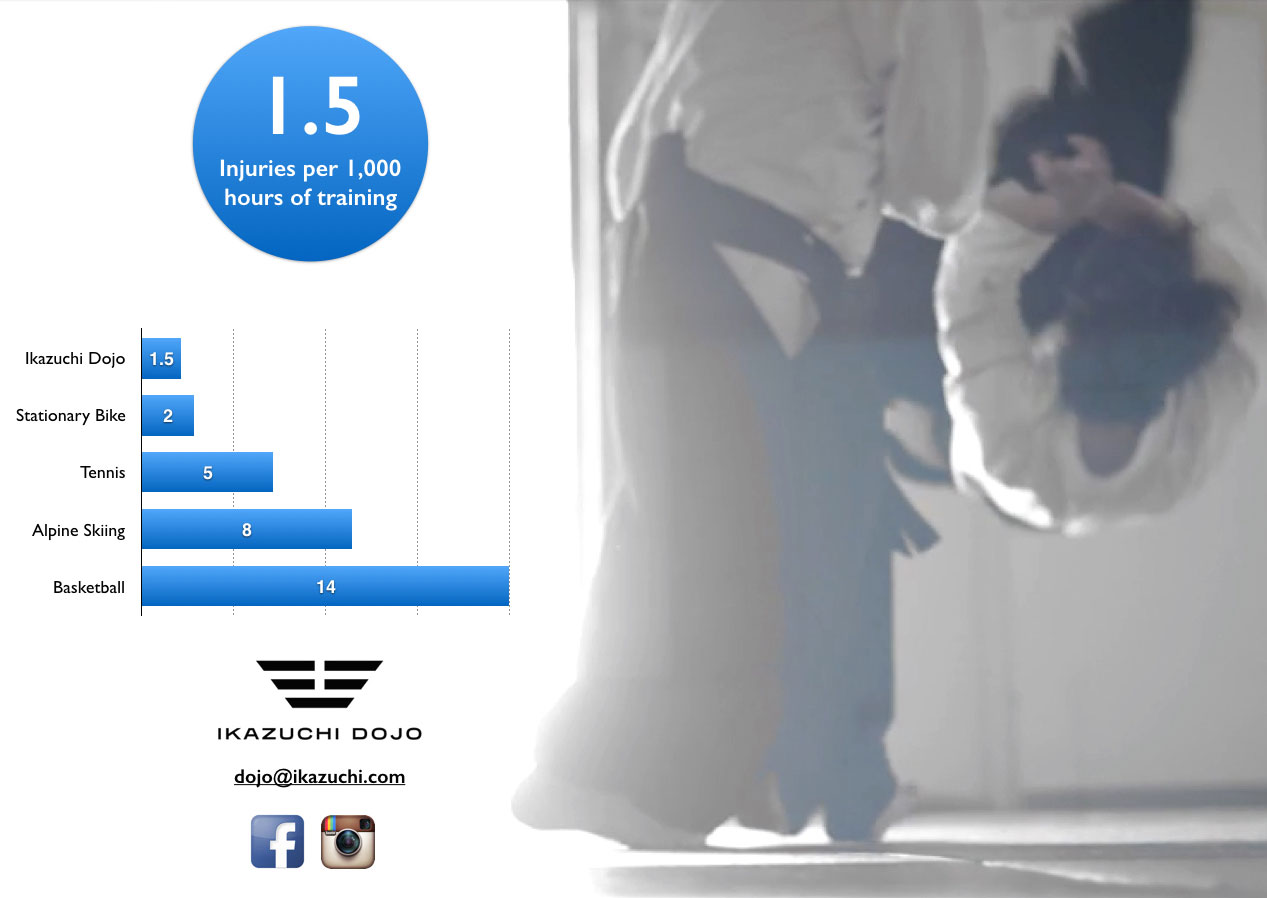
Injuries do happen at Ikazuchi Dojo, but how risky is our training really? For years after our founding, we had no clue. Now we track injury rates and quantify them using the standard metric employed in professional sports – number of injuries per 1,000 hours of training.
As a benefit of using this metric, we can not only compare against our own historical data, but we can see how we compare against other activities.
We’ve been able to get our injury rates down to around 1.5 injuries per 1,000 hours of training. Riding a stationary bike at the gym has an average injury rate of 2 per 1,000 hours. Basketball is 14.
Benefits of Tracking
Since we started tracking these metrics, we’ve been able to test different training methods and instructional strategies and objectively see if they improve safety without compromising the integrity of the practice. We also get insight into any correlations between injuries and specific students, instructors, techniques, or practice formats.
Additionally, we now have the benefit of being able to quantify risk to dojo members and prospective students. Training in the martial arts does have inherent risk, but that risk can vary greatly from art to art and school to school.
Those with a dream of becoming a marital artist often hesitate to begin training due to preconceived ideas about how much and how often they’ll get hurt. This is especially true for doctors, professional athletes, musicians, and other individuals whose livelihood depends on optimal use of their bodies. Now we can offer objective metrics to everyone so they can make informed training decisions.
Let’s Learn from Each Other
We’d love it if you share this post with other martial arts schools. We seek to learn more about what others are doing to track injury rates and reduce training risk without removing the martial effectiveness of their training methods.
Our systems and metrics are far from perfect. We know there are things we can do to improve our success in this area.
Also, please let us know if you’d like to learn more about how we’ve implemented our injury tracking system. If there’s interest, we’d be happy to share how we track, analyze, and respond to our metrics.
Thanks to Josh Gold of the Ikazuchi Dojo for sharing this article with Aikido Journal readers.
The subject of injuries in aikido dojos is of great importance to every school. The safety and well-being of students should be every instructor’s highest priority. We have and will continue to address this subject at regular intervals in Aikido Journal. – Editor
Further reading:
“Aikido and Injuries” by Stanley Pranin





There was a nice lady who advanced at least to nidan when I was coming up. She had a knee injury early in her training from catching a foot in the junction of velcro-attached gymnastic mats. That’s a hard way to learn about an equipment problem. I think it’s incumbent on all dojos to very carefully and critically look at their facility and listen to even the most timorous voices… as long as there’s a solution attached to the complaint.
As to comparing aikido to other sports, imo, it’s of little relevance. Except to consider the amount of kinetic energy in each. It is perfectly reasonable to me finding basketball as a high injury sport. It’s high energy. People run, and run into each other. They also fall at running speed and run into stationary objects. Nor is ukemi part of the program.
John Smith, a friend of Bill Witt and student of O Sensei, once quoted O Sensei on suwari waza, “They might learn something and probably won’t hurt each other.” Imagine the context of young, tough Japanese going fast and hard standing. Getting them down on their knees both slowed them down and also reduced their height off the mat. We would always like The Force to be with us. In martial arts The Force is gravity. It’s everywhere for everybody. Its acceleration is a square function and kinetic energy is related to speed as a square function. We all know about wear and tear on knees, but getting down makes it a whole lot harder to inflict traumatic injuries.
When I started long ago ukemi was just what you did when you fell down. Instruction was rudimentary and ad hoc. I hurt continuously for the first couple years of training. Systematize ukemi instruction. Make it part of every class. Associate a philosophy with it. “Whatever you just tried to do as an attack, it failed. Get out of there before you try again.” In dogfighting in WWI and II that strategy was (conserving) energy fighting. US aircraft were heavy and strong, but not all that maneuverable, so it was a winner. The alternative was to mix it up, trying to outmaneuver the other guy. That was known as stall fighting because sooner or later you would run out of speed and/or overcontrol causing the wing to stall and the plane to fall, usually in a spin. On the mat it manifests itself in movement coming to a halt as two people strain their muscles grappling. In banking there’s a saying that applies, “Your first loss is your least loss.” Get out of Dodge.
When your escape techniques are sufficiently good, the world of kaeshi waza opens. In the dojo that obviously has to be regulated or we end up with a lot of mini competitions, typically ending in static grappling. But take a systematic look at it. My proposition is that anytime a technique locks a joint, there is an opportunity for kaeshi waza. Another proposition is, if uke can take a “high fall” there was also an opportunity for kaeshi waza. Backfalls offer sutemi waza, a subset of kaeshi waza. I was fortunate enough to get a private lesson from Terry Dobson on the subject once upon a time. Frank Doran was teaching kochinage and Terry wasn’t interested in taking the falls.
One of the mental problems with practical, applied, aikido is related to the fact that nobody in America wants to fall down. It’s hard enough to teach ukemi to the willing. Nobody on whom you really need to throw is going to willingly go for it. Now, again, why fall? To get away from that which is worse. So, you better be willing to dish out “worse” in a real situation. Kokyu ho becomes a full power back knuckle strike to the face. Irimi nage becomes a forearm clothesline, again, with full speed and body power. Kokyu nage is a full power atemi, probably to the hanging ribs. If the attacker doesn’t want to fall down, that’s not your problem. Move on to the next customer.
The joint manipulations, I propose, don’t give any options. Done correctly they will unbalance anybody. That can be practiced at low speed and load. If it takes more than a few pounds of pressure to unbalance a relaxed partner with ikyo, nikyo, sankyo, kotegaeshi or shihonage, keep working on it. Now consider falling from full body height on your head. I doubt many people can punch or kick that hard. btw – I don’t think the effect is “mystical ki”. imo – It’s a subtle part of the skeleto-muscular system. There are ways we are strong and about which we know a lot from daily practice in life. The ways we are weak we skip. Of course in a real situation you may just break somebody’s arm. Move on to the next customer.
Aikido randori are so beautiful most people think they’re choreographed. The beauty is in the ukemi. Take out the ukemi and the essential brutality of the art is in full view… if you choose to see it. If you need it, it’s at your disposal… if you choose. Better, of course, if the other guy(s) just change their minds. That is likely to happen if your timing is really ai ki and you’re off the line of attack even a little bit.
I greatly appreciate the effort and the article. These statistics are important. There are many different training modalities, and some are certainly healthier than others. I did have my one arm broken in a class, and I still have partial paralysis nearly a decade later. I was certainly encouraged to be far more macho and dismissive of the injury, and encouraged to keep it quiet. We need a better paradigm than that.
But, I am not sure I would claim Aikido is safer than a stationary bike.
Both my son Julian and I have trained under Matsuoka Sensei several times while visiting my older son Nicco in California, Culver City Dojo, and have not only been graciously welcomed, but felt safe while receiving a rigorous workout! It is great to see such self reflection and observation for the betterment of the Dojo and it’s constituents as a whole! Thank you for the wonderful article Gold Sensei! Ossu! I will look forward for an opportunity to participate in keiko at Ikazuki Dojo when next visiting my son in CA! Peace!
Is that injury rate per 1000 hours of class time, or per 1000 student-hours? In other words, an hour singles tennis match is 2 player hours, whereas an hour aikido class with 20 students is 20 student-hours.
It’s not clear from your article.
I’m not even sure which is the more relevant statistic, but the two situations (tennis vs aikido) are quite different. In tennis, there are only 2 people who could possibly get injured. Trying to come up with a worst-case scenario: mismanaging a class situation could possibly lead to all 20 students being injured simultaneously. (Think a particularly uncontrolled multiple attack randori.) In a regular class, the more crowded the room is, the higher the risk of one person being accidentally thrown into another.