
 Josh Gold
“I have a serious bone to pick with certain Neanderthal type “purists” who insist that certain risk elements be incorporated into their training to ensure authenticity and martial integrity.”
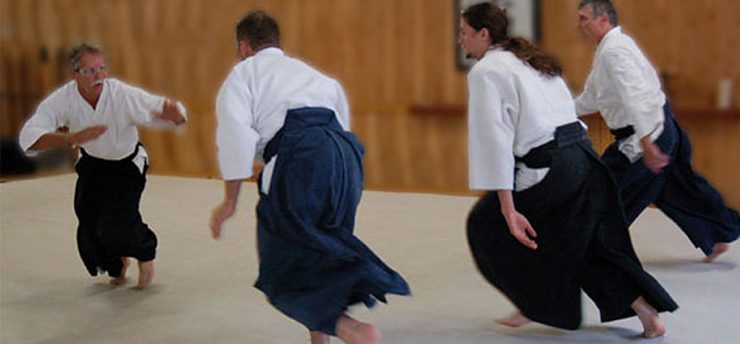
The photo accompanying this article was taken at a randori practice conducted at Aikido Eastside in Bellevue, Washington.
Ran (chaos) + dori (taking or grasping) equals randori, a specialized aspect of training employed by several martial arts systems, including Aikido, which is crafted to further develop technical proficiency, a heightened situational awareness, and hopefully, a growing ability to maintain “sangfroid” (unruffled coolness) during stressful training, as well as in real time situations.
Randori can be performed by two individuals, or by having several individuals apply various levels and styles of pressuring attacks to the nage, the designated attackee. The goal is not necessarily to triumph, but to primarily persevere throughout the ordeal, emerging with a more enhanced experience, and a more confirmed sense of self knowledge, and of self confidence. Real confidence in both the self and in one’s training partners is a true win-win scenario in randori.
In the highest sense, it is a celebration of genuine accomplishment for all involved, from those who successfully develop better skills for giving realistic attacks, as well as for those who need to deal effectively with such novel and intense scrutiny of their skill levels, not to mention, of course, their respective abilities to remain cool under fire.
In Aikido, we can acknowledge a wide and definitely diverse range of methods and attitudes to the role of randori in everyday training. Randori kyogi can specifically refer to “sports training”, using the medium of clearly defined methods and goals of implementing, and benefitting from this competitive randori style of training. Although the Founder himself, Morihei Ueshiba, is said to have unconditionally condemned this form of training in “his” aikido, there are schools that regularly promote its use and extol its virtues. Perhaps it can be a matter of degree, but even without formal rules and guidelines for the existence of “competitive aikido”, we do find in existence many levels of formats with intensity intended, and the affirmative support for realistic randori training. Perhaps the rationale is to promote more original and useful skills development of the serious student, via the various forms and interpretations of modern aikido training today.
An important point of this article is to examine the true nature and purpose for engaging in randori training, regardless of style, provenance or format. Are we deriving real, measurable, and generally beneficial results from such training? Are the students themselves really achieving real and measurable improvement in their desired skill levels, as well as for developing quantifiable increases in competence and self confidence? Most of all, do they truly come to appreciate that randori training is personally satisfying, and a valued aspect of their overall training in Aikido?
What should the mental focus be while engaged in randori? Must it be primarily a result of training obsessively to be the last person standing, outlasting any and all attempts to humiliate or subjugate the spirit? Should it be the capstone of technical excellence, finishing an examination routine that also proves one’s mastery of fundamental skills and basic techniques? Or is it about maintaining a sense of control, knowing that one is never in true danger of injury or embarrassment, due largely to an unspoken or unwritten understanding agreed to beforehand by all parties concerned? Is it ultimately merely a performance, a tightly controlled shadow of what a real situation should seem like? Security issues are crucially important, but to what extent should policy be contrived to ensure that all parties are safe, from both real harm and from unwanted and unintended legal liability?
Valid and debatable questions appropriately arise as to the need for, the nature of, and the proven justification for the emphases placed on randori training. Are the desired goals being achieved across the board for the majority of the students? Are the risk factors accurately being calculated to minimize injuries, both physical and psychological, and found to be reasonably acceptable? What level of students, age and experience wise, are the most eligible for this form of training, and which ones are not? Each dojo and system of training needs to develop prudent, acceptable and appropriate answers to these and other related questions for themselves, and for their constituents.
I have a serious bone to pick with certain Neanderthal type “purists” who insist on preserving, and even requiring that certain risk elements be incorporated into their regular training, to ensure traditional authenticity and martial integrity in such Aikido training. They say that in order to regain respect and acknowledgment of Aikido as a genuine and effective martial art, certain elements of the Founder’s reputed fighting skills, and proven theories of internal power, need to be re-introduced, and made an integral aspect of modern Aikido training. This may be an interpretation that has merit, but not remotely consistent with the Founder’s constant admonition that his Aikido is not about fighting, but rather of building pathways to harmonious and mutually beneficial relationships. We are admittedly free to develop an aikido style consistent with our personal visions and goals. We must also then acknowledge the similar right of others to interpret the Founder’s gift and legacy in ways they too find suitable to adopt and to follow.
This especially holds true for the purpose and manner of the “randori” training that they ultimately choose to promote, and to espouse for themselves and for their constituents.
Nonetheless, are traditional practices and time honored values being unintentionally, or even deliberately undermined, and perhaps devalued by the perceived necessity to make certain compromises in today’s training? And, by which authority or under what agency should we fairly and uniformly acknowledge that would comprehensively and fairly address these questions, and to provide meaningful and acceptable answers, alternate viewpoints and solutions?
For me, none of the issues presented above are as pressing, or as intrinsically important as the necessary acknowledgement of the real risks of intense randori training to each student, and the need for a fully informed mind set each participant must develop prior to participating in any and all manner of randori training. I have personally encountered no small amounts of fear and reservations on the part of novices, and even experienced practitioners, to the very worrisome risks of physical injury, and to the real possibility of permanent harm to their health, and unwanted changes to their life styles. Persons who use their bodies for work are especially vulnerable to accidents and incidents unintended, and are understandably hesitant to freely commit to such a training environment. These concerns also need to be the concerns of dojo cho’s, administrators, and practitioners alike, and must be addressed appropriately and fully. Dojo and health insurance policies are woefully inadequate.
The notion that one can actually “triumph” and escape unscathed from such encounters boggles the mind of experience, and deserves to be securely locked away in the realm of fantasy and romance. Time is the final arbiter for all things human, and we must acknowledge that, as skills and body conditions continue to erode, the average person will eventually succumb to the inevitable reality factors of injury, unforeseen circumstance, and of well intentioned, but uncontrolled optimism.
Nay, I truly feel that the most appropriate and universally acceptable results of genuine and correctly supervised randori training must primarily be for enjoyment. We should definitely relish and celebrate the experience, not to emerge as victors, but as fortunate co-survivors and enlightened comrades in the search for excellence in daily training. What better way to “die trying”, than at the hands of, and the happy smiles from those with whom we share and endure so much together, our compassionate dojo mates and our treasured teachers.
Each successful randori experience can then become a “baptism” of sorts, allowing for a continuous succession, not of graduations, but of commencements towards truly exciting vistas of enhanced personal experience, for individually crafted martial skills development, and for individually selected targets for growth and personal satisfaction.
One size does not necessarily fit all, but one uniformly held commitment to mutual security, to maintaining command over one’s life, and to promote individual excellence, surely can.
Click here to visit Francis Takahashi’s “Aikido Academy USA” website






Moderation is important. Train too rough and shorten your martial “career”. That said, if you leave the stone age, better hope the stone age leaves you. That works both internally and externally. The external part is easy to see. There are troglodytes all around us, even in the nicest neighborhoods, but most obviously in the less nice. The internal is harder. Haven’t you ever heard, “Oh. I train aikido to improve myself. In a ‘real situation’ I would use (fill in the martial art) which I did for (x) years…” There is a path to martial skill through aikido but it’s subtle. That is not to say it is smooth, far less that it’s easy. So, do you start by dealing with stone axes? Maybe not. At a certain point you have to move beyond dealing with marshmallows or you just go down the pleasant path of self delusion. That’s just fine if that’s what you want… until as Terry Dobson put it, “Push Comes To Shove.” At that point detachment is key. If you are not attached to winning or losing, living or dying, your aikido can freely express itself. Finally and firstly, then, victory is victory over self. That goes back to Musashi and is just as true today.
A photo credit might be nice… The image was taken at Aikido Eastside, Bellevue, WA, during one of George Ledyard Sensei’s randori intensives.
Randori practice as I was taught and as we practice it at our dojo is a form of moving meditation. In that regard I think it is one of the most valuable practices we have in Aikido. Since mainstream Aikido has no competition aspect, there are few times in ones Aikido practice when one goes 100% and is forced to be completely spontaneous in ones application. Multiple attacker practice forces one to maintain an awareness of multiple lines of attack simultaneously, move with no pauses or breaks, make instantaneous movement decisions, and, like any meditation practice, be completely in the present instant.
Like all of Aikido practice, this isn’t about some ridiculous idea of applied street self defense. Some of the skills developed via randori work might apply in real world self defense, but the practice, like the rest of Aikido, is highly stylized and real world application would look nothing like our randori practice.
Personally, I consider randori work to be a form of the highest expression of aiki and Aikido. No other practice challenges one so much, forces one to develop higher level perception skills while constantly revealing issues with ones kihon waza skills.
I would also like to point out that the image used in this article was taken by me at one of our randori intensives which we have run for 25 years at Aikido Eastside.
I probably don’t have the pedigree to weigh in too heavily, so I’ll just start by saying that I agree with Chuck Warren. I also agree with Ellis Amdur-sensei when he said in an interview that I read (paraphrasing), ‘the main reason to learn any martial art is to learn how to fight.’ One of his teachers was an Aikido shihan, Yoshio Kuroiwa, with scores of street fights under his belt….
The very spirit of Ikkyo-Ikkajo is to say “I choose death, because by moving through death there is life on the other side, so I’m letting it all go” because as Chuck Warren puts it–“detachment is key” and as the late Kevin Choate-sensei once told us: “Intent is all there is.”
For many Aikidoka, randori and jiyuwaza are the way that they personally monitor their progression. I trained in three ASU dojos and visited a few USAF dojos and clubs back in the day where the more advanced students would ask classmates to throw a little “kibishidesu” in their attacks after class, whether the class itself was soft or hard.
I think what is missing here is a little perspective. Historically, modern Kano-ha Judo emerged because traditional jujitsu practice was producing too many injuries back in the day. Even with your harshest randori nowadays students are carefully prepared to take the falls before participating, thus broken clavicles and detached retinas are pretty rare. Contemporarily, often Aikido training with tougher attacks might de-emphasize lessons of Aiki blending and other legacies of great masters like Seigo Yamaguchi. I agree that this is a horrible mistake, and the solution is to slowly emphasize and re-emphasize basic techniques time and again.
But incorporating Aiki training (awase, musubi, kokyu dosa, …) does not mean avoiding regular severity. On the contrary, it often demonstrates the ultimate futility of such severity in the face of such gentleness. This is the whole point to teaching and learning Aikido as I see it! No? What’s the point of learning kokyu and musubi if you never get to the point where you use it when it counts–like when you accidentally step on your own hakama? 🙂
I heartily agree that using randori and the like to test one’s mettle and throw around a bunch of aggressive ego is not in the spirit of Ikkyo. Training that uses randori to pass on the lesson that one must always expect a fight is not in the spirit of The Founder’s Aikido. But if one’s Aikido NEVER gets to the point in which it can handle some severe attacks before there is time to grab that cellphone or ballpoint pen and break into a run, then it’s not really “budo” [i.e., “the way of dealing with the thrusting spear”] that we’re learning. Ultimately, the stuff is supposed to work when someone tries to hurt us, and the shared compassion and treasures on the mat after we say “Let’s make beautiful things happen together,” is meant to celebrate the eventual success of doing that by using Aiki no matter how mean and fast our attackers might be.
Final thought: Life is violence. Existence is violence. Most violence is not aggressive, but some of it is. Our solar system is the product of at least two supernovas and the Earth is the product of countless collisions and extinction events. Even you vegans murdered future bananas and oranges when you ate breakfast this morning. Muteiko, the principle of nonresistance, has been shown in countless ways to be the greatest way to move through existence: from education, to politeness, to love, to communities, to civil disobedience, and on and on. All training cannot and must not be aggressive because most of life is not aggressive. Real training possesses constant encouragement and nurturing–like when nebula gases coalesce into the Sun or when a 1964 Freedom Rider’s eyes meet his attacker’s without fear. This is the sign of the TRUEST AND PUREST STRENGTH. But training in an art that teaches one to be prepared for life as it comes as beautifully as Aiki MUST regularly include real aggression.
Thank you Takahashi Sensei,
A very well written and closely reasoned article.
I could not agree with you more about the overall goals of training including randori.
Preventing injuries is also a key to good training as the danger to our long term health from injuries is almost always greater than the potential for being injured in an attack.
Please keep your wonderful thoughts coming.
Bob Noha