
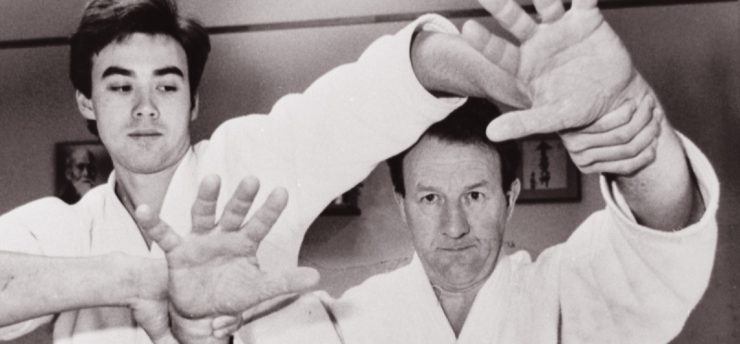
 Josh Gold
 “I have never had to use the physical techniques outside the dojo in 40 years of training, so I am not going to lose any sleep over that!”
Arguments about the “martial effectiveness” of aikido are a popular feature of Internet bulletin boards. Unfortunately, many posts show an abysmal ignorance of the premises on which the art was founded by making comparisons with various systems of fighting.
Aikido is not a system of fighting, but a way of not fighting, intended not to protect or enhance the ego but, potentially, to eradicate it. Its value lies in promoting qualities diametrically opposed to those advocated for use “in the street.”
Speaking for myself, the day I have to face a life and death situation will be soon enough to prove the effectiveness, or otherwise, of my aikido. I have never had to use the physical techniques outside the dojo in 40 years of training, so I am not going to lose any sleep over that.
Certainly one should strive for improvement, and it is always a challenge to try and perform the techniques with a bit more smoothness and elan, but what is the point of raving on about the inadequacies of aikido, versus kickboxing, college wrestling and street fighting? There is quite enough material to work with in aikido as it stands, without resorting to cross-training, or worrying about which schools have lost the plot and left us with some watered down, ineffectual version. There is only so much you can learn from others, anyway, so you can’t blame the system for your own shortcomings.
Effectiveness is bought at a price and the more I see of those who claim to have achieved it in aikido, or in other areas of life, the more empathy I feel with ordinary people who have no great ambition to be superefficient or effective. At best this attitude is irrelevant, at worst downright destructive and depressing.
To be appreciated, aikido needs “space,” i.e., spirituality, psychological depth, aesthetics, compassion and enjoyment. Not to mention love! (There seems to be a tacit agreement not to mention love in the martial effectiveness arguments, which is curious in view of the importance O-Sensei placed on this, and his insistence that love was the essence of aikido.)
Not that aikido’s “spiritual effectiveness” is any easier to prove objectively than any of the technical arguments are. There are no guarantees, anyway. I am not convinced, however, that someone’s inability to perform a technique from, say, a strong Iwama-style morotedori grip testifies to a lack of spiritual development. The link between spirit, mind and body is more complicated than that.
The learning curve is a broad one, and one may reasonably expect to spend a lifetime working on oneself without being able to boast of full enlightenment, aikido or no aikido. This is no reason to abandon the effort, and practicing aikido with a spiritual goal in mind, rather than technical effectiveness alone, is a good start.
Meanwhile, the health benefits, mental as well as physical, amply justify serious, regular training, without the need to be fixated on martial effectiveness or intimidated by those who are. Since aikido is an individual pursuit, the school you choose is important only to the extent that it suits you and it is pointless attempting to pit one against another.
For myself, exposure to the contrasting teaching methods of Kisshomaru Ueshiba, Koichi Tohei, Gozo Shioda, Kenji Shimizu and others during my prolonged sojourn in Japan virtually forced me to seek whatever common principles I could find. I have tried to keep the door open to new knowledge, without falling into parochialism or sectarianism.
But knowledge is not wisdom. Knowledge is derived by means of the senses, which cannot and were never intended to tell us anything about the truth of the universe. Chasing after more and more technical knowledge is likely to take one further from the goal of aikido, rather than closer to it.
I used to get a bit annoyed when I overheard people say that one or other of the various styles I was practicing was “not aikido.” (This seemed to be a common term of derision bandied around in Japan.) While I was willing to admit my own interpretation might leave much to be desired, it seemed incredibly arrogant for anyone to write off major Japanese aikido schools with this sort of flippant remark.
The major schools were established, after all, by masters who had each served a long apprenticeship under the founder, and who had devoted their lives to aikido. It became obvious to me after a while that the comment, “that is not aikido” was shallow and meaningless, and by the time I had heard it applied to every one of the major schools, it no longer bothered me.
Nevertheless, such a statement can easily discourage new students struggling to understand a particular version of the art, so I suggest they turn to O-Sensei’s words for advice on this:
“Failure is the key to success; each mistake teaches us something. Be grateful even for hardships, setbacks and bad people. Dealing with such obstacles is an essential part of training.” (From, “The Art of Peace,” by John Stevens.)
In relation to O-Sensei’s own definition of aikido, it is probably true that what we are practicing is “not aikido,” irrespective of what system of training we follow. In this respect we are all in the same boat; we all have a long way to go, as is obvious from O-Sensei’s words (quoting again from John Stevens’ book):
“There are many paths to the top of the mountain, but only one summit—love.”
“As soon as you concern yourself with the good and bad of your fellows you create an opening in your heart for maliciousness to enter. Testing, competing with, and criticizing others will weaken and defeat you.”
“You are here for no other purpose than to realize your own inner divinity and manifest your innate enlightenment.”
Senior aikidoka continue to criticize their fellows in other schools and to claim theirs is the only way to the top of the mountain, despite clearly not having reached the summit themselves.
I have found the different systems of training (which is all the schools are, since each individual must create his or her own aikido) complementary to a large extent, and I treat each as a piece of the greater puzzle.
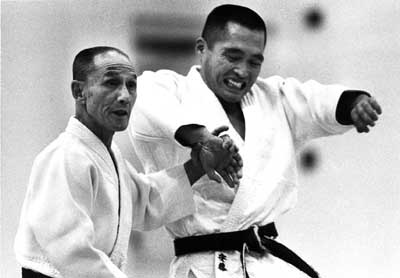
Uke was supposed to take “clean ukemi” and nage to perform “clean waza” and it was understood there was no competition, so that nothing would be gained by blocking or otherwise testing your partner. When individuals failed to heed this advice, things could quickly degenerate into an ugly trial of strength, as they could in any dojo when the principles of aikido were ignored.
I enjoyed training in the Aikikai Hombu for the speed, variety and relatively light training done there. Each of the senseis had a somewhat different approach, but overall there was more movement than in the Yoshinkan. When I first went there after my full-time stint in the Yoshinkan Hombu, people were running rings around me, literally! But after a while I got used to it and joined in the dance.
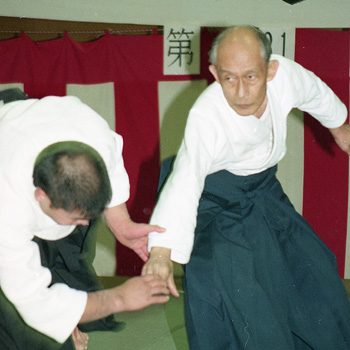
While I can understand why some would consider the generally softer attacks and “token atemi” sometimes encountered in the Aikikai less realistic than elsewhere, I am not sure that argument would stand up to analysis. Who is to say that a powerful punch that would smash your teeth in if it connected is any more effective (in the context of dojo training) than a wave of the hand or a touch intended to alert uke to where the opening for an atemi existed?
One could certainly take issue, too, with the idea that a full-on “committed” attack was any more realistic than a softer version, given the fact that no competent attacker in the real world would advertise his intention and follow through with a single attack in such an obvious manner. He would be as devious as possible. Not that I am against training with “attitude,” it is just that powerful strikes seem ultimately no more realistic as preparation for reality than a wave of the hand—well, not a lot more anyway. (I make this point not to start an argument, but to illustrate the futility of arguing about such strictly relative matters.)
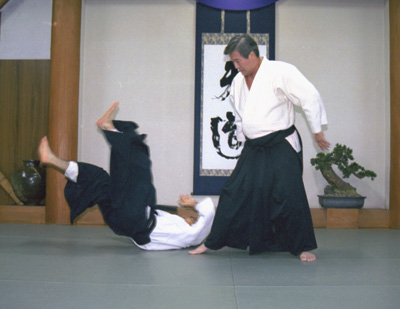
Koichi Tohei’s “ki development exercises” I find excellent for warm-ups and improving balance and awareness. The almost complete lack of injuries in the Ki Society is itself a positive testimony to their method of training, unless of course you have so perverted aikido’s meaning as to count injuries as evidence of effectiveness. I don’t buy the criticism that Tohei’s teaching is superficial, as he was always telling us not to accept his principles intellectually but to work them out ourselves through training.
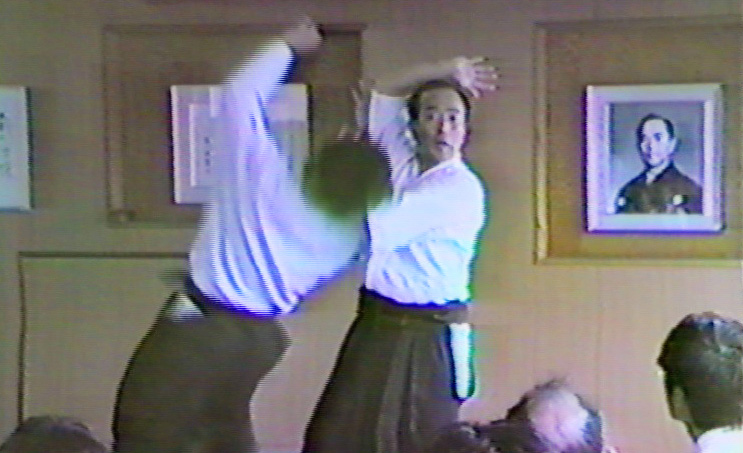
I recall an amusing incident at a dojo party when someone asked Tohei if he could move a teacup with his ki. “Certainly I can,” he replied and reached across to move the cup with his hand, adding that, “the mind and body are one.” To my recollection, he never claimed to be able to throw anyone with disembodied ki alone.
Of course, each system of training could claim to be complete in itself, and I am not necessarily advocating a blend of all of them. It is just that my own circumstances have enabled me to do this to some extent and I find that it works for me and seems to work for my students as well. No great disaster seems to have resulted in viewing each different system as part of a greater whole.
We need to try and see through the different personalities of the top senseis to appreciate where they are coming from. Perhaps one area in which we fall down in the West is in the amount of time we expect this process to take. The Japanese seem more comfortable with the idea that you would expect to spend a number of years if not decades in any one school before you could understand it properly.
It is just unfortunate when ranking and other “political” considerations force students to make a choice between the different approaches, rather than accept without prejudice what each has to offer. People should consider themselves lucky if they find the kind of training that suits their temperament.
A theoretical chart of “martial temperament” (Lynch’s ‘MT Chart,’ pat. pending), with “Mother Teresa” to the East and “Mike Tyson” to the West, might be useful to show the extremely different personalities and temperaments out there, and to help one decide where he or she fits on the line. But such a chart would be quite misleading if applied without reference to the philosophy of O-Sensei. It would be as one-dimensional and boring as most of the effectiveness theories. There would have to be an additional North-South line representing the human potential of the individual—a spiritual warp for the physical and emotional weft.
There is a Way to be followed if we are to approach the goal of aikido, which is no different to the goal of any of the teachings seriously concerned with man’s mental and spiritual evolution. The goal is a unitive knowledge of the divine principle, a direct intuition of spiritual reality and an awareness of the relationship of man and the universe. It is to find out who we are.
Of course the more there is of individual ego, the less there will be of this deeper understanding. Which explains why, wanting to be strong and to protect our egos, we make little progress in love or compassion. Instead of recognizing our ignorance of what really counts and making some effort, however small, to correct this, we spend our time arguing over technicalities, bogged down in materialism.
We look outside for more effective ways of fighting or defending ourselves, instead of inside for a more appropriate hypothesis, in keeping with the original rationale of the “Way of Harmony.”
In the end, we tend to get what we ask for.





Well said David. The same anti relativistic approach could be applied to the ‘internal’ ‘external’ dichotomy found in the assertions from other schools of Aiki, but I don’t want to create another relativist/anti-relativist dichotomy in so doing:) It seems that there is enough of that going on without my help.
Bravo Sensei Lynch! Thank you for your skillful tenkan off the line of my art is better than yours and redirecting the discussion towards why we chose aikido in the first place!
Having lost too many close friends in combat, I am always at a loss to understand the arguments over “combat effectiveness.” The fiercest mixed martial arts professional would still not be good enough to avoid the unseen shooter or the well concealed IED.
You don’t need martial arts to feel safe. Simply surround yourself with good people, avoid dangerous situations, and be alert to your surroundings. Be mentally prepared to act in an appropriate and tactically sound manner if your world suddenly tips upside down. Aikido, as well as every other art if practiced seriously, can help you be ready when the unexpected occurs.
Training out of love or passion for the art is its own reward. I used to be amazed at the number of aikidoka who profess to have never been in a fight. Then one day it occurred to me that these people and their personalities are what drew me to aikido in the first place. Their basic humanity is reflected in their careful treatment of their uke. Their joy of training is infectious.
I love to argue about aikido issues as much as the next guy. But how can I argue with a man with years of study in every major aiki style? Sometimes I am humbled enough to just shut up and listen. Thank you Lynch Sensei for sharing your not so common sense. Your wisdom shines through. Domo arigato gozaimashita.
Splendid, as always. David, I renew my plea to you (I have been mercifully quiet for several years about it): WRITE the books! Your unique background and person demands that you set down what you have learned from your unparalleled experience in Aikido. (Don’t wait too long least my advanced years see me dead and buried before your book is published.)
The catch 22 is that competition, the very thing you are shunning with this article, is precisely what got Aikido popular in the first place. The biography of Morihei Ueshiba ‘A Life in Aikido’ by his son Kisshomaru abounds with examples of Ōsensei’s feats against other martial artists from different budo schools (plenty of judo practitioners but also famous sumo wrestlers).
Do you really believe so many people who have followed the founder’s footsteps if he had refused to engage in any duels because of Aikido’s principles, no matter how pure and beautiful they may be? Or if he would have been pinned to the ground by the first challenger?
I don’t argue that Aikido should become competitive but how can the art be well regarded and prosper in the mainstream without any form of objective validation?
“Senior aikidoka continue to criticize their fellows in other schools and to claim theirs is the only way to the top of the mountain, despite clearly not having reached the summit themselves.”
What if hints of competition here and there is exactly what an Aikido practitioner needs to reach the oh so coveted summit?
Again from ‘A Life in Aikido’, an episode of Ōsensei’s early life in Mongolia:
“One day, he began his technical demonstration quite modestly but, as more people came, he felt he should show them his real strength… He grabbed the weak point of a man’s wrist and applied his full power- the man turned blue and collapsed. ”
Surely I’m not advocating such feats in a dojo (way to scare the newbies!) but it clearly suggests that such experiences were part of Ōsensei’s legendary budo journey.
Personally, I’m fascinated by Aikido but coming from a judo background (10 years while growing up), I feel sometimes frustrated with the lack of clear performance markers. I hope to be wrong but I also feel that Aikido is not as flourishing as other martial arts. The dojo where I train is struggling to attract new members and whenever some show up it seems difficult to convey the essence of Aikido. I’m sure it was the same for Ōsensei in Japan, probably even way harder since he was trying to promote a new martial art, but his unmatched budo skills were there to propel Aikido to where it is today.
Respectfully I offer a dissenting point of view. You wouldn’t want to buy a car that didn’t undergo rigorous safety inspection. You wouldn’t want a firewall to protect your company’s network that hadn’t undergone independent 3rd party penetration testing. Nor would you want medicine or surgeries that hadn’t gone through clinical trials proving their merit. You wouldn’t wait to fire a gun the first time you’re assaulted. There isn’t anything inherently wrong with testing the techniques of a martial art.
I respect the author and his opinion; I respect the idea that Aikido is a system designed with the ideal of not fighting. But I do disagree with the idea that the best self and the best technique can be found without ever challenging technique. Technique is already honed through practice with various levels of compliant uke, it deserves at least occasional controlled 3rd party review.
To my understanding, in Krav Maga, if a technique is shown to fail miserably and get people killed, it’s removed from the curriculum. In Aikido, from my understanding, technique is occasionally removed when it’s shown to injure students, be needlessly dangerous.
My point is, if Aikido is not just stretching, experimenting with the flow of your body, interacting and dancing with another person, if it’s also a martial art, then it should be real. If it’s real, then it should work. To demonstrate that it works, it should be tested. In my opinion Aikido is a martial art, it’s very effective, it’s real, and it works.
To counter the warranted critique of being ineffective as a MA by saying ” Aikido is not a system of fighting, but a way of not fighting”
shows a lack of understanding the true meaning of it.
Ueshiba himself had true martial skills and great strength even in advanced age and had no problems with challenging younger disciples who tested him.
So if Aikido would be just a way of become peaceful you could also do just meditation Qi Gong or whatever.
Also Ueshiba said many things about Aikido being true Budo, etc. So if someone think Aikido is just a pedagogically like gymnastics he should read some words of Ueshiba himself!
The lack of effectives is more a problem of that nobody reached his level.
Tatsuo Kimura:
“Frankly speaking, when Morihei Ueshiba died, I felt Aikido was finished. It disappeared from the world because the Aikido of Morihei Ueshiba and that of his students are completely different.”
O Sensei “I’ve given my life to opening the path of Aikido, but when I look back no one is following me.”