
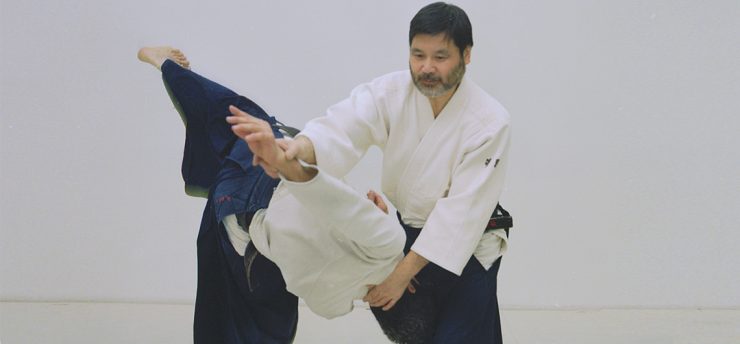
 Josh Gold
“The hara determines the feet, the feet determine your placement. As a result Aikido conducts evasion and engagement simultaneously, not separately.”
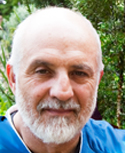 “What makes Aikido different from other mashal-arts?” some in the group once asked Sensei when the seniors were trying to get him drunk enough to reveal secrets. Presumable they were not OBSERVING in class because Sensei, whilst tacit gave away secrets freely.
BY EXAMPLE. But these guys wanted words.
Sensei grunted in his inimitable way. I could feel the discomfort.
“Move whole body,” he finally said.
Lots of talk followed as Sensei quietly sipped his Bourbon and Coke. The talkfest permutated multiple possibilities and finally the accountant turned to Sensei and asked, “What do you mean by ‘move whole body’?”
In the old world they had insulted him enough already, but these were modern city westerners and knew no better.
Sensei sat quietly and whilst appearing bemused was probably thinking, “How thick can these gaijin be?” Or maybe he was overwhelmed with compassion, who knows. But he never voiced it.
Grunting or clearing his throat, I’m not sure which, he appeared to be pondering.
Finally he said, “Move whole body,” with a sincere and respectful tone that suggested, even across the then linguistic barrier; that this could not be improved upon.
Now Sensei is one of nature’s gentlemen. O’Sensei would have simply waked away and Takeda Sokaku would have mostly likely demonstrated most firmly on the questioner for daring to ask stupid questions. But this was a different world.
In the dojo, “Like this,” followed by a fully powered waza was Sensei’s favourite method of explanation.
I loved it and took the message but these boys wanted words. Lots of words. Whatever for I’ll never know or understand.
MOVE WHOLE BODY! That is words enough. More than enough.
You witness crude fighters and beginners suffering from glue feet. They are not even aware of it but are betrayed by their ancestors, genes and hard-wired habits which cling to the ground they are standing on, if even, and most usually, at their own peril.
They just stand there like a block of wood. And get bashed. Or try to bash better.
I get cold shivers of dread when people don’t know what their feet are doing or which is their left or their right and ask myself, “WHERE HAVE THEY BEEN ALL THEIR LIFE?”
These are obsolete knuckle dragging habits, which in human verbal and social interaction reveal some very bad habits.
Among others, that of the inability to let go of the issue, flex the mind and look for alternative approaches.
I think the word “obdurate” or “intractable” best describes such attitudes.
Some alternative approaches are self evident and obvious. Such as getting out of the way of a force trajectory. If gossip is true, one instructor was “excommunicated” from a major cultish “aikido” organization for giving away this “secret of aikido” during a public demonstration, thereby revealing that the organization’s deadwood suffer exactly from this disease.
Getting out of the way is obvious to all but the thickest or most arrogant. It forms the basis of taisabaki or tainohenka.
Aikido requires the practitioner to behave as pointed out by another “heretic” Mr. Koichi Tohei, this being the body and mind united as one. And the body functioning as a coordinated unit instead of disparate parts.
Also it would be rather helpful to be focusing on the goings on of the present moment during a real and physical attack instead of planning your next political move, jostling for meaningless positions in meaningless organizations. And get a job.
The mat is where the action is in training. And real life in real life.
The hara determines the feet, the feet determine your placement. As a result Aikido conducts evasion and engagement simultaneously, not separately.
The attacker determines the technique to be deployed.
The defender allows and assists the attacker without compromising integrity, that is MOVING, into a better position of balance as required.
What is so hard about that?
If you don’t get it, you are talking too much and focusing or irrelevant matters.
More time on the mat, moving and sweating, dealing with firm and intentioned attacks will reveal all.
When you control your feet, and know which is which and what to do with them, you control the opponent’s feet and you thereby have defeated him before he has attacked.
The rest is mere process.
Get the glue off your feet and mind, and as Sensei used to admonish repeatedly: KEEP MOVING.





The article is implying that external movement is fundamental for Aikido, i.e. “Move whole body,”
External movement on its own is not Aikido, its simply evasion and furthermore its not Aikido to move offline as anyone can do that without going to an Aikido Dojo.
Finally, Aikido can be demonstrated with your feet rooted to the ground.
What’s wrong with asking questions if you do not understand what is meant? Move the whole body. What exactly does this mean. If I take a step my whole body moves but I guess that’s not what is meant.
Thank you Nev, very pertinent.
Standing stuck to a certain spot and just waving your arms around is not Aikido, it is just waving your arms around. I believe grounding is important, as the feet are the root of all human power, but standing in the right spot is important, at the right angle, with the right weight distribution. No matter how good you are at external/internal movement if you are standing in the wrong spot you will still get punched in the face.
As for the moving thing, perhaps, and it is my understanding that when we move not one part is left behind, all parts of the body in motion, expanding, contracting, stretching and spiralling, every part has a part to play. When one part stops, all parts stop, just like a full stop at the end of a sentence everything ceases motion at the same time.
People mistake movement for what they can see, for example that the arm does the throw, and then they copy this. That’s OK for beginners, but most practitioners never transcend this learning. They never get to the realisation that arms never throw. It’s not until form is transcended that real movement is internalised and understood.
I recall an interview with Shirata Sensei when he was asked what techniques work best in real situations, he named two or three techniques, but followed up with never stand still, make sure you are always in motion. He should know, he had to defend, in real life situations his Aikido, and that he did so successfully many times gives a lot more credibility to what he says. We stand on the shoulders of giants, my friends, heed their advise.
Peace
There are a number of interesting points raised in this blog which it seems I share a similar opinion.
Glued Feet – I have to agree that this a common problem for beginners, adults and children. I find it is accompanied by locked ankle, knee and hip joints. The next phase seems to be an obsession with the feet by focusing/staring on them and forgetting the rest of the technique. As much as it frustrates me I accept this is a standard process for beginners but NOT for seniors. What also amazes me is that you did any other activity that required agility, they would naturally move their feet.
Quickly touched upon was the attack. There is nothing worse than an in-genuine attack. My mantra to my students is a proper attack helps Nage learn a genuine self defence. Worst of all is when I see senior students (dan grades) stop there attack short. My expectation is that every level gives and receives a genuine attack but the speed will vary according to the level of the students involved.
Laslty, is what I see as embarrassing is seeing dan grades stop in the middle of a technique becuase things aren’t going to their plan where instead they should just KEEP MOVING.
I must immediately STEAL these phrases “Move Whole Body” & “Glue Feet” for my own training and teaching !
Compressing profound knowledge into such brief bursts of expression is pure genius!
Thank you Nev Sensei for keeping Sugano Sensei’s knowledge shining bright, and for adding to it.
Deep bow to you both.
“Move whole body“
It reminds me the story of Sakyamuni Buddha giving a wordless sermon to his disciples, by holding up a lotus flower. Only one disciple understood the gesture and smiled.
If a teacher says something, that you don’t understand, instead of asking, try to figure it out by constantly thinking about it. Like a koan.
I mean there is nothing wrong with asking question… But we as Aikido (Budo) students should ask less and try to understand more trough our body, reflection and focused observation? Pursuing the path means to discover by constantly cultivating ourselves. If you don’t understand something now, it only means that your body-mind isn’t ready yet and need some more work. My experience is, that answers will reveal to you naturally, when you’re ready.
There is an Chinese saying: Power emerge from the feet, is increased by the knees, steered by the hips and finally manifested in the hands. So to say a kinetic energy developed by moving your whole body as one. Wich in Japanese is called shuchu-ryoku (focused power). Emerging from the ability to align your whole body correctly.
The same as you would push your car after a breakdown…!