
 Antonio Aloia
Jamie Leno Zimron Sensei is a Board Member of Aiki Extensions, co-founder of the Middle East Aikido Project and the Association of Women Martial Arts Instructors. She is a Marriage Family Therapist (MFT), LPGA Golf Professional, Corporate Speaker, Holistic Peak Performance Coach, and Citizen’s Diplomat. She is esteemed worldwide for her dynamic teaching style and unique gifts in guiding people to newfound well-being, connection and success. Her company The KiAi Way Inc. provides integrative Aikido-based trainings for everyone to Work, Play and Be Your Best.

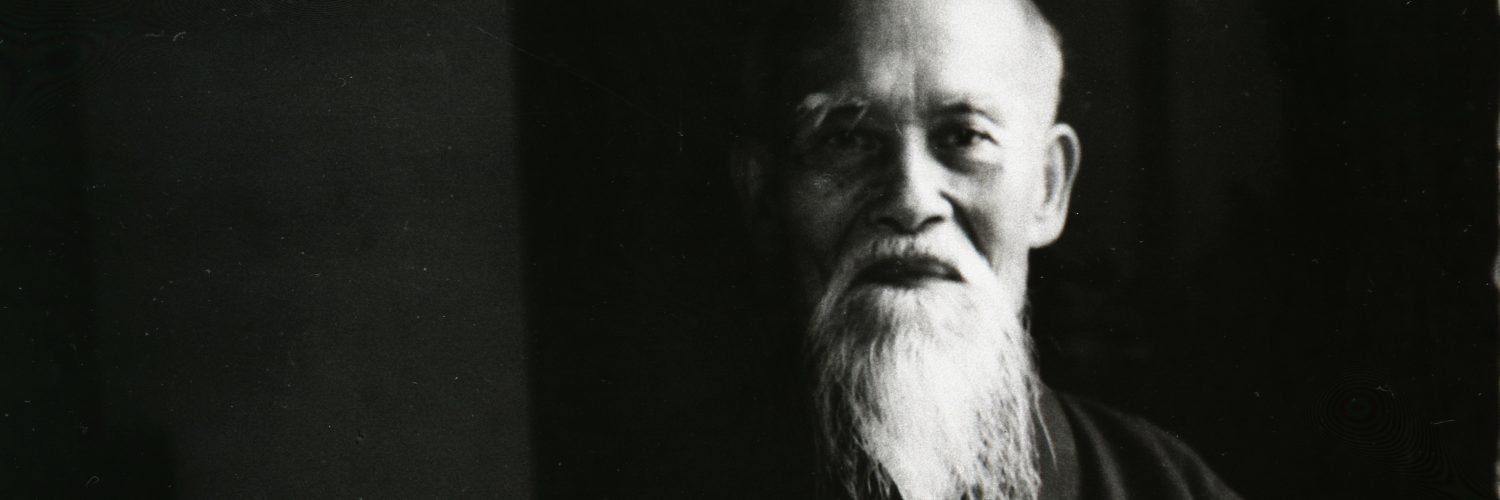
In all the debates of late over the current state and future prospects of aikido, I think most people would agree that it is wise to look to the Founder, Morihei Ueshiba, for guidance. O’Sensei developed aikido as an evolutionary art that encompasses rigorous martial technique rooted in a profound spiritual philosophy of non-violence and “the loving protection of all life.” His stated mission for aikido was to serve as “medicine for a sick world” and “to help make all human beings one family.”
These O’Sensei quotes are among his most famous and commonly shared. No need to search far to find them, or to dig deeply into his esoteric teachings to know what was his express purpose for aikido. Nearly a century ago, with nations mired in two World Wars, mass genocide in Germany, and devastating nuclear explosions on his home soil, O’Sensei put forth his overarching concern: that people learn to create peace.
With his realization that “True Budo is Ai / The Essence of The Warrior Way is Love,” O’Sensei set to work modifying centuries of samurai fighting arts. His purpose was to instill urgently needed ethics and physical practices of Ai / love in order to protect life, end war, promote harmony with nature and peace on earth. And so he named his art Ai-Ki-Do: The Way of Becoming One With The Life-Energy of The Universe.
The ills that plagued the planet then, and threats to civilization and life itself, have only intensified in the 21st century. From climate and nuclear peril, to severe injustice and inequality, to the global COVID-19 pandemic, it is obvious that the world is hardly in a healthy state. Aikido offers vital ‘medicine’ of humane values and harmonious practices. As practitioners and instructors, we have been left an awesome legacy. We are charged to help people transform the world’s existential dis-ease by deploying loving peaceful power. We are guided to create mutually beneficial outcomes via compassionate relationships and cooperative action.
O’Sensei’s stated mission for the Art of Peace is timeless, and has never been more timely. In this light, wondering whether aikido can be viable going forward ought to become nonsensical. That being said, I do think it is vital to address 3 main topics dominating current discussions:
1) The generational top-heaviness of aikido
2) The concern with aikido’s martial effectiveness
3) Rolling forward proudly with aikido’s truly Unique Selling Proposition
The Generational Top-Heaviness of Aikido
I started training at Stanford University in early 1976. As a shodan, age 25 in San Francisco, I opened and ran the first-ever Women’s Aikido School. I helped introduce The Art of Peace into the former Soviet Union, Palestine and Ethiopia, and to establish ongoing Training Across Borders projects and events. Now with four and a half decades on the mat, I continue to guest instruct in a wide array of dojos nationally and internationally.
“Aikido’s traditional power structures have become less and less relevant – particularly when they manifest in downright boring, stifling, oppressive and yes- even abusive ways.”
Most everywhere, there are not enough younger people in aikido, or women and people of color training and teaching. Dojos are largely failing to attract youthful students, on fire with the insatiable Aiki passion my generation had when our bodies were fast, flexible and seemingly indestructible. While I thoroughly enjoy every keiko and every person I meet on the mat, the general state of aikido affairs both saddens and maddens me.
I am part of the getting-older Boomers who started training in our twenties, when aikido was fresh and first ramping up in America. We wistfully remember being young whipper-snapping ukes and nages, training vigorously and fiendishly, usually eight days a week. Alas, to our chagrin and surprise, we are noticing the body does change with age. Speed and endurance are not what they used to be, and impact is out. My joke is that I can fly, I just can’t land … so please no break falls. While we still love to train, many veterans prefer taking minimal to no falls. There’s nothing wrong with that … unless you’re young, eager, and itching to train.
With no offense meant, we need to acknowledge that for young people, it is just not a thrill to go to class after class with predominantly slower, often jaded grey-haired folks. I am all for people getting on the mat and taking care of themselves, and there is so much to respect and learn from us Aiki elders. There is so much beauty in the traditions and rituals of the art. Yet aikido’s traditional power structures have become less and less relevant – particularly when they manifest in downright boring, stifling, oppressive and yes- even abusive ways.
Senseis and practitioners in my generation love the art deeply. We carry vital knowledge, experience and wisdom under our belts. Our presence is absolutely essential for newer students, and to continue proper transmission of the art. But we predominate in aikido – and it is time we dominate less.
Turning younger people on to aikido, not off from it, needs to be prioritized. Elder domination and male domination must get consciously changed up. Old hierarchies need to be challenged and relaxed. Sexism, racism and power trips cannot have any place whatsoever. We need to foster younger ranks to become senseis. We need to make a lot more room for capable black belts who are women, people of color, and younger in age to be teachers, and part of the line-ups at tests and seminars. Vigorous training must be provided, that aging bodies may not quite be able to handle but that younger people thrive on and deserve. As one teenage student told me: “If you really want aikido to survive, figure out how to make it amaze-balls!”
The Concern with Aikido’s Martial Effectiveness
The conversation around aikido’s efficacy generally rests on the assumption that “martial” means you can physically take someone out. While that may be one aspect, this premise is distorted and limiting. Self-defense importantly covers other areas of empowerment training, that happen to be the very strengths of aikido. These include centered awareness, presence and unified power. Setting boundaries. The ability to think clearly and act wisely under stress and threat. Verbal deescalation techniques. Harmonious disarming strategies and surprises of acceptance. Embodied power that broadcasts: “Don’t even try to harass or attack me.”
I have been asked the common question so many times: “Have you ever had to use aikido?” The answer is always “Yes, constantly, though I have never been in a fist fight.” aikido has equipped me with martial know-how along with verbal and self-management skills. These have proven successful in handling myriads of challenging and scary situations. I rely on the centered empowered presence, burnished and polished in to my bearing through training, that lets people know: “No messing with me.” This bearing has let me move confidently and safely in the world, even as a woman often traveling by myself in risky lands and places.
“Let’s stop doubting aikido’s future, or wasting precious energy arguing aikido’s martial value. There is no reason and we cannot afford to play defense. No more letting others question, define, or diminish us.”
Could I physically take down an attacker? Quite possibly. Or maybe not. The truth is that I’m not certain. I don’t want to get in a situation to find out – which in itself is doing aikido. What is certain, for any of us, is that there will always be somebody physically faster, stronger, tougher, meaner. Only one person can be the world’s top champion fighter. And even this position lasts only temporarily, and gives no guarantees of prevailing in an actual conflict.
True story: One night years ago, a virile Karate master was surrounded by a group of gang members in Golden Gate Park in San Francisco. He instantly went into his trained trooper-soldier kiba-dachi stance. As he stood strong and ready, eyes carefully scanning his attackers, some punk with a gun pulled the trigger, shot and killed the master.
To me, the moral of this awful incident has always been: No amount of martial arts rank or prowess can necessarily shield you or save your life. The story makes debates pale over which martial art is real or ‘the best’ or most effective. Trying to prove that aikido really does “work”, while downplaying the non-physical elements of self-defense and martial training, makes little sense.
In his younger years, O’Sensei is reputed to have been one of the greatest martial artists in all Japan. But that was not his goal, or what he considered the end-all be-all of mastery. He had no interest in beating up another person, or beating others in any way. We practice not to go toe-to-toe with kickboxers, or hand-to-hand with MMA fighters. We practice to attain a level of skill and self-victory approaching O’Sensei’s, and a mindset and heartset resembling his.
Rolling Forward Proudly with Aikido’s Truly Unique Selling Proposition
Just as The Founder knew and advised, aikido is uniquely and absolutely suited to meet the pressing needs of humanity. As today’s COVID-19 crisis is making abundantly clear, the Earth’s 7.6 billion people are in truth, all one. We are brothers and sisters, regardless of outward differences, responsible for one another and the collective good. Everything and everyone is interrelated in the whole of life. Our health, economic well-being, and life itself are intertwined. Mutuality, harmony, kindness and love are not mushy ideals. They comprise the strengths and modus operandi required for any and all of us to survive this pandemic – and to newly build and together prosper in a world that is more equitable and sustainable.
I don’t think it is too much to say that aikido has what the world needs. There are urgent practical issues out there, combined with a huge soul-hunger, calling for what we develop in our dojos. Embodied presence and authenticity. Body-mind unity and health. Non-violent “we-all-win” conflict resolution. Power that is peaceful. Centering and grounding. Balance and stability. Life-giving respect for the environment and one another. Love-based action.
Aikido offers magnificent somatic practices informed by universal philosophy and quantum understandings of the world we live in. Uniquely, its concepts and movements are applicable in every aspect and field of living: business, sports, education, leadership, medicine, healing, politics, the arts, mediation, peace-building etc. That’s ALOT. Every time a person goes to the aikido dojo, s-he can sweat, make friends, and be part of like-minded like-hearted community. S-he can simultaneously engage in personal and spiritual growth, party afterwards, and take it all home and to work and into making the world work for everyone.

In all of this lies aikido’s purpose today, and very Unique Selling Proposition (USP). There is so much at stake in our lives and the world, and so many great reasons to engage in The Art of Peace. I believe aikido can be invigorated through showcasing what is so incredibly cool, relevant and powerful in our training. Dojos need to invite in and promote upcoming generations; connect dojo practice to real-world challenges; and build off-the-mat alliances with holistic healers and innovative problem-solvers. Older and younger practitioners can join forces to envision and articulate aikido’s compelling ‘brand,’ then market it brilliantly. We all need to unite to blend wisdom with vigor and bring The Art of Peace more to the fore.
Let’s stop doubting aikido’s future, or wasting precious energy arguing aikido’s martial value. There is no reason and we cannot afford to play defense. No more letting others question, define or diminish us. The time is now to center ourselves solidly and be immovable in the incredible mission O’Sensei set out for aikido: To reconcile the world.
Learn more about Zimron Sensei at The Centered Way.
 Josh Gold



As in the tale of the karate master, fate too often lies in the hands of others.
No matter the inspiration of the leader, it is the self conversion of followers that counts.
There is, though it appears negative, a realism to what I say, but, like you who read this, I have not given up.
I almost don’t want to post this, I’d rather have written how wonderful the article was and ‘come on, let’s do this thing!’ But I couldn’t. Perhaps I’m getting too old.
Martial arts have protected me and prevented harm. An Aikido perspective has helped me avoid unwelcome kisses from drunk dudes on numerous occasions (often in such a way they didn’t even notice). Training in martial arts has also provided me with comfort around sometimes, you lose.
Sometimes (one time for me thank heavens, from a person I thought I knew) the dude is just stronger than you and there’s no time for a technique before he violently shoves his tongue down your throat despite pulling back with all your strength and keeping your jaw as firmly clenched shut as you can.
At times like that I have found knowing that event the best get defeated from time to time helps with the reality check and reduces self-recrimination. Sometimes you lose, but if you can get up again, at least you can get on with things. There’s a lot of getting up again in Aikido
“Could I physically take down an attacker? Quite possibly. Or maybe not. The truth is that I’m not certain.”
This does not inspire much confidence!
I am a judo dan grade who has been doing Aikido for a number of years on and off. I have had in my younger day a number of fights both in school and when I have been attacked abroad. There is not a lot of doubt in my mind i could take down most attackers in the street.
I personally believe that part of the problem with the martial effectiveness of Aikido is that many of the practitioners are non-athletic and many have a fear of training in a way where, for example, they may be thrown hard. These same people become teachers and set the culture of the classes.
Contrast this to Judo where in training for competition judo, there is some form of natural selection. If someone is not tough enough and good enough they drop out.
I not suggesting the training method for competition judo is ideal, but it does explain why the successful judo dan grade can throw most aikido practioners all over the mat.
Most of these alikido practitioners would have dropped out if they had done judo, so we are not comparing like with like.
I have found aikido has helped me with atemi , movement and dealing with and being aware of weapons. Also Aikido provides options which are other than throwing someone hard into the ground or strangling them unconscious.
“If someone is not tough enough and good enough they drop out.” – Or at least they would realize their faults and try to work on them during their training trying to achieve a higher level of proficiency but nooo.
Something of a tired narrative about hierarchy, sexism and racism that bears no relationship to my experience of aikido in the U.K. One sensei I have just so happens to be a black man. It is all but certain, he will, in due course, become the head of my dojo and so he should – he’s a great teacher and all round nice person and it would make no difference to me, nor, I believe, my fellow students, if he were also a woman. There is no question of there being no space – he just occupies it. A bit like aikido that!
Just because you don’t experience it doesn’t make it not real. You may be sick of it if things that make you feel uncomfortable and differ from your personal experience. People experiencing biases have a lot more to deal with and be sick of. I’m sick of the fact that because I’m a FF cup, I likely never have a gi that fits comfortably, because martial arts in general don’t care about curvy body types, and that’s just one teeny tiny example.
Hi Gary, just because you haven’t personally experienced something doesn’t mean it doesn’t exist. And perhaps there truly isn’t an issue of concern at your dojo, but that doesn’t mean that there isn’t an issue at other dojos or overall. So rather than dismiss this point as “tired”, may I suggest that you look with new eyes to see where it may actually be very relevant. Because, I can assure you it is, for many of us.
Wonderful article Jamie. There’s no question that aikido is “the right medicine,” but whether the patient wants it is another thing.
For Jamie and I – and many, many others who started aikido in the 1970’s or even earlier we were in an age of great philosophical introspection. We were being introduced to Heidegger through the Doors and to Maharishi Mahesh Yogi through the Beatles. The 60’s and 70s were about expanding consciousness and “peace and love.” No martial art better spoke to the times than aikido. As young people without cell phones we lived much more through our own thoughts and imagination. We had to imagine what everything was like – from dinosaurs to sex. It was easy for me to accept and understand aikido as metaphorical and to appreciate the mythic power it held. It was also a time of the phenomenological movement when existential philosophers were placing greater value on subjective human experience guiding us away from a purely materialistic view of life.
Today, if you want to see dinosaurs or sex either Spielberg or the internet will just show it to you. The sense of imagination, art, myth and metaphor has been replace by stark literalization. Aikido, which was created as existential pursuit is now disparaged in favor of literalized violence and the pornification of martial arts. Even some in aikido have found popularity taking this path. But making aikido popular for the wrong reasons is not helping aikido. In the same way that literalizing a myth eviscerates the power of the story, to bare aikido down to some sort of combat/self-defense method is to destroy the universality of its message.
Perhaps it’s our role now simply to preserve aikido, in the hands of a relative few, through a time when it may not be so popular. We may be like the ancient scribes that faithfully and thanklessly copied manuscripts to preserve for future generations. Perhaps that’s where our energy is best focused now, not allowing the moody winds of popularity to be the measure of our success. That certainly doesn’t preclude emphasizing aspects of our training that young people find more stimulating, vigorous and even realistic. But there is one value that is emerging in this generation: authenticity. If we try to be something that we are not we will fail. We must be content to be absolutely true to our art and to our message regardless of popularity. The right thing at the wrong time is like planting seeds in the sand. Trying too hard to fit aikido to what’s popular or what people want it to be carries the risk of losing it completely. This doesn’t have to be a sad thing. It just means we have accept our role at this moment in history. As Epictetus might say, “Amor fati.”
To everything
There is a season
And a time to every purpose, under heaven
A time to gain, a time to lose…
The Byrd’s 1965 (Ecclesiastes)
Respectfully, it’s this type of sentiment that has led so many to turn away from this wonderful art. I admire your desire to hold fast to the traditional ideals of the art, but a read of your comments seems to imply that aikido cannot be trained and practiced in a “practical, martial” way and simultaneously hold true to the philisophical underpinnings of the art form. As if they are mutually exclusive.
You say it was was founded on an ‘existential pursuit’ now “disparaged in favor of literalized violence and the pornification of martial arts”. Why is it disparaging to the art itself to want to train with a level of practicality? To want to see if the techniques we practice every day might actually work against an uke (or real life attacker) who isn’t fully compliant with every move we make?
You further write that “to bare aikido down to some sort of combat/self-defense method is to destroy the universality of its message”, again I would ask you why we must lose the message simply because we want to ALSO train with a level of practicality? It seems this attitude is one reason why we are losing so many to other art forms and training systems. Perhaps you don’t care about that, in fact,you go on to say …”Perhaps it’s our role now simply to preserve aikido, in the hands of a relative few”……but I care. I want to see aikido continue, and to thrive. But the notion of leaving it to a ‘relative few’, as if you are the chosen ones simply reinforce the undertone of pompousness that perpetuates among the traditional ‘old guard’ many find in today’s dojo’s. You will not find that in a judo club, on the mats in a BJJ school or in karate dojos (I am a black belt in aikido (shodan) that cross trains in BJJ and also spent years training in Uechi Ryu karate and I have never seen this attitude in those schools). It smacks of a ‘holier than thou’ posture shown towards those who actually believe in the core philosophy of aikido but who ALSO want to train with some semblance of realism. Most aikido dojo’s market aikido as a martial art, yet criticize and marginalize those who want to train in a practical manner, rather than having a compliant uke where we are essentially just practicing a dance.
I don’t have the answers to the problems and waning popularity that aikido is seeing, but I do know that marginalizing those who believe in aikido’s philosophy but who also want to train with realism and practicality will not help. I love aikido, it’s principles, it’s techniques, and it’s philosophy. I will continue to train in aikido. I do however feel dismayed at the level of arrogance so often displayed by those in leadership positions in this art.
Hi Ryan. Great comments and good points. If you look at my own teaching and that of Nishio Sensei you’ll see a high value placed on technical evolution, functionality and innovation in the art. Change in that regard is necessary. But it’s also necessary not to abandon the essential spirit and character of the art. That’s what the “old guard” is for. I think the fear of not being popular is a far greater danger to aikido than not being popular. Fashion, tastes and values come and go, only to return. People seek aikido when they are interested in the values that aikido has to offer. Krav Maga and MMA gyms already do what they are doing much better than we would do it because we have different goals. If people want that kind of thing I refer them there. The Chinese restaurant should not start offering hamburgers even if the burger place next door has a line down the street. They should just strive to make amazing Chinese food.
Nishio Sensei suggested that Aikido people learn some judo, karate and kendo and that you should include aspects of those within your aikido. Should aikido contain strikes? Yes. Should aikido contain ne-waza and ashi-waza? Yes. This is what many instructors, including myself, have done. At the same time, I would expect all these other arts to retain their essential character as each has a unique value they bring. At all the BJJ schools I’ve trained at the striking aspect of training is nearly non-existent. They’re mostly training for non-striking tournaments. But I don’t expect that aspect of training from them and it doesn’t diminish their value at all.
Other martial artists looking at your aikido should not have enormous doubts about you or your art. Your aikido may not answer every single question right now. And you don’t have to be the “badest dude.” You just have to function like an actual martial artist in whatever context you’re operating in. I will admit, many in aikido look like they’re about ready to get punched in the face or taken the the ground. That’s a problem.
Jamie,
Thank you so much for this article. As elders, we do have much to teach, but I agree, there must be more of a mix on the mat. I think getting that mix has become more difficult. At our dojo, and others, we have talked about ways of attracting new people. We sometimes joke about how yoga pulled away the “peaceful” people, and Mixed Martial Arts those who came to aikido after a Steven Seagal movie! One of my friends believes that the popularity of aikido waxes and wanes as societal values change. (And, of course, we are right now in the middle of such partisanship, that it is hard to imagine harmony.) But I think the corona virus, if dojos survive financially, can be an opportunity to bring aikido back in a different way. (I so agree with you about the “martial”effectiveness argument. Newcomers so often ask: “But does it work on the street?” I want to say “What street are you talking about? Mass Ave. in Cambridge??? Or a street in a poorer neighborhood, where, like that Karate instructor, guns are the solutions to problems.) Maybe, while people are off the mats, we could have some writing for the outer world about O Sensei’s philosophy. Anyway, thank you so much again.
Thank you very much, Jamie Sensei! I will share this further. I think we all need to hear and think about what you so beautifully express here.
I don’t understand what the Unique Selling Proposition Jamie proposes is.
I agree that aikido offers unique virtues that can benefit our brave new world, but how would reciting this stream of consciousness attract students?
Is there an “elevator speech” she would recommend to sell aikido?
If you want to know why Aikido is dying, ask other martial artists, “Why don’t you train Aikido?” and they will tell you why the art is dying.
They’ll say,
“Aikido is NOT MARTIAL.
Aikido looks FAKE.
Aikido has NO GROUND GAME.
People who train Aikido LOOK LIKE THEY WOULD BE UNABLE TO FIGHT THEIR WAY OUT OF A PAPER BAG.” etc.
The art as it is trained now is just not very convincing, and it does feel fake. In my personal training, I have uke’d for some very high ranking aikikai aikido practitioners, and I have not been convinced or impressed by many of them.
They hold out their sleeve to grab. You grab the sleeve as requested, and get thrown. That is not technique…. that is acting. When I’m called to uke at one of these demos, I’m always thinking, “What would happen if you hold out your sleeve, and I try to execute a double leg take down instead of grabbing your stupid sleeve like you requested?” …. But I know exactly what would happen…. You would be flat on your back, with the wind knocked out of you and a 200 pound guy on top of you.
The sad thing is…. ALL the tools in your tool box still work when you are defending yourself from the ground —- but you have no idea how to use them at this altitude.
You want the art to grow? Here are 3 foundational changes I’d recommend.
1) Incorporate a Ground Game using aikido concepts. It has already been done, so you don’t even need to invent it. Google “Aikido’s Hidden Ground Techniques” by Jose Andrade and David Nemeroff
2) Drop the GRIP as the main attack aside from “teaching elementary principles”, and transition to training against modern street attacks (roundhouses, jabs, uppercuts, punching combinations) that are not telegraphed by the attacker or requested in advance by the nage.
3) Incorporate a degree of strength training into every training session. The old school guys, “Who bought into the notion that Aikido does not require strength” need to remember that Ueshibia was one of the strongest men in Japan when he was forming the art out of DaityoRyu. Better to have strength and not need it than the alternative.
4) I know this will never happen, but two instructors I would be lifting up as a “Hey Aikido CAN be Valid” tag team are Gary Boaz and Lenny Sly. I do not know either of them personally, but they could right a lot of wrongs regarding the current trajectory of the art. I’d put those two Sensei’s on an international Aikido marketing circuit for the next 4 years, and let them do their thing.
Last point. If you do nothing, the art will die when you die. No new students are coming through the door. DaityoRyu and Judo (BJJ) will still be around, but Aikido will go by the wayside.
I realize this is an older thread, but I am just now seeing this. I’m actually thrilled to see some aikidoka actually discussing this rather do what’s typical in today’s aikido world….ignore it or make excuses.
I’ve been criticized in the past for teaching aikido in a more modern way. Also, many folks mistakenly think I’m saying that “traditional” aikido doesn’t work or that I’m guilty of “creating my own style”. That’s actually not true at all. First of all, I would never be so arrogant or full of myself to think I’m actually doing something new or even changing aikido. I feel the opposite is actually true…aikido is fine just the way it is. What needs to change is how we teach it and how we train it. The principles of aikido are rock solid. Apply those traditional principles to modern style attacks and you’ll see they ARE effective. But if we never push ourselves and challenge what we do, we are lying to ourselves and our students.
The typical question is why don’t you see aikido in MMA? It must not work effectively if it’s not useful in fighting match. Personally I think that’s bullshit. Aikido doesn’t work in a competitive, sporting application. It was never meant to. I teach it as a way to defend yours or other’s lives and also to hone character.
As far as ground fighting goes, I agree 100%. My aikido really became practical for me once I began training ground work. It gave me the confidence to move out of my comfort zone and really begin to test how effective my training is.
Great discussion!
I am also of Jamie’s 1970’s aikido generation. I love many aspects aikido that she describes, and I am sure we would have a wonderful time training together. I do, however, agree with many of the critical comments. Perhaps it is my occupational needs, working on psych wards and in law enforcement that has altered my perspective, and style of practice, but I believe little of modern aikido provides practical protection skills that students expect and deserve. We have failed in this regard.
The style of aikido almost all of us learned and most people teach (as Stan Pranin so often pointed out) is not that of O-Sensei, but that of my teacher Kissomaru Ueshiba.
He was a great man and fine teacher, but was required by post war authorities to remove many martial elements from his father’s art, transforming it into a Kagura – “ritual dance”(Kisshomaru’s own words.) It is a wonderful form of paired martial yoga. We have failed to tap into the 19 million strong pool of yoga students, instead insisting we teach “martial art” and “self defense.” This is somewhat dishonest.
Aikido as practiced in 90% of the dojos I visited (about a hundred in the U.S and Japan) neither Looks – Sounds (Kiai is conspicuously absent!) – Feels like martial art. Yet we are confounded when young people choose other martial arts. Too many aikido teachers believe the earnest desire for effective protection skills is a crass, less than honorable motivation. If you do -please- market your aikido honestly, as Martial-Yoga.
Bill Shakespeare can lend us a tip here:
“The fault, dear Brutus, is not in our stars, But in ourselves, that we are underlings.”
In our wee Nakayama KoAikidokai we have a saying based on Shugyo: We prune the soul (kirihaku) in order to “become the kind of people to whom and in whose vicinity violence never happens.” I have been practicing since 1966 and by now I think I am catching glimmers of what O-Sensei was saying in his later years.
This is excellent. Thank you for writing it. I do appreciate your outline of a USP, but we do need to find a way to express it more succinctly! And we can’t so easily dismiss the question of whether Aikido works. The accusations of fakery are a prime reason why we don’t attract enough young or diverse students. Sadly some Aikido is badly taught. And some Aikido is fake. We all have to keep challenging ourselves to improve.
Great article and opinion piece. Hope people take it to heart
This is such an upbeat article at a time when aikido is struggling. It presents a holistic view of what our study is all about. I do find some of the comments made attacking it incredible. I honestly wondered if they had read the same article. what really makes me sad is how they demonstrate very little aiki.
It’s fine to hold a different view about what aikido represents for you, but if it’s contrary to the author, it doesn’t make her wrong, it just means that her purpose and offering is different. People train for different reasons and get different benefits.
Is it really so hard to show a little respect for others. I thought that was was one of the fundamental skills that aikido teaches and wouldn’t it be nice if that value transferred off the mat, especially when we really need a bit of community spirit.
Thanks Jamie for your insightful article on the mindset that can help us to take Aikido into the future! Like many friends that I shared it with, I found myself nodding in agreement at many points in the article.
Years ago someone pointed out that no group preaches Harmony more than Aikidoists and Quakers, yet can’t seem to agree among themselves what Harmony is all about. People naturally have doubts and honest questions about Aikido, and you have addressed these well. Aikido is not the most interesting topic for debate, but it certainly rewards practice!
At the end of the day as you say we need to roll proudly forward with what we can agree on in Aikido. Koichi Tohei Sensei said something years ago that hit the spot, “I understand means I can do.”
Very interesting to see how you have applied what you learned from Aikido to professional golf! The parallels are fascinating, and it generates an entirely new type of discussion.
Hi Jamie,
I believe it is sensible to discuss the USP for ki-aikido. It seems that if someone is asking about martial effectiveness then this person may already be a bad fit for ki-aikido. From a marketing perspective this would indicate that the branding (by which I mean; name, images, logo etc) is not functioning well. The product is being shown to the wrong market, and the image from the outside is not accurately conveying the contents.
Heidigger may not (ever) be widely read but many young people seek depth and significance in their lives. I didn’t start aikido (at 27) because I was looking for a martial art, I joined up because my first Sensai put an advert in a holistic type newspaper saying ‘Would you like a direct experience of Ki?’ with the date and times of the classes.
Maybe we need to look at where we are on a map, and make new paths, and new signposts, for people to find us and discover their own aikido experience.
Thank you Jamie Sensei, for such thoughtful insights. When I first started Aikido at Stanford in 1983, it was because I saw a sign that said “Learn Aikido, a martial art devoted to Peace, Love, and the Resolution of Conflict.” Having grown up in a family with a lot of boys, and having been a rugby player, I wasn’t looking for how to fight. But peace? Yeah, I needed that. To me, these values are the essence of Aikido, and what makes it so powerful a practice. I’ve always been more interested in the “art” than the “martial”. That said, everyone gets into Aikido for different reasons, and what sustains them in their practice is different too. I think there is room for all, though maybe not all under the same sensei or at the same dojo.
Wow! Thank you for sharing your article. I agree 100% on 100% of it; which is actually rare for me.
The article was concise and very articulate. You hit all the key points and addressed them on point. Thank you for saying what needed to be said, and for sharing it with me and all the aikido world.
Thank you Aikido Journal.
Thank you Jamie Leno Zimron Sensei.