
 Josh Gold
 About 25 years ago I observed an otherwise legitimate meditation group descend into becoming a cheap and nasty, toxic cult. This happened because the person who had founded the group, because of her exemplary qualities, was placed onto an imaginary pedestal by people who assigned her a mythical status in their minds.
Whilst the founder of the group was barely aware and discouraged such aberration, she appeared subtly influenced by the limelight that was offered. Not long after the founder’s death, even greater fools buying into this myth, began a “takeover bid.” Of what, who can tell?
Meanwhile all meditation had gone through the floor. Politics had replaced it. A sneaky subtle politics pretending to be mediation oriented but in fact ulterior motives had toxified the group. It was not entirely obvious at first. As time passed, opposing cliques developed; then gossip, innuendo and a subtle “war” fomented between members.
Over what? Who can tell?
It got worse, but for purposes of this article I won’t go into all the ugly details. This pathology is nothing new. Needless to say, the group fell apart following numerous abuses and some issues ended up in the courts.
Everybody lost. It could have been something good. What happened?
Do you recognize the symptoms? Have you ever become entangled in a such a group.
A surprising number of Aikido groups have. Starting with the very hub of it all following the Founder’s death. I’m sad to say.
What is it that gives rise to this pathology?
You notice that everyone sustains a tragic loss from the concatenations of dysfunction which follow these psychotic events.
Where does it all begin?
Wishful thinking followed by a lie so subtle no-one really notices it until it is too late.
One such Aikido school symptom is the deceitful uke.
For whatever reason, ego, loneliness, a desire for recognition, a desire to follow a perceived “powerful” entity, hankering for “gradings,” the insecurity of craving peer group approval or a number of dark psychological spots growing larger than a spot following a perceived gain. The beginning of the end and instead great loss for all.
The uke fakes the response of a technique conducted poorly and the nage, sadly too often an instructor, cannot tell the difference, or refuses to check himself. Then, believing he is skilled, begins a delusionary biofeedback loop of increasing proportions where this becomes habit.
Nage fakes a “throw,” uke fakes ukemi. And they all feel happy. Or do they?
I reckon that deep down people know what they are doing!
You cannot hypnotise a person who does not want to be hypnotized.
And yet, in this case choosing to be hypnotized by their own folly, the awakener is not found until the disillusionment following a real violence event, the litmus test often sustaining serious injury.
But why do it hard? Who are you kidding?
A truly hard way to learn. Even after that some insist to remain in denial blaming everything from a 2012 apocalypse, global warming, Aikido, another “martial art,” their teacher, their students, dinner, their wife, the kids and the dog. The smart ones learn. Fast. Facing death is the best of teachers.
No-one else is responsible. The complicity was the result of a direct desire to imagine a lie, that he was in that instance, more skilled than he thought he was, instead of testing to discover factuality in order to develop the real ability to become indeed better by meeting the pain of change that leads to transformation. There is no other way. Work. Regular installments of work and questioning and clear thinking.
“Aikido is for self correction; masakatsu agatsu..” Morihei Ueshiba
The litmus test can be applied safely in the dojo. Honesty is the key. Victory over oneself requires it. No need to brutalize each other. Simply give the opponent something to work with. Double that for the instructor of course.
If he’s worth his salt he should be able to dispose of you safely. If not, he should step down and you should go hunting for a real dojo. More than once I have seen an innocent new member angrily chastised by seniors or the instructor for not jumping when he innocently stood there unaware that a “throw” had been attempted!
I expect my students to give me curry! If they jump for nothing, truth be told, they get yelled at. Scolded thoroughly! DO NOT FAKE UKEMI!!
I want them to survive the street and I am responsible if they should fail. The buck stops with the instructor to make his students honest, effective and respectful.
We are training together, practicing drills, not competing. The dojo is not for proving but for IMproving! Not for imagining to be something you are not, but to discover who you really are!
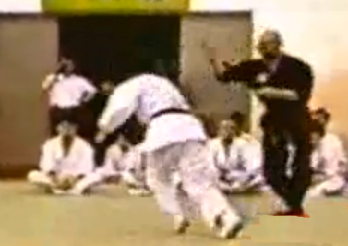
Watch this video.
http://www.youtube.com/watch?v=gEDaCIDvj6I
It encapsulates this whole self-deceit disease in a nutshell. And the outcome here was in a safely controlled environment. The poor kid who gave the “master” a hiding was not informed about faking, or any complicity to do so. Could it possible he refused a bribe to throw the fight? He fought honestly to the best of his ability. He didn’t have to do much! The poor lad became highly concerned as he at first, was led into believing the old fool was a fighter. But he found out to his immense concern, by the looks of it, that he had just bashed a deluded old man without a clue. So sad to see these events, yet they are common, not only in budo, but in all life. An old tub cannot safely sustain the high seas. Understand your vessel. Understand the ocean. Upgrade the vessel to suit the waters you plan to navigate. Learn in safe waters before setting sail where risk exists. Be honest about its capabilities. Get skill that is real or don’t sail! And if you’re not a sailor and can’t swim don’t sign up to join the crew with fables as credentials. You could end up walking the plank when they find out.
If your budo is not making you ruthlessly honest about yourself, strengths and weakness both, warts and all, it is time to change something.
Please do not let yourself get caught in this trap of self-deceit. At the least it will wreck your skill. At the worst it could cost you dearly.
By all means train safely at your real level. It’s nothing to be ashamed of.
But do so with sincerity, honestly and questioning mind. At least with yourself. Safely press the envelope gradually. You will grow.
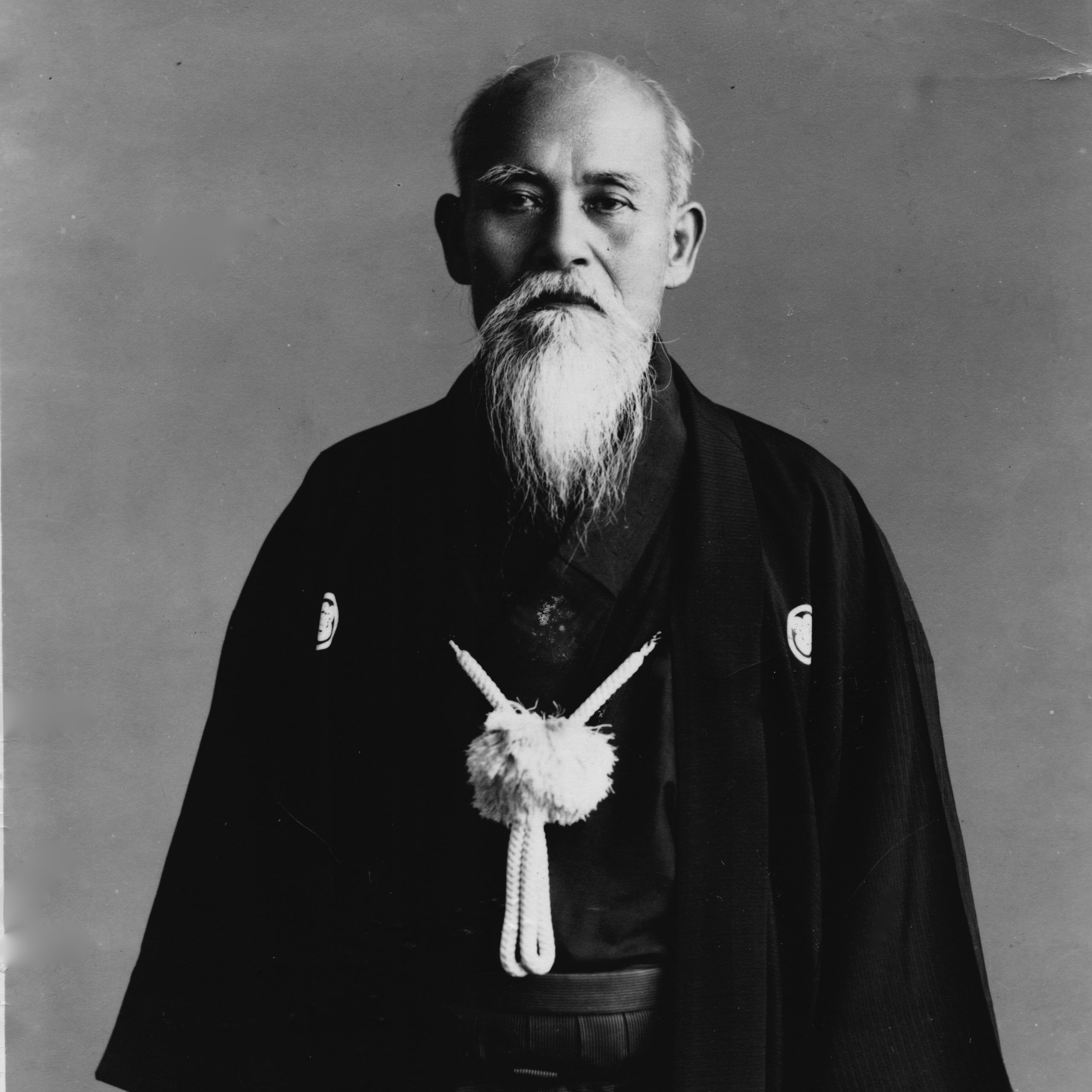
Please learn from this man’s mistakes. Self delusion can never survive real violence. Only experience will see you through. As The Founder of Aikido stated most clearly, “The path of Budo is an exploration without end..” and; “In training practice: Honest attack and honest defence!”
And learn to give your instructor a hard time. Respectfully and safely and with humour of course. If he can’t take it, go to a dojo where the skill is authentically such that you are made to find your place in the scheme of things. Safely.
True beginnings are made in such crucibles of integrity.
POSTSCRIPT: For the record, ki, chi, whatever label you want to indulge can not be “externalised” easily if at all. A Russian woman could move ping pong balls but it took her weeks to recover after each event. A few similar examples of rare individuals do exist. None fighters. Attempts to do so generally fail and take your mind into dark, psychotic and destructive blowback effects. Real life does not have the benefit of SFX. The price, even to move small things is too high. As the video demonstrates, a trained fighter has learned to INTERNALIZE and therefore be able to USE mentally directed energy through the proper channels, the nervous system, nadis, meridians etc. Air is not a good conductor of ki/chi wherewith to push matter, but may, given the right conditions convey thoughts, but not influence other than the most the gullible of feeble minders. It is easier, albeit hard work, to change yourself. And more gainful. The world has its own pre-existing forward motion. Why is properly effected Aiki-jujuitsu the most effective? Energy reserves being everything, why is accommodation more energy efficient? If you cannot understand this then get to work as you are no budoka yet. The sooner we divest from this tragic delusion of “externalising ki,” the sooner we can begin to discover Aikido. As it is!






Interesting article. Way too many main line Aikido people delude themselves. Different old high level sensei felt that much of Aikido was enhanced with attemi. Almost all of the Aikikai abandoned attemi long ago. If something goes “real” you will probably need some strikes to “warmup” the aggressor. Saito Sensei used them. Nishio Style techniques are loaded with them. Many don’t need much strength or “loading”. There are many that are flowing with multiple glancing blows that create flinches then go the other direction, to facilitate the off balancing for executing the technique. I’m still learning all the time. With more advanced students (I actually have very few), we consider training as a laboratory where we determine what makes the techniques actually work. I apply lots of physics, some psychology, and some kinesthetics to manipulate the body. It’s forever ongoing. Sometimes extra epiphanies show up. It’s still as fascinating as the day I started 40 years ago this year.