
 Josh Gold
Pay It Forward, by Josh Gold
Most of our lives have been changed for the better through martial arts. Budo Accelerator exists to give more young people that chance.
Today we’re launching our first scholarship campaign as we get ready to open our program, Budo Scholar, nationally in early 2027. Once it opens, any young person aged 14 to 22 who already trains in a martial art can join. Budo Scholar is a year-round leadership program, first developed and accredited at UC Irvine. Students from aikido, jiu-jitsu, kali and other arts learn together how to carry what they build on the mat into school, home and work.
For young people who want to train but can’t afford it, a scholarship covers a full year at a dojo near them, along with the program.
We’re raising funds for the first 20 scholarships. A full scholarship is $100 a month, and every gift of any size goes toward one, whether it’s a one-time gift or $10 a month. To support a student at a particular dojo, just name it when you give. Through December 31, every gift is matched 1:1, up to $20,000.
Ellis Amdur has given an enormous amount of time and care to Budo Scholar. He helped design the curriculum, he talks with our students, and he serves on our board. I asked him why this work matters. Here is his answer.
Let the Dojo Be the Dojo, by Ellis Amdur
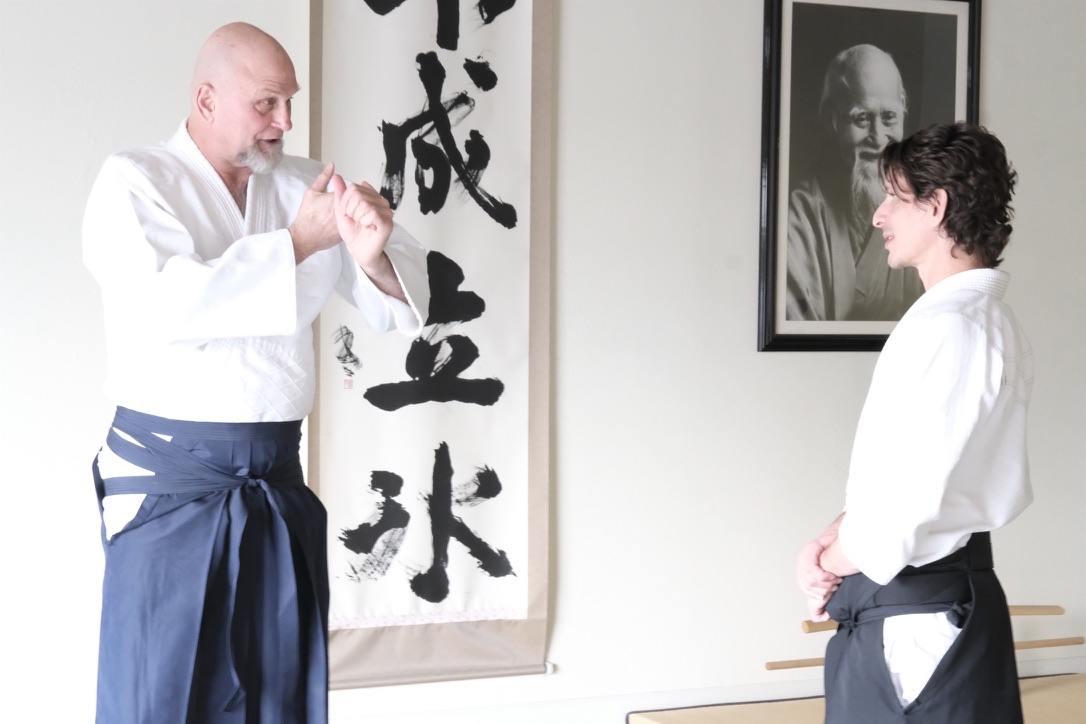
For decades, martial arts schools have promised young people two things. One is self-defense, the reason most people walk through the door, and it is well served. The other is character: self-esteem, endurance, commitment, discipline. That second promise should never be taken for granted.
Martial arts are a superb venue for building character. Every class puts a young person under pressure, in close contact with others, facing their own fear, frustration and limits. Resilience, resourcefulness, integrity, the ability to repair a relationship after a hard exchange: the chance to meet each of these comes up on the mat every day.
But the dojo is not the place to explain how to carry those lessons off the mat. Time on the mat should be full immersion in the art. Stop class to talk about applying it at school or at home, and you dilute the training. So the lessons stay on the mat, and many young people never learn to use them anywhere else.
Budo Accelerator solves this by leaving the dojo alone. Students train at their own schools, fully immersed in their practice and dojo community. Then, in a separate leadership program, they learn tools and techniques to extend what they build on the mat to school, home and work. They study alongside young people from other arts and other parts of the country, something no single dojo can offer. The teacher teaches the art. Budo Accelerator makes explicit how to carry it off the mat.
Young people, who are leaving martial arts in large numbers, respond to this with real enthusiasm. It gives their training a purpose beyond self-defense, and beyond themselves.
They need it. Young people are growing up in a hard and confusing world. Rates of mental illness are high, and fear about the future is everywhere. They need martial arts more than ever, and many of those who need it most can’t afford to train.
So I’m encouraging you to support Budo Accelerator in any way you can. Fund part of a scholarship for a young person who wants to train but can’t afford it; every gift, of any size, goes toward one. Share it with the people you train with. And if you run a school, consider becoming a partner, so a scholarship student near you can train with you.
Our teachers gave us a practice that went beyond ourselves. We owe the next generation the same.
Josh Gold, Aikido Journal’s executive editor, is co-founder and CEO of Budo Accelerator.



 Antonio Aloia




It’s not clear from this description what the end goal is, or the means to getting to those end goal. Aikido, according to Ueshiba, was a spiritual art, so that we may realize our oneness with the cosmos, Nature write large. As such, training is about letting go of ego so that we may unite with the forces of nature becoming one with Nature herself. Admittedly, neo-Confucian (Zen Buddhist (Buddhist-Taoist combo)-Confucian aspects form the background, but, on the face of it, by speaking of self-defense, confidence, commitment to facing fears, etc, it isn’t clear what philosophy is being touted here. Modern Western aikido is quite different to Modern Japanese aikido, and there are many different types of each. I may be mistaken, but given the generalized New Age sounding traits, I can only suppose that what you call ‘Budo Accelerator’ is a course of your own devising, unrelated to aikido’s original purpose and method. I don’t say you’re wrong to do so, since aikido globally today contains such a diverse range of ideas, but to make out as if you are transmitting something pure and authentic and singular or not to suggest the variety out of which you are making conscious choices into the future is to do a disservice to the facts on the ground (lying about its growing historical diffusion), while pretending that aikido is one technical school with no radical disagreements of purpose and method.
Hi Kenny. You’re right that aikido today holds a wide range of purposes and methods, and we don’t claim to be passing on any single, pure version of it.
Budo Accelerator isn’t an aikido program. It’s a leadership program for high school and college students who train in any martial art. It was designed by educators and psychologists together with teachers from several arts. We don’t build the curriculum on any one art’s philosophy. We build it on what training already gives students: facing fear, staying with hard things, and taking care of the people they train with. Our goal is simple: students take what they learn on the mat and use it to lead everywhere else.