
 Josh Gold
“Takako Kunigoshi is the only major female figure in prewar
aikido to have a prominent role in the art’s history.”
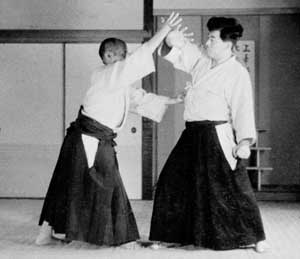
This photo is a rare one indeed culled from a Shukan Asahi magazine article published in Japan about 1935. In aikido history, the two persons appearing in this photo are of great importance. Here is the story.

First, the petite lady executing the “Aiki Budo” throw is a young woman named Takako Kunigoshi. A bit of history… Takako Kunigoshi entered the Kobukan Dojo in 1933, just prior to her graduation from Japan Women’s Fine Arts University. One of the few female students at the dojo, she trained seriously, and gained the full respect of both Ueshiba Sensei and the uchideshi. A skilled artist, Kunigoshi did the technical illustrations for the 1934 book Budo Renshu, which was given to certain students in lieu of a teaching license. Kunigoshi later trained at the private dojo of Admiral Isamu Takeshita for several years, and taught self-defense courses to various women’s groups. Following the war, Kunigoshi did not resume her aikido training. After her retirement, she taught the Japanese tea ceremony out of her home in Ikebukuro, Tokyo for many years.
I met and interviewed her on two occasions in 1981 and 1992. She was a charming elderly lady, most animated in her demeanor, and very enthusiastic in recalling the days of Morihei Ueshiba’s Kobukan Dojo. She is the only major female figure in prewar aikido to have a prominent role in the art’s history. Kunigoshi Sensei was highly respected by her male counterparts in the Kobukan Dojo. She will forever be remembered for the illustrations she drew for the 1934 Budo Renshu book which depicts the techniques taught in the dojo at that time, and which reveal a strong influence of the Daito-ryu Aikijujutsu of Sokaku Takeda.

The person being thrown is Shigemi Yonekawa. Yonekawa Sensei entered the Kobukan Dojo as an uchideshi in 1932. He taught at various locations as an assistant to Morihei Ueshiba, both in Tokyo and Osaka. In 1936, Yonekawa was the Founder’s partner for the series of technical photographs taken at Noma Dojo, which constitute the most complete record of Ueshiba’s techniques from the prewar era. He moved to Manchuria in December of 1936, where he assisted Kenji Tomiki in the instruction of Aiki Budo. Yonekawa was drafted into the Japanese Imperial Army in 1944, and saw action in Okinawa before being repatriated in 1946. No longer active in aikido after the war, he settled in Tsuchiura, Ibaragi Prefecture, where he was engaged in agriculture.
I had the great pleasure of interviewing Yonekawa Sensei in 1979 and 1992. He was one of the nicest and most gentlemanly-like persons I have ever met. He was a bit reticent at first to talk about the old days, particularly when the conversation touched upon the private affairs of the Ueshiba family. Over time, I succeeded in gaining his confidence, and he became quite frank during our conversations. He was a storehouse of information about the period. Yonekawa Sensei also knew a great deal about Morihei’s connection with Manchuria since he lived there in the late 1930s assisting Kenji Tomiki.
These conversations with Morihei’s earlier students provide an excellent background that permits a deeper understanding of the prewar era during which the Founder’s techniques were undergoing a steady transformation into the techniques that eventually became modern aikido.







Add comment