
 Josh Gold
“Description of the Desperate Attack of October 29, by
which the Japanese had hoped to caputre the Fortress”
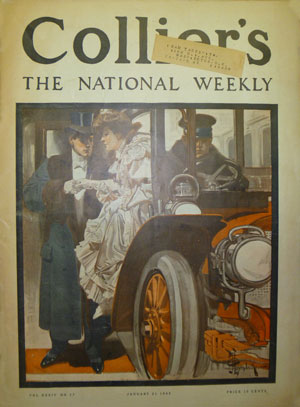
On a recent trip to Japan, I had an opportunity to visit with Katsuyuki Kondo Sensei of Daito-ryu Aikijujutsu at his home. During our visit, he shared with me a copy of “Collier’s” Magazine dated January 21, 1905. It contained a lengthy article about a particular siege of the Russo-Japanese War along with very impressive photos from the battlefield.
The magazine bears an address label that reads as follows: “Isam Takeshita, 1464 R.I. Ave., Washington, D.C.” This is of course the famous Admiral Isamu Takeshita. Takeshita would later become a patron and student of Aikido Founder Morihei Ueshiba. In 1905, he was living in Washington, D.C. where, at that time, he was serving as a military attache. Takeshita arranged for a judo teacher to come from Japan and give private lessons to President Theodore Roosevelt. He also actively trained with the President who loved boxing, wrestling, and the Japanese martial arts.
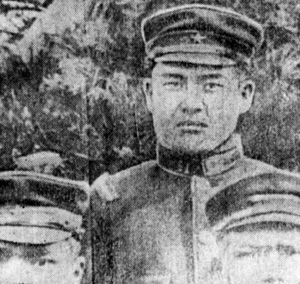
Readers will recall that Morihei Ueshiba was a foot soldier during the Russo-Japanese War (1904-1905). It is not known whether he was on the front lines or served in a support capacity. In any case, Morihei spent considerable time under life-threatening conditions during this brutal war. Morihei was a member of the 61st Osaka Regiment and troops from Osaka are specifically mentioned in this article. It is certainly possible that the young Ueshiba found himself nearby during this particular battle since he was stationed in Dalien, not far from Port Arthur. We will never know the truth of the matter, but this article and the accompanying photos will give readers a glimpse of the atmosphere of this horrific war that the Founder survived.
Last week Mr. Barry, who spent four months with the Japanese forces besieging Port Arthur, described the attack on Namicoyama and 203-Metre Hill. The present paper describes the grand assault of October 29, which followed weeks of sapping and trenching. The attempt cost over 2,000 lives, and resulted only in the capture of the “P” fort, an improvised outwork of the great Keekwan battery. From a military standpoint, the whole action would be called a reconnoissance in force, for the advance sent up as here described found that to take the positions in toto would entail too frightful a cost. Consequently, the commander-in-chief issued an order that night to continue the sapping. That is why the Japanese did not celebrate the Emperor’s birthday with an entry into Port Arthur. The description of this grand assault gives a perfect idea of the magnitude of the operations conducted by the Japanese in their desperate endeavors to take the fortress. Next week Mr. Barry will detail the conditions at the time of surrender.
Noon found me well up toward the firing line, assured by the staff that it would be the day of days. To get there I passed a mile and more of batteries-the Osaka guns vomiting balls of fire, puff-balls of smoke and fat, heavy balls of steel; the howitzers-coyotes of artillery-spitting from peaks, snap louder than the monsters growled below; the naval six-inch turret firers rakishly sunk in valleys, their greyhound noses dappled with mud, and baying out reverberations at which even the sulking sun might have shuddered; the field four-point-sevens, bag-redoubted, conventional as pictures, flinging forth the business barks of house dogs; then, finally, the hand one-pounders, hauled well up the parallels, their bodies angled half-wise and as forlorn amid such colossal music as a penny whistle before a symphony orchestra. To be in it, to pass through it, to feel this whiz and boom people the air above with demon gossip, to sniff from ravines the gusts seeped with cordite and with phosphorous, while in the far-stretched vistas bluecoat files wind through the fierce, vain taunts hurled in among them-ah, this is the atmosphere-the grand, the fearful, the unspeakably sublime atmosphere of war!
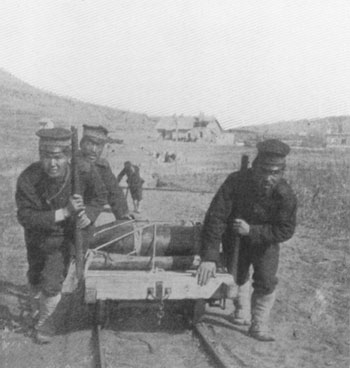
Cloudy! Yes, but what day could smile in the face of such a row as this? The grand bombardment has been on for five days. We call it the “grand” bombardment, to distinguish it from that other trifling bombardment of a few hundred field guns that was on for nearly three months. Now the big coast defence mortars from Osaka, hurling shells the size of donkeys, are ripping the lining from the doomed fortress.We cry for rest, but there is no rest. Night and day the fearful din keeps up. The paper windows of the Manchurian house, where we live, two miles away, have been blown out twice by concussions. The mountains tremble. If you get within a hundred yards of the guns, you must wear cotton batting in your ears and walk tiptoe to save ear-drums. This for a ten mile front, with infantry and regular artillery hammering the spaces out, was enough to discourage the sun. Sun, however, is an incident. War waits for no weather.
Half-way in among the batteries I paused for guidance. There were certain lines between our batteries and the Russian batteries which were called “lines of fire,” and these lines were good places to avoid. Soon two soldiers, each with a rice bag on his back, came along, and I picked up their trail. There was a narrow valley which led to the Ninth Division, whose firing line was to be the centre of the attack and for which I was bound. Along the centre of this valley seemed to me the right way, but the soldiers headed straight across it, business-like, stolid, as if they knew where to go, and I followed. We were fair in the midst of it then. In ravines on both sides the Osaka mortars were hid. From behind and directly over our heads a naval battery was firing, and in front of us there were four of five batteries of field artillery, opening the engagement.
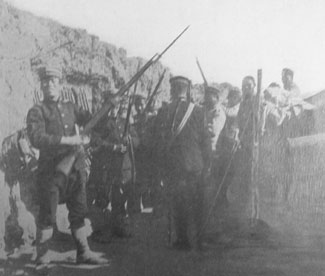
There was never a moment without two or three shells in the air directly over our heads. So long as they were friendly shells-imagine a shell being friendly!-no one seemed to mind. (That “seemed” is a good word to describe my state.) But directly they came viciously from across the valley-look out! Presently one did come that way. I knew it was coming. How? I felt it. So the ground in front found my stomach and my nose sniffed the gravel. It could not have passed very far above our heads-this shell-for when it exploded behind the dust showered over us, and I thanked myself for lying down, else a fragment might have rapped me so I would have cared nothing for dust or dirt of stale encampments. Of course, the soldiers must have lain down, too-they surely must have known the danger. I looked up to laugh with them, but they were trudging on stolidly, as if they were carrying a pound of meat home from the butcher’s. When the dust came they blinked-that was all. So ashamed I hardly dared show myself to them, yet I needed my legs to get on out of the line of fire, and there are times one forgets his pride. I ran; but no need to be ashamed; they had not seen me fall, had neither quickened nor lessened pace, had turned not so much as eyelash to left or right. They had orders to take that rice to the battery, and to the battery they were going. So I paused-amazement surviving fear-and looked at them,cogs of the machine, secret of an army’s strength, of its indomitable bravery. As well expect the shafts of an engine to cry quits when the trucks spring a hot box! At length I found myself where the pewit of bullets beat a quickstep for the inferno aloft. It was on the crest in front of the furthest field artillery, at the rear of the parallels in which the infantry lay, huddled, masses of blue dabbed above with glints of bayonet steel, waiting for the assault. Occasionally the sun came out and sent a heliograph message from those bayonets to me, and then, like myself, sought cover again. The four forts slated for attack by the two divisions in my view lay directly in front, about a mile and a half by parallels and approaches, but, as my vision went, eight hundred yards for the nearest, fifteen hundred for the furthest. From the rear that assorted pack of war dogs






Hello Stan,
The last sentence ends in the middle like there was more to the article. Was this all that was available? I think it’s pretty interesting. I have a history magazine article about a battle in late fall early winter at Mukoden. I’m writing from memory, so the spelling may not be right. It talks of the third army coming from Port Arthur to take part in the battle. If I recall correctly it was sent to the middle of a line maybe thirty miles plus across the front. I’ll have to look at it again for more accurate details. The battle ended kind of in a draw with the Russians retreating, but horrific losses on both sides. The weather accounted for about as many or more losses than the fighting. The Japanese were too strung out and low on supplies to pursue and do any further damage to the Russian army. This detail of the 61st Osaka Regiment gives me more to look for.
Thanks,
Tom Huffman
Tom,
The part of the article I uploaded was an inset. Since there was no period at the end of the sentence it may appear truncated, but there are several others like that. The main article is much longer but I did go to the trouble to key in all of it. For most people, history is a curiosity, but I thought there was particularly interesting in order to convey something of the atmosphere that Morihei experienced while a foot soldier.
Stan:
The photo of the young O’Sensei seemed odd. The head is tilted uncomfortably, and doesn’t aligned with the collar. It also stands out from the background, unlike the other soldiers. Could that be a cut-and paste, not unusual for the era. If so, why that was done would be very interesting.