
 Guillaume Erard
Aiki Forum features discussions with individuals involved in the martial arts in various capacities, such as writers, editors, video producers, etc. In this way we hope to offer alternative viewpoints in order to gain new perspectives on how others view aikido, Daito-ryu, and the martial arts in general. On this occasion our guests are Shigeo Kamata, Kenji Shimizu, and Japanese Editor Ikuko Kimura.
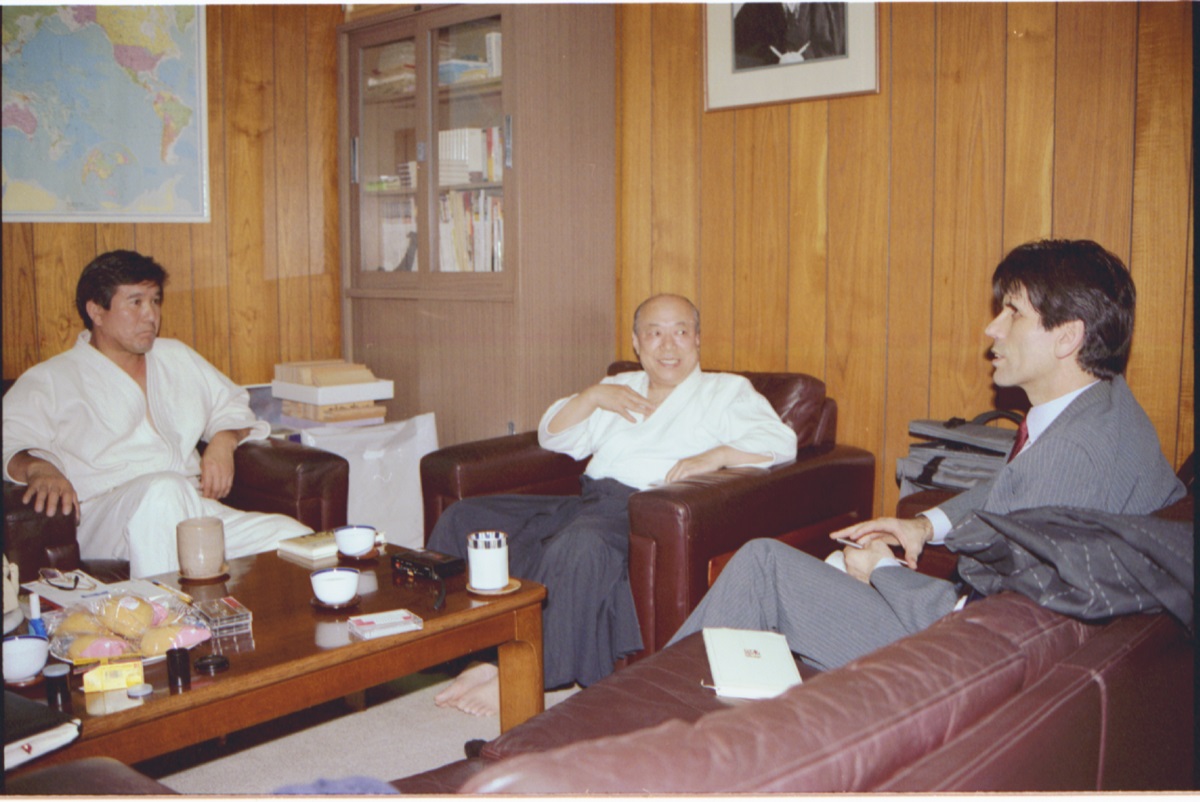
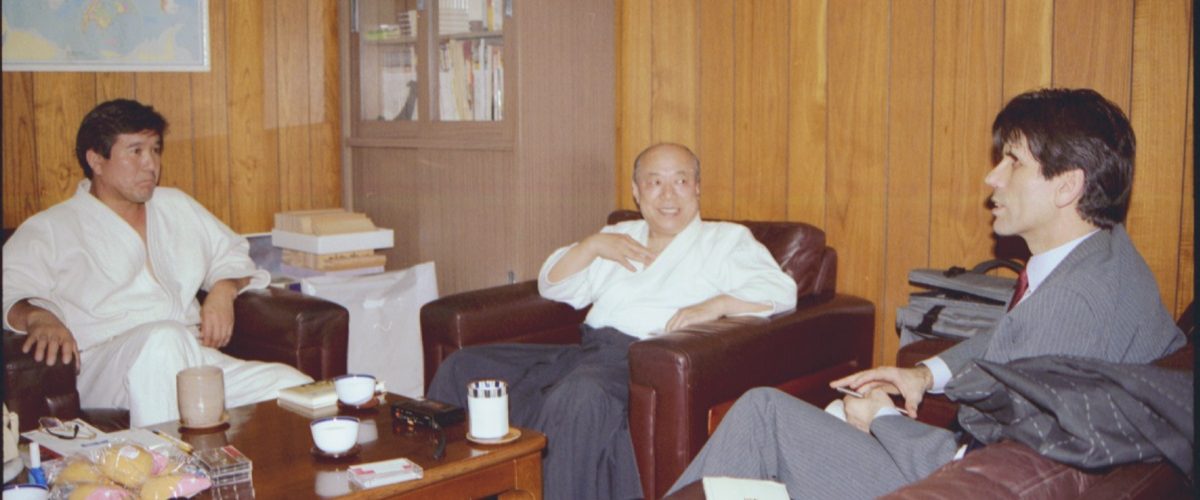
Pranin: Morihei Ueshiba was clearly influenced by the Shinto religion, in particular that of Onisaburo Deguchi of the Omoto-kyo. However, Zen was an influential factor among the Meiji era martial artists. Could you name some of these people?
Kamata Sensei: I believe that Tesshu Yamaoka is the most famous of those who were strongly influenced by Zen. His Muto-ryu style arose from Zen. Muto-ryu was first devised by Munenori Yagyu (muto, no-sword) during the reign of the Shogun Iemitsu Tokugawa [1623-1651]. He wrote a book entitled Heiho Kadensho that includes two volumes known as Setsuninto (Death-dealing Sword) and Katsujinken (Life-giving Sword) in which the influence of Zen is apparent.
Pranin: I believe that Jigoro Kano and other practitioners of the traditional martial arts during the Meiji era were also influenced by Zen.
Kamata Sensei: Yes, that is true. In the Edo era, Zen philosophy was adopted on a large scale into swordsmanship, and thus it is only natural that martial artists of that time were influenced by Zen, although there were some who rejected it.
When a martial artist is young, his sword is merely a “killing sword,” but as he reaches maturity, he does not even draw his sword, much less kill a man. We can see this change in the swordsmanship of Bokuden Tsukahara, who in his later days no longer aimed to kill with his sword. If this is viewed negatively, we can regard the change as a weakening, but in addition there were some spiritual factors which changed the nature of his swordsmanship.
Ueshiba Sensei too seems to have trained in his youth only to become strong, but after he was exposed to Omoto-kyo he could perceive the power of the universe, a power far greater than his own. After that, his aikido changed from mere techniques into an art that also included a mysterious power. I think that anyone who pursues a martial art aims first to become strong, but eventually the possibilities of the art are exhausted and, while trying to break this deadlock, one can come to perceive God, or the spirit of the universe, or Zen, or some such thing.
Pranin: Ueshiba Sensei used to say, “Aikido is based on the sword.” How did he explain the role of the sword in aikido to you?
Shimizu Sensei: He didn’t explain it very fully. In fact, he used to get very angry when he saw us training with weapons. I think he thought that the basis of aikido was taijutsu, so that we, who were as yet untrained students, should not study anything that was not essential to aikido. First we had to learn empty-handed techniques in order to train our bodies.
O-Sensei was severe with our training and used to oversee us even when we were unaware of his presence. When our training did not meet with his approval he used to advise us in a loud voice. He was very careful in watching our training. O-Sensei often showed us the principles of aiki (aiki no riai) using a sword. I think that these days there are too many people who use a sword when doing aikido. If O-Sensei were alive, he would scold them severely, and would say, “This is not aikido!” O-Sensei used to give us a sword and say, “Strike me at me!” But we never could, because we were overwhelmed by his spirit as if we were merely puppets. He captured our spirits and we could not strike at him.
Pranin: You might say that you were beaten even before you attacked him.
Shimizu Sensei: Yes, we were completely baffled. I heard that in his early days he often ordered his students to attack him with real swords, but before they could strike they had already lost. I suppose that they too were overwhelmed by his spirit, like a frog that is mesmerized by the stare of a snake and cannot run away.
In the martial arts, which for me means aikido, the power of spirit can be cultivated regardless of age. Thus, even if an opponent is an old man, we should not allow our ki to slacken. For example, a young man can be overwhelmed by his older opponent’s ki, so that he cannot apply any techniques. It is said that when Tesshu Yamaoka slowly raised his sword, his opponent was compelled to bring his head under it. As a result, he killed no one. Once an opponent hung his own head as if bowing, there was no need for Tesshu to kill him.
Kamata Sensei: I have the impression that Tesshu was a person who had a very strong and powerful character, while at the same time he was a natural and relaxed man. The same thing can be said of his sword. Although he had trained for a long time, he never displayed his skills.
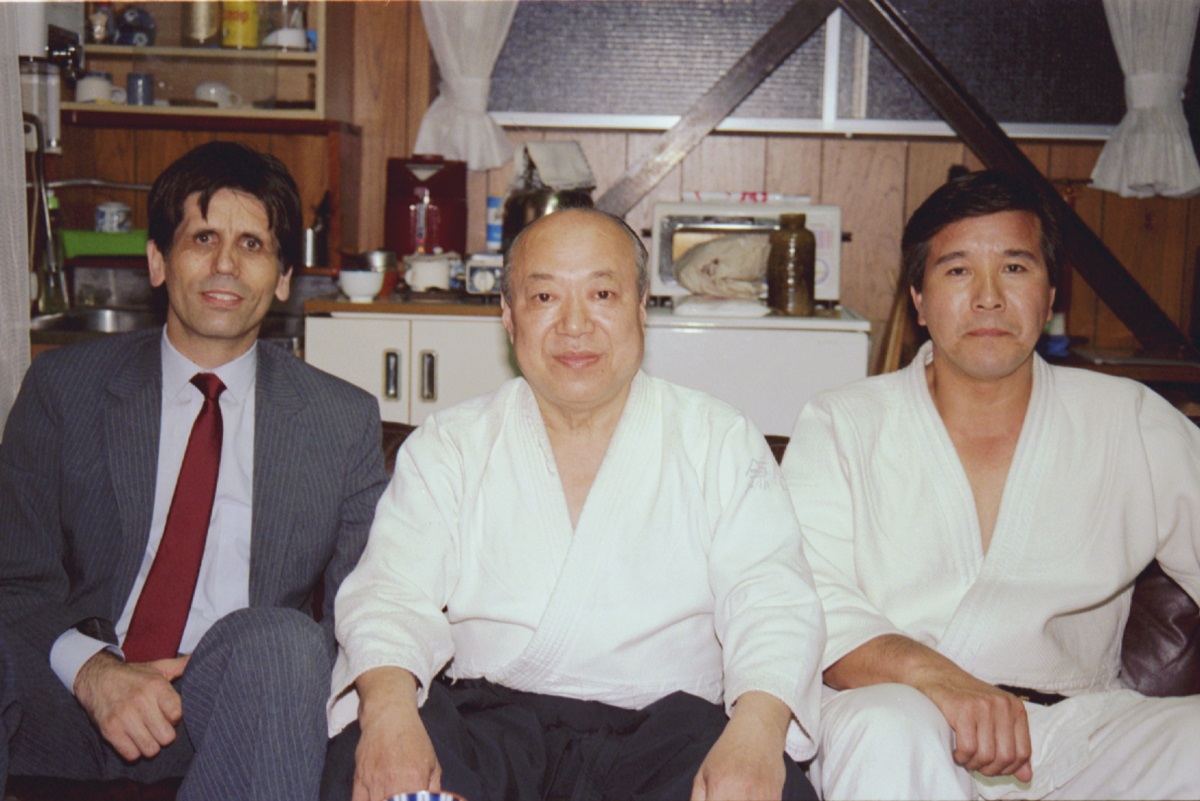
Pranin: Kamata Sensei, in your book, Zen and Aikido, you described Takuan’s central thought, which is to harmonize the spirit of human beings with that of the universe. I think this is the most important goal. I understand that Ueshiba Sensei said, “Aiki is love.” Do you think there are any similar points between the thoughts of Takuan and Ueshiba Sensei?
Kamata Sensei: I believe that Ueshiba Sensei did not read Takuan’s books because he was a member of the Omoto religion. However, although these two men expressed their thoughts in different words, they do have something in common. For example, Takuan did not use the word “love” which is a modern term; instead he used the phrase “all-encompassing embrace.” According to Takuan, love meant to embrace all things around one. This love is utterly different from the general concept of love, and Takuan argued that once a man can embrace his opponent, he is able to embrace all of his opponents, even if he is attacked by five or ten at once.
Ueshiba Sensei too seems to have trained in his youth only to become strong, but after he was exposed to Omoto-kyo he could perceive the power of the universe, a power far greater than his own. After that, his aikido changed from mere techniques into an art that also included a mysterious power. I think that anyone who pursues a martial art aims first to become strong, but eventually the possibilities of the art are exhausted and, while trying to break this deadlock, one can come to perceive God, or the spirit of the universe, or Zen, or some such thing.
Pranin: I understand that O-Sensei said, “When there is one enemy, we must act as if there are ten thousand; when there are many enemies, we must treat them as a single enemy.” I think this is the same as what you have just said.
Kamata Sensei: Musashi Miyamoto also said the same thing in his Book of Five Rings. But if a man feels restless or uneasy, he cannot act in the manner Takuan suggests. Once surrounded by ten opponents, he will flinch, no matter how well he has been taught to regard ten enemies as one. His body will be unable to move, much less succeed in real fighting.
There is an old saying among martial artists that in a real conflict it is difficult for a practitioner to step into his opponent’s maai (combative distance). To cope with this, the Jigen-ryu of Satsuma [present-day Kagoshima Prefecture] has an exercise in which one steps forward into an opponent’s maai, putting one’s body within range of the opponent. When the opponent has a real sword, even when one thinks that the distance between the two is one meter, the actual distance is three. This is why the practitioner cannot strike down his opponent, and can at most merely scratch him. Thus, the people of Kagoshima first train to enter into an opponent’s maai. Once a practitioner enters into his opponent’s maai he can be struck and so he risks his own life to strike down the opponent. He is prepared to be struck down and is trained to strike down his adversary by counter-attacking the opponent’s attack twice. Thus, it is impossible to practice entering into an opponent’s maai using a real sword.
Shimizu Sensei: In Japanese we say, “Niku o kirashite hone o kiru” (if the opponent cuts your flesh, cut him to the bone).
Pranin: Shimizu Sensei, you have been teaching abroad for many years. I think foreigners and Japanese differ slightly in their reasons for learning aikido. Have you ever been questioned on matters of philosophy by your foreign students?
Shimizu Sensei: Yes, I have. First of all they ask me why only a limited number of Japanese people learn aikido despite the fact that they have access to such a splendid martial art. Also they ask me what I think of rei (etiquette) and bu (martial arts).
Pranin: How do you answer them?
Shimizu Sensei: I have a hard time answering. But there actually are Japanese who are diligently studying aikido. As for the second question, I answer as follows: It is best to achieve victory without fighting, and the saying “Rei wa sonae nari” (etiquette is preparation) is the wisdom we use to avoid discord. But if we overlook ill manners because of cowardice, we encounter a situation “where might is master, justice is servant,” and the world comes to be governed by the law of the jungle. Since ancient times it has been said that true preparation is to denounce ill manners and champion justice. We call these preparations “bu” (martial arts). Aikido must be learned in order to cultivate the spirit that can denounce ill manners and bring justice, and to learn to intuitively perceive danger and acquire body movements to cope with it properly and instantly. I have the impression that both individuals and society, which is insensible to circumstances, are fundamentally weak.
One day a person who wanted to enter my dojo asked me, “It is said that aikido is moving Zen, and I know nothing about Zen. Will I be able to learn Zen?”
Kamata Sensei: I do not think he needs to learn Zen. The goal of aikido is to train the hips, just as in Zen. We use the word seikatanden to mean the hips. This technical term refers to the ten-centimeter region of the lower abdomen. We must train this part both in aikido and in Zen. Shimizu Sensei advises us to perform circular movements with the hips. This is very difficult to practice; at first we move the hips describing a simple circle or a simple sphere, then we must perform the exercise in three dimensions, describing many circles. Takuan presented a similar theory to Munenori Yagyu.
He didn’t explain it very fully. In fact, he used to get very angry when he saw us training with weapons. I think he thought that the basis of aikido was taijutsu, so that we, who were as yet untrained students, should not study anything that was not essential to aikido. First we had to learn empty-handed techniques in order to train our bodies.
Pranin: When did the term seikatanden first come into use?
Kamata Sensei: I don’t know the date, but it was initially used in medical science. Chinese medicine was first introduced to Japan in the Heian era and the core of the teachings is to train the seikatanden, ki, and breathing, which originate in the seikatanden. In Zen we train the seikatanden and ki by meditating seated in zazen. The effect of zazen can be seen in aikido, although we are not conscious of this in everyday life. But if anything unusual should happen, I think a practitioner would not be very upset.
Shimizu Sensei: Kamata Sensei gives many lectures and he says that his state of mind while lecturing has gradually changed since he began to learn aikido.
Kamata Sensei: Sometimes I have lectured at large halls such as the Hibiya Hall and have had stage fright. But about five years after I began to learn aikido, I began to think I could embrace the audience even if there were 1,000 people in it.
Shimizu Sensei: Kamata Sensei gave a lecture at our dojo’s Kagami biraki (first training of the year) in January of this year, and it was splendid. The audience was absorbed by your lecture. I am deeply impressed that your aikido is improving every time you practice. You train so hard that you are covered with sweat. It is commonly said that when a scholar like yourself, a professor emeritus of Tokyo University, takes up athletics, he tends to do it with his brain, not with his body. We call this “tonosama keiko,” which means “dilettante practice.” When O-Sensei was alive, I used to act as uke for some of O-Sensei’s celebrity students, and most of them were doing tonosama keiko. This is only natural because they were not young, so as soon as they got tired, they would take a rest. But Kamata Sensei rarely rests until he is drenched with sweat and his heart is pounding. Therefore, he can absorb all of his training, chewing and digesting it. Although I am his teacher I still can learn from Kamata Sensei’s attitude whenever I watch him practicing.
Pranin: I would like to ask you about your book Zen and Aikido, in which you wrote: “Each life has a cruel relation with the lives of others. One life can only be maintained at the price of the death of others.” What does this mean?
Kamata Sensei: It refers to mortal combat. In single combat, if a man cannot kill his opponent, he will be killed by that opponent. But as long as he continues this kind of fighting sooner or later he will be killed. In the old days some people acted as hired assassins. But most of them were killed within three years of beginning their work, no matter how strong they were. It was not because of their technique but due to their destiny or fate. At the end of the Edo period, there was a group of samurai called the Shinsengumi and they were assassins. But despite their strength, none of them escaped death, in fighting or by execution.
Pranin: Kamata Sensei, what is your main motivation for practicing aikido?
Kamata Sensei: For myself; to train myself. I usually spend my time writing books, and I eventually developed writer’s cramp and was unable to move my hands. I tried acupuncture, and went to the hospital but nothing was effective. One day someone said to me, “In aikido, people move their hands during warm-up; why don’t you try aikido?” So I came to the dojo for the practical purpose of curing my hands. But after four or five years of training, I realized that I had not been learning aikido merely to cure my body but for some deeper reason, in Ueshiba Sensei’s words, for “love.” In other words, in aikido the most important thing is to harmonize one’s ki with another’s.
Musashi Miyamoto also said the same thing in his Book of Five Rings. But if a man feels restless or uneasy, he cannot act in the manner Takuan suggests. Once surrounded by ten opponents, he will flinch, no matter how well he has been taught to regard ten enemies as one. His body will be unable to move, much less succeed in real fighting.
If our intention is to harmonize ki with another person’s, we must be spiritually mature and should not be choosy, and say, “I don’t like him or her.” Then I found that I gradually did not care about such things. I cannot express this state of mind very well, but in the words of Ueshiba Sensei, it may be “love.”
Pranin: I have heard that O-Sensei used to tell stories about God, and it must have been difficult for you, when you were in your twenties, to understand them. Do you think that now after thirty years you are adopting some parts of his stories into your aikido teaching?
Shimizu Sensei: To tell the truth, at that time I could not understand perhaps 70% of his stories. When I was O-Sensei’s uchideshi, Mr. Takeo Kimura, who was, I believe, at that time Minister of Construction, was also a deshi and used to practice on me. One day, he said, “The stories Ueshiba Sensei tells us are too difficult to understand.” Because most of them dealt with God, and worse he told them to us as if he were speaking directly to God, we were embarrassed by them. I attended O-Sensei and trained directly under him. One day he lost his temper in front of me. The other students present thought that I had made some mistake, and after he left to go to his room, they asked me, “What the devil did you do?” I hadn’t the slightest idea. An hour later, he emerged from his room and said to me, “Shimizu, a little while ago God made me angry.” That’s all; he said nothing to apologize. Then he said, “Aikido is odo no kamiwaza, do you understand Shimizu?” [odo is a narrow floodgate, kamiwaza is a work of God, so this phrase means “the floodgate of God”]. He was always like that; it made no sense at all and I was utterly puzzled.
But I don’t think I was the only person who could not understand what he said. I think O-Sensei was a martial artist of the caliber that appears only once in 50 or 100 years, but on top of that he was somewhat eccentric; he was not an ordinary man. I have known this for many years. He told us many stories at that time, and recently I think I have begun to understand the meaning of some of them. When we perform aikido we tend to emphasize technique. For instance, when I do nikyo, I am apt to focus my attention on my wrists, or when doing shihonage, I try to bend the wrists.
One day, O-Sensei saw me practicing and said, “You’re doing it wrong!” He said this as if I were typical of the many students present [laughter]. “Apply techniques with a mind to embrace the earth. They’re not effective as long as you apply them cowardly.” At the time I was quite depressed to hear this, but after many years, I think I have gradually come to understand what he meant. In addition, I have come to understand the meaning of “ki” in his words, “Power is finite; ki is infinite.” I understand that “ki” will improve and be cultivated over the years. This is why O-Sensei had such surprisingly vigorous ki power in spite of his age. Frankly, he could not have lost his temper so strongly if he had not had such strong ki power. He was on a different plane. I have come to understand the meaning of “ki” in his words, “Power is finite; ki is infinite.”
Pranin: I think that once we begin to be conscious of ourselves when we apply techniques, our technique stops; the more we wish to perform well, the worse the performance. The more we are conscious of the movement of our sword or other things, the worse we become. I think that is why we must think about mushin (no-mind).
Kamata Sensei: When I began to write Zen and Aikido, I had been reading the philosophy of Takuan. I was impressed and wrote about aikido through his philosophy. I had heard from Shimizu Sensei that aikido is based on circular movement, so I wondered whether I could connect that with the theory of Yagyu-ryu or Takuan. As you know, aikido doesn’t have a philosophical system. Although there are some books written about the words of Ueshiba Sensei, they are not well understood.
It refers to mortal combat. In single combat, if a man cannot kill his opponent, he will be killed by that opponent. But as long as he continues this kind of fighting sooner or later he will be killed. In the old days some people acted as hired assassins. But most of them were killed within three years of beginning their work, no matter how strong they were. It was not because of their technique but due to their destiny or fate. At the end of the Edo period, there was a group of samurai called the Shinsengumi and they were assassins. But despite their strength, none of them escaped death, in fighting or by execution.
The philosophy of Japanese martial arts can be explained through the thoughts of Takuan, which is Zen, so I thought I should be able to connect aikido, which is a type of Japanese martial art, with Takuan and Zen. This was what I attempted to do. I took notes on Shimizu Sensei’s technical explanations during practice for about six months. In these notes, I discovered sections that were the same as the philosophy of Zen which Takuan described.
Kimura: I think that people who are learning aikido will be interested in Zen as well, and it is easier for them to find out about Zen by reading this book, which explains the relationship between aikido and Zen clearly, rather than reading only Zen books.
Pranin: This book is good for both Japanese and foreigners who want to know more about the culture of Japan or of the martial arts.
Kamata Sensei: Yes, the book may act as a guide to the Japanese culture, and I think it will be more helpful when spreading aikido to foreign people to let them know that aikido has many fundamentally similar points in common with traditional Japanese martial arts in its philosophy.
Pranin: We are now translating this book into English and expect to publish it this winter. Could you give our readers some suggestions about what they can learn from your book?
Kamata Sensei: Musashi Miyamoto had a saying, “chotan sekiren,” which means training hard from sunup to sundown. The tan in chotan refers to training for three hundred days, while the ren in sekiren refers to training for thirty years. Musashi Miyamoto said in his Book of Five Rings that a practitioner must train in swordsmanship for 30 years, and he added that one should not learn it hastily. He said, “Learn step by step… Advance step by step.” I think this is the most important thing for both Japanese and foreigners in learning aikido.
Shimizu Sensei: In aikido there is no competition. Therefore, we are apt to forget our original purpose; we forget seriousness and become stereotyped. Thus, the most important thing in learning aikido is not to forget the original purpose, and not to belittle it. I think we must keep this in mind.
Pranin: In aikido, people react in ways that are opposite to our ordinary reactions. Generally if a person is pushed he will push back, or if pulled will pull back. But in aikido we move in the opposite manner.
Shimizu Sensei: We don’t resist our partner. But when we don’t try to resist, it does not go well if we do not surpass our partner. For example, when we are pulled, unless we surpass our partner spiritually, we will continue to be pulled. We must reverse the power of our partner.
Pranin: I think the true character of a man is expressed by his technique and you can see his partner’s feeling toward him in his technique. This, I believe, is one of the fascinating aspects of aikido. Thank you, gentlemen, for joining us today.
Shigeo Kamata Profile
Born in 1927. Graduate of the Buddhist Studies Department of Komazawa University. Ph.D. in literature. Presently a professor of Tokyo University specializing in the history of Zen Buddhism. 5th dan in aikido; student of Kenji Shimizu Shihan. Also holds a 1st dan in kendo. Author of The History of Chinese Buddhism, The Vision of Buddha, and Japanese Buddhist Terminology. Co-author with Kenji Shimizu of Zen and Aikido.
Kenji Shimizu profile
Born in 1940. 8th dan, Nihon Budo Kokusai Renmei. Professional aikido instructor. One of the last uchideshi at the Aikikai Hombu Dojo; began training in 1963. Separated from the Aikikai in the mid-1970s and now heads his own organization, with his Tendokan Dojo in Sangenjaya, Tokyo as its center. Travels regularly to Europe to conduct seminars. Appeared in the Aiki News-sponsored Friendship Demonstration II in 1986. Co-author with Shigeo Kamata of Zen and Aikido.


 Josh Gold



Add comment