
 Josh Gold
P6: “War with Russia broke out in February of 1904. Morihei was stationed in Manchuria, but the year and a half he spent there is shrouded in mystery. Despite vague references to a distinguished service record, it seems that Morihei never saw action in the conflict, reportedly because of Yoroku’s secret plea to his superiors not to send the family’s only son to the battlefront.”
DOSHU: My father didn’t participate in the actual battle but it had nothing to do with Yoroku. At that time, only sons were valued highly and it was the custom to try not to send them into actual battle. I think that is the reason. Although it is said that his activities were recorded, I doubt that they really knew how he moved around in detail. What I heard from my father is that he took part in a mopping-up operation. The old records in Tanabe City in Wakayama Prefecture say that my father received the Eighth Order of Merit for going to the front.
P35: “… Morihei could even dodge bullets fired at point-blank range. Once a group of Omoto-kyo-affiliated military officers formed a firing squad at Morihei’s direction and aimed their pistols squarely at his heart. The instant that they pulled the triggers, Morihei gave out a tremendous shout and knocked them all flat on their backs.”
DOSHU: I have nothing to say about such comments. Nobody will believe this sort of thing. (Laughter) Nowadays anything having to do with the occult is welcome and people are interested in how to execute little tricks to make an opponent fall. This is what I said on one occasion in response to a comment that Morihei Ueshiba could dodge bullets fired from a gun. I said that it was not that he could avoid bullets but that it was possible to imagine him entering towards the opponent the moment he pulled the trigger. In any event, there are many people now who enjoy doing occult-like things. I said the following at the end of my speech: “If you do have interest in things like that, you should be actually practicing them rather than just being interested. You should practice to your limit. Then, after many years of practice, you can understand, for the first time, what we call kotodama (a Shinto-based belief that sounds have an intrinsic value capable of affecting physical reality), which makes it possible for one to execute incredible techniques. This understanding will lead to a manifestation of the spirit of Aikido. You should never think that you can do such things from the beginning.” Today people try to acquire things of value without making an effort. I mean they try to get tasty food without lifting their heads off their pillows. In this sense, I think Japan is lax spiritually.
P38: “Jigoro Kano, the founder of Kodokan Judo, paid a visit to the Mejiro dojo in October 1930. Kano, a cosmopolitan, English-speaking intellectual, was in most respects the diametrical opposite of the old-fashioned mystic Morihei, but he too was dazzled by Morihei’s techniques. ‘This is the ideal budo—true Judo’, Kano exclaimed after witnessing Morihei’s performance. Kano humbly asked Morihei to accept two of his senior students as trainees; Morihei agreed and Kano had them report to him regularly the results of their study with the master. There is another story that Kano and Morihei met again and after Morihei toyed with four or five of Kano’s best students he asked the Judo patriarch rather sharply, ‘Just what kind of budo are you teaching at the Kodokan?’ Somewhat sheepishly, Kano replied, ‘Our system is more a form of physical education than pure budo.’”
DOSHU: This is a much-talked-about story. However, since I was in the fourth year of elementary school then, I do not know any details. It is true that Kano Sensei was really impressed with my father’s techniques. I understand that Kano Sensei did say, “This is real budo, the true Judo.” I also understand that his student named Mr. Hideyuki Nagaoka then asked a question in return, “Does that mean that what we are practicing is not true Judo then?” I have heard that in answering this question Kano Sensei replied, “That’s not the case. Kodokan Judo is the Judo of 90 degree angles and Aikido is the Judo of 180 degree angles.” Although many people have talked about things which occurred later I am not familiar with the details.
P44: “Initially, Morihei—essentially a self-taught master—used his Daito Ryu licenses to give himself a measure of legitimacy in document-obsessed Japan. After Sokaku’s last visit to the Kobukan, Morihei removed his Daito Ryu licenses from the training hall and had nothing more to do with the old-time warrior…”
DAITOKAN: This comment refers to events occurring in 1931, doesn’t it? Ueshiba Sensei gave Daito-ryu licenses in 1932 to Mr. Minoru Mochizuki and as far as we know he continued giving out Daito-ryu certificates up through 1937.
My father didn’t participate in the actual battle but it had nothing to do with Yoroku. At that time, only sons were valued highly and it was the custom to try not to send them into actual battle. I think that is the reason. Although it is said that his activities were recorded, I doubt that they really knew how he moved around in detail. What I heard from my father is that he took part in a mopping-up operation. The old records in Tanabe City in Wakayama Prefecture say that my father received the Eighth Order of Merit for going to the front.
P47: “… Morihei’s prestige was so great that certain government officials secretly commissioned him to try to negotiate a peace settlement with the Chinese leaders; following Pearl Harbor, Japan was incapable of waging war on two fronts for very long. Nothing came of Morihei’s efforts, however, and he suddenly retired from public life in 1942.”
DOSHU: My father never negotiated a peace settlement. Some generals and others who used to come to the dojo did ask my father to propose a settlement to the commander if he was to go over there [China]. My father and Mr. Hata (Shunroku Hata, commander-in-chief of the expeditionary force to China) were old friends, you see. So it was true that my father met Mr. Hata because he was asked to do so. However, my father told me later that when he met him, he was told that although Mr. Hata appreciated his taking the trouble to go over there, he would like my father to leave everything to him and so he came back. I think that this is what actually happened. Since it expressed in sentences like this in print, the story sounds a little funny. Trifling things like this are blown way out of proportion.
P67: “In his youth Morihei learned of the Aioi ryu (probably an offshoot of the Sekiguchi Ryu) from the stories told about his grandfather, a famous exponent of the art. This and related systems stressed the importance of freely applying the “hard” and the “soft”~ according to each particular situation.”
DOSHU: I don’t know much about Aioi-ryu, but my father did say, “Our family has a school named Aioi-Ryu and I learned it from my father, Yoroku,” and I have also heard about the art. However, my father never told me what techniques Aioi-ryu includes or anything like that. Sekiguchi-ryu is a school of jujutsu handed down in Wakayama Prefecture. Although my father associated with people of Sekiguchi-ryu, this was in his later years.
P69: “Since Nakai was additionally proficient in sword, spear, and jo techniques, it is likely that Morihei trained in those arts during his four and a half years of apprenticeship. Morihei received a Goto Ryu Yagyu Jujutsu teaching license from Nakai in 1908 at age twenty-five. Even though Morihei studied a number of different systems, this is the only full teaching license he obtained.”
DOSHU: In the old army system, soldiers could not leave the base easily. They could only take a day off on Sundays. My father entered Nakai’s dojo in Sakai, Osaka first and soon after that he was stationed in Manchuria during the Russo-Japanese war. While a soldier after his return from Manchuria, he continued to train at the Nakai dojo once a week. After he left the army and returned to Tanabe, he went to the dojo in Sakai for a change of pace about once a week. Thus, he practiced only a short period all together. Since Mr. Nakai did not yet have authority to give licenses or scrolls, my father received the license from Masanosuke Tsuboi (a senior instructor of Yagyu-ryu Jujutsu Gotoha) through Mr. Nakai. Therefore, the name of Masanosuke Tsuboi is written on the scroll left in our house. Although I wrote that Morihei Ueshiba received a license from Masakatsu Nakai, people in general didn’t believe this. They understood that my father studied only under Sokaku Takeda Sensei of Daito-ryu. Although I forgot the exact date, I was informed of the existence of Mr. Nakai through old documents about him which a certain old martial master found. We were all surprised to know that Mr. Nakai really existed. Then I did research on the dojo of Nakai in Sakai, Osaka and found documents there as I expected. I even found out where the dojo was. This was the reason Mr. Nakai also became a focus of attention.
This is a much-talked-about story. However, since I was in the fourth year of elementary school then, I do not know any details. It is true that Kano Sensei was really impressed with my father’s techniques. I understand that Kano Sensei did say, “This is real budo, the true Judo.” I also understand that his student named Mr. Hideyuki Nagaoka then asked a question in return, “Does that mean that what we are practicing is not true Judo then?” I have heard that in answering this question Kano Sensei replied, “That’s not the case. Kodokan Judo is the Judo of 90 degree angles and Aikido is the Judo of 180 degree angles.” Although many people have talked about things which occurred later I am not familiar with the details.
P69-70 .“.. Sokaku, who initially called his system the Yamato Ryu, decided to change it to Daito Ryu and had formal documents drawn up tracing the lineage back to Yoshimitsu. Daito was the name of Yoshimitsu’s mansion and further referred to the Daito (Great East) Prosperity Sphere then being promoted by Japanese imperialists. Sokaku thereafter styled himself thirty-fifth Grandmaster of the Daito Ryu.”
DAITOKAN: We have visited the Daito before. We thought that there would be only a temple but in fact it was actually a military affairs office. This was called the Daito mansion. One of the daughters from the family married an emperor. Therefore, it would seem that this military affairs institution had a strict set of formalities. As for the name of the art, Sokaku Sensei used to call it Yamato. The Chinese character for this Yamato was the same as that for Daito but he had people read it as Yamato until the beginning of the Taisho period (1912-1925). However, Mr. Kotaro Yoshida (an intellect who was the head of a newspaper company in Kitami, Hokkaido and also a student of Sokaku) told Sokaku Sensei that the Chinese characters for the art were no longer read as Yamato then and suggested that they should be read as Daito. In those days, that is, in the Meiji period, they did talk about Daito Bunkaken (Greater East Co-Prosperity Sphere), but this had nothing to do with the name of the art. The origin of the name came from the Daito mansion of Yoshimitsu. Moreover, Sokaku Sensei never used the title of thirty-fifth Grandmaster. Why would he have to call himself a “master?” He did use names such as “chief of general affairs” or “headquarters chief.”
P70: “… Quite similarly to Morihei, Sokaku continually modified his techniques over the years, and there are distinct differences in the way his early and later disciples execute them. These discrepancies have resulted in several schisms within the Daito Ryu, the most serious breach being between Sokaku’s son Tokimune and Sokaku’s one-time designated successor Yukiyoshi Sagawa.”
DAITOKAN: Only the blood succession system is used in Daito-ryu. An outsider cannot succeed to the house, and so the term “successor” is not used. Only the “blood successor” (soke or headmaster) can inherit material and immaterial assets in a legal sense and in terms of family register requirements. Daito-ryu has been transmitted through blood relationships and so it was impossible for Sokaku Sensei to designate Mr. Sagawa as his successor. Also, although it is written here [in Mr. Steven’s book] that Headmaster Tokimune and Mr. Yukiyoshi Sagawa have had a serious breach, when the Headmaster traveled to Tokyo he visited Mr. Sagawa many times and when Mr. Sagawa came up to Hokkaido, he has visited Tokimune Sensei in Abashiri. Because of this fact one cannot say that there has been a complete breach between them.
This is what actually happened then. At that time Tokimune Sensei said to Sokaku Sensei before entering the army, “Since I am entering the military it is quite possible that I might not come back alive. So I would like to recommend Mr. Sagawa to take my place just in case. Since Mr. Sagawa is young and also talented, I would like to recommend him.” Then Tokimune Sensei talked about this with Sokaku Sensei and Mr. Sagawa was called to Sendai. Therefore, it is wrong to say that Sokaku Sensei designated Mr. Sagawa as his successor. Both Tokimune Sensei and Mr. Sagawa accompanied Sokaku Sensei to police departments in the Saitama area. Tokimune Sensei and Sokaku Sensei returned to Hokkaido while training continued in Saitama. What Sokaku Sensei seems to have said then was, “Although Sagawa is instructing, he is not suited for teaching. He is too attached to techniques and doesn’t teach well. So it’s difficult for students to learn easily.” It seems that what Sokaku Sensei meant was that learning techniques oneself is not enough. You have to be able to teach them. Since Mr. Sagawa is in Tokyo, if he wanted to, he could have taught on a large scale. He was skilled at techniques and also was recommended by Tokimune Sensei himself, you know. However, since Tokimune Sensei returned from the army safely, the subject of the recommendation was dropped.
P70: “… In Hokkaido, Morihei was initially given instruction in the “108 Basic Techniques” of Sokaku’s Daito Ryu.”
DAITOKAN: The number of techniques is not 108 but 118.
P70: “Sokaku opened Morihei’s eyes to the potential power of Aiki timing, breath control, and the unity of body, sword, and stick techniques. Nevertheless, Morihei learned very little from Sokaku following the first period in Hokkaido, and in fact complained to confidants that Sokaku showed him nothing new during later visits to Ayabe and Tokyo. On his part, Morihei pursued his own independent studies of different traditions. In short, the influence of Sokaku’s Daito Ryu on the development of Aikido should not be overemphasized. As Morihei clearly stated, “The direct influence of Sokaku’s Daito Ryu techniques on the formation of Aikido is not that great. It was but one element among many.”
DOSHU: To state it clearly, the influence of Daito-ryu on Aikido techniques is great. However, the greatest influence for my father was Onisaburo Deguchi. I think the spiritual talks of Onisaburo Deguchi rather than the Omoto religion had the greatest influence on him. Morihei was strongly influenced by spiritual things. My father was very attuned to the philosophy of religion. I believe that he always had the same sensitivity towards the martial arts. This is the reason he practiced arts other than taijutsu (unarmed techniques) such as the sword, staff and spear whenever he wished. First he practiced the staff and sword as well as taijutsu at the Nakai dojo. I do not know to what extent he studied other traditional martial arts there, but I believe that at least these arts had some influence on the process of creation of the present training method of Aikido. However, basically speaking, I think Morihei created his own style himself.
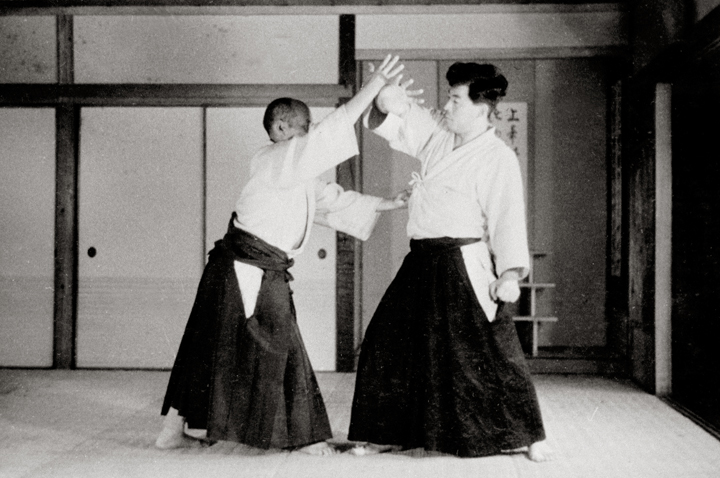
DAITOKAN: This becomes clear if one considers the techniques of present-day Aikido. A look at the photos taken in the Noma dojo in 1935 will reveal that Morihei Sensei was doing Daito-ryu. It is also true that Morihei Sensei changed the techniques of Daito-ryu. An analysis of the techniques of the above-mentioned Noma Dojo photos proves that they are all Daito-ryu techniques. For example, this is one of the ikkajo techniques of Daito-ryu and it is called ikkyo in Aikido. There are 30 techniques in the ikkajo of Daito-ryu. Only one of them is practiced in Aikido. This is obvious from observing present Aikido techniques. Nikyo is, as Mr. Katsuyuki Kondo explained at the Third Friendship Demonstration (sponsored by AIKI NEWS), definitely one of the techniques of the Daito-ryu nikajo. Also, the gokyo of Aikido is an emonodori or capturing technique. However, there is also an emonodori technique in the gokajo of Daito-ryu. Only one of the gokajo techniques of Daito-ryu is used in Aikido.
It is said, for example, that the difference between Daito-ryu and Aikido is that in Aikido there are aikinage (aiki throws). However, Daito-ryu has aikinage techniques and aiki no jutsu. Also hanmi handachi techniques are a characteristic of Daito-ryu. They are among the old techniques of Daito-ryu. When the fourth Shogun, Ietsuna (1641-1680), was 11 years old, Masayuki Hoshina, an Aizu clan lord, had been in Edo castle for 20 years as an instructor. He taught hanza handachi (seated techniques in Daito-ryu) then. However, these techniques cannot be used in battle. These hanza handachi were to be used against sudden attacks inside Edo castle. Since techniques could not be executed while in a standing position inside the castle, one had to do them while kneeling. Masanori Hoshina studied these highly formal techniques, that is, the techniques created in Edo Castle. Sokaku Takeda taught hanza handachi techniques in Sendai. Many people of the Sendai clan studied these techniques.
P72: “On another occasion, Morihei was demonstrating before the president of a large newspaper company, when the president thought to himself, ‘This is all fake’. At that instant, Morihei let loose with an explosive kiai, and all the flashbulbs in the cameras of the news photographers went flying out of their sockets.”
DOSHU: This is a story told by Mr. Matsutaro Shoriki of the Yomiuri Newspaper Company. But the content of the story is written in a strange way. One day in the period when the Hombu Dojo was still a wooden building, Mr. Shoriki came to the dojo with various people including many cameramen and my father demonstrated before them. They set up their cameras and were ready to take photos and then my father gave a demonstration. When my father executed a kiai, they tried to catch that scene at the same time and three or four flashbulbs happened to go off at the same time. It is true that seeing this Mr. Shoriki was really impressed and said, “This is a great kiai. This is really a genuine martial art. It seems like I have experienced the kiai of a Zen master. Ueshiba Sensei was really great as I expected.” However, I do not know anything more. Mixing fiction and facts is not a good idea.
This becomes clear if one considers the techniques of present-day Aikido. A look at the photos taken in the Noma dojo in 1935 will reveal that Morihei Sensei was doing Daito-ryu. It is also true that Morihei Sensei changed the techniques of Daito-ryu. An analysis of the techniques of the above-mentioned Noma Dojo photos proves that they are all Daito-ryu techniques. For example, this is one of the ikkajo techniques of Daito-ryu and it is called ikkyo in Aikido.
P81: “As noted above, he was only briefly under the auspices of the Daito Ryu and never possessed the full teaching license of that ryu. He gave mokuroku (“catalogue of techniques”) to a few of the early disciples and/or copies of Budo Renshu and Budo to others as a kind of license.”
DAITOKAN: The period was not at all short. There are written documents proving that the connection between Morihei Sensei and Daito-ryu lasted from 1915 through 1937. Even from information presented in Mr. Stevens book, it is clear that Morihei Sensei was connected with Daito-ryu from 1915 through 1931. Is 16 years a short period? Although it is also written that Morihei Sensei didn’t have a Daito-ryu teaching license, he received the kyoju dairi (instructor certification) license as well as the Goshin’yo no Te scroll which constitute the highest levels of Daito-ryu from Sokaku Takeda Sensei. There is also proof that Morihei Sensei was associated with Sokaku Takeda Sensei for some 23 years.
DOSHU: This Budo Renshu was published as the first series of several volumes but it turned out to be the first and last one. And this Budo was made as a text when my father was teaching Prince Kaya. For that reason, a staff officer came to take pictures. My father didn’t give this book as a license but he gave it to those intellectuals who practiced very hard at the dojo or those by whom he was helped in his daily life. I believe that 500 or 600 copies of Budo Renshu were published while only 200 or 300 of Budo were printed. I published a revised edition of Budo Renshu after the war but only a few copies. The present Budo Renshu is an edition which was recently revised for people in general.
This is the second part of a two-part interview. Read the first part here.





Add comment