
 Josh Gold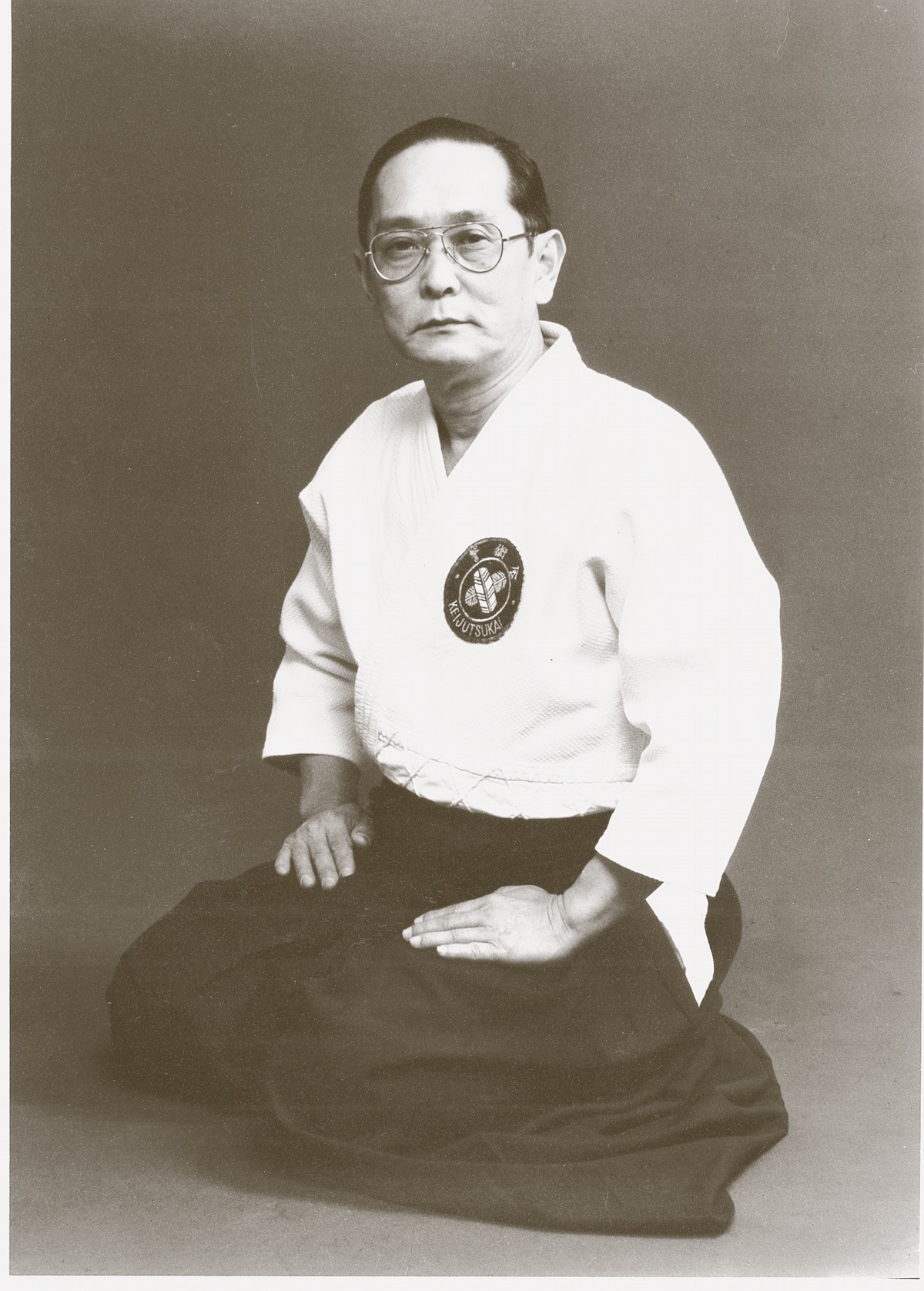
I’ve been a student of aikido (Aikikai) for the past seven years and, to be honest, find getting my seika tanden consistently working in the way that many teachers suggest seems to me impossible. This is one of the things I took up with Makiyama Sensei. I first met Thomas Makiyama (8th-dan) through Lloyd Kumagai, a 71-yr-old 5th-dan Canadian friend who has been practicing with him for 20 years. I’ve asked Makiyama Sensei about this seika tanden business, and he always refers to the hips (koshi) as the source of power. Another word that keeps coming up in our conversations is “compatibility”, which he says can only be understood by feeling it with one’s body. He says no instruction manual on any sport can teach you how to play, and aikido is the same: “There is too much going on that you can’t see.”
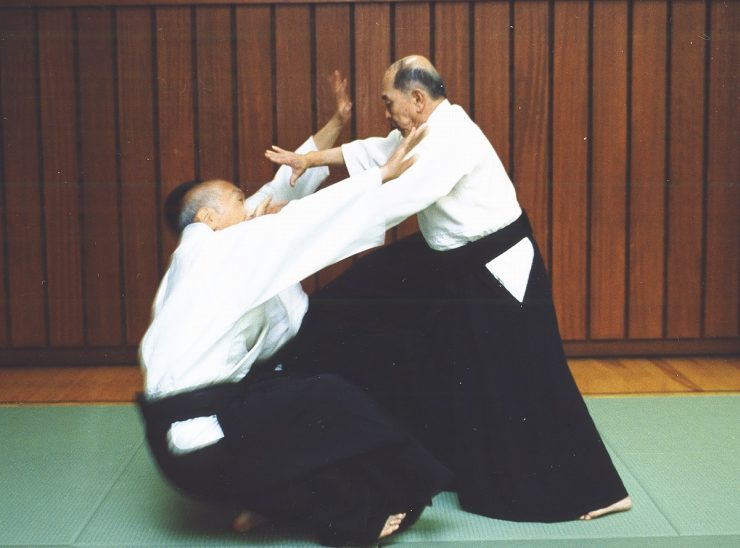
Nevertheless Makiyama Sensei has written a book (Keijutsukai Aikido) in which he defines kokyuho as “the way of compatibility”, an exercise with the aid of which the student begins to “feel the movements” of an opponent. When uke grips nage’s wrist strongly, for instance, the instinctive tendency is to fight back, either by resisting or attempting to pull the captive wrist free. This is force against force, and the stronger man usually wins. However, through regular practice, it becomes possible for the aikidoka to learn how to relax mind and body and “go with the flow” instead of fighting back with strength. The flow principle also applies to strikes, although the force then is harder to feel. Through practice one learns to react automatically, providing one has mastered to some degree the concepts of marui, ma-ai and has proper control of the koshi.
Perhaps being a Hawaiian Nisei (second-generation Japanese) fluent in English and Japanese, and comfortable in both cultures, 73-yr-old Makiyama Sensei, who lives in Tokyo, is able to see aikido more objectively than most, without getting caught up in so much of the cultural window-dressing. He is the founder of the independent Keijutsukai (“Police/Security Techniques Association”), and one of the more outspoken expert commentators on aikido today, often challenging one’s notions of what aikido is. As one of the most senior foreign aikido masters in the world (25 years as an 8th-dan shihan and 55 years of martial arts’ experience), he has a deep understanding, which he says is, “beyond aikido.”
In the following interview I asked him to define his approach to teaching. This is the second part of a two-part interview. Read the first part here.
What do you mean by “compatibility”?
It is flowing with your partner’s movement.
How did you come up with this idea?
A long time ago it occurred to me that you have to be compatible with a person’s movement. There’s nothing mysterious about it. Compatibility could mean timing, coordination, lower body stability, or all of those things working together. I’ve described certain movements to you today, but I don’t think that you have registered them. Words and pictures can only show you the visible parts of a technique, but compatibility is not visible. How do you understand this? Only through practice, practice, and more practice. If you stay with it long enough you’ll learn. I don’t say that it is something that belongs only to me. I think compatibility exists in any martial art.
The “spiritual” aspect of aikido is overemphasized, I think. For one thing, we western aikidoka are from Christian societies, and ideas that originate in Shinto or Buddhism don’t necessarily mean anything to us. I think about compatibility from a practical, rather than spiritual, point of view.
Aikido has been described as something spiritual, something deep inside of you, involving an area a couple of inches below the navel. Well, that’s all well and good, but to try and convince the western mind is pretty difficult. Seeing is believing, and these mysterious ideas seem like a bunch of bull, and people won’t stay with them for long. In order to duplicate this so-called “spiritual power” many western aikidoka have resorted to physical strength.
Just strength?
Strength becomes a substitute for skill, just as it does in other sports. Everything is based on strength, but aikido is not strength.
What is aikido then, Sensei?
It’s ai-ki-do (ki wo awasu) “to fit in,” to be compatible. It’s simple. Then, why do people use so much force? I don’t believe they really understand what they are doing.
The techniques I learned for many years in my younger days felt wrong because I had to use force to make them work, and this did not mesh with the aikido theory.
I spent a lot of time trying to understand, until finally I hit on the point that it is a matter of flow, going with the flow, not going against the flow. In other words, being compatible.
You mentioned “timing,” “coordination,” and “lower body stability;” could you elaborate on these aspects?
If somebody throws a punch, you have to get out of the way: that’s timing. To understand footwork takes both timing and coordination, right? You have to be coordinated in order to execute the movement. Because we don’t dance around like they do in boxing we must rely on lower body stability. The upper body can move anyway you want it to, but the lower body, the koshi, has to be stabilized.
What exactly is the koshi?
Koshi means your hips! It stands to reason that if you lower the body’s center of gravity, you have more balance, like a gyroscope, where the center of gravity is always stable.
What is coordination?
Once a person strikes, you must be able to move away from the line of attack. Then you have to coordinate your movements to be able to do anything. The reaction has to be automatic, and this only comes with practice.
A long time ago it occurred to me that you have to be compatible with a person’s movement. There’s nothing mysterious about it. Compatibility could mean timing, coordination, lower body stability, or all of those things working together. I’ve described certain movements to you today, but I don’t think that you have registered them. Words and pictures can only show you the visible parts of a technique, but compatibility is not visible. How do you understand this? Only through practice, practice, and more practice. If you stay with it long enough you’ll learn. I don’t say that it is something that belongs only to me. I think compatibility exists in any martial art.
But it’s clearly not any old kind of practice. How can we develop these skills?
The major problem that I have seen over the years with my students, here and overseas, is that everybody is too tense. They anticipate an attack and worry too much about what to do. The thing is to relax completely, react, and then relax again. You should not react continuously from beginning to end. That’s a major problem in aikido today. People try to force a movement, whereas it should not be forced, it should be natural.
But most of us train at schools where strength is just the way it is.
But why? Has it ever occurred to anyone that it’s wrong? No one questions it, because they are trained only to do as they are told!
Many teachers and high-ranking students still insist that they aren’t using power, when in fact they are.
Compare what you’ve seen before with what you’ve seen today.
You are completely relaxed.
I am completely relaxed. And I am absorbing uke’s power completely and returning it to him from the koshi. It flows in and then it flows out again with twice the power.
That’s a difficult idea. How do you absorb someone’s power?
Learn to relax completely when somebody grabs you, so that you can feel their power, the direction it is going, the pressure of the grip, and so on. If your mind is made up that you are going to fight against it, you end up with a struggle. I don’t struggle because I’m getting too old!
Is there a method to learn this?
It’s just flow, that’s all. I don’t say it has to go into the hips alone, but it flows naturally into you; you’re feeling it all the way through your body and you’re returning it.
Like drinking a cup of coffee, there is very little strength or power necessary. You know the saying, “minimum effort, maximum result”? That is the principle of aikido, I think. And that’s what you’ve seen today.
How can people in other schools of aikido come to a better understanding of what you’re saying?
They have to undo the habit of fighting back and learn how to flow with the opponent. That comes first. It’s only practice, more practice and still more practice. Keep working at it. Some people get to that point in maybe five, ten, twenty years. Each person is different in how they understand that feeling. You’ve got to be able to feel your partner’s power. If he’s gripping, is he pushing, pulling, squeezing, or what? If he’s pushing, you go with it; your whole body turns from the hips.
When I grab some students by the wrist, they try adjusting many points of their stance or posture but nothing seems to work. They are already excited. They are only thinking, “Somebody is gripping me,” and they want to escape.
They’re panicking?
In a state of panic there isn’t going to be any flow. The point is to learn to relax, react, and then completely relax again: the main three points. Everybody is reacting from the very beginning, and then they’re continuing the process until the end.
What do you teach your beginners?
They do very simple basics to learn the flow. If a person pushes, you react automatically, if a person pulls, you go with the flow, not against it.
How do you teach this?
We do exercises. The beginners you saw today have the tendency to bounce their hips up and down. You notice their feet are not sticking to the mat, which indicates they are going to lose their balance. We are teaching the principle of balance, and how to relax. In the beginning it’s difficult for them because of poor balance.
What about timing?
If you are relaxed and watching a person’s face, their eyes, you can see their movement coming, whatever it may be. If you have proper ma-ai (controlled operating distance), you’re able to sense when the person is coming in to attack.
It’s in the eyes?
By looking in someone’s eyes you can see their whole body, whereas if you are looking at the fist you become sort of hypnotized by it. If you’re completely relaxed and looking into the person’s eyes, you can see their movement coming. I always tell my students to watch the eyes. This doesn’t mean that you have to stare at them!
What is your feeling about ki?
It should be a matter of fitting in with the movements of an opponent, not a mysterious, mystical power.
The idea of ki is not so dominant as it used to be. Some people still emphasize ki, but generally they’ve done away with it. On a scale from one to ten, maybe one or two might still be fooling around with it. The others are using brute force, with the exception of one: me!
I think that many of us who study aikido feel the same way as you, but we often don’t have much choice in the matter.
Yes, you do! Why the hell do you go to those places and learn those things? If you are in doubt, why do you keep on going? Don’t you realize that ignorance of the true nature of aikido only breeds more ignorance!
But what if the person likes the idea of aikido?
I cannot personally recommend any dojo. I have been asked but I can’t do it, even the ones I know are teaching something different. A lot of them are mixing different arts without realizing it. It may be OK for someone who really knows different arts to mix them up, but for those who don’t, it’s asinine. Ignorance breeds more ignorance. The teachers mean well, but for some reason they have not continued their studies. Call it a false sense of pride or whatever; they do not continue, but a person at the lower level must continue to study. In a lot of places they don’t have ranking instructors to teach, or, the teachers just arrive and then leave again: that’s it! I don’t know what the solution is. All I can say is if you want to know more, dig deeper, do research, find out, and by all means check out the instructor!
I have a difficult time tooting my own horn, and I can only try and show people what I mean. I envy those who say how great they are. It’s not “how great they are” that matters, but what they can do. Thirty or forty years ago, very little was known about Japanese budo. You could open a dojo out in the boondocks, wear your black belt and nobody questioned it. Today, people are a lot more knowledgeable. When I wrote an article in 1981 for Black Belt magazine, there was a lot of immediate reaction. I expected it. The upshot was that some guys called Black Belt and said they wanted to have their say so as well. The magazine said, “Sure, we welcome comments.” A few months later I went to the Yoshinkan and I was talking to Kancho (Founder Gozo Shioda) and he said, laughingly, “You’re causing problems again.” Someone from New York had written to find out if my qualifications were legit!
My aikido philosophy and my personal philosophy are two different things. I say in aikido, “Flow, don’t fight” but, personally, I’m a hard man. If a person crosses me, I laugh about it. But I’m waiting. I’ll drop the damn bomb later when it’s time. Maybe that’s not aikido, but maybe it is, I don’t know. I’ll argue. I’m hard-nosed. In aikido, though, I say you have to go with the flow.
How has aikido affected your personal life?
They are two separate worlds. For one thing aikido is not a way of life for me. I believe in it, but it’s not a way of life. Because of the other side of me, I’ll fight. I’m hardheaded; even if it’s a losing cause I’ll fight; I’ll stay with it because I have loyal students I can’t let down. Otherwise I would have given up a long time ago. It’s not a way of life for me, but I’m the kind of person who will go all out for people who believe in me, win, lose or draw.
What do you think about people who turn aikido into a way of life?
That’s OK, but they shouldn’t go overboard. I have a good friend for whom it has been a way of life. He’s devoted many years to it. There are those who treat aikido like a religion. They would probably come out against me, because they’ve been brainwashed. They are narrow-minded. I don’t need people like that. If they want to be narrow-minded, fine.
What role does aikido have in your life then?
I don’t think about it all week long. I think about it when I get to the dojo. When I leave, I forget about it, I cut it off. I’m more worried about my little squirrels!
What about thinking up new techniques?
I’ve been in several arts for 55 years already. I’ve been an 8th–dan in aikido for 25, so what do I have to prove?
Would you do it all over again?
Never. It’s hard dealing with students of all different types, Japanese ones particularly, and trying to convert them, trying to “Americanize” them. If I knew then what I know now, I would have given it up long ago. I’m strange that way. Many years ago I was ready to go home but Noriko Takahashi and Lloyd Kumagai asked me to wait until they became shodan at least. I said OK. Time went on, I didn’t forget, but they forgot! They got their shodan and I said the deal was done, but they insisted shodan was not enough. I felt I owed them some responsibility, and 20 years went by! Would I ever do this again? Never!
My aikido philosophy and my personal philosophy are two different things. I say in aikido, “Flow, don’t fight” but, personally, I’m a hard man. If a person crosses me, I laugh about it. But I’m waiting. I’ll drop the damn bomb later when it’s time. Maybe that’s not aikido, but maybe it is, I don’t know. I’ll argue. I’m hard-nosed. In aikido, though, I say you have to go with the flow.
What’s kept you in it?
I gradually got to a point where I decided that it was something I wanted to finish up, mainly because of what was going on elsewhere in aikido. Now I have age and time on my side, they can’t say I’m a Johnny-come-lately. I outrank a lot of them.
Where would you like to see aikido go in the future?
I’d like to see aikido get back where it was supposed to be: the main purpose being the training, not selling things, or saying how great you are, that type of thing. I think that all of us should work for one common cause, for the good of aikido, regardless of the school.
It’s OK if everybody is out there building their own empires if they know what they’re doing. But, if a school dispatches a young instructor to open a school in a foreign country invariably there is a power play. These guys are young and inexperienced. There is confusion because of the cultural differences too. I only wish that they could all work together for the good of aikido, not this school or that school.
Many people have asked me why I set up the Keijitsukai. I did that because for many, many years I tried to help the Yoshinkan with the American area, but “the establishment” kept seesawing. I said that wasn’t the way to do it. I set up the Keijitsukai mainly because I’m willing to accept responsibility, personally, if anything goes wrong. I won’t say, “Hombu said this, Hombu said that,” and run away from it. I want more teachers to take personal responsibility.
They are two separate worlds. For one thing aikido is not a way of life for me. I believe in it, but it’s not a way of life. Because of the other side of me, I’ll fight. I’m hardheaded; even if it’s a losing cause I’ll fight; I’ll stay with it because I have loyal students I can’t let down. Otherwise I would have given up a long time ago. It’s not a way of life for me, but I’m the kind of person who will go all out for people who believe in me, win, lose or draw.
Foreign dojo think if they don’t affiliate with a Japanese headquarters they can’t get their dan grades. Who cares! This is 2002. If the certificate is signed by somebody the recipient respects, whether they are right or wrong, that’s the individual’s responsibility. Why should he worry about who is signing what? If a person gets a rank from a school that has no affiliation with Japan that’s fine by me. On the other hand, when you go to a big school they ask where you got your grade from, and they don’t recognize a lot of them, mainly because they haven’t been paid for them. Money, money, money! That has been the main problem with the aikido set-up. People feel they can’t get any rankings if they don’t belong to one of these major groups. I am trying to get everybody who doesn’t belong (I call them the mavericks) and put them into one group. If they don’t belong to any headquarters in Japan, they can use me, the Keijutsukai!
Those who have been thrown out, or have given up because of some political problem, all the hardheaded guys. Why not all belong to one group and try to get along with one another? But there can only be one boss. I don’t want any in-fighting. I have no time for that.
What about elderly people who want to start aikido?
When people get to be older, its not so much training as the mental outlook that’s important. They’re set in their ways, and you have to understand why they behave the way they do, in order to help them. You can’t push them, whether they’re healthy or not. I speak with some authority because I have quite a few in my group! One in particular is a classic example. But he’s good-natured. His seniors chew him out quite often. He has improved but its taken three-times as long to get to that point. Besides, old people have all kinds of aches and pains, and we don’t want to aggravate their problems by having them take falls. It’s not that we don’t want them, but we try to keep the age limit at 60.
The way you trained in several of the martial arts, is that even possible today?
Its possible but it may cause confusion because the arts are so different. If you do judo and karate at the same time you are bound to get confused. Unless you have a lot of stamina, trying to follow different teachers and join different groups can’t be done easily. Lloyd is taking kyudo and aikido, but most have enough trouble with one art.
Is there a natural companion to aikido?
Jujutsu, but that is a static art and there are a lot of injuries. I’ve always encouraged people to stay with one art until they get to around shodan, then look into other things. You shouldn’t take up too many things; otherwise you’ll be a Jack-of-all-trades and master of none!
What is the ideal age to start aikido?
There is no ideal age. There is no maximum age either. I’ve arbitrarily decided on an age limit of 60 because of the problems I’ve had. We’ve had 16-yr-olds. I like to get them young. We find that girls are more sincere about studying the art. No matter how you look at it, my group is different. Maybe it’s me?
What about setting up branches in other cities?
I don’t think it is fair to set up branches unless you can service them properly. Also, I’m of the age where I can’t go hopping all over the place. It would be nice to have one or two branches where we could exchange students, where the teaching criteria can be the same, but at the moment, we can’t do that.
What does being a shihan mean to you?
Shihan is the top teaching rank granted by the school. I was a shihandai, a “vice-shihan” when I was third-dan. I’ve still got that certificate stored somewhere. A couple of years later they made me a shihan!
What does it mean to you personally?
Well, it means that they have a lot of respect for me. It’s different from a dan rank. You can be an 8th–dan without being a shihan. In my case, I am both. But if you ask me what it means to me, I’d say about the same as “a cup of coffee with a refill in Hawaii”! It’s no big deal! I was surprised that people got all excited when I first went to the U.S. and they asked me, “Are you really an 8th–dan?”
What about the idea of harmony?
There has to be harmony, but many aikidoka don’t practice what they preach. It’s all lip service. I’m not that type of person; I don’t want to be a hypocrite.
Generally speaking, the the Ueshiba school (Aikikai) is known as the “soft” school, the Yoshinkan is the “hard” school. I coined those phrases back in Hawaii in 1957 or 58. Maybe even before that, because even in Japan I was calling them “hard and soft” schools. Today, everybody uses these terms. The difference between the schools is that movement in the Aikikai is very flowery, nice to watch whereas the Yoshinkan is very hard and more static, like the jujutsu of old.
While circular movement is important, how you apply the circle is even more so. At the Aikikai one expects to be thrown and sometimes they get thrown before the technique catches. But at the Yoshinkan, it’s going to work all right, and by force if necessary! In my school, the movement and technique both have to be compatible.
What is the difference between irimi and compatibility?
Irimi is a “body-fitting” throw. Initially, it meant fitting in. Today, it’s bouncing and throwing. Sokumen irimi is a good example. In the Yoshinkan, they bounce in. Visibly, it’s the same, but the application is different. As I was telling some of the girls, you have to break the balance first before you can fit in; you cannot fight your partner.
So you have to break a person’s balance before you can execute the technique?
I think generally that’s true. Maybe I’m confusing the issue for you. If the person strikes, the idea is not to be there! If you stay put you’re going to be hit! I’m not thinking about the technique, my mind and body are automatically moving to avoid the blow!
In your classes you stress realistic attacks?
Oh yeah, that’s why I get after them if they play a sliding game.
Is atemi a big part of your aikido?
Yes, it’s not just a distraction. In my place atemi is part of the technique. If the attacker gets clobbered by the atemi then, fine, you don’t have to do anything else. But if the atemi doesn’t connect, you go into something else by shifting gears, like an automatic transmission.
While circular movement is important, how you apply the circle is even more so. At the Aikikai one expects to be thrown and sometimes they get thrown before the technique catches. But at the Yoshinkan, it’s going to work all right, and by force if necessary! In my school, the movement and technique both have to be compatible.
People watching our training know that it’s different. I call it aikido but it’s beyond aikido. Aikido as it is cannot cope with certain things, so that’s why I want to change it, and I do so without the frills! I have a lot of female students, so atemi makes a lot of sense. I’ve given them a lot of advice but I don’t know if they have grasped it or not. I feel that techniques should be gradually assimilated. You can’t say, “Aikido doesn’t have this or that,” because aikido did have them all originally. It did not have kicks, with the exception of sidekicks to the knee, but there’s a reason for that. Under the old school, with samurai armor overlapping like a lobster, they could not kick up or forward, but they could kick sideways. I did a lot of research, you see!
How about developing one’s koshi?
I keep telling you and my students to practice, practice, and practice. I don’t know how long it’s going to take but, before you know it, somewhere along the line, you’ll start feeling it. It may take you a year, two years, or 20 years. It depends. I keep telling my students, it’s not something I can teach them. You’ve got to want to know it!
I hear so much about the seika tendan, the area a few centimeters below the navel, which is supposed to be our center of power. Can you comment on this?
If I start using words like “spiritual strength” and things like that, it will be about as clear as mud. I’ve had people tell me, “Oh, Sensei, you have strong ki.” I say, “No, I’ve got good koshi, that’s all!” Actually, I think that I’ve got normal koshi. It’s just that I’m able to react to situations. I’ve been clobbered so damn much in different arts that I learned a long time ago not to be there if someone strikes, I’m not there, and my hands and body are moving very fast. Without my realizing it, I’m moving. When I stop, I’ve accomplished what I wanted. I know that it’s difficult to understand.
This is the second part of a two-part interview. Read the first part here.





Add comment