
 Josh Gold
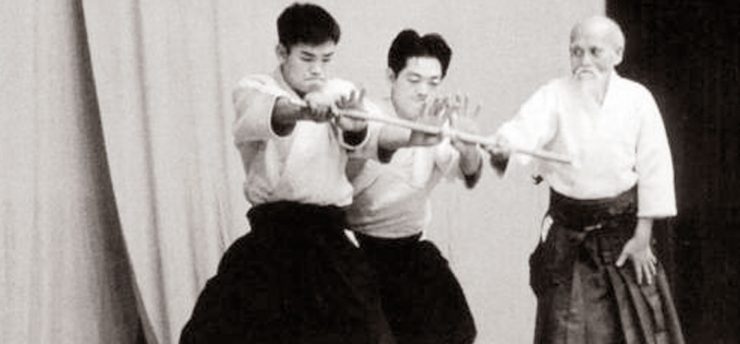
“What does stand out is that instead of stifling his genius as a compliant “follower” of this or that, O-Sensei allowed his genius to come forth.”
 The two dozen or so basic techniques that are held out to be “aikido,” are nothing new. They pre-existed Ueshiba in both western wrestling as well as eastern jujutsu arts.
These techniques, or variables of them, usually crude versions, can be seen in other fighting arts as well.
In fact, so many fighting arts have them that one can be forgiven for making the assumption that “aikido is universal.”
So what’s the difference, if any?
People often cite “the philosophy of aikido,” but can not tell us what this is. Probably just as well, since the “philosophy” of Aikido is something that can only be personally discovered. The innate universal essence all life already contains, requires no brainwashing or stifling dogma. It is innate and can be brought forth though regular discipline using the aiki-yoga of the basic kihon, almost-combat like techniques, resembling something more and which trigger awakening of body-mind and psyche to bring forth the eternal universal internal essence.
The details you can fill in yourself.
Is there a moral and ethical dimension to Aikido?
Is there an ongoing refinement of technical ability?
Is there an emphasis on kuzushi in training rather than deadly finalization?
And using whole body-mind united to harmonize energy?
Is there a removal of the stifling element of contest that destroys and injures the psyche and often the body as well and which would place most practitioners outside the possibility of practice?
Has it retained the highest ideals and aspirations of the samurai who built the “new world” that was to become Japan?
There is no doubt that the Founder of Aikido was “influenced” by Shinto, Buddhism, Christianity, various forms of Mysticism, Shamanism, Omoto and other religio-mystical-humanitarian practices and ideals. After all, like so many do, he was searching. These too, when each stripped of their peculiar window dressing, are universal human aspirations at the core. High values not really that dissimilar to each other.
So what did the Founder really do? What did he achieve? Did he set out to achieve anything at all, other than to live his own life as best as he knew how?
Aside from living a heroic life outside the expected mold, pursuing self-correction from a deep, authentic basis, trying to serve humanity as best he could and make some measure of difference..
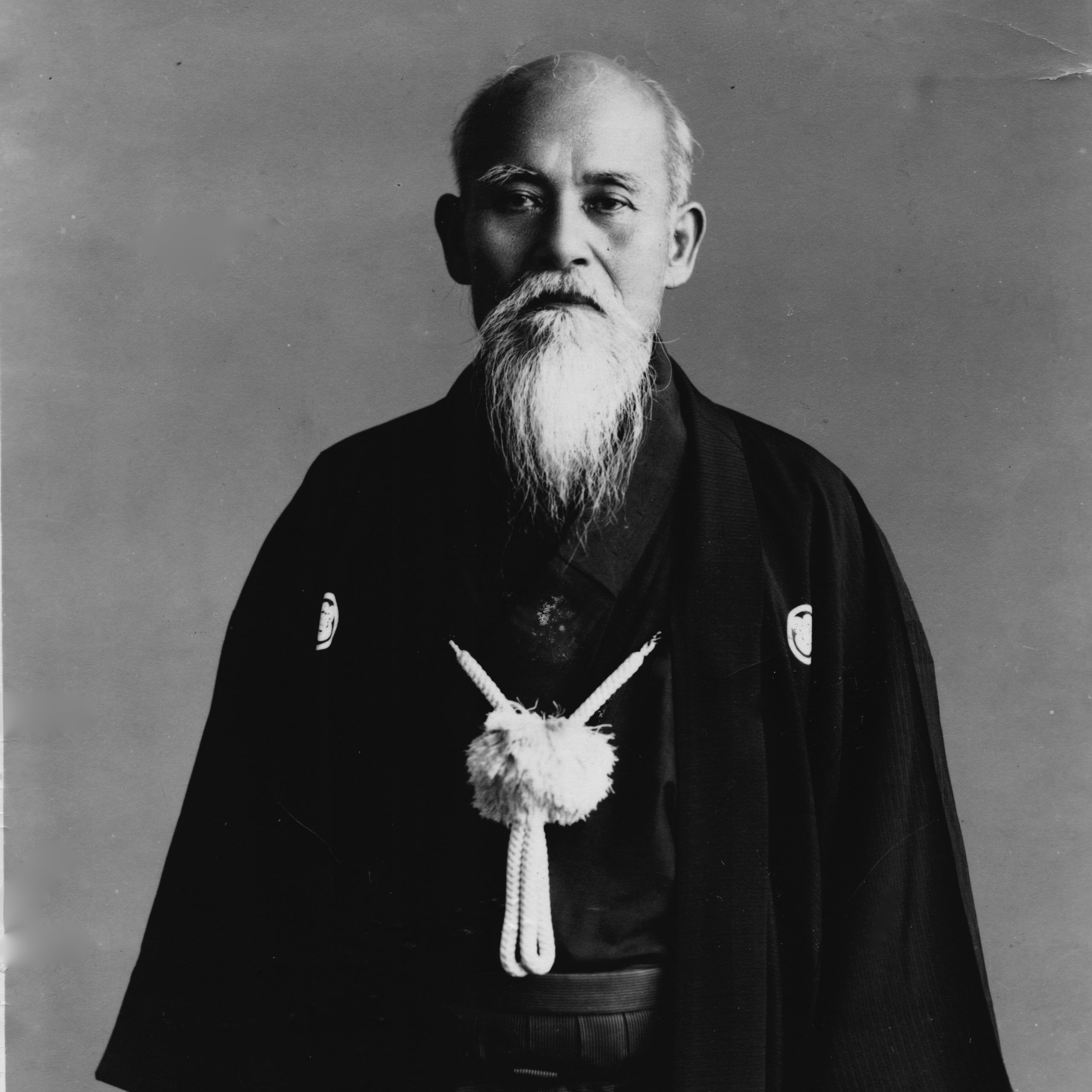
Aside from being human? What does stand out is that instead of stifling his genius as a compliant “follower” of this or that, he allowed his genius to come forth.
Are we doing as much today?
Or are we attempting to cram this immensity into a box of our own preconceptions, hoping to hang onto it without doing the real and meaningful work involved in continuing to bring it forth?
Did Ueshiba simply repackage and syncretise valid, preexisting values and skills?
If so, does this in any way take way from the immense transformation and mainly uplifting influence that followed his advent, in so many lives globally?
The real question is not whether the techniques of Aikido are common or not. That’s a visible given. That Ueshiba refined these to their umpteenth optimal function and exemplified this, there can be no doubt.
The real question is whether we who proclaim to be following in his footsteps are adhering to the ethics the founder espoused and progressing the art, or merely vitiating it with other motives; whether the compassionate and humanitarian ethic is alive and well; whether the unique attitude that is Aikido is still Aikido or whether it is at risk of becoming something else and getting lost in the woods.
Ueshiba was so outstandingly pioneering that he most certainly did not behave as a characteristically compliant traditional Japanese would be expected to. Certainly, he did not dye what little hair he had purple, dance in the streets to pop music dressed defiantly different as are today’s teen generation. But not so differently, although perhaps in a more meaningful and far reaching way, he did pioneer changes. He made a difference to his world. That he used established tools to do so, and honored them in the process, is a testament to his almost mythical stature.
Did he expect to make a difference in the whole world? No-one really knows. Did he succeed in doing so nevertheless? Without any doubt whatsoever. That he cared for the whole world is clear from his writings which reveal insight into the unbreakable bonds of the unity of all life.
And if the Founder were here now, would he want mere followers? Or fellow researchers who also allow their personal genius to unlock, using the simple but refined tools he left behind, in something of such immense value that it constitutes a treasure in the history of humanity?
How many lives have been touched and thereby changed because of Aikido?
Thus I have heard: On his death bed he put his hands together in gassho, bowed his head and to his attending senior students said, “Thank you for helping me in my research…”
For us, what is the next step?
Nev Sagiba




Nice article. Out of the ordinary and very thought provoking. A good note on which to start the new year.
Well said, inspiring writing. As Nev indicates, there are many differences not just one or two. A key one, as one of my senseis told the class once, is movement. When we do nikkyo, for example, we move off the line with the reception. Old styles of budo might have done pretty much the same technique but without that initial movement which is part of the reception (ai) characteristic of aikido.
But something broader emerges in aikido as well, like a paradigm shift, which elevates everything, with the result that there are so many detailed differences one would be hard-pressed to catalog them all. Something emerges in aikido, which uplifts it’s practice and elevates and transforms it’s pracitioners. O-Sensei’s experiences of enlightenment live on in the practice. He was able to express, share and embed his enlightenment in this new martial art. As Nev so well puts it, what results is an immense treasure in the history of humanity.
…at my level of training i would say that refinement of technique is a major distinction of aikido. the refinement may be finite, or perhaps no more finite than the number of numbers between zero and one. perhaps if it looks finite, that’s a reflection of our own limitations, just as seeing a millimeter is possible if your eyes are good, but not a nanometer.
so, to learn aikido takes time. am told that a one year course was not sufficient for the WWII era Japanese secret police. if you need something quick and dirty, there are probably better options. indeed, in the day, aikido seems to have been something of a postgraduate school. total beginners were rare if present at all.
i keep at it as a sort of obsession. imagine there are others who have similar motivation. the era of the samurai is past but there are a few of any society, it seems, who are inclined to martial pursuits, for good or ill. probably those whose pursuit is protective probably have a longer training career than those who are anti-social and thus might gravitate to aikido.
is aikido, then, practical? in my experience yes. for fighting between equally matched opponents? in my opinion no. two reasons. first, while aikido is martial and practical it is not confrontational in the sense of fighting. if a situation becomes a contest of strength, which fighting typically is, that’s a measure of the limitations of the aikidoka’s understanding. and there is no question of equals. an apple doesn’t equal an orange although there may be one of each…
Happy New Year to all Aïkido artists!
Hello All and happy New Year to all of you
An interesting question you ask. As always the answer is to be found in the very technique, nowhere else. Let me give an example:
http://shoshin.over-blog.com/article-from-daito-ryu-to-aikido-2-nykyo-59467429.html
The technique is fueled and filled with a different intent, it breeds, it makes the person grow. But still it is a technique. It is a tool to go beyond ourselves, to grow.
For us, what next step ? Understand his way and follow the same way if we want to. He gave everything we needed.
True enough, the very meaning and know how is hidden behind many curtains of misinterpretations, blunders and errors (or worse) but eventually, the pieces are all in front of us. Thanks to the info age (yes that website for instance), we can find the right persons to help us.
Gambarimasho !
L
Can anyone survive and attack of today’s modern weapons? Answer: NO .. you cannot.
So why do you train if you know you will lose, know you cannot win?
Strength and speed will win every time against strategy, unless you use pressure points that will injure or kill, if escape is not possible?
In a world of anger and violence we try to foster a mindset of peace, or overcome frailties of the human spirit as we train to strengthen both our body and mind which will in turn strengthen the spirit as we feed the mind with information, experiences over time and distance.
The deadly parts of Aikido are not there because they would endanger the safe practice. They used to be there and taught to the advanced practitioners, but then .. most of those advanced practitioners came from other styles of martial arts and had some idea of those deadly techniques that were left out.
We are not Samurai, nor are most of us practicing soldiers who need to kill, maim, or injure our opponents, we are citizens and human beings of a larger society.
There are a few in that society who use guns, sharpened weapons, and dirty tricks, but on the whole our protection is not appearing to be a threat to anyone, to appear average and somewhat helpless to those with mal-intent.
Your aikido training will help you deflect strikes and blows, help you to absorb punishment, and help you to find the weakpoints in an attacker’s attack so you can survive to a point where you can neutralize their attack, and if you are paying attention …. see that attack long before it ever happens so you can avoid it.
Pay attention to all that happens around you during practice as your body and mind are focused because your mind will operate on many levels and be able to absorb much more than you realize. THAT is what you are doing as you practice the physical techniques during any style of martial arts, you are perfecting not just the physical discipline … but the mental discipline also.
There is no question … most of us will never have to fight for our lives, nor be the hero or some story, but we will improve the quality of our lives and the lives of people around us because we practice and take those practices to heart for the rest of our lives no matter where life takes us. Isn’t that the point?
Yeah, to learn to give those hope who have no hope, to provide opportunity to those who are down-trodden, and to be an example to the generations that follow so they do not seek the path of violence and anger .. that is what you train for … not to be a warrior of violence, but to be a warrior of peace.
Another thought provoking article from the pen/keyboad of Mr. Sagiba.
As I teach in the dojo, at their core, all martial arts, self defence and personal combative methods, are essentially a solution to a problem, for example, a right hand punch on the nose, each system, method, tradition, and culture, have their own particular way of dealing with the said problem, as to their ethos and technical efficacy etc, each of us have to make up our own mind about that.
As to the question “what makes aikido different” most Japanese budo have an ethos of some sort, and a technical curriculum to develop a certain skill set, as the path to follow by its adherents.
But what makes aikido different, is conundrum I have been trying to unravel for over thirty years, going down many false and dead end paths, seeking an understanding of it, now with the culmination of much research and theoretical/practical experimentation and discovery, particularly over the last five years, a vital and fundamental truth has being realised, that of “aiki” it is this aiki, in my mind which sets true aikido apart, from other means, it is I believe, what Ueshiba sensei understood, and practiced.
Once one grasps aiki, the technical and ethical dimensions become clear, for with true aiki, the means of taking a life becomes readily apparent.
It is this ability, which gives rise, to the ethical choices and outcomes in the daily dojo training, we come face to face with our own mortality, and that of another human being, who’s life is in our very hands, in that moment, only then does the essence of aikido, become clear to the practitioner.
How we resolve such an issue is what we wrestle with in our hearts and minds, thereby learning the true value of life ands aikido, and so we continue on the path, furnished with this knowledge and ability, for the real fight is against our lower base passions, but through daily aikido training, we strive with all our powers to be pure of heart, meek of spirit, which gives peace of mind, for this is the soul of aikido as budo.
I have to admit I didn’t know that aikido was “invented” by Proff. Ueshiba until I had reached 1st dan level.
All we were taught was that he had the art from Takeda Sokaku and so forth, and not much emphasis was put on him other than that he was the teacher of Tomiki Shihan of Tomiki/Shodokan aikido and others. We were also informed that he was religious and was much more so as he grew old with “wisdom”
In truth, all aikido was to me was a grappling martial art similar to judo, I still see it much that way today although I can understand the importance attached to these teachers, and to some extent respect for their efforts, but I do not have the need to put them on a pedestal as many seem to do these days….
I make up my mind to the people I meet in reality and go by that experience alone…
There have been a great many people in history who have reached a level of “wisdom” in life and have gone down in history….. I see no more difference in that as I would with Proff Ueshiba, I’m sure he was a very nice chap, but as for “worshiping” him, that so many seem to aspire to seems a bit odd to me….?? Well that’s how it comes across….
Sorry if that sounds disrespectful, but it’s the reality to me…..
Again I agree with Tony…the rest is a lot myth and bull about someone none of us never met…and God like worship.
I’m sorry that happened. When we think too much we tend to “make waves” and “rock the boat” but these are the keys to enlightenment that stagnation fears. Part of navigation is to know when to reveal or to conceal from the unconscious and reactive chaff. But the wiser will identify the pearls and embrace them. Best wishes.
I have written a note on one of your articles mentioning connection between Christianity’s intent and Aikido. And I was reprimanded. Sad.
Bruce, I don’t know what you define as “strategy” but you’ve not only hit the key-note, but managed to reverse it, when you said, “Strength and speed will win every time against strategy..”
Strategy is everything. Play chess, it’s a good start to get insights. Strength, speed, tricks, decorates and manipulations and all the convolutions won’t stand up in the face of strategy. Tactics are the tools used to deploy strategy. All existence is an ocean consisting a multiplicity of currents. This is not a mystic fantasy but borne out by scientific testing. It is as it is and not how the limited mind of a hairless monkey’s fears dictate. The universe will still be universing when you and I and we all are long forgotten.
It is possible to live, instead of merely exist as a processing machine, by tapping all our natural human potentials and to NAVIGATE existence. Instead of drifting, or getting tossed about by the weather.
Tony, not disrespectful at all. In my view, your approach is sound because skepticism is the beginning of finding out facts.
Ueshiba could not help himself, was eccentric and I don’t say that in a disparaging way. As a result, and his remarkable and very real combat skills he stood out. He also made the effort to know himself and to seek out and to understand how existence works and how to navigate. Which he did.
This is in everyone’s reach. Yes, making an effort that’s different to rote habit is uncomfortable and it takes effort, work. Dedication, giving attention to any art, science and skill will induce and awaken an increase of conscious understanding to notice what the untrained miss is work and also fun. That’s just nature. Aikido, whether by serendipity or by design, address this faculty of awakening. More so than knitting or skateboarding for example, because it faces the preeminent challenge of restoring harmony in the face of aggressive attrition. Violence. Making harmony. So, it is a superlative challenge (easier to fake than to investigate seriously).
Yes, its evolution was in battlefield necessity. Ueshiba noticed more. Scientific research, without the scientists involved ever having heard of Aikido or Ueshiba, are right now discovering these dimensions, such as the E8 polytope. Ueshiba alluded to and dressed up these blueprints of existence in the language he understood, such as “kami,” poetic odes, kotodama and ancient “beliefs” others had noticed before him.
On the other hand cynicism closes it’s own doors because it has made up its mind.
There is no obligation to “expand consciousness.” None at all. Look at the global internet, for example. A few simple ways to link things and click on things. Fearful indeed to anyone unwilling to alter their restricted paradigm of thinking. Those who fear the pain of learning and who refuse, are being left behind, as we speak. Nature is like that. Adapt to change and evolve or become extinct.
You won’t get any awakening by grovelling before someone else whose searching to improve themselves; although that’s the facile path chosen by most. They are soon parted from their money.
Being yourself, and learning how to achieve this more fully, is better. Discovering who you are and reclaiming yourself is not always easy. But the rewards never end. That defines Do or The Way.
Change is an inevitable, the primary of the universe and the only thing that won’t change.
Aikido addresses adaptation and change and the primary “muscle” to develop in order to adapt the emerging new ways. Good training. Whether you get into a fight or not is almost immaterial. Whether you can survive the overwhelming changes of life smashing you, is the real concern.
As for “anities” and “isms” of any kind, the universe does not care. In the face of the immense vastness, our planet is speck of dust and we are not even mold spores on it. It is curious though, and worth researching how, the failing Roman empire, grasping at straws whereby to continue their vampiric reign of tyranny, found that it could not do so for an additional 2000 years, without using the myth of a man of peace who taught egalitarian values and respect. And whom they nailed up. The empire is in fatal decline and yet those core human values (albeit sometimes too dressed up) have survived to continue to remind us that we are more than warring apes. Whether planned or serendipitous, it turned out to be good aiki strategy.
Change may be uncomfortable at first. Ask any athlete, but then that changes as well and the same activity becomes empowerment in skill.
The ultimate strategy for a human being is that of adaptation to conditions and navigating them instead of resisting and getting broken thereby. Much like surfing. You can catch a wave and ride it in, or you can get dumped. Same wave, different attitude.
You use whatever tools work best for you. Therefore life for a human being is a research more than it is finding the next feed or other indulgence.
In my opinion, regular Aikido training is a good tool. It may not be the only one. So look around. Include as many auxiliary methods as you find are good for you. That’s what Ueshiba did. That’s what anyone else who lived more fully, did.
After that the adventure of human life is whatever you want to make it.
“In my opinion, regular Aikido training is a good tool. It may not be the only one. So look around. Include as many auxiliary methods as you find are good for you. That’s what Ueshiba did. That’s what anyone else who lived more fully, did.”
Aikido is good if you keep it within the bounds of reality and not the hippy hoppy, tree hugging, ribbon twirling, dancing crap that so many delude themselves with…
Proff Ueshiba had ability there is no doubt of that, he just happened to be in the right place at the right time, got the right contacts, the right backing financially, got through the Sh1t basically unscathed and got famous through his eccentricity most humans secretly aspire to, but never get…. Luck and fate in my opinion….
There are many out there who could have dusted the deck with Ueshiba, but never got the chance or even heard of him, Those that did try just weren’t good enough, that’s all…. He was human just like the rest of us, make no bones about it…… He wasn’t the best, just one of the best.
Most ju-dan judoka were of the same skill level as Osensei…particularly Mifune sensei…who didn’t think much of him.
I would most certainly agree their Taisho, having seen the video remakes of him….. he was exceptional, made it look easy, just like anyone with that skill level, they didn’t call him Osensei, did they?…..
Called him Sensei…and more here…
https://aikidojournal.com/article?articleID=184
Even more…
http://judoinfo.com/new/alphabetical-list/judo-history/135-on-jujutsu-and-its-modernization-by-kenji-tomiki
See Nev? No matter how meaningful and skillfully written an article is, the comments always deteriorate to “my way/style/sensei can kick yours’ ass”.
Read the articles. The whole article (this one is particularly good). Never read the comments. They always end up pathetic. (this one included, beginning with the fact that it is here at all)
We just see thing as they really are that’s all Wow…. whatever you name is….?
It’s got nothing to do with who’s better or not, it comes back to ‘there is always someone better than yourself’ and you can only be the best you are on the day, some are lucky to be recognised for it, some are not….. That’s all…
Respect those that have achieved something worthwhile yes, but do not put them on a pedestal, they are not gods….
Enjoyed this one as well Nev keep it up 🙂
A great springboard for thought: “Tactics are the tools used to deploy strategy.” Often folks deploy tactics completely oblivious to the strategy those tactics are implementing. Asked to reflect on the underlying strategy or even just to articulate it, they may become confused, passive aggressive, intolerant, and offended.
For instance, take the tactic of flipping someone off while driving. This implements the strategy of “If I don’t like what you do, I’m going to get ticked off, and, I’m going to let you know that you ticked me off by getting in your face.” This is a strategy of affront and confrontation, as if one had been personally assaulted by the (perceived as) offending driver. On the other side of the coin, or finger, the tactic of tailgating also implements a strategy, that of disrespecting the life and safety of others, with predictable results. These are self-centered, win-lose strategies, subject to the attrition of evolution. Instead, we need to find a way to make a contribution. Here we have a case in point where Aikido excels in the most dangerous of venues we encounter day to day, yes, on the streets, but not as you might think, but on the roads either as drivers or pedestrians. Aikido is perfect for defensive driving and being a pedestrian.
“The ultimate strategy for a human being is that of adaptation to conditions and navigating them instead of resisting and getting broken thereby. Much like surfing. You can catch a wave and ride it in, or you can get dumped. Same wave, different attitude.”
The tactics-strategy distinction shows the way to the “difference of aikido”. Some of the tactics (techniques) may be the same, but the strategy is different (or you can say that the objective of the strategy is different). Those who look for the difference in the tactics may conclude that there is no difference – because other arts include some of the same techniques. However, strategy underlies technique. What’s the purpose of (strategy behind) the technique? What is the purpose (objective behind) the strategy? Course we need to sincerely practice (aikido) over many years to assimilate it since it’s not just one’s mind that needs to understand and appropriate the strategy, but one’s body (or center) as well.
Attention to misogi has to do with the purification of strategy (or higher up one level you can say with the purification of the objective for the strategy). The objective is not to beat the opponent (win-lose), but to win over the discord in oneself for the objective of peace of mind and as a stepping stone toward a greater harmony. It’s true that is an ideal situation and is not always possible in individual cases. Still, let’s not be so “real politic” or cynical that we give up hope or drop the ball.
Ksenia, if you are reading this, please note the very interesting points Mr. Sagiba makes regarding the way Christianity/Jesus led the way forward through the Roman empire. “Whether planned or serendipitous, it turned out to be good aiki strategy.” It’s pretty clear that aikido’s strategy is fully harmonious with any (open-ended or inclusive) religion. You can see that O-Sensei was a very devout person with his religion and martial practice fully blended.
Wow, some comments are very worthwhile reading. For the rest, well, you know what they say about opinions. It’s also said that we hear the music because of the gaps between the notes. Let’s keep that salt shaker handy (to take things with a grain of salt) … and our center’s calm. You can generally discern the significance of a piece of writing or an opinion by the amount of thought that has gone into it and by it’s degree of self-criticalness.
“opinions are like A-holes…everybody got one”…sgt/Barns
Ha! Reality rears it’s ugly head….. ha ha! (bloody good thing too!!)
That’s the trouble today, everyone wants to be in denial, must be something in the water……
Why is it humans just love to complicate things?
Taisho?
Because they are human…and can’t face realty of how things really are and not as they wish or like them to be.
Truth = reality…..
Already two years ago. But due to the Aikido Journal I got notice of this contribution (and discussion) only now. I do like the logic in your argument, your arguments, and the many questions, you put forward. Especially because of the same human body all martial arts are confronted with the same biomechanics. Therefore, there is only a finite set of basic techniques to lock joints, to move the point of gravity, etc. And I also agree that Aikido has a different message beyond these techniques (independent if they are more efficient than in other martial arts). And that this is the deeper quest in practicing it. And, maybe, there is no common answer but only personal ones. Your answer may be different from mine. Or incomparable. But if you would be me, you would understand my answer.
Thank you Nev, always a pleasure to read. I would Love it if you wrote another book!
Let’s take the two possible extreme outcomes of a physical confrontation. The other guy dies or you die. You can do a number of things to tilt the odds toward the other guy dying. If that is your desired outcome, I recommend proficiency with firearms. There are some problems with that, however. Trayvon Martin probably got what he had coming to him, but that doesn’t mean that Mr Zimmerman escaped. We could expand on that for a long time.
Now, the difficulty, as I see it, is in the old wisdom that the use of weapons is unfortunate. This doesn’t mean, at least for some of us, that we can avoid that misfortune. In Japan if you were in the samurai caste, weapons were a defining part of your life. Musashi put forth the question whether in that case having some proficiency with their use wasn’t a good idea, then proceeded to teach how to win. Yagyu took a different slant and came up with “The Life Giving Sword”, the spirit of guardianship. Here we have no castes, but we still have karma. Ardjuna had his karma, but so do we. At a restaurant over lunch an hour or two after class, I put forth that everybody at the table was different and special in that we were still talking about conflict, even after eating and on a beautiful sunny day.
The genius of O Sensei which is hardest for us to grasp is that he found yet another solution to the problem. This is not to say that aikido techniques are pacific. Far from it. They can be intensely injurious, even fatal… but only if “the other guy” fails to “see the light”. The miracle of ukemi is survival. The miracle of nage waza is an absence of injurious intent within the dominance of the situation. O Sensei said something like, ‘the attacker injures himself by his destructive intention’. A bad analogy is consider the attacker as a drunk driver and nage as setting up any number of ditches, trees and walls in the attacker’s way. If the drunk driver doesn’t “get it” and just stop his car, well, the tree, wall or ditch were simply there. Not just any tree, ditch or wall will do, of course. They have to be strong enough and well enough placed to stop a car. You might ask how it is ethical to cause a drunk driver to crash, perhaps fatally. Back to Yagyu. Better they crash into a wall, tree or ditch than a woman pushing a baby carriage. And as to how you are nominated, well, here we are discussing conflict on a sunny day. That’s who we are.
To me AIKIDO is a method to deflect an attack in an effective way, via Uke-Negashi Tenkan or Irimi or a 2 hand parry, You could then escape after the first deflection if it´s possible, or stay there and try to counter the next coming attack, with one of your fancy techniques.
To me Aikido only has a few real self-defence technique and they are Iriminage, Kotegaeshi, Shihonage, Sankyo, Ikkyo and Nikyo. All of them could be used defending against a hook punch, straight punch. or a chess push. Also using an Atemi to set up those technique, via an Kuysho-Jitsu strike to the on coming arm would make him buckle a bit.
Don´t get me wrong, I like Traditional Aikido, but has nothing to do with the real cruel world we are living in now I´m afraid. Aikido is about principles. Therefore, one has to evolve the art from the traditional basics.
More
What Makes Aikido Different? by Nev Sagiba
Reacting to how O Sensei “did his own thing” I remember that great unsung American Strategist, Boyd – “You can either be something or do something.” At some point that’s a choice most of us will come to, whether we realize it or not.
I’ve still got a bit of hair left. I wonder if purple would suit me.
While I’m deciding, I’ll keep on practicing, and see if I can find out what O Sensei was up to. An interesting article, Nev.