
 Josh Gold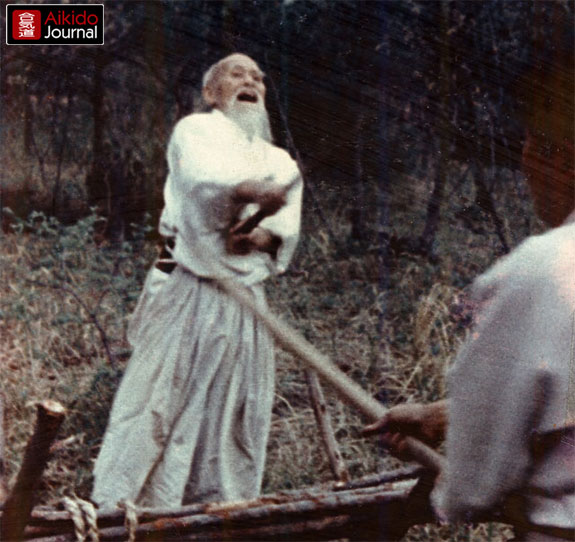
Morihei Ueshiba and Morihiro Saito practicing the Aiki Ken in the fields of Iwama c. 1957
“In order to practice Kiai correctly, we must keep in mind two concepts: our energetic center and abdominal breathing”
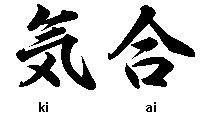
Its characters are the same as those of Aiki (Ki = Energy, mind, will / Ai = Union). From a purely physical viewpoint, Kiai is the art of knowing how to breathe deeply and slowly. The power of Aiki is silent, while that of the Kiai is a power vector that greatly develops the physical aspect. The Kiai is one of those elements inherent in Bujutsu that produces a notable increase of efficiency in combat movements.
Traditionally, Kiaijutsu is the result of the working of internal energy, and is called “Nei Kung” in Chinese and “Haragei” (stomach art), in Japanese. It is through the concentration of energy in the abdominal region (hara) that Bushi (warriors) were said to be capable of paralyzing, killing, or curing at will using the most universal form of Kiai, the “Kensei”, or abdominal shout. It is often considered erroneously that the Kiai is merely a shout.
The shout is a vibratory expression of the Kiai, a vocal Haragei, that is, a concentration of internal energy in the abdominal region through a contraction of the diaphragm and the production of a mudra (symbolic or ritual gesture in Hinduism and Buddhism) using the vocal cords. It is a sound emanating from the stomach, that is, it does not proceed from the throat, which would convert it into something completely negative, but rather from the tanden (Hara) which transforms it into something totally positive. At very high levels, the Kiai may be inaudible to the human ear.
The Kiai is also used by different religious movements in Japan such as the Shingon sect, which is based on the teaching of Kiai in the Taki Shugyo rite, a type of meditation under the icy waters of a waterfall.
It is understood that all Bushi should know this technique and master it. Some of them managed to perfect the Kiai to the point of creating an independent discipline called “Kiaijutsu”. We can also produce kiai by invoking internal ki energy and focusing it with the mind, and freeing it with our spirit.
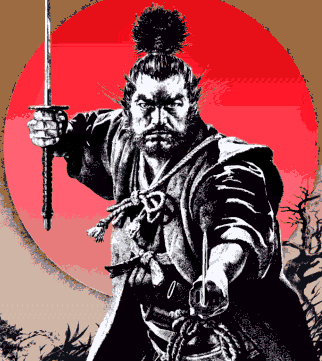 There are numerous sword and empty-handed combat treatises that record strategies for using this energy in battle. The term used by Japanese sword masters, “KIAI WO KAKERU” (to utter a Kiai) means to bring to bear full force against the enemy with a shout at the exact instant he exhales. Miyamoto Musashi describes in his “Gorin no Sho” (Book of the Five Rings) three types of Kensei in combat, and on numerous occasions, emphasizes the importance of Kiai in combat.
The Kiai practiced generaly in all dojos is nothing more than an imitation of the true form since, in the final analysis, the Kiai is knowledge jealously guarded by monks throughout the orient, and is not transmitted to students until a clearly advanced stage of their apprenticeship.
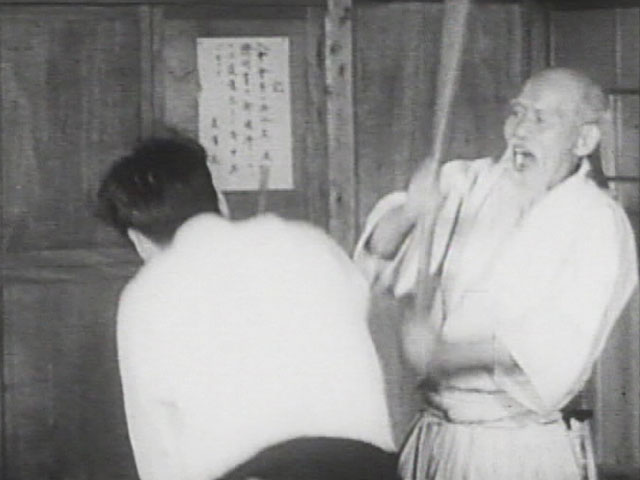
If an action executed, for example, a turn, contracts breathing (apnea), the movement will have a negative polarity (chikara) because it is executed through muscle alone. However, if at the moment of execution of the action we emit a Kiai, that is, we release the energy of the breath (ki) through an abdominal shout, this action will have a perfect form since it is produced by both polarities of the universe, one material and the other spiritual. In martial arts, one is taught to attack the adversary when he has expelled all his air while the attacker is filled with air. Attacking an opponent who has expelled all his air is a sure form of achieving victory.
Students of Japanese esoteric arts and especially students of Kiaijutsu (art of Kiai) understand that when submerging themselves under icy waterfalls (Taki Shugyo), they must totally relax their body since they are completely engulfed in water which is considered to be a grounding polarity (yin). If they don’t adapt their body through the use of specific Kiai and proper positive breathing (ki), they run the risk of falling victim to fainting.
Thus, we see that for something to be manifested (in this case, a true action), the presence of opposing, yet complementary, polarities is necessary, one positive (yang=Ki) and the other negative (yin=chikara).
In order to practice Kiai correctly, we must keep in mind two concepts: our energetic center and abdominal breathing. An advanced student of any school should begin by occupying himself with finding his vital center, Kikai Tanden or Saika Tanden, in the abdominal region (Hara). This is usually located two or three inches below the navel. In Japan, mastery of the Hara was fundamental since it was the factor that determined power, calm or serenity. Then, a man was said to have “Hara” (Hara no aru hito).
Beyond that, it was necessary to distinguish between pulmonary breathing and abdominal breathing. In order to breathe with the stomach, we should imagine a sphere situated in our vital center. We inhale air by expanding the muscles in this region thereby inflating the sphere. Then we move the inflated sphere to our thoracic cavity where we continue inflating it to the maximum. Next, we begin to deflate the sphere, first from the chest, then lowering to the stomach where we deflate it fully by completely contracting the abdominal muscles thus removing all air while permitting the diaphragm to assist. Everything is relaxed and remains in place.
This is a simple beginning exercise that will allow us to start concentrating our breathing in the Hara. As we gain skill in this form of breathing, we begin to emit a guttural sound (Kensei) when we expel air. The next step will be to perform this exercise while moving by taking a step or evading in such a way that we harmonize our breathing with the movement. The guttural sound will then become deeper.
The third step will be the union of the energy generated (Ki) with muscular power (chikara), both while still and in movement while being pushed, struck or subjected to any powerful movement. The guttural sound will be fully produced.
Over time, muscular power will assume a lesser role and the concentration of energy will come into play. The time will arrive when the use of power is produced through Ki itself. The choice of a monosyllabic guttural expression does not matter in the beginning; it should be personal. Later, each school will practice its characteristic sound or sounds.
Translated by Stanley Pranin
Click here for original article in Spanish
_______________________________________
Click here to discover the secrets of the highest
level of aikido to accelerate your progress!
The Morihei Ueshiba Founder’s Course is O-Sensei’s video legacy starting in 1935 and covering a span of 34 years until just before his passing in 1969. Besides the more than 30 films of the Founder, the course includes three rare audio interviews of O-Sensei with complete subtitles. These are wonderfully intimate conversations with the Founder that convey his bright personality, playfulness and sincerity. In addition, the course includes a series of video documentaries by Stanley Pranin on the life of the Founder and the spread of his art worldwide.
>






Hola!! Me ha parecido muy interesante este artículo de tu blog.
Puedo publicarlo en mi web y face citando la fuente?
Un saludo
Pranin Sensei –
thank you so much for this!!!
okagesamade…
Excellent article. The lack of kiai in modern aikido is a significant weakness in training. Kiai is valuable in so many ways and in so many different situations, it is a skill worth developing. Just one brief example:
My sempai from the Iwama Dojo, Danny Russell (currently Asst. Secretary of State for Pacific and Asian Affairs) recounted this incident that highlights the power of KIAI in a most dramatic fashion. ” Inagaki sempai came early every morning dragging me out to jog with him. Everyday we would pass a house with a large vicious Akita on a thick chain. One day as we passed, the dog lunged for me as usual, but this time the chain broke. When I heard the chain snap I looked behind me and saw it was charging right at me. In the next moment Inagaki, who had been running way out ahead of me suddenly zoomed past me charging straight at the dog with a resounding kiai. To my astonishment, the huge dog did an about face and ran right back home. I could not believe what I just saw.”
El kiai es imprescindible en la práctica del Aikido… Gran artículo.