
 Josh Gold
“Practice forms are loosely passed down through successive generations
of students resulting in poorly executed, ineffective techniques.”
 In modern aikido, it is common to see techniques practiced with little concern for technical precision. This lack of attention to detail produces many strategic weaknesses. Such practice forms are loosely passed down through successive generations of students resulting in poorly executed, ineffective techniques. In many quarters, aikido is not considered a serious martial art due to a laxity in the execution of its techniques.
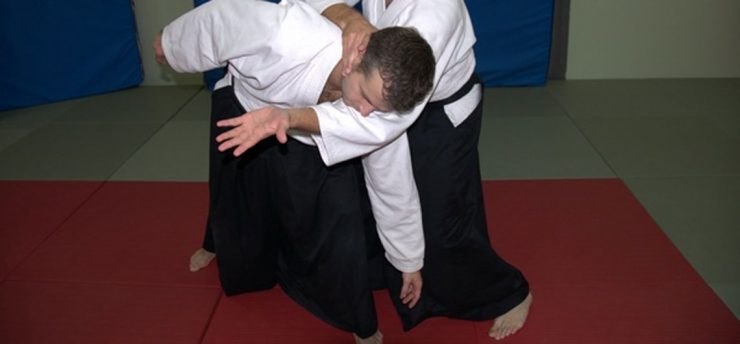
Please study this image for a moment. We see the attacker (uke) taken off balance and leaning forward. The person throwing (nage) has uke’s head in the cradle of his elbow. Nage will next proceed to reverse the flow of energy by lifting uke’s head with his left arm and throw him backwards. Or, if uke has adequate falling skills, he may execute a high fall to dissipate the energy of the throw.
Now, direct your attention to nage’s balance. Nage too is off balance with a large amount of his body weight being loaded onto his left leg. In addition, he is supporting part of uke’s body weight. This increases nage’s instability and further impedes his ability to execute an effective technique.
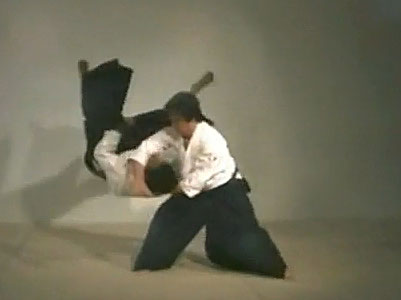
There arises another problem that may not be obvious. Due to the fact that nage is off balance, he will be obliged to use physical force to attempt to regain his equilibrium and reverse uke’s body while performing the iriminage throw. This is because his center is displaced and he is therefore without a stable base from which to engage his hips which is necessary to complete the iriminage.
This use of force will be most noticeable as tension in nage’s left arm. Being in physical contact with nage’s arm, uke will feel the tension there, and it will reveal nage’s intention, timing and direction in real time. Because of the cooperative nature of aikido practice, uke may not take advantage of this information to resist, but he certainly could.
I have discussed aspects of iriminage, one of aikido’s core techniques, on various occasions over the years. One such example is this article titled “Someone please explain the logic of this iriminage throw!”






I thank you for your posts on Aikido.
As a long time student of the late Professor Ronald Duncan I have been involved in the Japanese arts for many years and enjoy your extensive experience in this amazing art.
Much respect to you Sensei on your Martial Journey.
Thank you indeed, Mike.
Agreed that kihon waza from the position demonstrated would fail against any serious resistance or countermeasure. That uke is so far off balance forward might lead to a “walk the dog” style iriminage. A small but interesting point is nage’s left foot. He is not in hanmi pointed in the same direction as uke. He appears already to be attempting to lift uke. If so, that also puts his left arm out of alignment with his center, or his upper body out of alignment with his stance. The first just makes life difficult. The second is a recipe for a knee injury.
I must confess – this all too common mistake brings out the prankster in me. Rather than being a nice guy and cooperating with foolishness – if they can break fall, I hold my partner’s arm to my chin – bow strongly – and send them flying. Most training partners get the hint on their first or second break fall. Some just get upset. That’s fine. “Budo da kara.”
Martial arts is kind of a smorgasbord of techniques. Take what you like and feel is effective and efficient and leave what you don’t like. Some things we do in Aikido are done for instructional purposes only and are not necessarily fight scenarios, but etude’s if you will, techniques to be learnt, drilled and applied in combination or in concert at the right instance. Thank you for sharing your quest! Question everything!
Instead of lifting uke’s head just go with the direction of his/her force joint with it and over extend them in that direction. The uke does not need to cooperate, just join with their movement which is usually easily redirected to the standard iriminage pattern. I learned this from Clyde (Takeguchi Sensei) thirty some years ago.
The way i have been taught is not to rely on the left arm to lift uke, (in the still image shown) but to step out with the right foot keeping the right arm close so to draw the uke across so his weight shifts from his left foot to a back stretch position. Then he should be being only kept up by tori, the left arm can then be used to aid uke falling. My own opinion is that if uke is put into that position, he wouldnt want to stay down there anyway so should be trying to stand up to regain balance rather than staying there making the tori (in a bad technique) feel he/she should have to use the left arm to pick him up again.