
 Josh Gold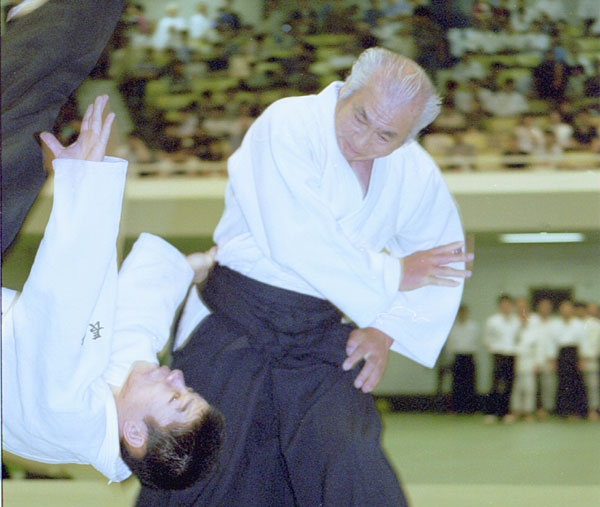
“You are going to be required to absorb the application of numerous, painful techniques which, lest we forget, were originally intended for maiming and killing.”
From Aiki News #65 (December 1984)
The AIKI NEWS staff recently returned from a long, highly successful trip to the west coast of the United States during which thirteen Aikido film presentations were given, each in a different city. A total of some 800 appreciative persons viewed the seven films we had selected from our collection of O-Sensei movies plus a beautiful color film shot primarily in Iwama which was kindly provided by Saito Sensei especially for our trip. The number of impressions and experiences collected during those thirty-four event-filled days would no doubt fill a small book if I were to have the time to record them. But as that is not possible here, let me relate to you one incident which did occur, not once but several times, that left me feeling extremely awkward and has presented me with quite a challenge in order to find a suitable response.
“This is nonsense, the attackers are all cooperating with the old man!”
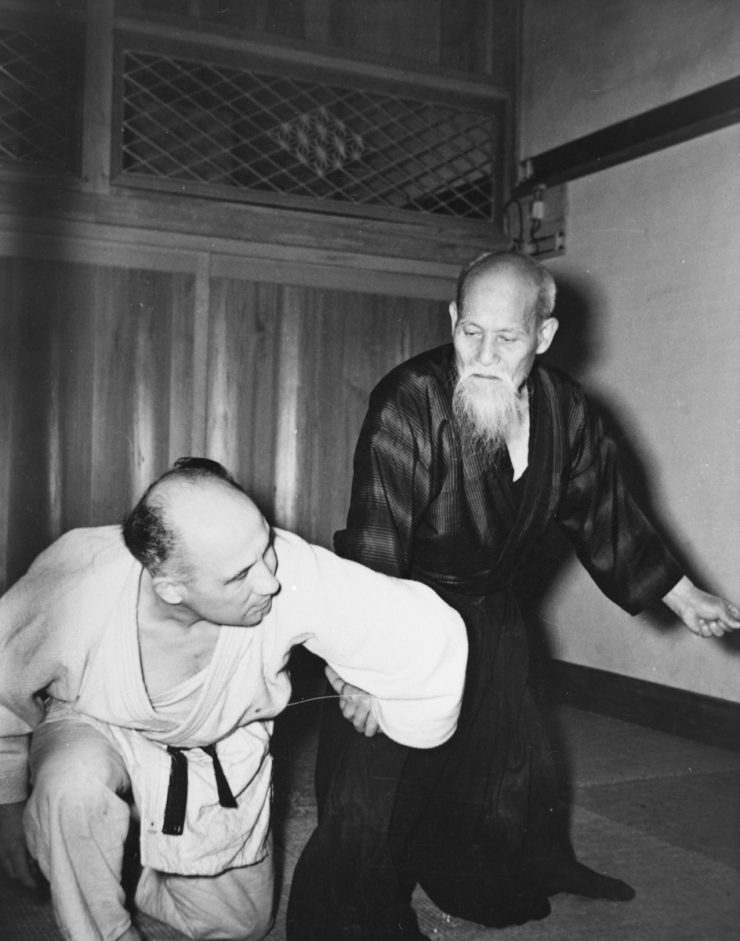
Several of the viewers of the O-Sensei films, one of them in fact being my father, had the following reaction upon seeing the movies: “This is nonsense, the attackers are all cooperating with the old man!” Well, how would you respond to that sort of deflating comment directed at the founder of Aikido, one of your life’s heroes? This especially when a careful viewing of many sections of the films indeed reveals what appears to be half-hearted, weak attacks often delivered late after O-Sensei has already begun to move. I assure you that this is the case since I have without doubt watched O-Sensei movies more times than any other mortal in the history of mankind! Having I hope duly established my credentials and by way of a response to the above comment, I think it might be fruitful to probe a little into the psychology of the attack in Aikido.
“The harder your attack, the harder your fall!”
First, assume that you are an advanced student in your dojo and will be taking falls for your teacher during a demonstration. Your instructor is an accomplished martial artist and has long since earned your respect for his/her technical expertise and, no doubt, for other reasons as well. I presume this to be the case, else why would you be training with this particular teacher in the first place? Now, you are standing before an audience and are ready to attack your teacher. What attitude do you adopt? I would imagine you would attack in very nearly the same manner as you do in the dojo under normal circumstances, except that you might be a little more intense because of the adrenaline flow in your body. After all, you have been training for a number of years and certain habits have surely become ingrained. But then, on the other hand, what have you learned from past experiences when you have attempted to test how your teacher responds by attacking more strongly than usual? Probably you will have discovered that your fall becomes more difficult. Or, put in plain and simple terms, the harder your attack, the harder your fall. You moreover recognize that for the exhibition you may be called upon to take not one, but many falls, that is, a long series of “harder” falls. What is likely to be the cumulative effect of this repeated pounding on your body? Quite a beating, indeed! Fatigue, too, must definitely be factored into the equation. What do your attacks look like when you are tired?
“Some extraordinary demands are going to be placed on your body”
Then, there is also the other side of the coin. Your teacher, too, is likely to be stimulated under the circumstances and may be putting a little more “ki” into his throws than usual. In short, you have a special situation in which some extraordinary demands are going to be placed on your body. You are going to be required to absorb the application of numerous, painful techniques which, lest we forget, were originally intended for maiming and killing. Not exactly a Sunday afternoon picnic!
Given such a precarious set of circumstances, how are you likely to handle the situation? Since you are familiar with the content of the demonstration you will probably take steps to protect your body from being victimized. This might include things like de-emphasizing your attack and positioning your body in advance for the throw you know or suspect is coming. This permits you to maintain control of your body for what might otherwise be a dangerous fall. (It also if I may be so bold, allows you to “look good” which for some is an important consideration.) I would further surmise that you are not particularly concerned with the audience’s desire to see something resembling a “real fight,” if you are even conscious of the fact, which is altogether unlikely. For those wanting that kind of action, there are always “kung fu” movies and professional wrestling bouts, right! Especially, considering that you would be providing the cannon fodder required for their entertainment!
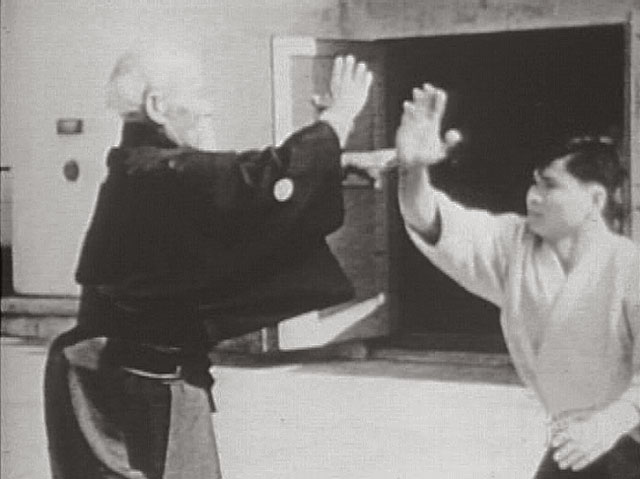
“Try to launch an effective attack when you are not well-balanced”
In the case of O-Sensei and a few of the more skilled teachers, the story doesn’t even end here. There are subtle movements and positioning maneuvers executed by these masters which make it extremely difficult for any one to mount a meaningful attack in the first place. For example, try to launch an effective attack when you are not well-balanced or when the defender is suddenly no longer where you thought he was. We have, in a word, a situation where the “strength of the attacker is sapped” (thank you Nicolai!) before he begins his movement.
Several of the viewers of the O-Sensei films, one of them in fact being my father, had the following reaction upon seeing the movies: “This is nonsense, the attackers are all cooperating with the old man!” Well, how would you respond to that sort of deflating comment directed at the founder of Aikido, one of your life’s heroes?
All of these factors I would suggest may not be obvious to the casual onlooker or even to many practitioners of Aikido. In fact, ever since my beginnings in the art I have had to attempt to respond to the type of comment mentioned above and have always felt uncomfortable doing so.
In closing, judging from many of the exhibitions of other martial arts I have witnessed, there is also a significant element of “cooperation” going on there, too, even though it is largely hidden by the spectacular nature of some of the techniques. It would thus seem that a “cooperative attitude” would have relevance within the context of a martial arts demonstration in addition to its appropriateness in daily life. For if this were otherwise, the demonstration would cease to be a “demonstration” and would be transformed into a “match” or “competition” which is what we, as Aikidoists, are trying to avoid in the first place.

 Antonio Aloia


Well, I think cooperation and mutual trust are essential properties of aikido. An ordinary spectator is not used to see attackers, who are very committed (pretending to be aggressive or more precisely pretending to have a destructive intention) and very soft at the same time.
There are any number of flavors of training. Cooperation is one. The idea there is for the senior student, as uke, to lead the junior through the technique. There are various possible levels of resistance. Saito Sensei said at least once in my hearing, “Hold tightly enough that nage can just barely move.” After a while, of course, there is no amount of firmness that can stop a technique.
Beyond that, however, is a level of mastery that commands uke’s mind. Once Saotome Sensei asked me to take ukemi. I was seething looking at what looked to be flaky attacks all afternoon. Attacking is not a problem for me. Then when I was standing there, I could spell a-t-t-a-c-k, but could not actually visualize it. Eventually, I got my body to go through the motions, but I bet it looked pretty flaky.
My teachers advice for demonstrations has always been, “Do your job! Your job is be Uke. That means a fully committed honest hard attack and then using your skills to survive whatever happens.”
On numerous occassions, I have seen him ask ukes to punch him directly in the nose and when they do, he doesn’t react and they have ALWAYS stopped short or missed him. This is usually his lead in to discuss the “honesty” of Uke. I have asked him what he would do if he ever gets his face smashed in the demo and he said he would get up off the ground (hopefully) shake this persons hand and thank him for being so honest.
The previous organization I trained with, it was actually said during a demo,”Your job is to make the Sensei look good. You take care of him, he’ll take care of you!”
As any practitioner of Aikido knows if you receive technique with out good ukemi, you WILL sustain injury. I always saw it as an honor to be asked to be Uke, as it demonstrated to me the trust of Sensi in my level of experience, that I could attack with sincere intent and strength, he could apply strong technique, and we both knew there was no risk of injury. It was always exhilarating and a joyful experience, basically a lot of fun, I always wanted the experience to last longer than my cardio could handle.