
 Josh Gold
These remarks were submitted as comments to the post titled Former Aikikai Employees… by Stanley Pranin. I felt they were worthy of being published as a separate blog. Particularly interesting to me was David Brown’s description of the blend of disciplines required to carry out meaningful historical research and publishing activities. – SP
Stan,
The very fact that you have engaged the FB poster to the extent that you have and in the manner that you have just continues to speak to your integrity and openness. And, if I may add, your integrity as an historian is damn near above reproach, as near as I can discern.
You are so much more than a mere “chronicler”. Yes, the foundation of a true historian at work lies in the thoroughness of their research. Getting access to original sources – documentation and in-person interviews with relevant participants and witnesses. It is a fascinating blend of archeology (fact gathering), CSI type investigation (fact testing and comparing), and courtroom presentation (fact based argumentation).
A true historian both investigates and interprets.
In my experience, you have always been scrupulous in your approach to both.
Dig under, look behind, peel back, and reveal the truth – is Step No.1. Now let’s move from the technical to the prosaic and articulate these discoveries in well thought-out and cogent presentations – Step No.2. Now we can proceed to the more poetic phase of personal interpretation and the assignment of significance, relevance, and consequence – Step No.3.
You have always striven to imbue your efforts (as student, teacher, and historian) with the maxim:
“I do not look to Authority for truth, rather I look to Truth for authority.”
_____
One Last Thought Department:
This exchange of yours with the FB poster and its open revelation – IMHO – serves as a very healthy paradigm for all such discussions / debates. I am on the side-of-the-line that always favors accuracy and openness over their opposites … whenever possible.
Honorable and reasonable men can (and often will) disagree … fact o’ life.
I have commented in the past on this Forum that you have provided for us, that my own “take” is that the “JAPAN, INC.” mentality will ultimately condemn formal Aikido to the status of a quaint but largely irrelevant historical phenomenon.
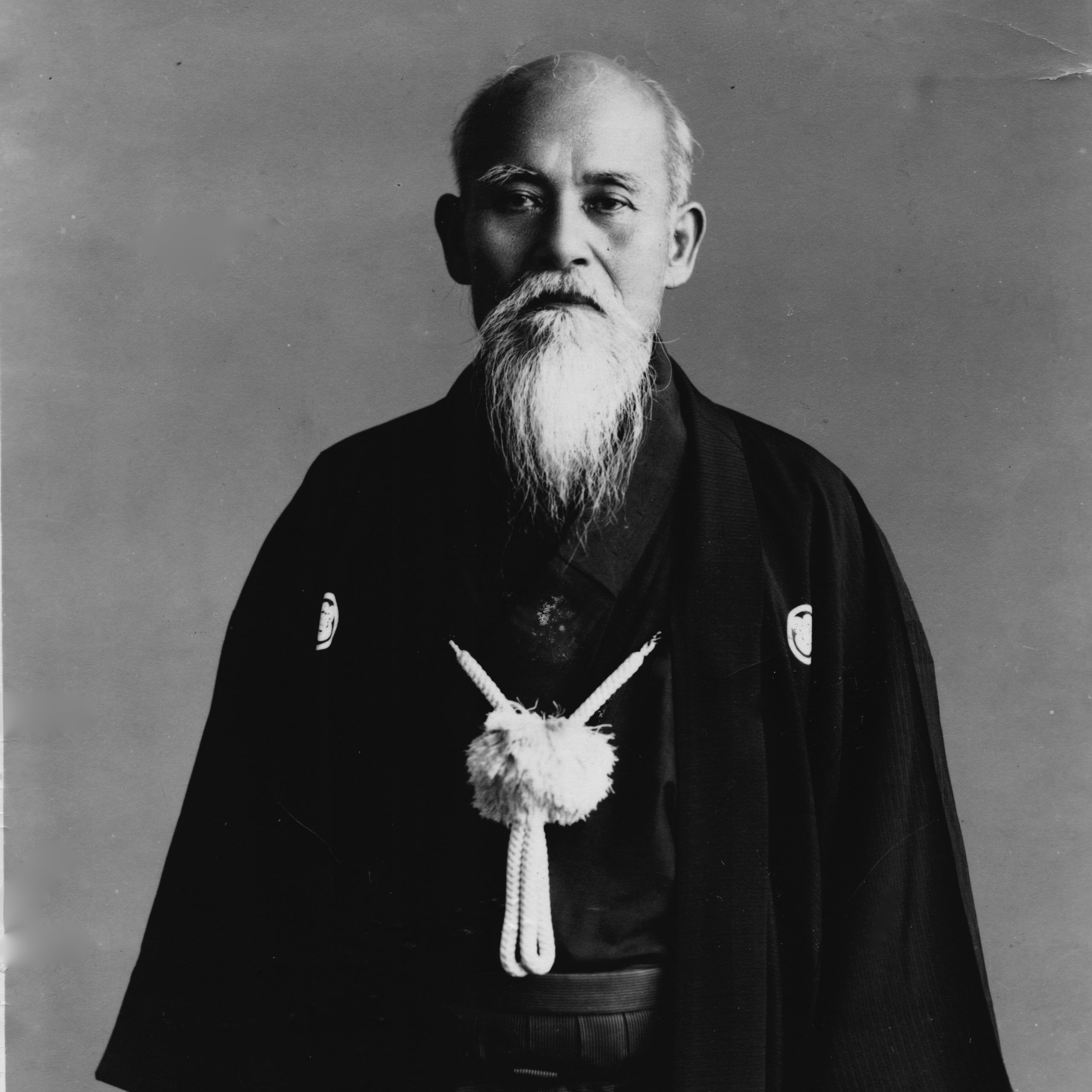
For all his “Japanese-ness”, O’Sensei was an extraordinary maverick for his time and culture. He evolved into a global sense of the “human dynamic” that completely transcended tribal, ethnic, nationalistic, and ideological boundaries.
It is an arduous Path. And it must be walked with a fierce commitment to discovering and embodying the very best and finest that the Domain called “human” can reveal. Like a beautiful “katana” we too must also be forged in the repetitious process of heat and pounding and shaping until a work of awesome power and beauty is fashioned.
Thank you FB poster. Thank you Stan.
~David Brown
Stanley Pranin explores in detail his approach to aikido training in his “Zone Theory of Aikido” course.





I cannot recall when I last read anything with the crystal clarity and beautiful expression of David Brown’s post. Even I were not in agreement with his ideas, I would still be hypnotized by the beauty of his prose. Thank you for sharing it with us Stan.
imo – We are the beneficiaries of an historic accident. I doubt that anybody, with the possible exception of a few idealistic Americans, had any concept of Aikido becoming any sort of international forum.
In church, they talk about in, up and out. In develops the parish, congregation, community. Up is the relation to God. Out is outreach, evangelism. I didn’t know O Sensei and even if I’d met him I don’t speak Japanese. From what I see, largely thanks to Pranin Sensei’s good work, I suspect that his notion of universe or universal was “up” in relation to the kami.
I have at times in my career, been an evangelist. Hey. It’s done me good, or so I think, why not everybody? Tohei Sensei, and later Saito Sensei, evangelized successfully. If not for them, I doubt we’d be having a conversation. The “in” part of Aikido is about as coherent as Christianity taken as a whole. The advantage of Aikido over religion is that it has a key premise, that it is a functional martial art. That is a testable premise, though the nature of any test is a bit unclear.
What we are doing is different than many martial arts. In also has to do with in ourselves. I have any number of references in shooting. Only one, now out of print and expensive, “Shooting From Within” expresses similar thoughts. At least in shooting, the test is obvious and numerically measurable. What’s your score? I’ve heard competitors say they’re not competing against other shooters. They’re competing against themselves. I can relate.