
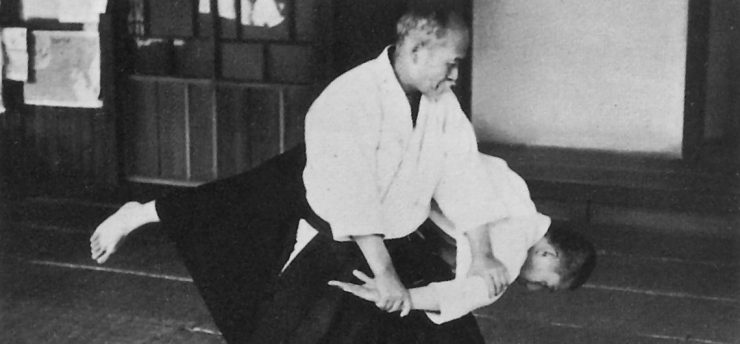
 Josh Gold
“Why do so many aikido styles totally ignore what the Founder clearly taught?”
The correct execution of Shomenuchi ikkyo omote is one of the most debated technical issues in aikido. Actually, it seems odd that this should be the case. The reason is that Aikido Founder Morihei Ueshiba was very clear about how this technique should be implemented.
For those new to aikido, Shomenuchi ikkyo refers to a strike to the head by an opponent. The person throwing (nage) meets the attack by advancing with both hands extended moving his feet together with his hands. Nage then maneuvers the attacker’s arm downward while applying a lock, and proceeds to a pin. Here Morihiro Saito, 9th dan, walks us through the steps of Shomenuchi ikkyo omote…
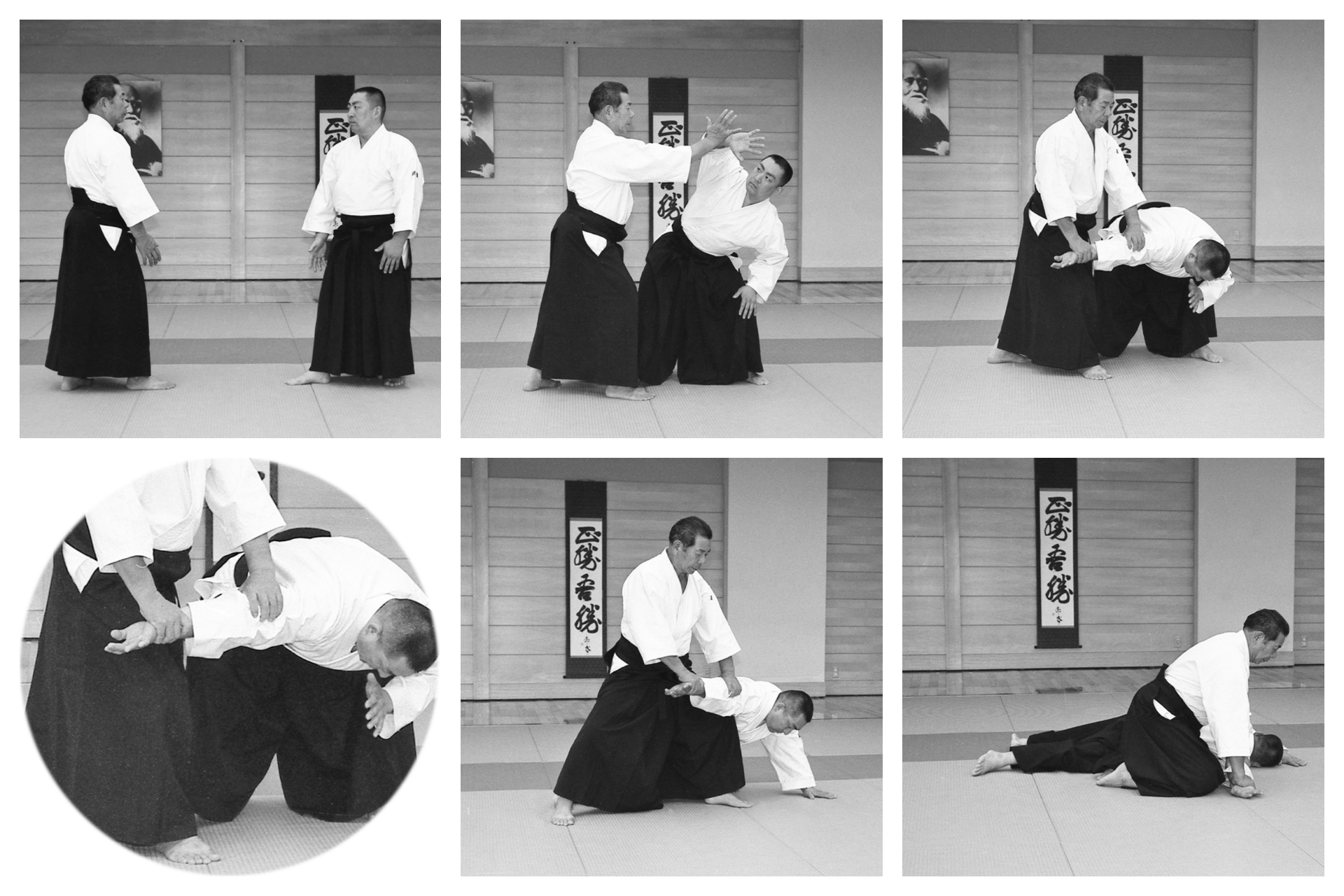
What did the Founder have to say about this technique? In his 1938 technical manual Budo, he wrote that the person throwing initiates the technique. “Advance one step with your right foot while striking your opponent’s face with your right tegatana…” (p. 11).
Now watch this video where Saito Sensei elaborates on the set up for Shomenuchi ikkyo as taught by the Founder.
The defender moves first against the attacker? What can we make of this seemingly counterintuitive approach of the Founder where the defender “steals the initiative” from a would-be attacker?
Think of a shomenuchi attack in the light of physics. If uke attacks in this manner, in an aikido context it is symbolic of a sword attack. An expert wielding a sword can generate tremendous speed. If nage stands directly on the line of attack and waits for uke to strike, he will be late… and dead! So, in this situation involving a strike, O-Sensei clearly specifies that nage initiates the attack, which makes perfect sense from a martial standpoint.
Think of the further implications of this approach. Aikido is often described as a self-defense art. Normally, people think of this to mean that a defender waits for an attacker to initiate, and then responds using a defensive technique. The problem with this view is that it fails to take into account the speed of an attack or the surprise factor, and the near impossibility of managing a successful response within such a limited time window.
Another dimension worth mentioning is that one might be called to action to defend or save a third party, perhaps a loved one, in a dangerous situation. You might call it an instance of “defense by proxy”, but it definitely falls within the scope of martial arts. It’s worthwhile taking the time to think things through both from the practical and moral standpoints before accepting truisms at face value.
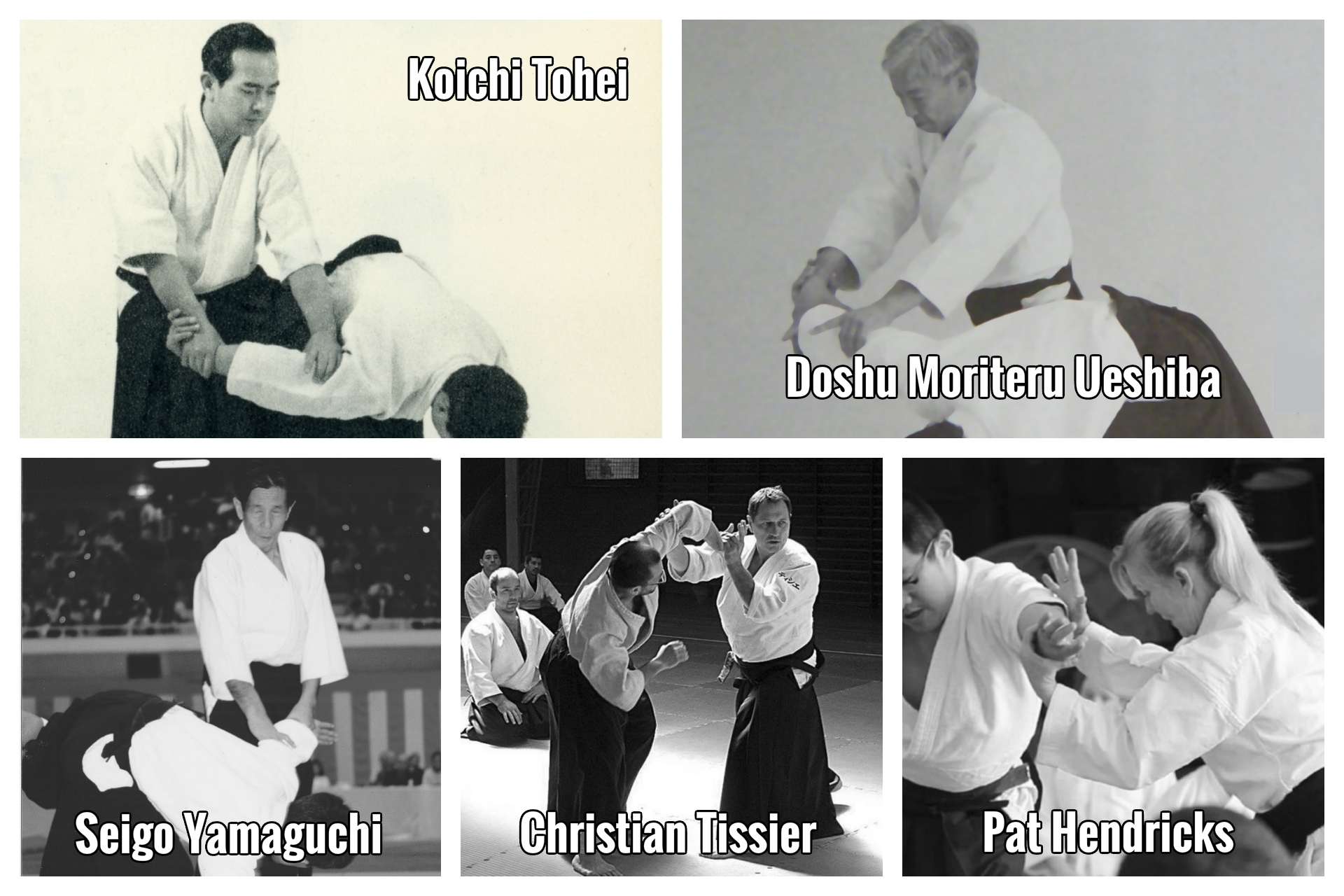
One might be tempted to ask how it came to be that many dojos practiced a watered-down form of Shomenuchi ikkyo when the Founder was clearly teaching something quite different. This has to do with the postwar policy of the Aikikai Hombu Dojo in Tokyo where Kisshomaru Ueshiba and Koichi Tohei were particularly influential. Their idea was to remove the martial elements of the art in order to make aikido more palatable to postwar Japanese, and in the process make it more acceptable to the growing number of foreign martial arts enthusiasts.
Whether or not this policy was responsible for the steady growth of aikido internationally or a misguided decision resulting in a dilution of the art’s core principles is a matter of discussion. Aikidoka will arrive at their own conclusions based on their training experiences and philosophical views. What we have attempted to do here is to identify the technical approach of the creator of aikido to stimulate your thinking and hopefully contribute to your progress.


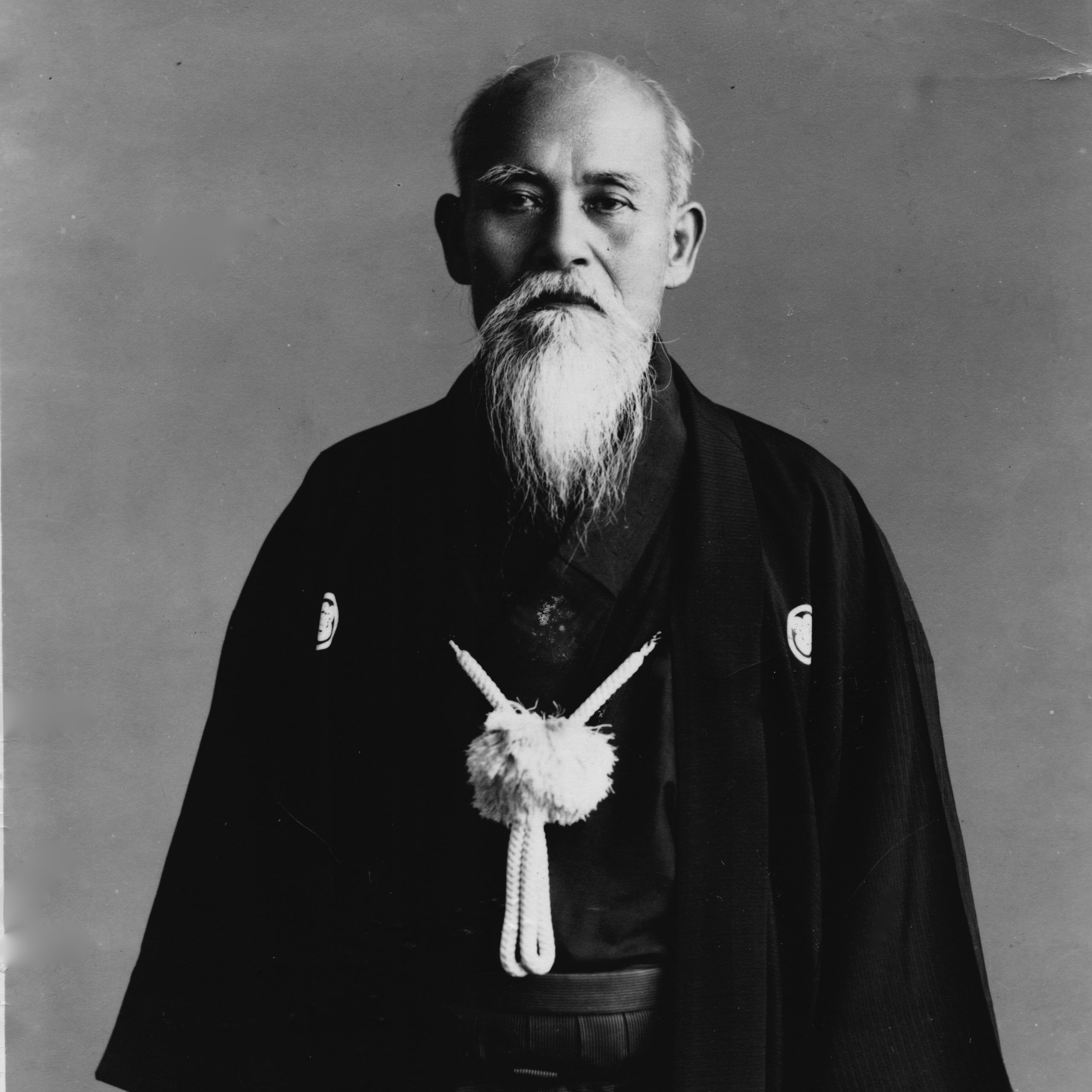




It’s like the whisper chain game where you have a circle of many people and start a simple message by whispering it in one person’s ear. By the time it has gone around… There are all sorts of ways to say this. One of my thoughts is signal to noise ratio, where any teacher’s style is the noise.
HI Mr. Pranin – I respectfully disagree with you as to your theory as to why Tohei Sensei does it differently or for that matter any of the others. However, I do know why Tohei Sensei changed it and I bet the others likely found out that when you have a taller person initiating shomen it just does not work. Tohei Sensei found this out during his first visit to Hawaii when it did not work with a 300 Lb. 6 ft 10 Hawaiian. Tohei Sensei changed it so it would work with any size individual. But stating that his version is watered down is absolutely ludicrous. I know you are a journalist and you do love sensationalizing things, but you really should state facts and when you do not know them don’t make it up. What you may call dilution some would call innovation and evolution. If it stays the same it will be a dead art. Aikido is an actual evolving art not static fixed martial art like some would make you think. Thank you.
Your comment fails to persuade me. I was a student practicing Koichi Tohei Sensei’s aikido for several years in California. I practiced in his classes on a number of occasions in California and in Tokyo in 1969. I would invite you to look at your copy of “This is Aikido” on page 100-101, photos #2-5, and observe uke’s balance. You will see the entire sequence of Shomenuchi iriminage although it is named Shomenuchi kokyunage here. This is how I and others were taught the movement.
You can call me a sensationalizing journalist who makes up things if you wish. But then you disregard 42 years of publishing, a great deal of which has been devoted to technical and historical matters. Some in aikido might consider this body of work as having some value and qualifying me to write on various aikido-related subjects. Others such as yourself do not.
I have no basis to evaluate what you are saying because it does not coincide with my personal training experience with Tohei Sensei. You have chosen to remain anonymous, and have not stated your qualifications or provided any evidence such as photos or film of what you are saying.
The curricula of Koichi Tohei, Kisshomaru Ueshiba, Morihiro Saito and other postwar aikido teachers are well documented in books and film. Anyone may access these materials and draw their own conclusions… and they will.
In conclusion, I was unable to find the respectful part of your rebuttal.