
 Josh Gold
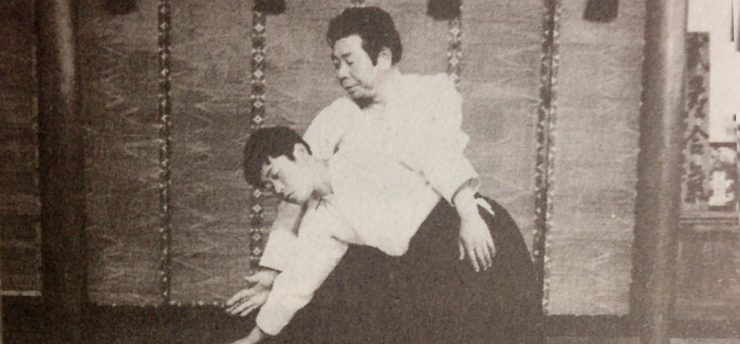
I would like to briefly discuss the origins of iriminage as a type of throwing technique peculiar to aikido and believed to be original to Founder Morihei Ueshiba. Next, we will see how modified versions of iriminage became popularized within the Aikikai, the world headquarters of the art, and from there spread abroad as aikido established roots overseas.
It seems that iriminage — although not originally named as such — has its origin in the Aiki Budo period in prewar Japan. Aiki Budo is the general term used to refer to the pre-modern form of aikido taught by Morihei Ueshiba in the 1930s and early 40s. As to the time frame of the emergence of this particular throwing art now called iriminage, we can say with certainty that it was being taught by 1938, the date of publication of Morihei’s “Budo” training manual. Two of the 50 techniques presented in that book are what we would today call iriminage.
The basic techniques presented in this series of articles are covered in-depth in the Complete Guide to Aikido
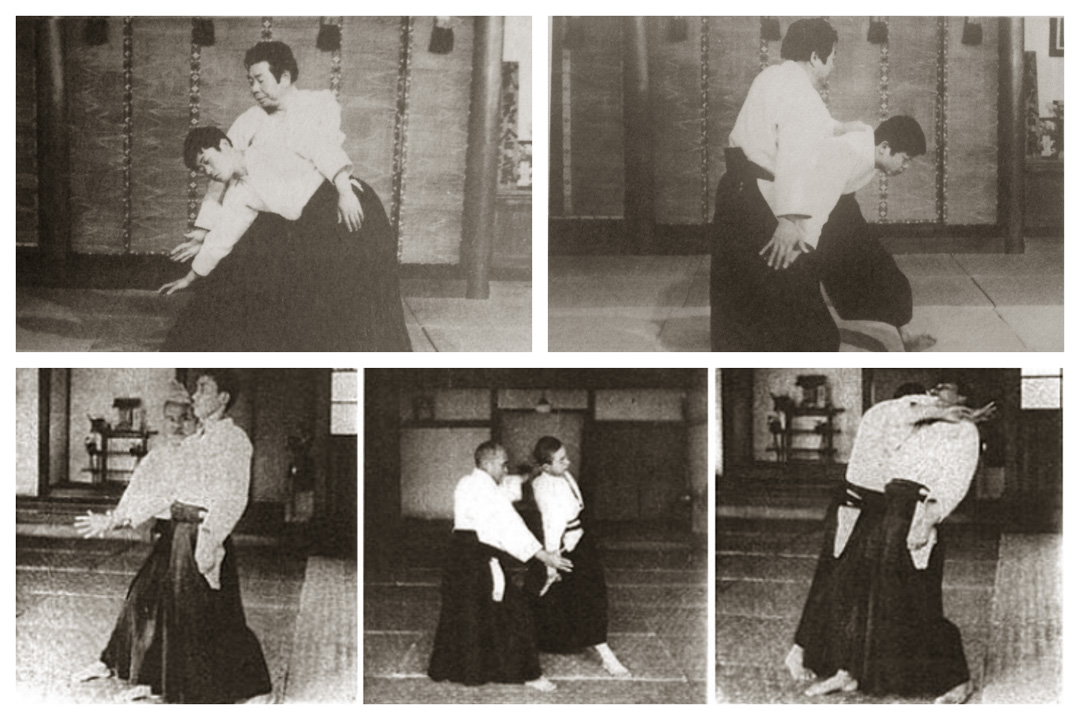
Interestingly, iriminage does not appear in an earlier film document from 1935, the famous Asahi News film. I don’t recall seeing anything like iriminage in the more than 1,000 photos from the Noma Dojo collection that date from 1936 either. Using these surviving documents as reference points, it appears that Morihei’s version of iriminage emerged between 1936 and 1938.
An important note here is that Morihei stresses in “Budo” that in the shomenuchi iriminage technique, nage should seize the initiative and begin an entering movement in contrast to the norm in aikido practice where uke acts first. The rationale behind this seemingly odd manner of treating this technique is complex enough to demand special treatment as it has far-reaching implications.
By the early 1950s, the practice of iriminage — sometimes referred to using the more generic term of “kokyunage” — had undergone a rather dramatic transformation. A legitimate question is how did this modified iriminage come to be regarded as the Aikikai technical standard and who was responsible for these changes.
Actually, it’s fairly easy to prove that it was the Founder’s son, Kisshomaru, who was primarily responsible for introducing this “new” iriminage in which uke was brought off balance and his head lowered only to be allowed to return to an upright position before finally being thrown. This differs from Morihei’s way of executing the technique where uke is immediately unbalanced and thrown, without Kisshomaru’s additional step.
These screenshots from a 1962 film of Kisshomaru Ueshiba clearly illustrate these changes. Compare them with the above photos of Morihei’s iriminage.
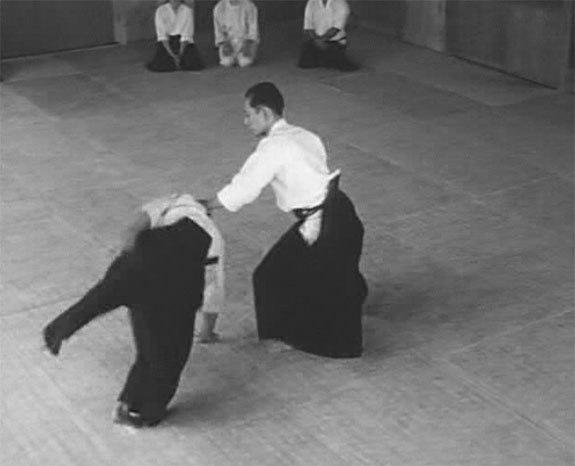
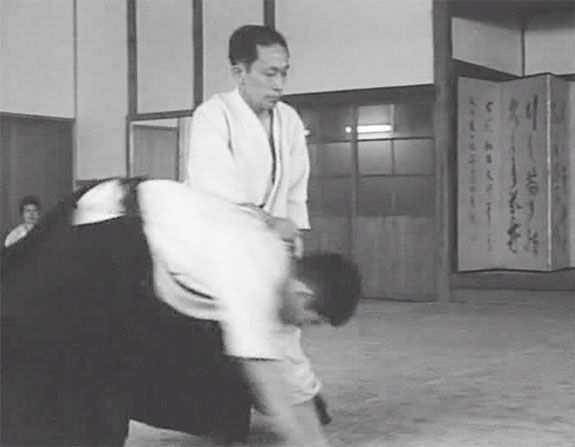
In the above two images, we see Kisshomaru’s modification where he moves circularly while pushing down on uke’s collar to take his balance.
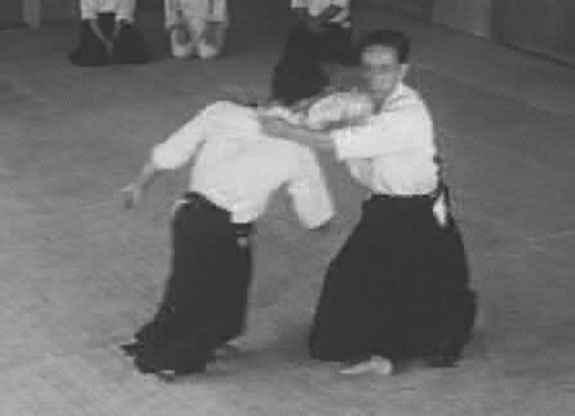
At the next stage of the technique, uke is permitted to stand up whereupon the throw is executed.
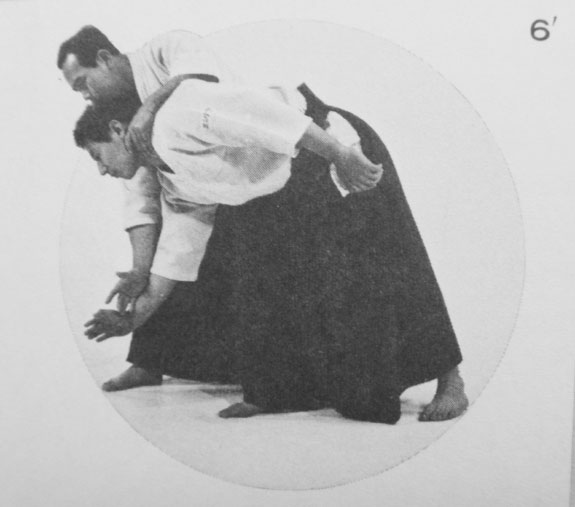
Above, we present a photo of Koichi Tohei, the other main Aikikai teacher from this period, where he demonstrates his version, here called a “kokyunage.” Tohei leans forward while pressing at the base of uke’s neck to unbalance the latter, and then allows him to stand up before finishing the throw.
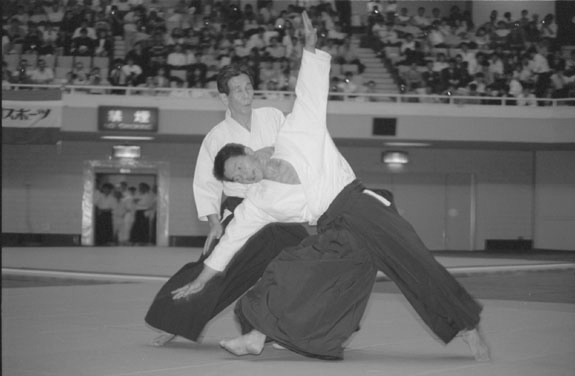
Here is a photo of another famous Aikikai instructor Seigo Yamaguchi, junior to both Kisshomaru and Tohei, where he shows his version of this technique that combines elements of both approaches illustrated above.
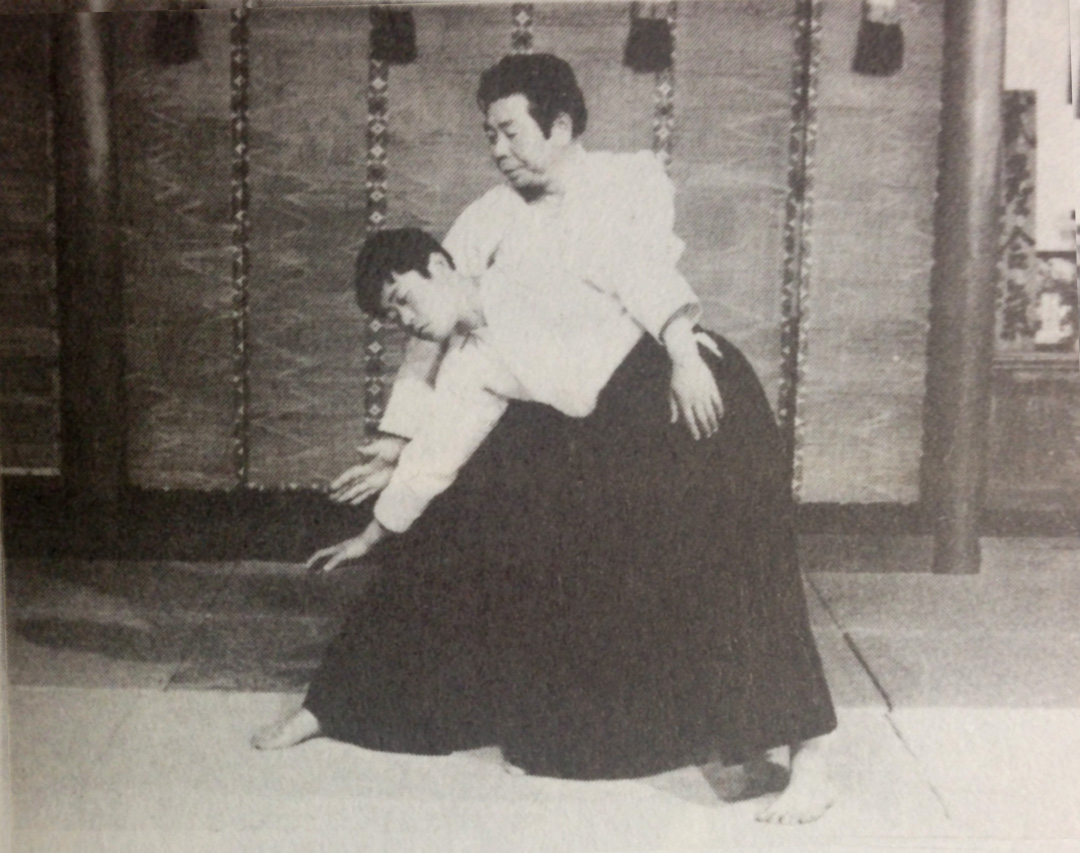
Finally, we offer the photo above of Morihiro Saito executing his version of shomenuchi iriminage which preserves the method taught by Morihei Ueshiba O-Sensei.
It’s fairly easy to prove that it was the Founder’s son, Kisshomaru, who was primarily responsible for introducing this ‘new’ iriminage…
To conclude, this is an overview of the evolution of the iriminage throw as devised by Aikido Founder Morihei Ueshiba and later modified within the Aikikai Hombu Dojo by Second Doshu Kisshomaru Ueshiba and Koichi Tohei, 10 dan, in the early postwar era. As Tohei resigned from the Aikikai in 1974, it was the Founder’s son Kisshomaru Ueshiba whose techniques had the greatest influence and remain today the standard on which the Aikikai curriculum is based.




My current take on aikido techniques is that each is an answer to an often obscure “what if” question. You know, “Sensei, what if they..?” Some of the what-if questions are more general. Some are more obscure. I propose that if uke needs to learn much to take the fall, that variation is more obscure. I will further propose that kihon waza is, therefore, more general. If you resist strongly, you will still fall. How you fall and how it feels is up to you and where you start your ukemi learning curve. Of course Saito Sensei made kihon basic for nage as well, but there are MANY interesting components to kihon waza irimi nage.
Hello Sensei, I’ve trained at a dojo teaching “traditional” Aikido for more than 20 years and have seen iriminage executed in a variety of ways. The adjectives practical, effective, and/or powerful were more relevant to the skill of the practitioner then the technique itself. I suspect this is true for most if not all techniques in any art.
I have watched Iriminage executed by prominent instructors such as Saito Sensei Pat Hendricks, Bruce Bookman and Tissier. The 1st 3 instructors appear similar to O’Sensei’s application while Tissier’s execution appears more like Kisshomaru’s. Is Tissier’s execution less effective? Is the effectiveness of his execution due to his superior skill set or his excellent uke?
I recently renewed a relationship with an former training partner who spent several years with the Birankai organization. Just the other day I watched a video of Chiba Sensei executing iriminage. It was powerful to say the least! Also, it appears that Chiba Sensei’s execution was similar to O’Sensei’s.
The execution of iriminage by each of these instructors had at least one thing in common, the attacker’s balance was immediately taken and not permitted to be recovered. A point made repeatedly in your zone theory of Aikido.
I believe I read an Aikido Journal article written by Tom Collins that Mr. Collins and Bruce Bookman Sensei attended several of Chiba Sensei’s classes at Hombu Dojo.
To what degree does Chiba Sensei’s training at Hombu Dojo reflect the techniques of O’Sensei?
Thank You,
Hello Stanley,
here in France, and in Nocquet’s sensei group we do this technique like the O’sensei and Saito sensei did. Unless you’re a very fit uke, doing the Kisshomaru style is quite unrealistic. 10 years ago I have practiced with a Tissier’s student during a seminar. I reckon I had to stay put and on my knees on the mat after being unbalanced, and I felt that I could have tackled nage from under his knees like they do in rugby. The longer steps you need to apply a technique, the higher risks you take that your uke comes back to a balance stance. To me the kneeling stance is a powerful balanced stance
Did Ueshiba invent Irimi nage completely on his own, or – like Ikkyo – was it something that first originated with Daito Ryu (Ippon dori) and that he then changed to take out some of the more martial elements of it to suit his religious views? Thanks..
Well, perhaps is it not so easy to put all the responsibility of the evolution on Kisshomaru Ueshiba. If you take a look at Morihei Ueshiba postwar videos, you will see that he often used this circular form of irimi nage (for example the demonstration on the roof of the building where uke takes a 360° turn around O sensei during irimi nage and has his head lowered by the master before returning to an upright position). You can even see it in the 1964 video of Saito sensei (actually, the second picture of Saito sensei above also shows a front bent uke…).
I also have to say that we can see a few irimi nage actually appear in the Asahi news 1935 film, during tachi waza techniques
I agree with what you say. The form I’m referring to appears clearly in the 1938 Budo book and is used through at least 1955 or so. The key is aligning your hips to mirror uke’s stance. Other versions result in opposition to uke’s movement and present a vulnerability for uke to counter.
If I compare the second picture of Saito with the second of Ueshiba. The head of uke with Saito is level with the elbow and with Ueshiba the head of uke is level with the head of Ueshiba. With Saito uke is going forward and down. With Ueshiba uke is going backwards and sideways. Unless the difference comes from the moment the picture was taken.
Yes, I know exactly what you’re referring to. Now look at volume 4 of Saito Sensei’s “Traditional Aikido”, pp. 88-102 and look at his hip alignment relative to uke. I speculate that his bad knees made it painful to use the parallel stance in later years. You have to be agile and do a rather aggressive hip shift to achieve O-Sensei’s form.
At A seminar with Saito Sensei he called me out and demonstrated irimi Nage and Kokyu Nage from the same attack and stated as an instructor I must know the difference. It was something I never forgot.