
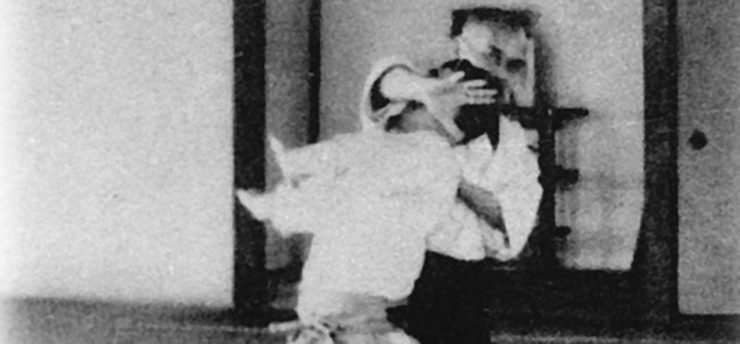
 Josh Gold
I have been fascinated with Morihei Ueshiba’s iriminage technique since I discovered his prewar “Budo” manual in 1981. There, I found what I consider to be an innovative and effective method of executing one of aikido’s core techniques. Personally, I have found nothing that matches the sophistication of this iriminage in present-day aikido.
To my way of thinking, what we have nowadays are unrealistic, showy iriminage that play to the public’s love of the spectacular. That these forms accompanied by acrobatic, audience-wowing falls have serious vulnerabilities seems to bother few. I have railed against these sensational versions of iriminage for several years in videos and articles. I fear I have had little success in drawing attention to this “old way” of executing iriminage and that it will be relegated to the dust bin of history.
To illustrate my point, just the other day I received a quite extraordinary email from a Daito-ryu instructor in Finland. Not only did he chide me for stating that this iriminage form emerged somewhere between 1936-1938, but that it can already been seen in a 1933 book and the 1935 Asahi News film. Not only that, he included 15 photos to prove his point!
Although I remain completely unpersuaded by his argument, he went to a lot of trouble to find and organize these photos to send to me. It then occurred to me that he had given me a wonderful topic for discussion and saved me a lot of work by preparing these photos. Now I share them with you.
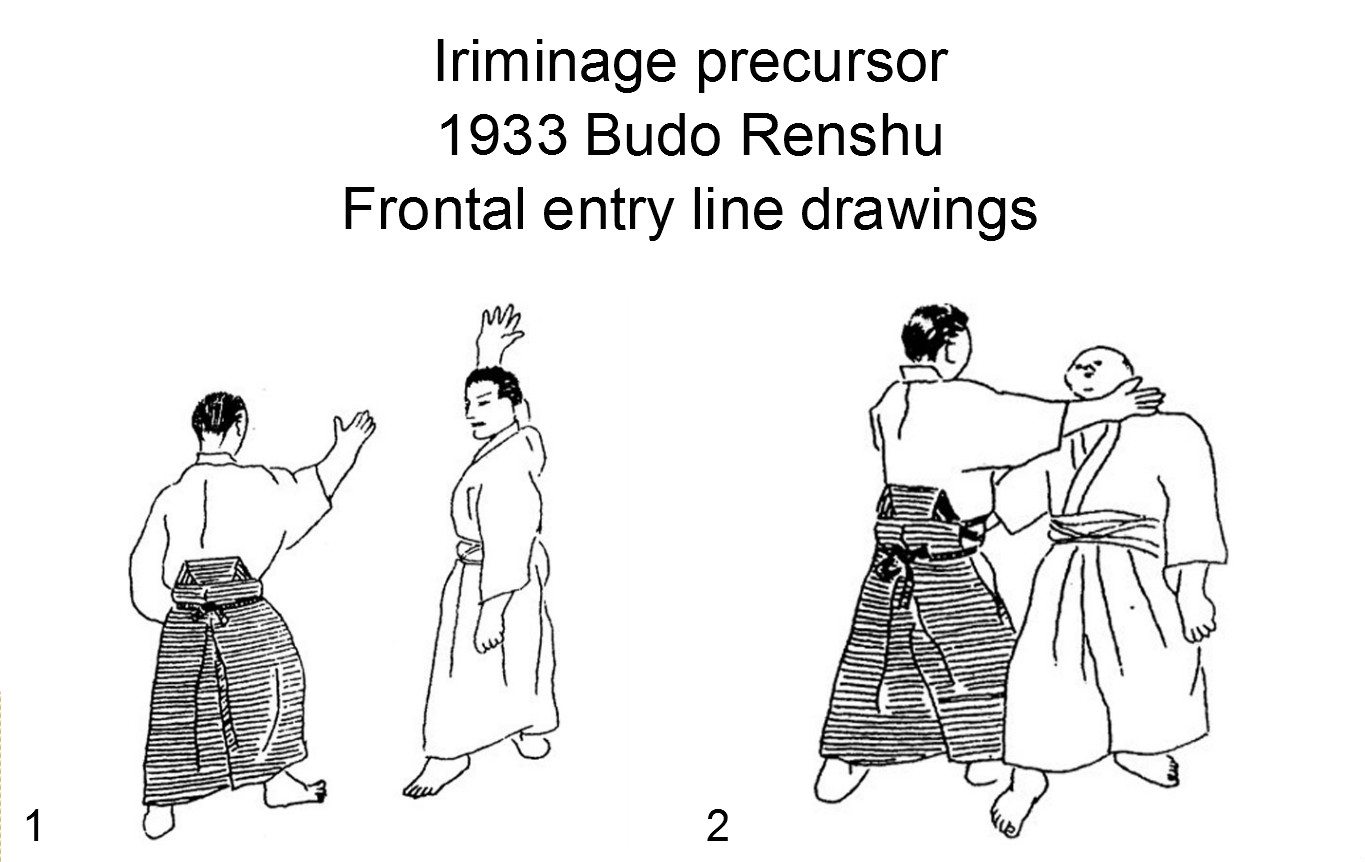
The first exhibit we see are two line drawings from the 1933 “Budo Renshu” manual that show a shomenuchi attack (1) and an entering throw (2). My critic’s argument is that this is an iriminage.
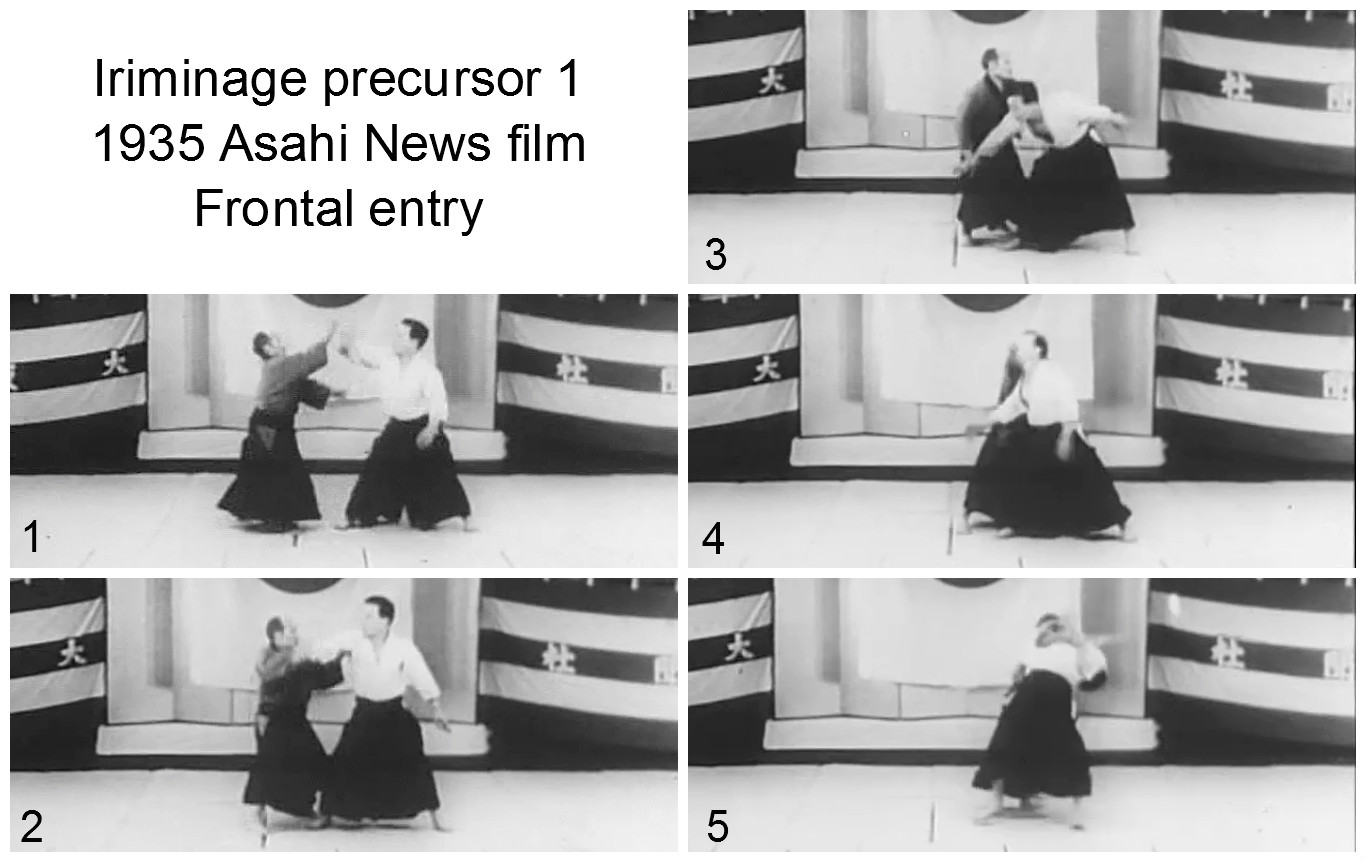
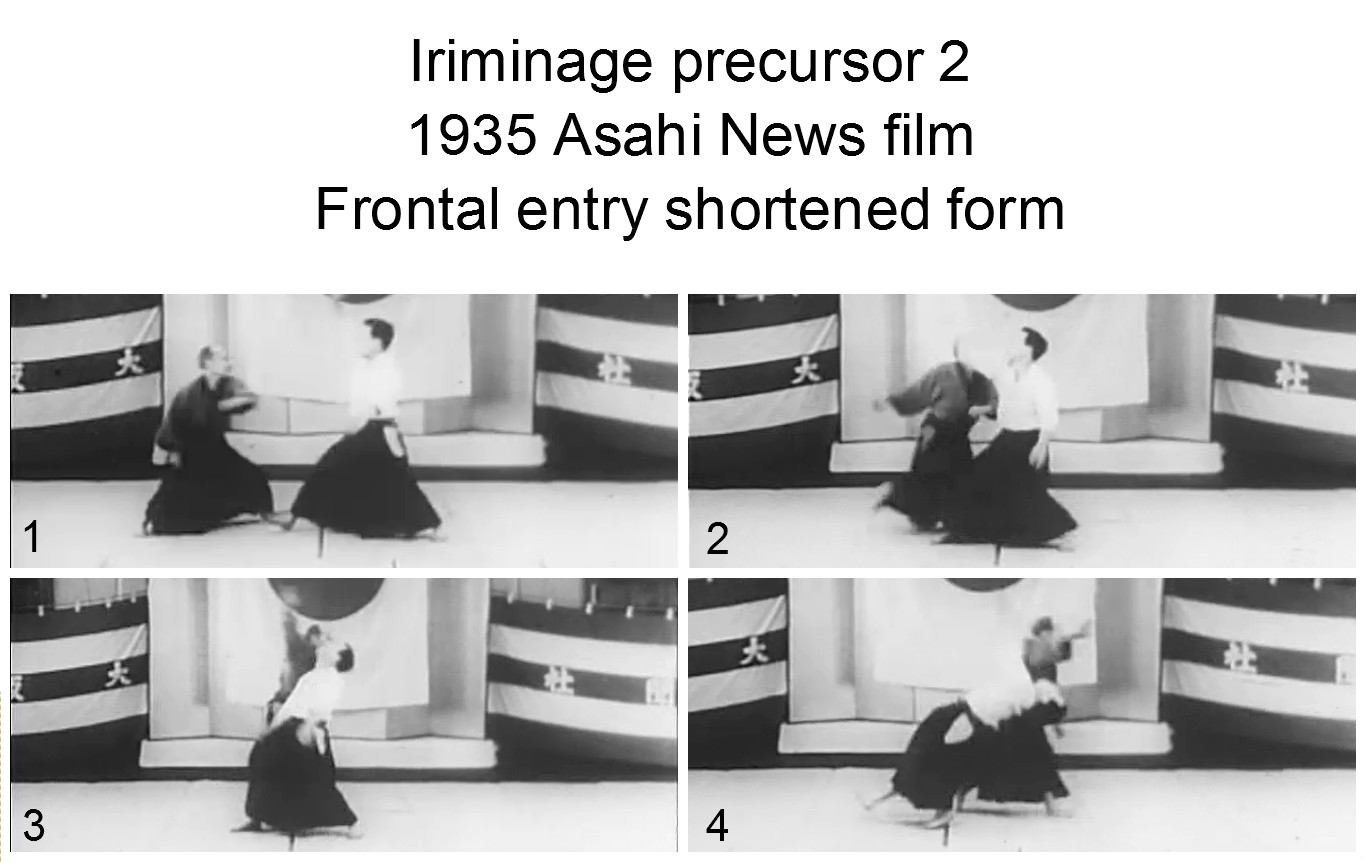
Next, we have two sets of sequential stills from the 1935 Asahi News film, the only surviving film footage from the prewar era. These two sequences reinforce the line drawings and his claim is that both of these are iriminage as well. Do you agree?
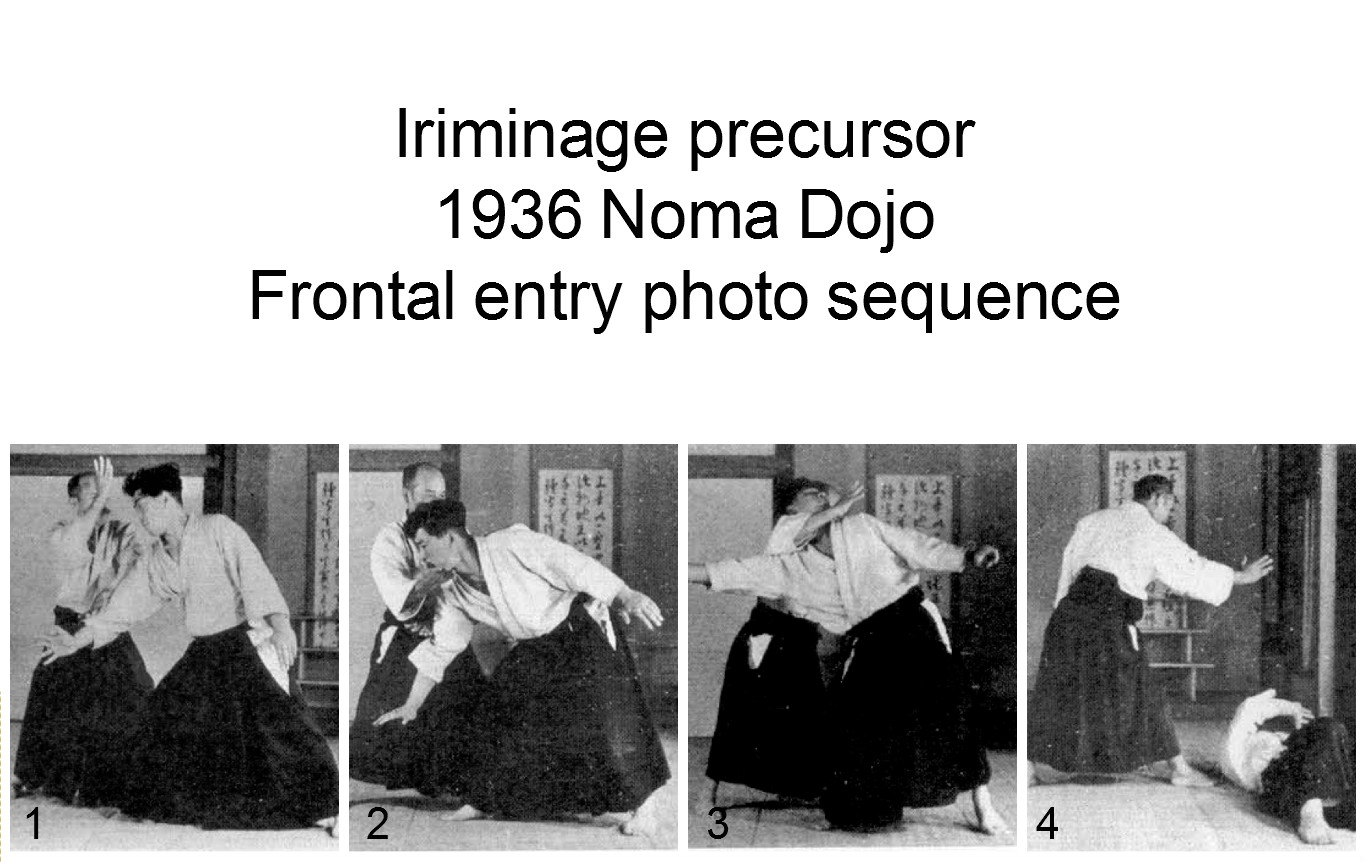
Finally, to seal his thesis, he presents this series of photos pieced together from the Noma Dojo photos shot in 1936 which illustrate the same throw but with better clarity. This is another example of the iriminage that I “missed” and further proof that Morihei was already doing this technique earlier and that it existed in the Daito-ryu curriculum of Sokaku Takeda.
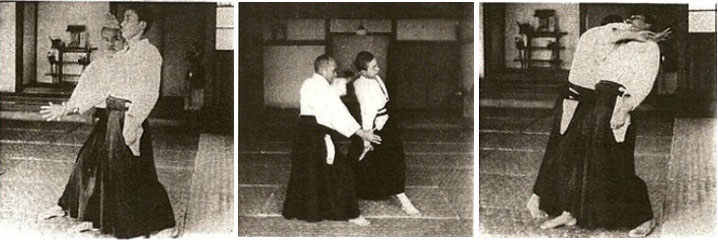
Before I offer my rebuttal, take a look at these photos from the 1938 “Budo” book and see if you think this is the same technique we see executed above.
First of all, compare the first collages with the photos from “Budo.” Look at the initial contact between Morihei and his uke. His hips are facing at a right angle or forward in relation to his partner. Look at the position of Morihei’s feet. Now look at his feet in the “Budo” images to see how he is aligned in parallel with uke. This is the effect of the blending motion used to set uke up for the throw.
Notice also that Morihei has clearly positioned himself to the rear of uke with both arms extended. He is creating a triangulation in his stance that mirrors uke’s and a physical separation that prevents his opponent turning and countering.
As to the final phase of the technique in the earlier sequences, Morihei uses a certain amount of physical force to drive uke backward for the throw. In “Budo,” his opponent is clearly unbalanced to the rear thus requiring no force to complete the technique.
I contend that these photos support my argument that this refined version of the technique we now know as iriminage came into existence around 1938 and that Morihei continued using something very similar immediately after the war in the Iwama period. What existed prior to this is a precursor technique found in the Daito-ryu curriculum that was less “aikido-like,” without the smooth blend and light, unencumbered throw. I fully realize that my views are subjective and that readers will have a variety of alternative reactions to the same historical evidence we present here.
Fire away! But please, go to the dojo at the next opportune moment and practice O-Sensei’s version.





What’s interesting in the 1935 frames is that “the blend” is invisible. In one frame O Sensei is looking directly the other direction from uke. Now, we all know that frame-by-frame at movie speeds can be deceptive, but it leads to the question as to whether a longer more obvious blend was a postwar development. Today most aikido practitioners, imo, over emphasize the blend, but there you are.
The 1933 yokomenuchi variation resembles ten-chi nage to me. Then we get into all the varieties of nomenclature.
He did indeed do a lot of work, and the issue for me is more with nomenclature.
The Budo Renshu image is something I have seen called kokyunage, Tenchinage, and Iriminage as well as Shomenate. In my mind, I use Shomenate as I do prefer the clarity of a name that does not mean a dozen other things. I think the use of Irimi and Tenkan led to the idea that any time I enter, I am doing Iriminage. I like to keep atemiwaza and kokyunage separate from Iriminage, but I am not sure they really are.
The 1935 versions, particularly the first one – yes, I have teachers calling this Iriminage, and students do perform these on tests as Iriminage. I had a student of Koichi Tohei tell me these were kokyunage, but I didn’t find the idea helpful for myself. They could be called atemiwaza as well.
Yes, there is a difference in hip placement and the use of kuzushi in the bottom pic. Are all these Iriminage – mostly a vague yes.
In Baguazhang, the same gross motor movement can be done as Heaven Palm (forceful, near linear continuous, outward), Thunder (sudden sharp brief explosive) or Earth (circular, soft, coiling, drawing in) and so on for many variations. In Aikido, “arm-in-face, bend-over-backwards” has several different names that seem to point to political associations and not technical differences.
STAN:
Once again, a superb and in-depth analysis on your part. “Match, set, point!”
__________
I came up with a maxim about these things a while back. I call it my “Force vs. Finesse Equation”.
“As FORCE goes to zero, FINESSE goes to infinity.”
As far as my personal experience is concerned, you can carve that one in stone.
It’s also a very useful and pragmatic calibration tool for assessing the relative degrees of Force and Finesse that you are manifesting … moment to moment … both on and off the mat.
The Mastery Game in the Internal Arts is all about shifting the “pie chart” divisions more and more in favor of Finesse and further and further away from Force … as the dominant Internal sense-feeling AND in the Outer manifestation of the Form(s).
The most productive way that I have found to both test and cultivate this quality is to work with trained wrestlers and MMA fighters. Guys who are very, very tough, competitive, able to absorb and dish out punishment, who are not afraid of pain and sweat, and who absolutely … repeat, abolutely … hate to lose and love to win.
They have helped me (sometimes painfully) to separate what I can finesse and what I cannot … and where I stand on the Bell Curve at any given moment.
*(NOTE: BTW … When done with finesse, timing, and positioning, Irimi Nage IS an incredible waza. On several occasions, I have raised a few eyebrows and earned a few grunts of respect when performing Irimi Nage with some degree of genuine finesse.)
These guys do not wait around for me to get my technique right. If I miss or am misaligned, I wind up being, punched, dumped, pinned, submitted, or choked out. “Wham bam, thank you mam!”
You wanna “road test” your ‘stuff’? Just grab an outstanding High School or College Wrestler, say 170 lbs. – 182 lbs. Weight Class, … and prepare to be educated and probably humbled a bit. I know that I have been.
To this end, I will always remember the core lessons I have received in the elements of Irimi Nage from many, many teachers and fellow trainees.
Some of the most notable:
From Kato Sensei: Being on the receiving end of his “irimi” (taijitsu and aiki ken). His irimi was the most penetrating and overwhelming of anyone’s that I have encountered.
From Saito Sensei: His astounding melding of the “circle” and the “square” were without equal. More than anyone, his Irimi Nage always felt like being caught up in a great and powerful wave.
His base and connection to ground serve as the ‘gold standard’ for me.
From Saotome Sensei: He can ‘shape shift’ from a solid entity, to flowing water, to swirling smoke. And I always felt the sword cut inside his waza … always.
The list goes on …
__________
One Last Note Dept.:
The Aikido pedagogical paradigm of progression:
– Kihon Waza
– Ki no Nagare
– Takemusu Aiki
is the only way I know of to approach this level of skill development with any possibility of mastery.
This model has, and continues, to serve me well in any and all efforts at skill development in just about any endeavor.
Thank you Stan,
~David Brown
Excellent observations, David! Thanks for participating in the discussion.
Here’s something fun to look at. Try comparing Budo Renshu with Kanemoto Sunadomari’s Aikido Densho.
The Budo Renshu (BR) technique mentioned in the article above is number 42 in my copy (a French translation pdf. I lost my old blue covered English version a decade ago. C’est la vie!) The same technique is found in Aikido Densho (AD), page 24, Yokomenuchi 1. The written instructions are almost identical.
And now here’s the cool part. On page 23 of AD is a technique numbered Shomenuchi 3, it is an irimi nage technique. Neat! Now go back to BR and look at technique number 41.
It looks like the same entry as the one on page 23 of AD. However, there is no follow up to the setup, at least not in my pdf copy (which might be incomplete, I really have to hunt up a new bound copy one of these days.) The parallel of the presentation order of these two techniques in two different books is enticing, neh?
A review of the things thrown into the mix: The first image in this article, dubbed “Iriminage precursor”, is from Budo Renshu, technique 42.
Technique 42’s twin appears in Aikido Densho on page 24. On page 23 of the same book an irimi nage technique is shown.
Technique 41 of Budo Renshu shows an identical entry to the Aikido Densho technique on page 23, but nothing more (again, at least in my copy which may be incomplete).
So, the plot thickens! How long did Kanemoto train with Ueshiba and when was Aikido Densho published? Maybe these years can help narrow down the time frame of irimi nage development.
(Hope I didn’t make anyone’s eye’s swim with all the back and forth page numbering, but sometimes it’s necessary.)
Just thought of something, my first thinking was that they are indeed different However……….
It just occurred they could also be the same and I think it is quite a simple explanation.
In the Noma Dojo series this looks like this would be a Kihon or the basic way of doing irimi nage solid and precise. In the Asahi video the techniques I hope you would agree are lightning fast and so could be reasonably considered ki no nagare full speed, full power, I would also like to add Morihei appears to be little excited and full of adrenaline which would add to the obvious use of a little more force than maybe strictly necessary.
The drawings from Budo Renshu looks more like shomenuchi Kokyu nage, I maybe wrong but that is what it looks like.
Thanks for a great topic Stan as always,
Andy B
HI Stan,
I mad mistake above, I meant the photos from Budo 1938 look more like the Kihon Version, the Noma dojo series I dont believe is Irimi nage.
Andy B
I think these are all variables of similar techniques. Isn’t that what Takemusu is all about. Spontaneous generation of technique does not mean they will all be exactly the same. Attacks are different, bodies are different, intent and intensity of attacks are different. How many differences do you need until the reactions can become infinite?
Stan,
It took me a few reads to understand what you were saying. It became pretty obvious when I checked where O’Sensei’s feet were on the mats in the photos, especially in the first and last photos of the Noma Dojo and Budo manual photos.
In overall summary, my understanding is that you’re saying:
Modern Irimi = Cutting down then when they stand “coat-hangering” them, or any modern variation based around forcing the angle of the head through one’s shoulder and finishing with a forward movement.
O’Sensei’s Irimi = Cutting down with a turn that unbalances/demolishes (kuzushite) their structure through tori positioning themselves in uke’s “dead point” behind them (Budo manual middle photo) then stepping back and turning in reverse to take them down in that direction effortlessly and irresistibly.
I hope those descriptions make sense!
The former is what I was initially taught to do from students of Sugano Sensei (albeit without the fancy forward throw, uke falling backwards) and the latter, with a collar grab, what I learned from Suganuma Sensei. The latter, when done well feels like you have fallen down without having been thrown at all.
In “Aikido – The Way of Harmony” Rinjiro Shirata shows sankaku no irimi, chokusen no irimi, and en no irimi. Since he was an early student of Osensei, these might shed some light on the development of irimi nage.
I think the complication and debate arises due to a poor concurrence of what the term “iriminage” means across the various lineages of Aikido. While the Budo Renshu photo illustrates a form of irimi tai sabaki and also appears to be nagewaza, my own dojo (USAF-affiliated, with strong influences of Chiba, Shibata, and Yamada shihans) would not name that technique “iriminage”. It would be “sumiotoshi”, “kokyunage”, or “tenchi nage”, all depending on whether the throw is (respectively) low, high, or both-simultaneously.
For the techniques that we do name “iriminage” (which is a wide set), a commonality is that nage always enters on uke’s soto (outer) side. Our fundamental form of iriminage involves sweeping uke’s near arm while performing an ura (tenkan to uke’s rear) motion, securing uke’s shoulder in the opposite hand with downward pressure, then making a final, displacing irimi as uke begins to rise, at the same time cascading over uke’s far shoulder with a kokyu movement.
All of the photos would be valid iriminage-class variants in our naming scheme. Other valid variations include: 1. pressing uke all the way to the mat with his shoulder, instead of letting him rise, 2. securing uke’s face, instead of his shoulder, 3. wrapping uke with his own attacking arm to a corkscrew-pattern drop, 4. ushiro-ate (cross uke’s rear, while rolling both his shoulders back and down), 5. (sho)men-ate (deflect uke’s tsuki to his interior, while pushing uke’s face up and back) 6. transferring the kokyu into a kubishime. There’s probably even more I’m missing that would count.
One other technique that wouldn’t count under our naming scheme is Yoshinkan’s Sokumen Iriminage. We give the name “Kokyu Ho” to this technique and similar ones where-in nage enters, then uses the back of his forearm to press uke downwards/backwards.
Excellent summary, James! Thank you.