
 Josh Gold
Dawn of A New Era in Motion Capture
Motion capture technology has been around for decades. The fidelity of current systems is phenomenal. They bring amazing characters to life in film and games. But the technology is expensive and requires substantial human and infrastructure resources to support it.
A set-up used to capture an athlete’s moves for a sports game requires a dedicated mo-cap studio and an array of cameras and sensors that cost hundreds of thousands of dollars – not counting the specialized operators or the custom software required to make sense of the data.
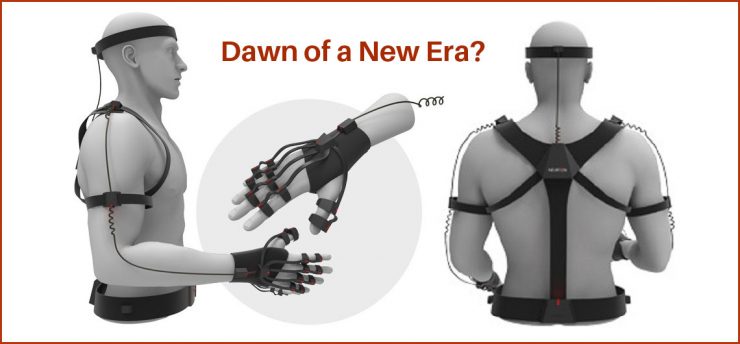
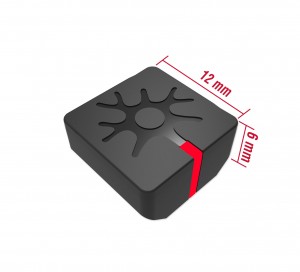
Recent innovations have made available a new breed of motion capture. One new system, the Perception Neuron, uses an array of 18-32 sensors, each with a highly accurate accelerometer and gyroscope. The system can record up to 120 samples per second, and unlike high end optical systems, it doesn’t have problems with occlusion because the data is not being captured by a camera – just sensors. The system can record and transmit data wirelessly. In real time. It’s designed from the ground up to integrate with virtual reality displays. It costs $1,000.
The Future Is Here
We believe that over the long term, three major new technologies will have far reaching impact in the martial arts world.
- Motion Capture: Low cost, real time, sensor based systems will allow for efficient recording of martial arts movements. These systems can capture position, orientation, and movement of the human body in great detail.
- Virtual Reality: A fully immersive environment that can be used to view recorded motion capture, or experience others’ movements in real time in a virtual space.
- Augmented Reality: Holograms superimposed into the real world via glasses or other similar viewing technology. Motion capture data and other information can be projected in real time into an existing space.
What does this mean for the marital arts world?
Potential applications for this technology are far reaching and breathtaking. As a sci-fi fan, the long term arc is exciting to dream about. But as a practical martial artist, I realize the value in taking the first steps on the path – the near term applications. We’ve just begun to think about what those might look like:
- Movement Research: With some custom software, we should be able to calculate and display a martial artist’s center of gravity, base of support, and balance state. Looking at this data may reveal ways to optimize movements and techniques. There are many other types of data that can be recorded that should yield insights in a range of areas.
- Individual Assessments: This new breed of mo-cap systems is already being used for golf swing analysis and other similar applications. We think there’s a place to use these systems as instructional/assessment tools for students. It should be straightforward to measure body structure quality, alignment, movement path efficiency, and speed. We expect this to have value for a certain kind of martial arts practitioner.
- Time Capsule: Imagine if we had 100 hours of Morihei Ueshiba’s movements recorded in 3D at 120 frames per second. What about Bruce Lee? We can begin to capture and immortalize the movements of today’s great martial arts masters. The future value of this data from a historical and research perspective is huge. In capturing the essence of the martial arts greats, the impact of this technology should be no less than that of video.
- Entertainment: We have some ideas about how this technology can create new bridges between the worlds of martial arts and entertainment. We’ll save our thoughts on this for a future post.
Our First Step
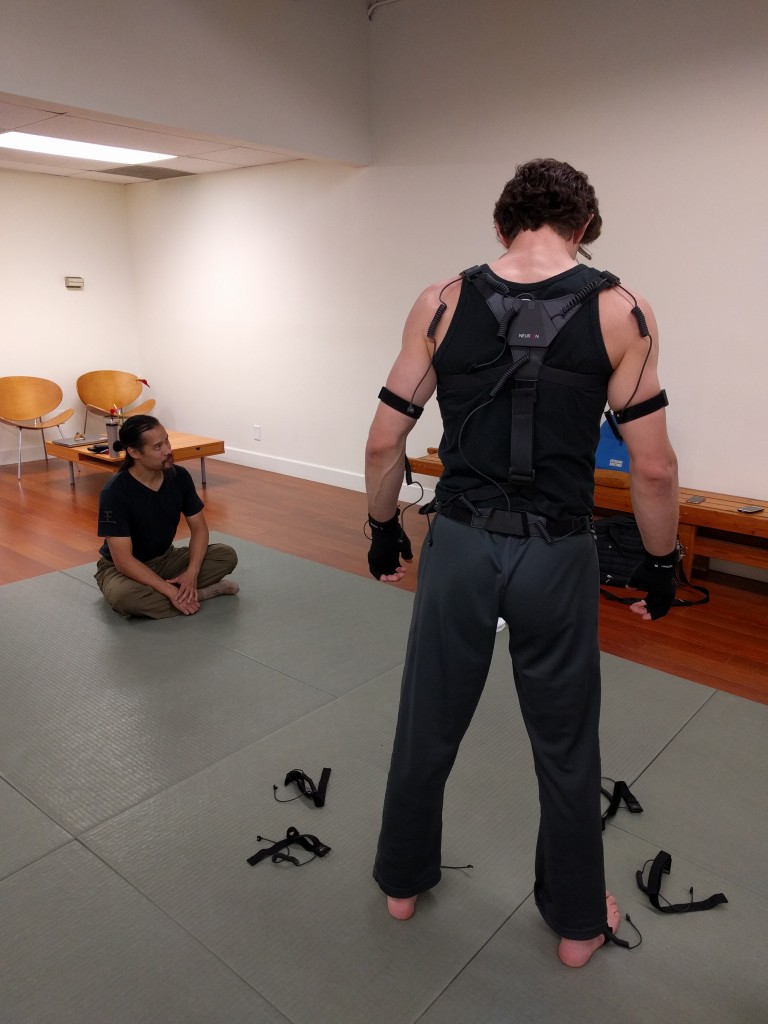
As a first step, we purchased a system and started testing it. Before spending too much time thinking about applications, we wanted to get the system up and running and see what the data looks like.
We’re sure to run into a range of obstacles and problems. We’ve already identified a number of issues like proper calibration (the movement data doesn’t quite map properly to the model) and dealing with elevation changes (the system doesn’t deal well with rolling/falling). These kinds of things are pretty straightforward to address. If we do encounter hard problems to solve, our community has brought together individuals with the experience and motivation to do so.
Here’s a look at some data from our first capture session:
(The red circle in the abdominal area and the red circle projected onto the ground plane show the center of gravity.)
It’s possible our efforts won’t produce anything meaningful. Our dojo has invested resources into many projects that didn’t yield beneficial results. But through those failures, many valuable efforts and innovations have blossomed. We are cautiously optimistic and hope this effort will have a significant positive impact on how we think about perceiving, analyzing, and harnessing the power of movement in the martial arts.
Join The Conversation
Do you have any ideas to share or experience in this realm? Will this develop into a powerful and transformative technology, or will it just be a fad?
We are excited to hear your thoughts. We are just beginning to experiment in this new world of motion capture, virtual reality, and augmented reality. A constructive dialogue and information exchange can only help us illuminate our path as we navigate the unknown.
Our thanks to Josh Gold for contributing this timely article. The original article is hosted at the Ikazuki Dojo website.

 Antonio Aloia






An interesting correlation….
http://firstround.com/review/the-adaptable-leader-is-the-new-holy-grail-become-one-hire-one/
32 sensors would show a great deal, but not everything. Over 200 bones, around 800 muscles. While some matter less than others and some likely don’t matter, the difference between a pressurized abdomen and loose abdominal muscles is enormous in terms of force delivered. Toes and their connection to the ground, how the palm makes connection in the grab – very palpable differences that this would not catch. For Aiki, I also find my structure is only half the equation – Uke’s structure and how I fit with it would mean two people in suits.
Biggest reason for doubt that this will catch on for me is that it hasn’t already. These ideas have been in use in sports medicine and Olympic training for decades. High speed photography is used by Karate and Judo, aesthetically pleasing photography is more what I see in Aikido. Motion capture video clip analysis can be done on an iPad with very inexpensive apps already.
In Karate, being back weighted or front weighted is given a different name. In Aikido (in English speaking areas), I just hear it called Hamni. Twisting left or right without moving the feet has a different terminology in other arts. Again, I usually just hear the stance called Hamni – even when maybe it isn’t.
I see one person throw back weighted and turning in, another throws front weighted and out – and I hear uke talk about the different “energies.” Doing a Tenkan and shifting to back weighted or front weighted – if we have quick easy language to communicate this, I am not aware of it.
The whole reason for the filming would be to make Nage even aware of these gross motor movements we don’t have names for. Meanwhile, any technical name is a near limitless category.
The point being as other sports and arts have explored movement in this fashion for decades, many Aikido people do not. Many are openly disparaging of science – anatomy, physics, neurology, psychology – being applied to their practice. We have had the forerunners to these technologies available for a very long time, and we chose to never use them.
As indicated, the center of gravity (= center of mass in a uniform gravitational field) is only correct for a body adopting a linear shape with arms at the sides. As the human body is not rigid, it’s center of mass moves as the conformation of the body is altered. For instance, in a forward roll, adopting a posture akin to a tire, the center of mass is actually outside the body, in the center of the circle.