
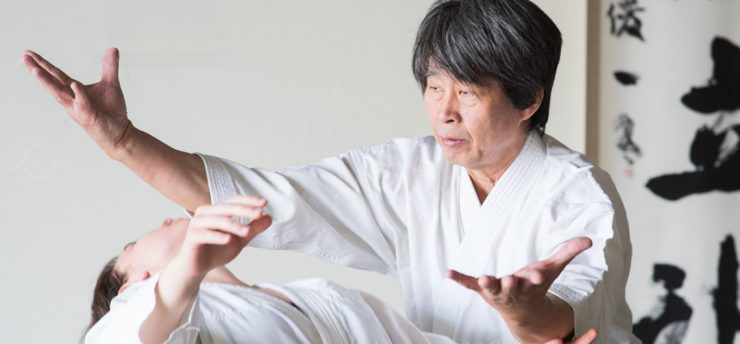
 Josh Gold
Recently, there’s been an active and healthy dialogue around the effectiveness of aikido as a martial art, and how the general lack of practitioners’ martial skill development has contributed to a decline in popularity of the art.
After reflecting on our own dojo’s approach and contemplating ways we can improve in this area, we wanted to share our current thinking on this critically important topic.
We have practitioners, ages 13-80, with a wide variety of motivations for training and personalized paths for development. While combat readiness is not the highest priority for many of our practitioners, we believe that for aikido to remain a martial art, it should have martial value and integrity.
We are continually evolving our instructional strategy and have successfully (and unsuccessfully) explored a range of training approaches. At Ikazuchi Dojo, we’ve prioritized five areas of focus that are designed to lead us towards better development as capable martial artists.
1. Functional Techniques
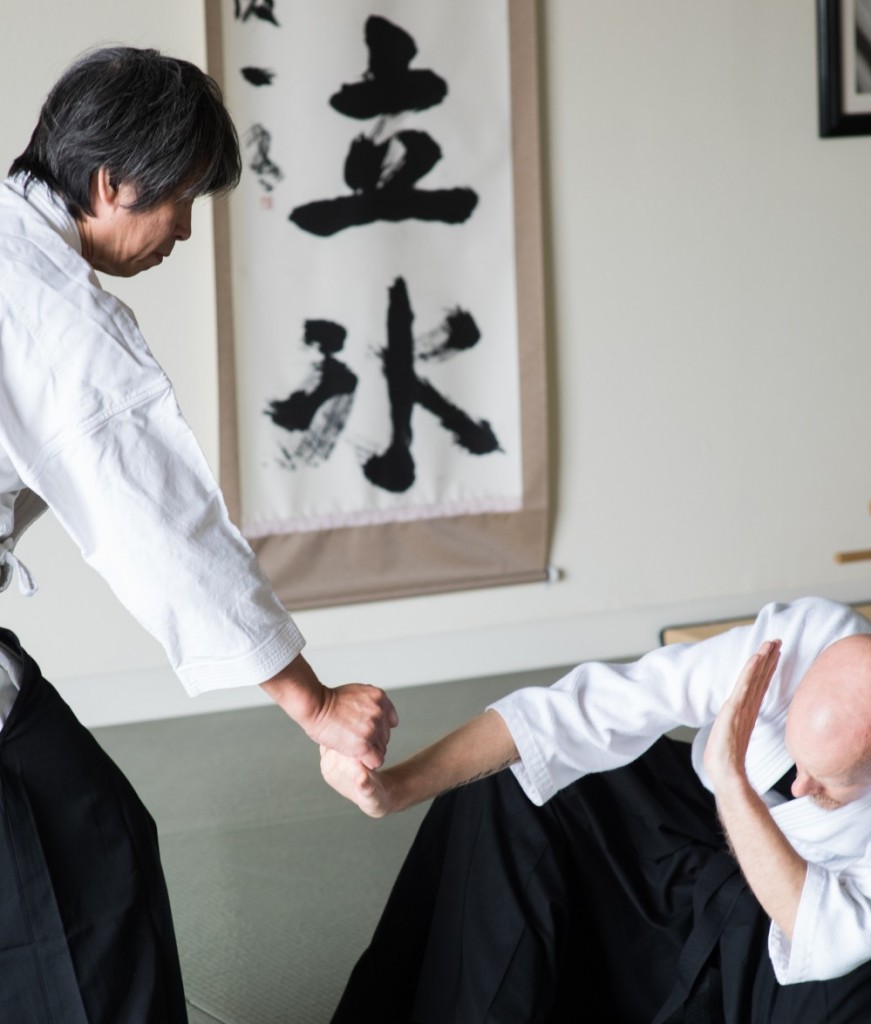 In order for our aikido to be effective, it’s only logical that our techniques must be relevant and reliable in a self-defense scenario.
We do practice flow exercises and techniques (ki-no-nagare training), but we place primary emphasis on direct techniques that are designed to quickly break the attacker’s balance.
We also make sure techniques that answer punches and kicks are part of our curriculum.
2. Outside Perspective
We allocate a great deal of training time to the practice of traditional aikido techniques. However, we also take the opportunity to explore new technique applications and training methods.
- We offer self-defense workshops in which we have the opportunity to view and express our aikido through a new lens.
- We bring in seasoned instructors from other arts to lead workshops. We recently had the honor of hosting Mark Cheng to lead a Knife Knowledge workshop. We learned how the Filipino arts view, train, and move with the knife.
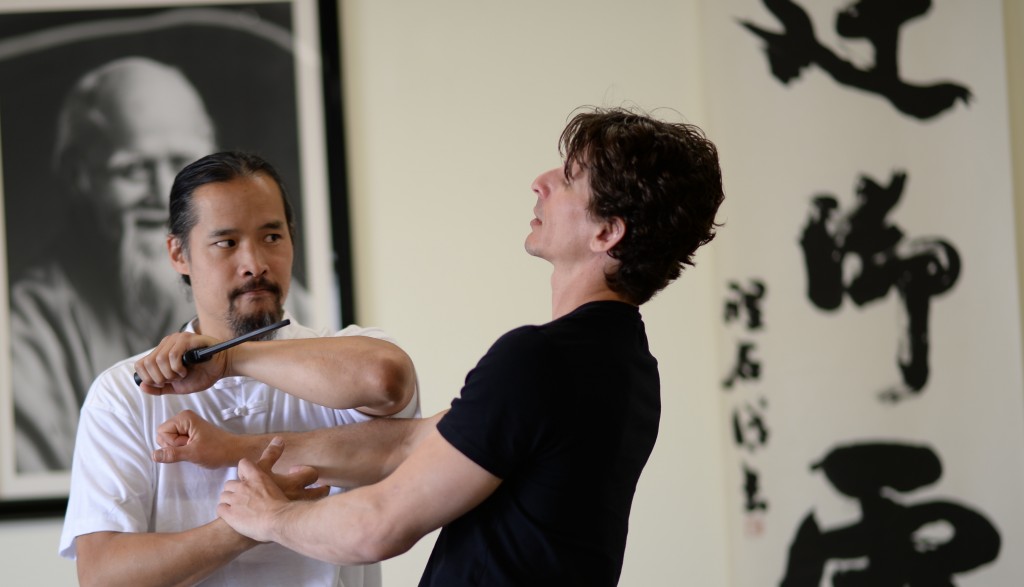
- Cross Training: Our team of instructors has collective experience with 13 different martial arts styles. With some exceptions, we don’t recommend that beginning, or even intermediate level practitoners learn two martial arts styles at once. It will likely cause confusion at a conscious and neuromuscular level. However, for advanced practitioners, this experience can create profound perspective shifts and learning experiences. I can attest to this first-hand through my experience learning from Mark Cheng.
3. A Focus on Body Structure
The great masters like O-Sensei (and many others) had the ability to move freely through resistance to execute their techniques. Haruo Matsuoka Sensei, our Chief Instructor, places great emphasis on research and instruction in this area. He seeks to demystify how it works by understanding it in biomechanical terms and developing instructional methods to consistently transmit this kind of movement capability to aikidoka.
In our experience, the number of techniques an aikidoka knows is largely irrelevant if they can be completely shut down the moment someone attacks with resistance. We prioritize quality of movement over quantity of movement.
You can only do this if you are able to use your body structure to create movement freedom and power.
4. Henka-waza
Our ultimate aim in a physical engagement is to break the opponent’s balance and decisively end the conflict in a single action.
However, we’ve found that even for seasoned practitioners, technique execution will fail with some regularity if the uke is not providing full cooperation. Sometimes resistance is encountered. Sometimes you fail to break the uke’s balance. Sometimes you take their balance more than expected. These kinds of variables lead to unexpected body states and failed techniques.
While we strive for successful technique execution, we accept the reality of failure, and prepare for it. We make henka waza (technique transformation) a key pillar of preparation for our higher level tests.
Take a look at this 13 year old’s kyu test. He decisively executes a hip throw on an uke over twice his weight. However, on his second attempt, his hip isn’t positioned properly and the uke doesn’t fall. Instead, the technique is transformed into a sankyo hold. Every time a movement doesn’t work as expected, the student flows to another application without hesitation.
We start building this competency by practicing with lots of constraints to reduce the risk of injury and isolate skill building. For example – the way we usually apply nikyo requires the uke’s elbow to be bent. If the elbow is straight, our application of nikyo loses effectiveness. However, a straight elbow is perfectly positioned for a hijishime (elbow lock) application.
We will have nage apply nikyo and uke will either leave their elbow bent and take nikyo ukemi, or they will resist and straighten the elbow. Nage then needs to switch to hijishime. Then nage can attempt a hijishime and the uke will either take the ukemi, or resist by bending the elbow. In this case the nage needs to switch to nikyo.
This kind of practice helps us understand which techniques are effective in different body states, and trains us to flow to a new movement when conditions change.
5. Tests are Challenges
Ikazuchi Dojo’s testing culture is built around a format that’s not a choreographed demo, but a carefully calibrated challenge. We use tests as an opportunity to understand our true skill and ability. It’s a priceless learning opportunity – not just for the student testing, but for dojo instructors. The students learn their strengths and weaknesses and the instructors learn if their teaching strategies have been effective. Did the students successfully internalize what we tried to teach them? Did we emphasize teaching the right things?
As students test for higher ranks, they’ll encounter increasingly greater challenges. The ukes will disengage and release from ineffective controls, regain their balance if given the opportunity, and will show the nage if they leave any major openings.
At these levels, the tests also allow nage greater freedom to chose techniques. We want to see flexible application of aikido, and we want to see a student freed to use the techniques they are most comfortable and effective with. We want to see them start to own a set of techniques.
Here’s a video of part of a student’s 1st kyu test. This was one of his three attempts to demonstrate his randori skills during the test. Xander is 14 years old.
You’ll see that the ukes aren’t pausing and taking turns attacking. They’re really going after him. We insist the attackers possess an extremely high level of ukemi skill before practicing this way. You’ll note that while the attacks are fast and powerful, they’re not random, reckless, or brutal. All 6 students testing for 1st kyu on this day experienced randori in this format. The youngest was 13 and the oldest is in her 60s. No one was injured and everyone had a powerful, positive experience.
Xander gets caught and has many points of failure, but alongside his mistakes, we see his victories and successes rise to the top. He cleared the initial charge with a perfectly timed first cut. He escaped after getting caught by two attackers twice his size, he pulled off one throw, and after getting steamrollered by Chris Jones, he fell back into a back roll and stood up in a ready position with eyes on the attacker.
Xander internalized these movements and can execute them without hesitation or thought. He’s calm and confident throughout the engagement. He has much to learn and made many mistakes, but I don’t think many would question that he’s building a solid foundation of skills that will lead to development as an effective martial artist.
We don’t have all the answers, and our approach won’t be right for every dojo, but we did want to contribute to the dialogue on this topic and share our strategy and results.
As always, thank you for reading and supporting our efforts.
Our thanks to Josh Gold for contributing this excellent article. The original article is hosted at the Ikazuki Dojo website.

 Antonio Aloia



I came up through Iwama style, which is also my teaching emphasis. Without saying anything bad about Saito Sensei, I think I’ve been trying to invent this for the last couple decades. Everything, of course, is problematic. Kihon waza is unlikely “to work”. It has to be amped up, not just in strength and rigidity. Ki no nagare is unlikely “to work” if it runs into strong rigidity. So what happens when your aikido “doesn’t work”? My present thought goes back to Musashi, “release four hands”. In ukemi we get some distance without losing too much energy and then retarget. Why not apply that principle to nage waza? Once upon a time a smart aleck tried to reverse my irimi nage in a 2 man freestyle using a judo throw. I could have taken him out at the knees, but that might have involved an ambulance and still would have had me tangled up with him when #2 arrived. So I “took the fall”, maybe a little early, maybe adding some spin, and ended up in front of him on my knees ready to go hanmi handachi. He and his buddy wandered off mumbling and giggling. I think they thought they’d won.
Very good article. I especially liked your method of testing at full speed. The kids are great, but I would like to see a couple of adults going thru similar tests. Your style of Aikido is definitely changing and maturing. Keep up the good work!
Thank you for the feedback and encouragement Steve!
We will release some videos in the near future of adults practicing randori in both training and test conditions .
This looks like an excellent way of training. I was impressed by how calm the kids were even under should strong attack. They must have been well coached to be able to respond so well. I’m not sure I could keep my cool as well as they did.
Good morning Gold Sensei:
When I read your great article highlighting your approach and The Five Areas of Focus, I felt a strong appreciation for your lineage and martial integrity.
I have been a student of Yoseikan Aikido, Patrick Auge Sensei for over 35 years. Mochizuki Sensei, his teacher, studied directly with Kano Sensei, Funakoshi Sensei and O Sensei and others, had a very eclectic background. Similar to your study and teaching. Auge Sensei stresses sincere attacks, of course according to our partners level. Every class consists of shite, jiyu or chikara randori using grabs, tsuki, tonto, tombo, bokken etc. thus developing effective techniques to the best of our ability.
Your focus on seeking to improve and evolve technically and spiritually helps all of Aikido. As Auge Sensei reminds us, we have been given the raw material, now we must develop it.
Matsuoka Sensei, Auge Sensei and yourself have raised the bar for all of us.
Thank you,
Joseph Capogreco