
 Josh Gold
This blog was edited from the contents of a well-thought-out reply of David Masumi to the following two recent articles that we felt would be of interest to many of our readers:
“The Origins of Modern Aikido: The Shomenuchi Dilemma” by Stanley Pranin
Closing up the loose ends: “More on Aikido’s Shihonage Dilemma” by Stanley Pranin
I began my training with Tohei’s system in 1974 and I would occasionally attack my teacher full speed. The dynamics are such that if nage can intercept the strike just at the moment prior to the body consolidating its forward momentum with the downward trajectory of the arm, the strike can be effectively negated with not much “collision.” However, the uke’s body will continue forward and fly past his now secured striking arm, causing his body to rotate 180 degrees and for the most part be airborne.
If nage tries to force the technique, uke will feel that and start to re-posture his body from an attacking attitude to a more self-protective one. In the strike uke is relaxed and elongated, but if he starts to experience or perceive an impending “collision,” he naturally tries to secure his joints and shortens his length, effectively killing any forward momentum.
You will not see this dynamic with anything less than a full-speed attack because there will not be enough momentum generated to result in what I just described. I attest to this occurring consistently and routinely. It is a startling fall to experience the first time because you are up-ended and you have to trust that your partner will not slam you to the mat while you are in the descent phase of your fall. (I never saw Tohei slam anyone to the floor though a few got slammed due relative to the intensity of their attack.)
Stan, you posted a video with Chuck Liddell’s overhand fist as being something you wouldn’t want to be passively standing in front of. That is true, but – Liddell’s power comes from the torque he develops by the thrust he initiates from his rear right leg with his left leg firmly planted. The speed of rotation of the hips and upper torso is what culminates in the power seen at the point of impact. It is similar to the mechanics of a baseball pitcher or a boxer’s right-cross. Although the strike comes from overhead, the body mechanics is more closely related to yokomenuchi.
If nage can intercept the strike just at the moment prior to the body consolidating its forward momentum… the strike can be effectively negated.
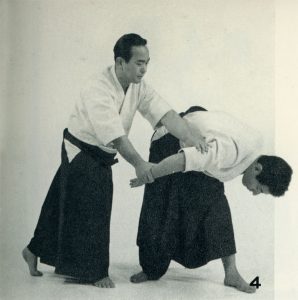
The impressiveness of Liddell’s strike is the impact point which pre-supposes his target being within the arc of the strike. What you don’t see is how he closed the distance to his target sufficiently such that he can strike with his rear hand. Though shomenuchi can be executed this way, it is more commonly performed with right hand/right foot forward, or vice versa, as in your photos above.
When the striking hand and foot are of the same side, it is like a boxer’s jab. It breeches distance with speed not power. Power is reserved for the rear hand, and that is the product of torque. There is minimal torque with a front foot/front hand strike.
(Regarding the above photos, #1 suggests that ukemi’s arm is in its up-swing phase as opposed to the downward as Tohei’s head is outside the arc of the strike. #2 shows ukemi has advanced one foot-stride closer with Tohei now within the arc of the strike.)
Another note is that, in my experience, Tohei’s body was incredibly centered in that even if you did collide with him it was more likely you would bounce off him, even if coming to him with speed. However, Tohei’s body was very soft, such that any initial contact was not a hard, impactful one, but one that was initially absorbed as his joints worked like shock absorbers. With one’s initial energy displaced, what was felt immediately after was solidity and weight.
Training at full-speed introduces a range of dynamics that are unique but somewhat dangerous to incorporate into a general training session. I was perhaps a little reckless when I practiced this way, but I really came to believe in the dictum, “the harder you come, the harder you fall.”
You will not see this dynamic with anything less than a full-speed attack because there will not be enough momentum generated to result in what I just described. I attest to this occurring consistently and routinely. It is a startling fall to experience the first time because you are up-ended and you have to trust that your partner will not slam you to the mat while you are in the descent phase of your fall.
 One example of an interesting dynamic in real-time action is how easily one can be “wrong-footed.” Gionelli states above, “…sensei drops his center right after uke (Endo?) begins his attack…” In a workshop with Tohei in San Francisco in 1974, one of the nuances to shomenuchi-ikkyo he showed us was this little “dip,” just as uke was about to strike. As uke, just prior to coming to your release point for striking, that little dip and 2 inch shift in your target had the effect of totally messing up your timing and you instinctively pulled back your power. However, you were already charging forward and had committed a good deal of momentum to the attack that couldn’t be pulled back. For one moment you were almost weightless and could not consolidate your total body movement into a coherent strike. It is like a 100 meter sprinter miss-timing the starting gun and meekly falling forward off his blocks, unable to hold himself back. In baseball when a good pitcher sets up a power hitter with fastball after fastball, high and inside. With 2 strikes on the batter the pitcher throws a slow breaking ball to the outside corner. He can even throw it into the dirt and the big swinging homerun hitter is so out in front of the pitch, all he can do is swat at the ball, strike 3!
I will agree with you Stan, that if someone attacks you with a full commitment, you cannot just stand there and passively react to it. And generally, if anyone has any sense about it-they don’t. Whether it is a slight step to change the angle of attack or Tohei subtly messing up your timing with his “dip.” Perhaps aikido can never break-out of it’s structured kihon modes but there needs to be more play, improvisation and experimentation, as in systema. I admit to now being a systema devotee but I haven’t given up on aikido.
So in conclusion, I think it is possible to stand in front of Chuck Liddell’s overhand right, as long we start off with a proper ma-ai, (giving me at least the chance to turn tail and run!)





In case you haven’t seen this, please check it out:
https://youtu.be/EfG8SOPf1yI